


One teal rain drum appears twice on CraftFolk: as the last batch of a retired music teacher in Arizona and the final run of a welder in New Zealand.
We opened the store’s public catalog, policies and company details, compared the maker stories line by line, and followed the return address to see where a parcel would go.
Overview
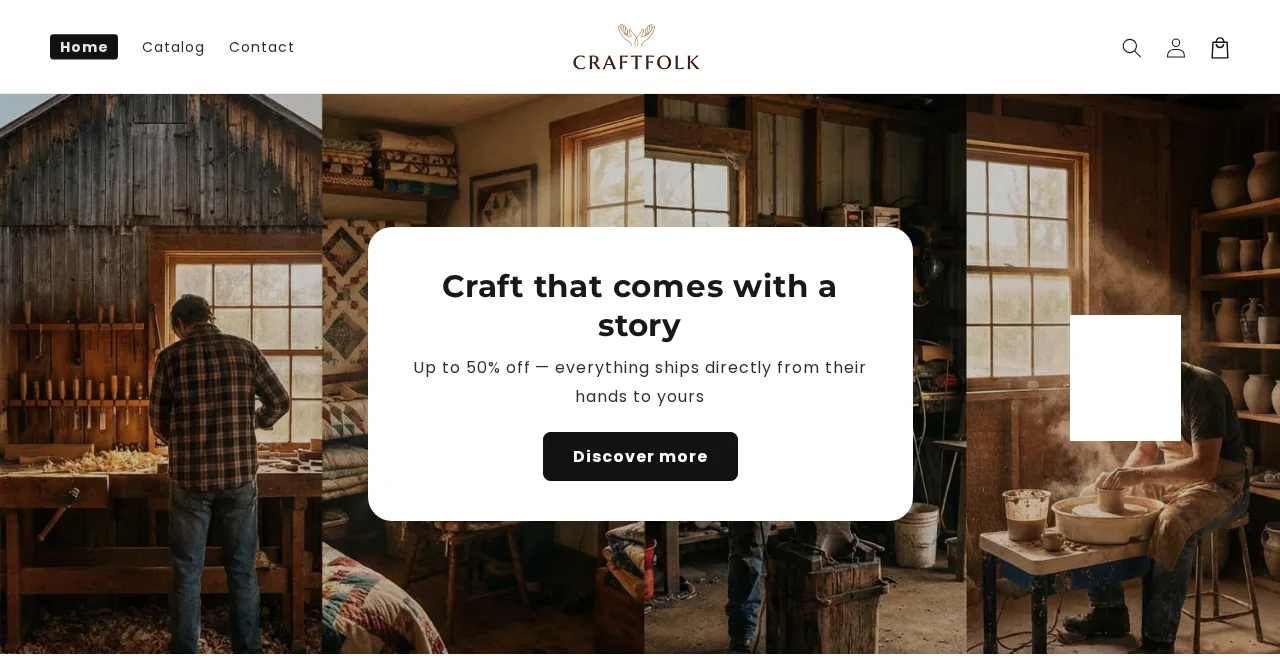
What the Home Page Promises
The home page promises craft that comes with a story, up to 50% off, and goods shipped directly from the makers’ hands. We set out to test each promise.
Product pages add a 30-day money-back or return promise, a shipping time and a maker with a name, an age and a hometown, often in a final batch.
What Our Checks Found
The same drum photographs, price and box contents appear under two different makers, and each page carries its own stock counter and rating.
Dozens of maker stories reuse the same sentences with only the names, towns and streets swapped, including across continents.
Returns go to a technology park in Guangzhou, the refund policy excludes sale items, and 139 of the 168 listings display a crossed-out price.
What We Could and Could Not Verify
Here is where the evidence stands after our checks:
- Verified by us: the catalog of 168 listings, the shared photographs, the policies, the company name, the return address and the domain registration date.
- Not found: any public trace of the makers, workshops or shop we searched for, or a web record of the Hong Kong company named on the contact page.
- Not verified: where any item is made or shipped from, because we placed no order, and who owns the company behind the store.
Our advice is not to buy on the strength of a maker’s story, and to read the return steps below if you already ordered.
One Rain Drum, Two Makers
Two listings, Margaret’s and Maree’s Hand-Tuned Rain Drum, carry the same price, €39.95 against a crossed-out €60.95, so we opened both pages to compare them.
Margaret’s page introduces her as a retired music teacher, 64, who tunes the drums in a wooden shed behind her cabin in Sedona, Arizona.
Maree’s page introduces her as a 67-year-old welder who made farm gates for thirty-six years before switching to rain drums near Hokitika, on New Zealand’s West Coast.
The two stories have nothing in common, yet the drum on both pages is the same teal steel disc, photographed on moss, on cloth and on dark stone.
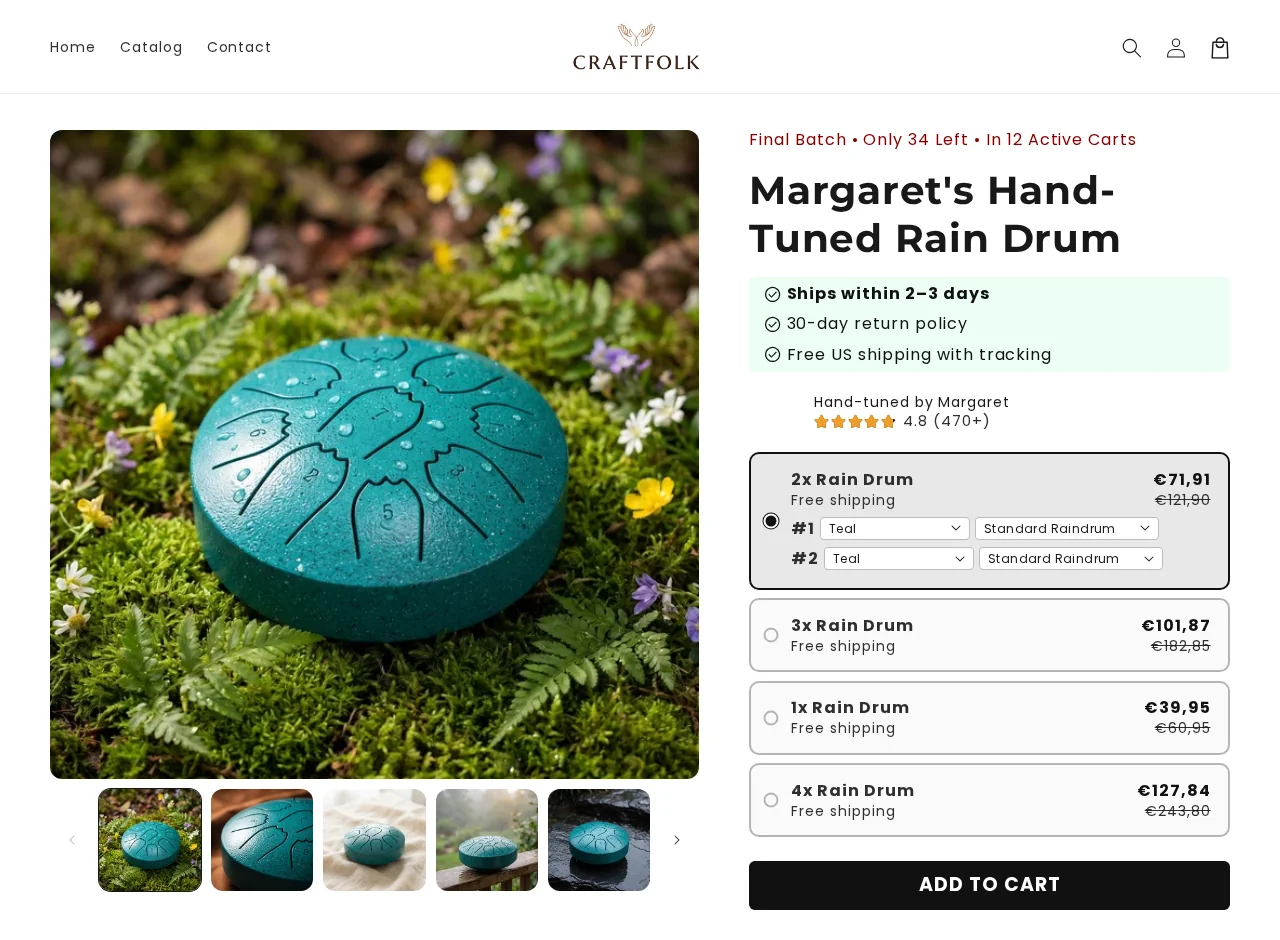
The catalog data confirms it: these two listings, plus an unsigned one titled Weather-Played Rain Drum, use the same 17 image files.
The box contents match too: a drum, two mallets, a beginner songbook and a cloth pouch, followed by a section on six things a machine-tuned drum lacks.
Only the story changes: one drum is tuned by a retired teacher in Arizona, the other by a welder where it rains 170 days a year.
The counters differ: Margaret’s page shows 34 left and 12 active carts, while Maree’s shows 18 left, 7 active carts and the line One of Maree’s final 210.
Both pages show a 4.8 rating, 470+ ratings on one and 340+ on the other, and Maree’s listing was only created on October 18.
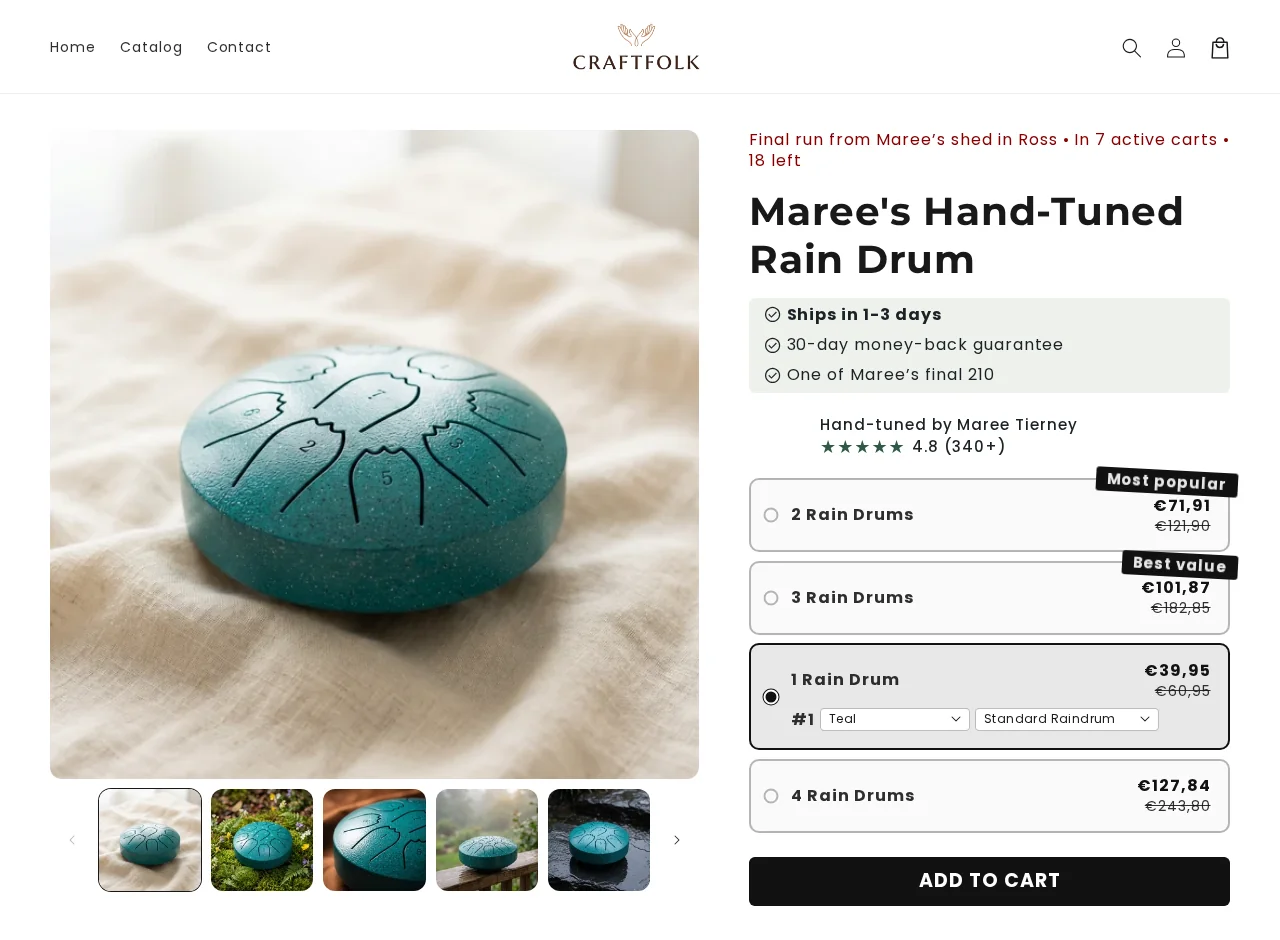
A buyer is shown one drum and told that two different people tuned it by hand, in two hemispheres, with two different amounts of stock left.
At least one of those two stories cannot be accurate as written, and the store gives a buyer no way to tell which one.
The drum is not an exception: comparing all 168 descriptions, we found 39 that share at least half their wording with a listing credited to another maker.
Two more cases show the same habit:
- Walking stick: the Odette page (71, Muskoka, Ontario) and the Hamish page (72, the Wairarapa in New Zealand) share six photo files, one price and one crossed-out price.
- Bird bath: the Murray page (74, Alexandra in Central Otago) and an unsigned Leaf Maiden listing share nine photo files and one price.
How a Maker Story Is Built
To see how far the pattern goes, we read all 168 descriptions and measured their parts, and the stories turned out to be assembled from the same pieces.
A typical page opens with a place, then a name and an age, as in Verna, 72, of Lititz, Pennsylvania.
Of the 94 descriptions that give an age, 79 fall between 66 and 76, and 17 make the maker exactly 72.
Next comes the reason for stopping, and ten descriptions use one frame, has ended the work, with eyesight in four, arthritis in five and a tremor in one.
Then comes a final stock figure, and the figures repeat between strangers: four makers each have exactly 212 left, two have 167 and two have 160.
The quilting stories show the template at work: four of them feature 72-year-olds who learned at their mother’s machine and have sewn for nearly fifty years.
Each is set in a little shop on a named street, and only the street changes from one story to the next.
The streets are Main Street in Prince Edward Island, Talbot Street in New Zealand, George Street in South Australia and Water Street in Suffolk, England.
Three more stories, set in New South Wales, the Shropshire Hills and East Tennessee, give the same quilter a nan or grandmother and her mother’s 1969 Singer.
Lorna’s story, set in Nova Scotia, and Raewyn’s, set in New Zealand, share an age of 68, 49 years at a 1962 Singer and about 800 baskets left.
Their pull quotes match word for word, from I kept them to myself for a long time to they should go somewhere, and both buildings close on November 30.
In the walking-stick pair the quote is the same with the nouns swapped: canes for half of Huntsville become sticks for half the Wairarapa.
A mother who sat at home all winter becomes a father who sat in his chair all summer, and an owl at Mass becomes a horse at the Golden Shears.
The template even loses track of its own people: Dot’s pages, set in Weaverville, North Carolina, give her age as 64 on five listings and 75 on three.
Boilerplate travels too: No factory, no assembly line, no shortcuts appears in 13 descriptions, and A printed graphic is a picture of a design in 13 as well.
A craftsperson writing about their own work does not repeat a stranger’s sentences from the other side of the world, but a template with blanks does.
Whatever the true origin, these pages read as one template filled in with names, towns and ailments, not as dozens of separate voices.
How the Pitch Works
We then followed the path of a buyer from the first price to the return label, checking each promise against the store’s own documents.
Step 1: A crossed-out price sets the anchor
The first thing a buyer sees is a discount: 139 of the 168 listings carry a crossed-out price, with a median saving of 41% and a maximum of 73%.
The same crossed-out €91.95 sits beside 14 unrelated products, from a folding trivet and a shoe horn to a kitchen set and a bird house.
On the trivet page the bundles climb from two for €98.91 to four for €175.84, and each crossed-out total is simply €91.95 multiplied by the number of trivets.
Real earlier prices rarely repeat across unrelated goods, so the crossed-out figure works as a sales device, and the saving it shows tells little about what an item is worth.
The same item can also carry two prices: one bird house sells for €41.95 with a crossed-out €64.95 and, in a second listing, for €45.95 against €91.95.
Step 2: A scarcity banner with three numbers
Verna’s trivet page opens with a red banner, Final batch from Verna’s workshop, In 14 active carts, 21 left, above a story that ends: These are her last 214.
We captured the page at 03:55 UTC and again at 15:28 UTC, and both captures show 14 active carts and 21 left.
A live counter on a page that is selling a final batch would normally move within eleven hours, and this one did not.
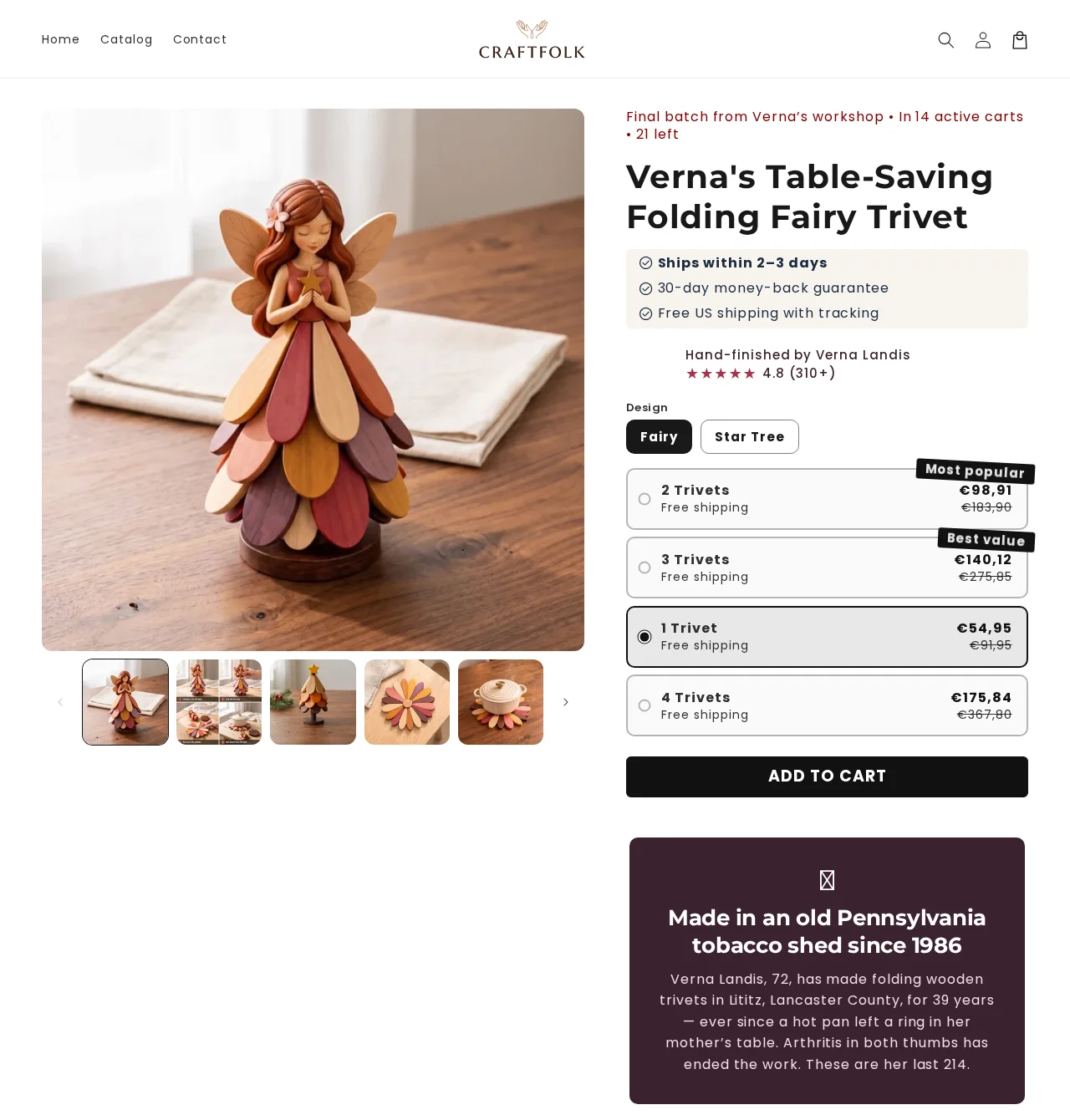
The figures also collide: if 214 was the final batch and 21 remain, 193 have sold, yet the listing was created on November 4 and already shows 310+ ratings.
We could not reconcile the three numbers, and the page gives a buyer no way to check any of them.
The scarcity belongs to the template: Edith’s rug page still announces that her workshop closes at the end of July, more than three months after that date.
Step 3: A shipping promise that splits in two
Product pages promise shipping within 2-3 days, or 1-3 on Maree’s page, plus free US shipping on the others, yet every price our server saw carried a € sign.
The shipping policy gives 7-14 working days, counted from conclusion of contract, for the United States and for deliveries abroad alike.
That policy also refers to a quote, an advance payment and a Legal Notice, wording that does not fit a shop selling €54.95 trivets.
The terms add that delivery times are estimates, the store is not liable for delays, and risk of loss passes to the buyer once the carrier has the parcel.
So the 2-3 days is not a commitment the contract makes, and under the terms the risk of a lost parcel shifts to the buyer at the first handover.
Step 4: A guarantee that meets the fine print
The product pages we captured promise a 30-day money-back guarantee or return policy, so we read the refund policy to see what a buyer must do to collect it.
The item must be unused, with tags, original packaging and a receipt, and the buyer must email first, because parcels sent back without a request are refused.
Then comes the sentence that matters most: the store cannot accept returns on sale items, and the policy never defines the term.
Yet 139 of the 168 listings, including the trivet, display a crossed-out price, so a buyer cannot tell from the policy whether the guarantee covers what they buy.
The terms of service go further: they disclaim any promise that a product will look or perform as depicted, and they let the store change descriptions without notice.
Nothing in the terms promises that an item is handmade, or made by the person named on its page, so the maker story is marketing, not a contract term.
Three placeholders reading [LINK] remain in the terms where the links to the refund and privacy policies should be.
Step 5: A return that leaves the country
A buyer who wants a refund must send the item to a technology park in Baiyun District, Guangzhou, after the store approves the return and issues a label.
Picture day 8 of the 30-day window: a buyer in the US with a damaged trivet emails the store, waits for approval, then ships the parcel to southern China.
The policy never names who pays that postage, although the rug and basket pages promise Free Returns with no forms and no questions.
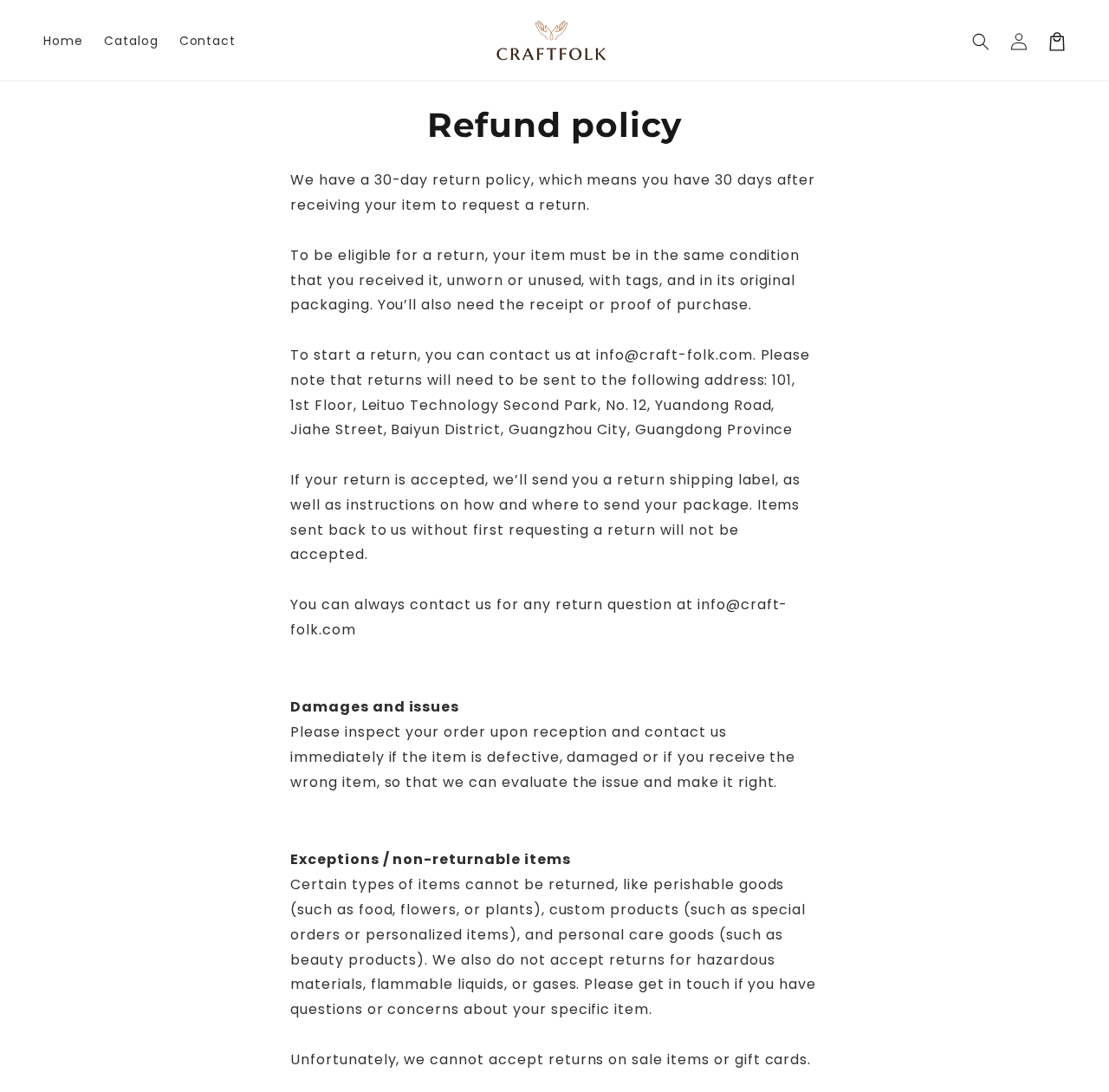
Refunds follow only after the store has received and inspected the parcel, within 10 business days of approval, so the buyer funds the whole journey first.
A different rule applies to the European Union: for goods shipped there, the policy grants a 14-day right to cancel for any reason.
Who Sells on Craft-folk.com?
The company named in the documents
The contact page lists the trade name CRAFTFOLK, run by ECOMCLOUD TRADING LTD, with an office in Central, Hong Kong, and a registration number.
It also lists an email address and a phone number with a US area code, but no street address in the United States.
The privacy policy never names the Hong Kong company, and the terms place disputes in the courts where Craftfolk is headquartered without saying where that is.
A web search for the company name found no Hong Kong record, but we did not search the Hong Kong Companies Registry itself, so its owners remain unknown.
Where the address and the registry lead
The UK Companies House register lists ECOMCLOUD TRADING LLP, number OC456652, incorporated on 7 May 2025 and active, a near match for the name here.
That LLP is the company our earlier BackRoad Goods review found named on another store’s contact page, so we opened that store’s policies again today.
Its refund policy repeats this store’s Guangzhou return address character for character, and its contact page lists a +1 724-865 phone number that differs from this store’s by one digit.
Four product web addresses are identical on both stores, including the Margie lamp, and seven BackRoad products use image files that also appear on CraftFolk.
The CraftFolk catalog also carries vendor labels of other storefronts, including BACKROAD GOODS and Namora, the brand whose policies our earlier review found on the BackRoad Goods site.
Shared names, addresses and products show a common setup, and they do not prove common ownership, which only a company record can establish.
Domain, platform and leftover templates
The domain craft-folk.com was registered on March 14, 2026 through GoDaddy and runs on Shopify, and the first listing was created two days later.
Listings arrived in waves: 46 in May, 59 in October and 12 in November, so 71 of the 168 were created since the start of October.
The privacy policy is dated August 30, 2025, more than six months before the domain existed, and it names a different brand: itBag is powered by Shopify.
That text looks written for another store, and the three [LINK] placeholders left in the terms point the same way.
What we could not confirm
We placed no order, so delivery, quality and refunds are untested, and we do not know where any product is made or shipped from.
We searched the web for the makers Verna, Maree, Margaret and Odette with their towns and crafts, and found nothing.
We also found nothing for the Truax Paper and Post card shop in Galena, Illinois, which a listing names as a Main Street business.
A web search is not a registry check, so the other makers, the company owners and the way the photographs were produced remain open questions.
What to Do Before You Buy or After You Paid
-
Search the maker. Look for the person by name, town and craft, and treat a maker with no trace outside the shop as a marketing character.
-
Compare two pages. Open a second listing of the same kind and check whether its photos, price and story reappear under another name.
-
Price the return. The return address is in Guangzhou, so add the cost of shipping to China and the sale-item exclusion before you order.
-
Save proof. Keep the order email, the product page text, the banner and the policy pages, with dates, before they change.
-
Ask for a refund in writing. Email the store within 30 days of delivery, quote the handmade and ships-from-the-maker promises, and keep every reply.
-
Dispute the charge if it stalls. A card dispute letter must reach the issuer within 60 days of the first bill with the error.
-
Ask for proof of the workshop. Before paying, ask for the maker’s studio address or a dated photo of the work, and treat a refusal as an answer.
-
Report it. File at ReportFraud.ftc.gov and name the store, the domain and the promises you relied on.
Frequently Asked Questions
Is CraftFolk really handmade?
We could not verify it for any item: one drum is credited to two makers, stories reuse sentences across countries, and returns go to China.
Who owns craft-folk.com?
The contact page names ECOMCLOUD TRADING LTD in Hong Kong, and we found no owner details, though a store sharing its return address once named a near-identical UK LLP.
Why do the maker stories sound alike?
Sentences, ages and closing dates repeat across makers in different countries, which points to one template with names and streets swapped.
Where do I send a return?
The refund policy names a technology park in Baiyun District, Guangzhou, but it requires you to request a return first, so write before shipping anything.
Does the 30-day guarantee cover sale items?
The policy excludes sale items without defining them, and 139 of 168 listings show a crossed-out price, so ask for written confirmation before you buy.
How do I get my money back?
Email the store within 30 days, keep every reply, and if it stalls dispute the charge with your card issuer within 60 days of the first bill.
The Bottom Line
Do not buy from CraftFolk because of a maker’s story: the same photographs are credited to different makers, the sentences repeat across continents, and returns leave the country.
If you want a handmade gift, buy from a seller whose maker you can find independently and who accepts returns in your own country.
If you already ordered, save your proof, ask for a refund in writing within 30 days, and dispute the charge within 60 days if the store stalls.

Join the discussion
0 commentsShare your experience or ask a question about this article.
Community experiences
Did this happen to you?
Your experience could help someone recognize the same scam. Submit a private report for our team to review.
I experienced this tooReports are reviewed before publication. Sharing publicly is always your choice.
Discussion
Start the conversation
Have a question or something useful to share? Add the first comment.