

A hurricane makes landfall, an earthquake breaks the news cycle, or floodwater fills a town. Before the full damage is known, donation links are already moving through social feeds and inboxes.
The disaster donation scam looks like an urgent chance to help while there is still time.
The story may be real. The fundraiser, charity name, payment account, and person collecting the money may not be.
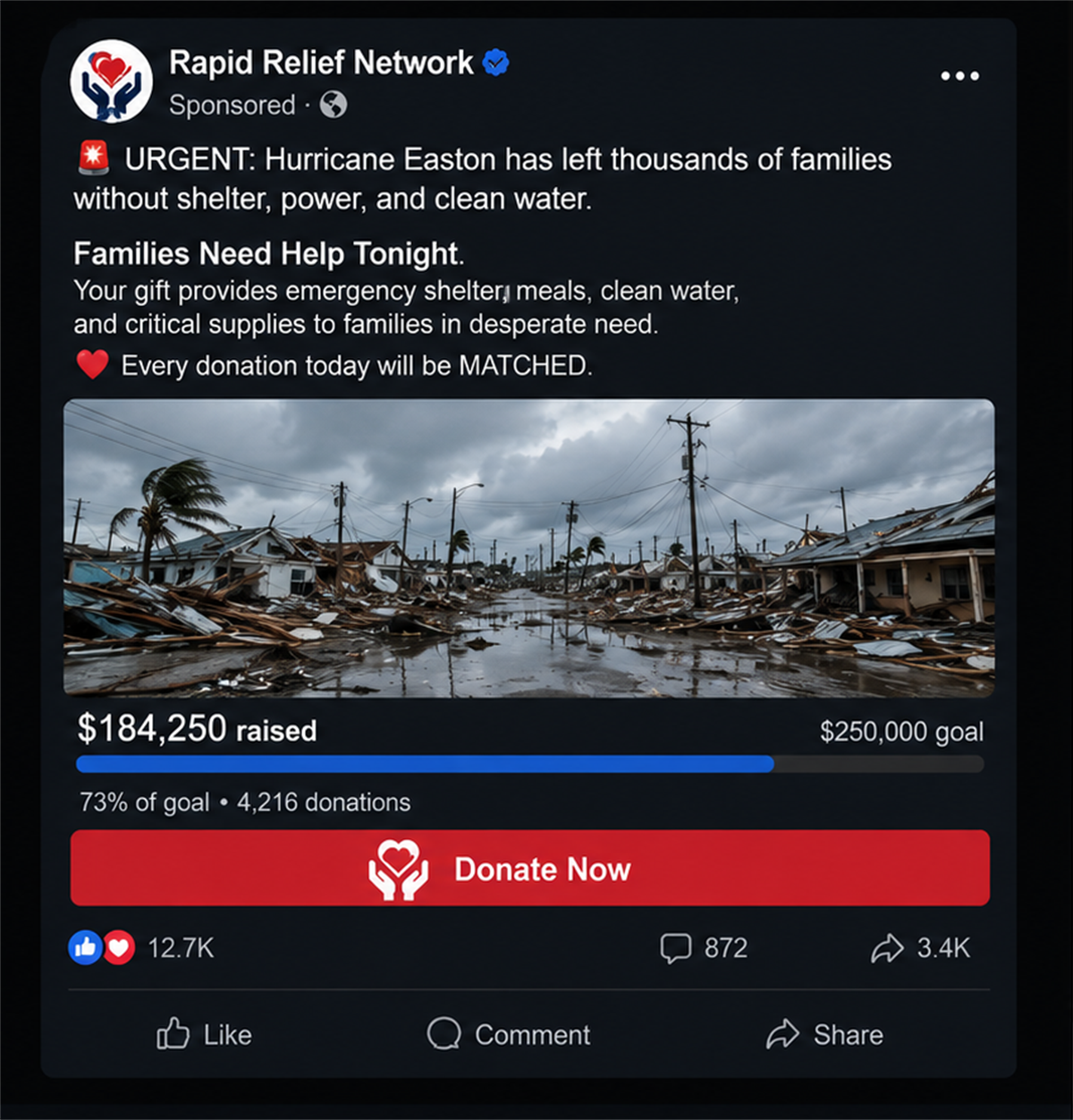
Criminals copy real photographs, news details, charity names, and emotional survivor stories. Some create an entire fake organization while others impersonate an established relief group.
The link can lead to a cloned donation page, a personal payment account, or a cryptocurrency wallet. Urgency leaves little time to check who controls it.
Friends may reshare the appeal in good faith, allowing borrowed trust to carry the fraud farther than a cold message could.
The FBI and Federal Trade Commission both warn that scammers exploit disasters and mass-casualty events to steal donations and personal information.
Overview
A real emergency supplies the false urgency
The criminal does not need to invent the storm, fire, earthquake, war, or attack. Public reporting supplies names, locations, photographs, casualty figures, and immediate needs.
That accuracy makes the appeal feel verified even when none of it proves who owns the donation account.
The collector may imitate anyone people trust
Fake appeals can impersonate charities, government agencies, celebrities, influencers, local volunteers, survivors, or relatives of victims. Artificial intelligence can help alter images and messages.
A familiar logo or copied personal story creates recognition. It does not establish authorization.
The payment method reveals the exit
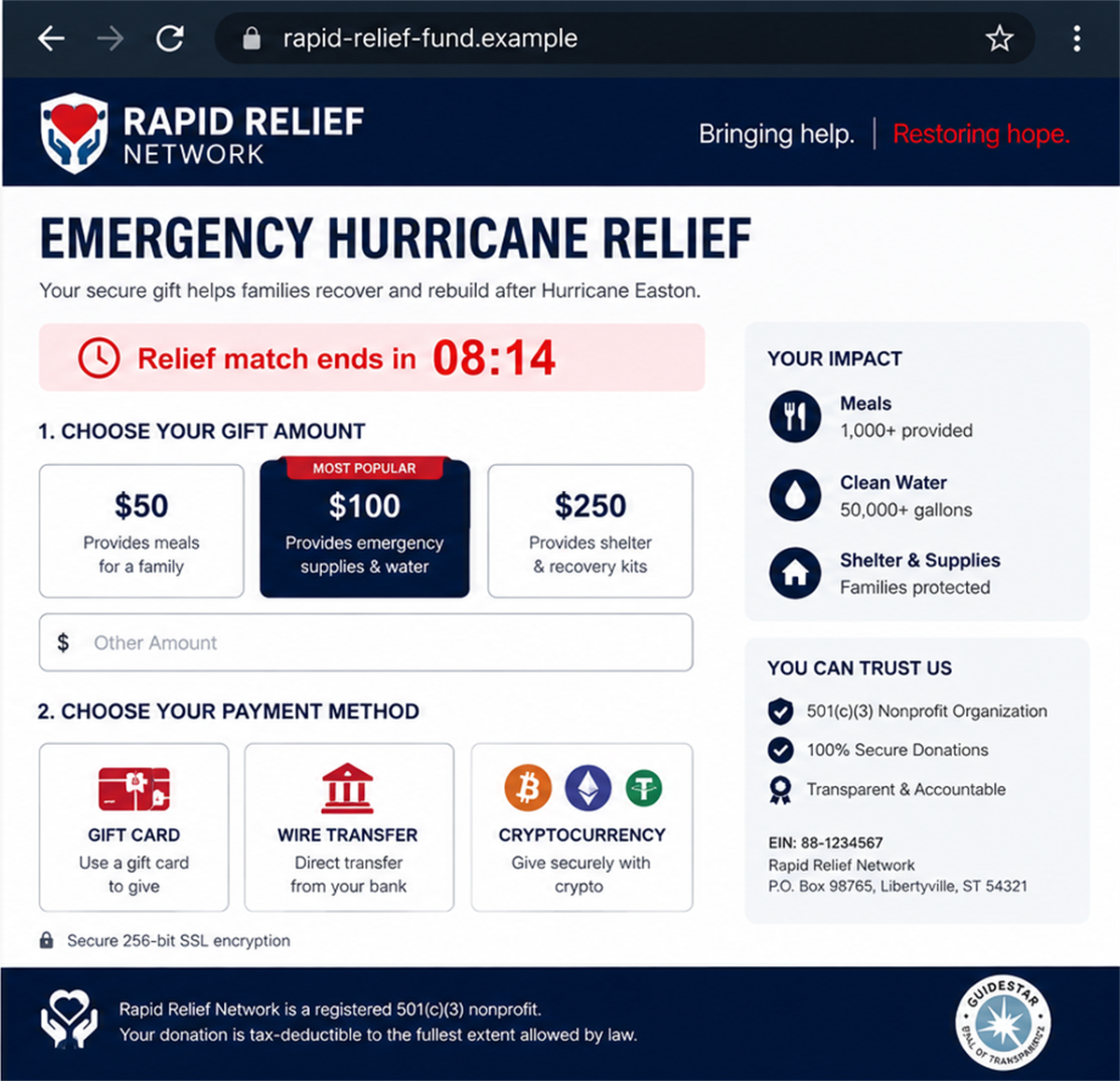
The page may accept cards, but higher-risk appeals often insist on gift cards, wire transfers, cryptocurrency, or a personal payment handle. Those methods reduce recovery options.
- A breaking event triggers an immediate appeal.
- Copied images and details make the story believable.
- A social post or message reaches potential donors.
- The link imitates a charity or survivor fundraiser.
- A timer or matching promise creates pressure.
- Payment goes to an unrelated account or wallet.
- Identity and card information may also be collected.
- The page disappears when reports begin.
Federal Warnings Confirm the Disaster Fraud Pattern
The FBI warned about charitable fraud tied to disasters and mass-casualty events in January 2025.
The bureau said scammers pose as relief agencies, charities, celebrities, influencers, and victims. They may request ordinary money or cryptocurrency while collecting personal information for additional fraud.
According to the advisory, the FBI Internet Crime Complaint Center received more than 4,500 complaints in 2024 involving fraudulent charities, crowdfunding accounts, and disaster relief campaigns. Reported losses were approximately $96 million.
In August 2026, the FTC again warned that disaster scammers create fake charities and impersonate established organizations.
The FTC advises donors not to assume a social-media request is legitimate because a friend shared it. It also recommends confirming text-to-donate numbers on the charity’s official website.
These are confirmed, recurring fraud tactics. This report does not label every new fundraiser as fraudulent or suggest that small community groups cannot provide genuine relief.
The question is narrower and practical: can the donor independently prove who controls the appeal, where the money goes, and how the organization delivers the promised aid?
Why Breaking News Makes Verification Harder
People want to help quickly. Relief groups also need funds quickly, so speed alone cannot distinguish an honest appeal from a fake one.
Scammers exploit that ambiguity by attaching a payment request to the first wave of emotion. A message saying families need water tonight makes research feel like delay.
News images are widely available and easy to copy. A photograph of real destruction proves the disaster occurred, not that the account posting it represents the people shown.
Early casualty and damage figures also change. A fraudulent page can repeat accurate numbers from a news report and appear connected to official responders.
Social sharing creates a second layer of trust. The person who reposted the fundraiser may be sincere but may not have checked the organizer, beneficiary, bank account, or domain.
Platforms can remove fraudulent fundraisers, yet review is not instant. A sponsored label shows that advertising space was purchased, not that the charitable claim was audited.
Donation matching can add pressure. A fake timer or anonymous sponsor supposedly doubles contributions for the next hour, creating a deadline that no independent source can confirm.
The Different Faces of a Fake Relief Appeal
A copycat charity uses a name and logo close to a respected organization. The domain may add words such as emergency, relief, global, fund, official, or donate.
A survivor fundraiser uses stolen photographs and a personal story. The organizer may claim to collect for a named family while having no relationship to that family.
A government impersonator says a public agency is accepting emergency contributions. The page may use seals or disaster-management language even though the payment goes to a private account.
A celebrity appeal copies a public figure’s video or voice. Artificial intelligence can alter the media, while a fake profile provides a wallet address or donation link.
A text-to-donate message sends a short code or payment link immediately after the event. The display name can imitate a charity while the number belongs to an unrelated sender.
A cryptocurrency appeal claims blockchain transparency proves legitimacy. Public transactions show where funds move, but they do not prove the wallet owner will provide aid.
A registration-fee variation targets victims directly. The scammer promises disaster grants, shelter, or assistance, then charges an application, processing, delivery, or release fee.
How the Disaster Donation Scam Works
Step 1: Criminals monitor an unfolding emergency
Major events reveal public interest, urgent needs, and communities likely to donate. Scammers collect official names, images, hashtags, locations, and current statistics.
They may register domains or social accounts within hours. A young account can still look active after copied posts and automated engagement are added.
Step 2: A credible identity is copied or invented
The operator imitates a known charity, creates a plausible local relief group, or steals a survivor’s identity. Logos and mission statements can be copied in minutes.
Fake nonprofit numbers, badges, addresses, and testimonials are added to reduce hesitation.
Step 3: Emotional content spreads through trusted channels
Sponsored posts, direct messages, emails, text messages, search ads, comments, and crowdfunding pages carry the appeal. Compromised accounts may share it with existing followers.
The message asks readers to act before supplies run out or a matching deadline expires.
Step 4: The donor reaches a controlled payment page
The site resembles a charity checkout and offers suggested amounts. Another version sends the donor directly to a personal payment handle, bank transfer, or cryptocurrency wallet.
The recipient name may not match the organization advertised, but urgency discourages questions.
Step 5: Money and personal data are collected
The donor submits card information, name, address, email, phone number, and contribution. A malicious form can retain all of those details.
Gift card codes, wires, and cryptocurrency move quickly and are difficult to reverse. Card data can support unauthorized purchases later.
Step 6: The appeal asks for more
A thank-you message requests a second donation, monthly pledge, processing fee, or identity check. Contact information identifies the victim as responsive to emotional appeals.
The same details can be reused in fake aid, recovery, or government-grant scams.
Step 7: The campaign disappears or changes names
Once the account is reported, the operator deletes the page, changes the username, or launches a new domain around the next emergency.
Learning the payment and verification pattern is more useful than memorizing one charity name.
Identity, Address, Support, and Traceability Checks
The legal organization must exist independently
Search the exact name through state charity regulators, the IRS Tax Exempt Organization Search, and established charity evaluators.
A registration record helps, but confirm that the website and payment account actually belong to that organization.
The domain and contact details must match
Type the known charity address yourself. Compare the registered domain, email ending, phone number, mailing address, and privacy information across official records.
Do not call the number displayed only inside the suspicious appeal.
The beneficiary relationship must be verifiable
For personal crowdfunding, determine who organized the page, who receives the funds, and how they know the named victim or family.
Contact the beneficiary through an independent route when possible. Stolen photos and a familiar hometown are not enough.
The payment trail should make sense
An established charity should not insist that a donor pay one individual through gift cards, a personal wire, or an unexplained cryptocurrency wallet.
Use a credit card through the verified organization’s site when possible, and keep the receipt and confirmation.
Warning Signs Before You Donate
- The appeal appears immediately after breaking news.
- A copied photograph is the main proof of legitimacy.
- The organizer’s account is new or recently renamed.
- The charity name differs slightly from a known organization.
- A countdown says matching funds will vanish soon.
- Only gift cards, wires, cryptocurrency, or cash are accepted.
- The payment recipient is an unrelated individual.
- The organizer will not explain the beneficiary relationship.
- The page promises tax deductibility without verifiable registration.
- A second fee is required to release aid or process the donation.
Urgency may be real, but a legitimate charity will still let you verify its identity and donate through a known channel.
How to Donate Without Following the Scammer’s Link
Decide what type of help you want to support, then identify established organizations working in that area. Begin from a regulator, trusted evaluator, or previously saved charity address.
Search the exact charity name with terms such as complaint, fraud, and review. Compare several independent results and confirm that the domain has not been changed by one letter.
For a text appeal, visit the charity’s official website and confirm the number or short code. Do not reply to the original message for verification.
For a social fundraiser, inspect the organizer’s history and beneficiary relationship. A friend’s share is a reason to look, not proof that the payment route is correct.
Ask how much reaches the program, whether the gift is restricted to the event, and whether recurring billing is preselected. Save the final checkout and receipt.
A credit card generally provides stronger dispute options than cash, wires, gift cards, or cryptocurrency. Never send a payment method solely because the organizer claims every other channel is unavailable.
What to Do if You Have Fallen Victim to This Scam
- Stop further payments. Do not send an additional donation, release fee, tax, recovery charge, or identity payment requested by the organizer.
- Contact the payment provider immediately. Ask the card issuer, bank, wire service, payment app, or exchange whether the transaction can be blocked, recalled, disputed, or flagged.
- Secure exposed card data. Replace a compromised card, review recurring payments, and monitor for small test charges and unfamiliar merchant descriptors.
- Protect your identity. Change reused passwords, secure email with multifactor authentication, and use IdentityTheft.gov if sensitive identity documents were submitted.
- Preserve evidence. Save the post, profile, URL, charity name, payment recipient, receipt, messages, wallet address, transaction hash, and screenshots.
- Notify the impersonated charity. Use its official website. The organization may help report the copycat page and warn other donors.
- Check the device. If an attachment, app, or extension was installed, run a full Malwarebytes scan and remove unfamiliar software before using financial accounts.
- Block repeat campaigns. AdGuard can reduce exposure to known malicious ads and phishing domains, but it cannot reverse a donation or certify a new fundraiser.
- Report the fraud. Submit the campaign to the social platform or crowdfunding service, the FTC, and the FBI IC3.
- Warn your contacts carefully. If you shared the appeal, post a correction with the verified facts and ask others not to forward or pay through the fraudulent link.
Frequently Asked Questions
Are new disaster fundraisers always fraudulent?
No. Many are genuine, but urgency and a new page increase the need to verify the organizer, beneficiary, and payment route independently.
Does a social platform verify every charity advertisement?
No. A sponsored label means the post is paid advertising. It does not guarantee that the charitable identity or use of funds was fully authenticated.
Is cryptocurrency transparency enough to prove a charity is real?
No. The ledger shows transactions, but it does not prove who controls the wallet or whether funds will support victims.
What is the safest way to help after a disaster?
Choose an established organization through independent research, type its official address yourself, pay through its verified checkout, and keep the receipt.
Can I recover money sent to a fake fundraiser?
Recovery depends on the payment method and speed. Contact the provider immediately, report the recipient, and preserve complete transaction evidence.
Why did a friend share the scam page?
They may have believed it was genuine or their account may have been compromised. A familiar sharer does not authenticate the organizer.
The Bottom Line
The disaster donation scam steals trust already created by a real emergency. Accurate news, heartbreaking images, and a familiar charity name can all surround a payment account controlled by a criminal.
Pause before paying, reach the organization independently, and verify who receives the money. Fast relief matters, but sending funds to the wrong account helps nobody except the scammer.

Join the discussion
0 commentsShare your experience or ask a question about this article.
Discussion
Start the conversation
Have a question or something useful to share? Add the first comment.