

A video pops up in your feed with a calm, confident tone and a familiar face.
It claims a simple honey trick can melt fat, restore memory, “flush toxins,” balance blood sugar, or fix another serious health concern, often in weeks.
Sometimes the video appears to feature Dr. Gupta, framed like a trusted medical segment or a breaking news report.
But once you click, the same thing happens again and again: the “recipe” stays just out of reach, the pressure builds, and the page pivots into a supplement sale that feels rushed, confusing, and hard to undo.
This article breaks down the pattern behind the Dr. Gupta honey trick scam supplements, why it spreads so fast, and what to do if you already bought.
Scam Overview
The honey trick is the hook, not the point
Honey is the perfect bait.
It feels natural. It feels gentle. It feels familiar. It also feels safe in a way that pills and powders do not.
That is why the honey trick angle converts so well.
The funnel is built to make you think you are about to learn something practical, like a kitchen recipe you can try tonight.
A spoonful.
A “golden blend.”
A rare type of honey.
A simple ritual.
But in most of these campaigns, the recipe is not delivered clearly upfront.
It is teased, delayed, and used as a storyline prop that keeps you watching until the product offer appears.
That is the first big clue that this is not health education.
It is sales scripting.
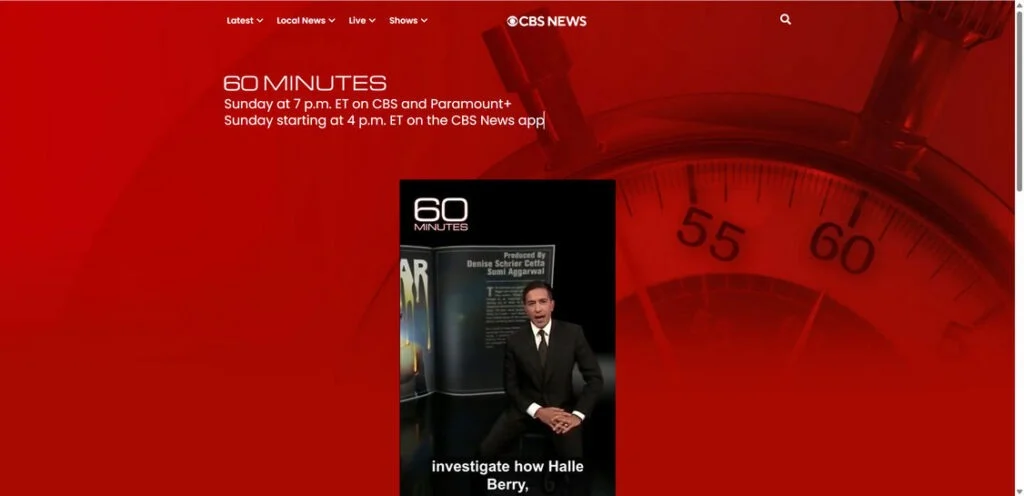
This is not one product. It is a reusable ad system
One of the most frustrating parts for victims is how often the names change.
Today it is one brand of drops.
Next week it is a different bottle with a new name.
Then it becomes gummies, capsules, or “probiotic oral health support.”
The funnel survives because it is modular.
Operators can swap:
- the domain name
- the product label
- the “doctor” voiceover
- the promised “secret” ingredient
- the condition being targeted
and run the same conversion engine again.
That is why it is more useful to learn the pattern than memorize one product name.
Why Dr. Gupta shows up in these ads
When scammers want instant trust, they borrow trust.
A recognizable doctor figure lowers skepticism fast, especially for older adults and caregivers who are already emotionally invested in finding solutions.
CNN itself has stated that Dr. Sanjay Gupta discovered scammers are using his likeness in AI deepfake videos and doctored images to sell bogus health cures and fake health products.
That one sentence explains why these ads feel more believable than older scams.
You are not just reading a claim.
You are watching what looks like a real endorsement.
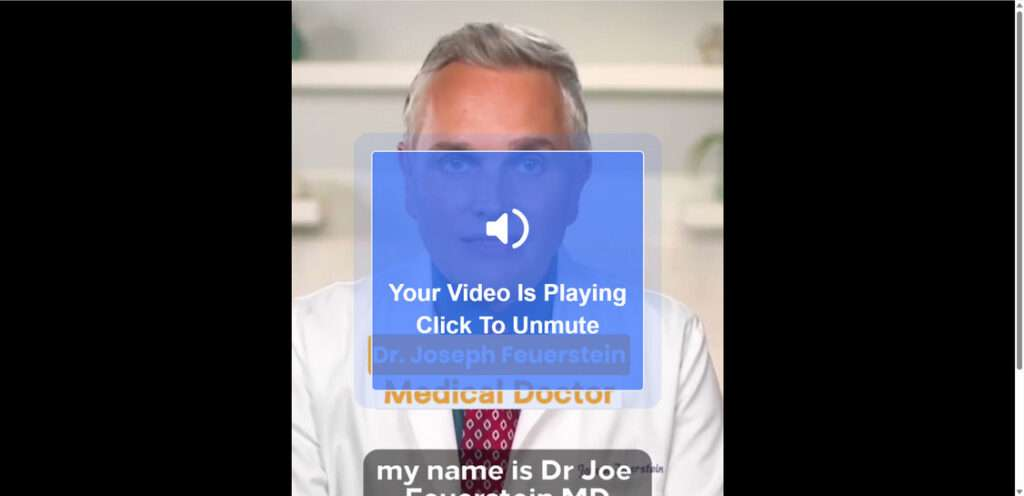
AI-generated videos make the scam feel “confirmed”
Many victims describe the same reaction:
“I saw him say it.”
That is exactly the trap.
The Federal Trade Commission has warned that scammers are using fake celebrity and influencer endorsements, including doctored video and audio that seems like the real thing, to generate profits.
So the presence of a familiar face is no longer evidence.
It may be a fabrication designed to bypass your skepticism.
The honey trick scam often targets high-stakes conditions
This funnel shows up across multiple categories, but it is especially common in areas where fear and urgency are easy to trigger:
- memory loss and dementia
- blood sugar and diabetes
- weight loss
- “blood support” and circulation claims
- male enhancement
- oral health “miracle cures”
These are sensitive topics.
People are scared, tired, and looking for hope.
Scam marketers build narratives that feel comforting and time-sensitive at the same time.
That emotional combination is powerful, and it is not an accident.
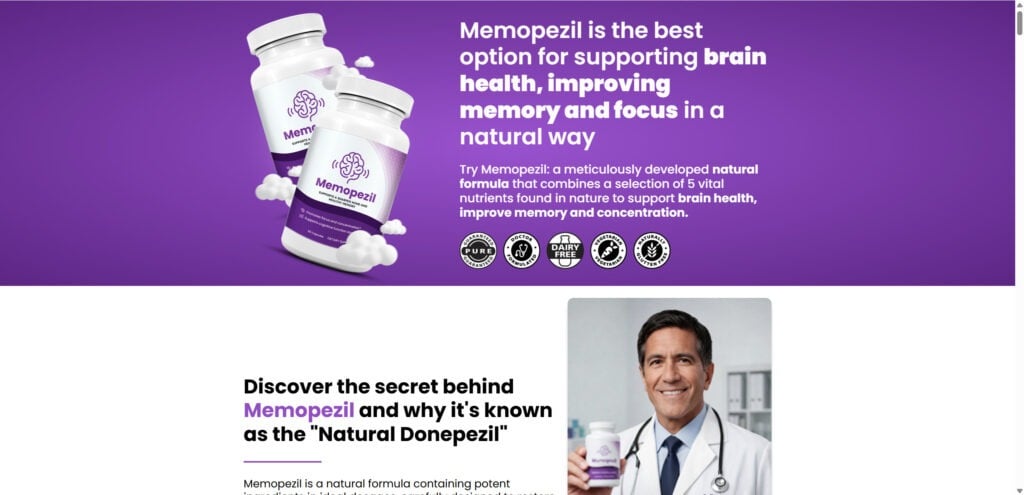
The memory-loss version is one of the most common
A very common variant is the “honey trick recipe for memory loss” pitch.
It’s often framed as a CNN-style breakthrough: rare honey plus a plant ingredient, paired with dramatic claims about “brain toxins,” rapid reversal, and hidden cures.
We describes exactly this pattern: fake news-style reports using CNN logos, edited clips, AI-generated voiceovers mimicking Dr. Gupta, conspiracy framing, and a bait-and-switch that swaps the promised “recipe” for supplements with changing names.
That matters because it shows this is not isolated.
It is a repeatable structure that keeps resurfacing.
The claims are designed to sound specific, not to be provable
The scam pitch often includes very specific-sounding details:
- “rare Himalayan honey”
- a named plant extract
- a “detox” chemical or toxin claim
- a success rate like 97%
- a “doctor reveals” narrative
- a “watch before it’s removed” warning
Those details create the feeling of science.
But the page rarely gives you what real science requires:
- peer-reviewed clinical evidence for the exact product
- transparent dosing and ingredient sourcing
- credible third-party verification
- clear safety and interaction warnings
- a real company identity you can verify
Instead, it gives you a story.
And stories sell better than studies.
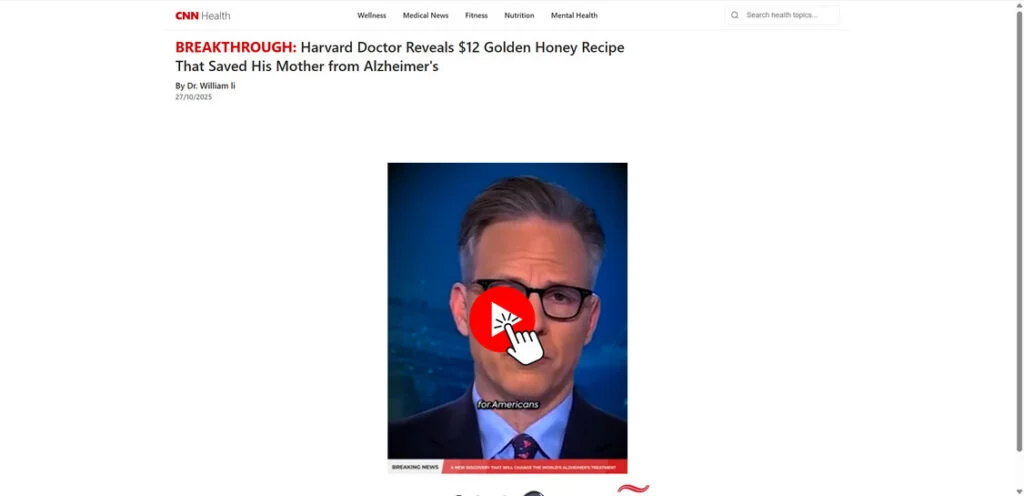
Fake news layouts are a core part of the scam
Another key element is the “article” that is not an article.
It is an advertorial, meaning advertising disguised as reporting.
These pages often include:
- a logo that resembles a mainstream outlet
- a byline that is vague or hard to verify
- “breaking news” style formatting
- a big embedded video that demands you watch
- references to universities or major medical institutions without citations
The goal is to make you feel like you are consuming trusted journalism.
But the page is engineered to lead to a checkout.
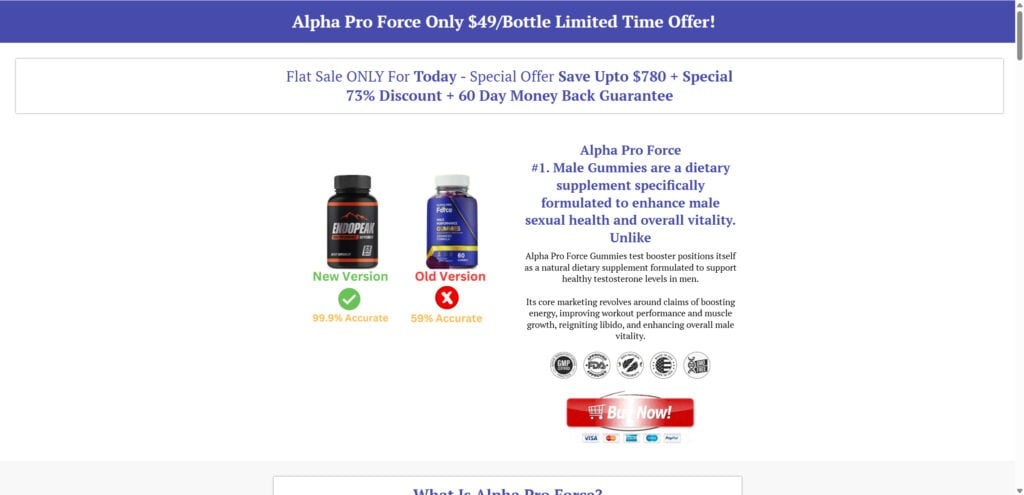
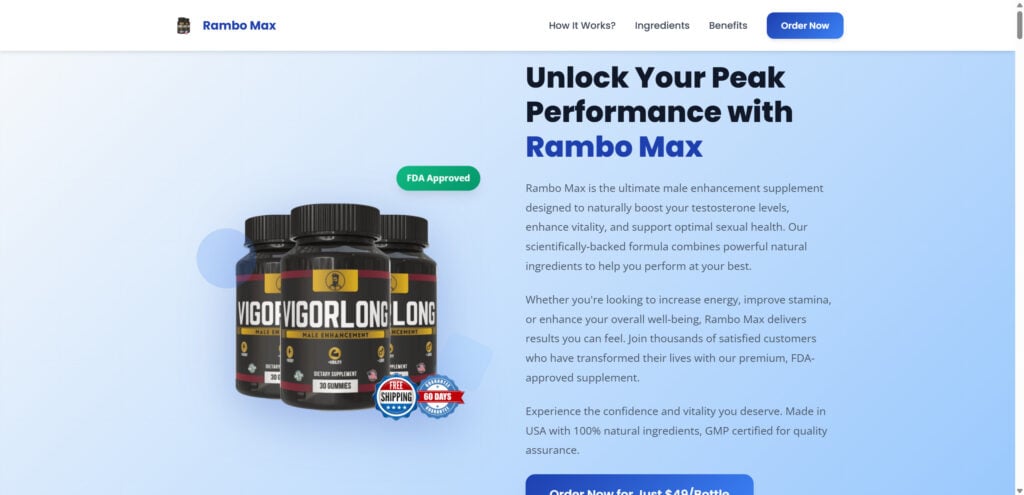
“FDA registered” and “GMP certified” badges are often credibility theater
Many of these honey trick pages stack official-sounding badges near the buy button.
They often claim:
- “FDA registered facility”
- “GMP certified”
- “lab tested”
- “made in the USA”
- “clinically proven”
Even when a manufacturing statement is technically true, it does not prove the product works.
It also does not prove the claims in the video are accurate.
In high-fraud supplement categories, the FDA warns consumers to be cautious because many products marketed for weight loss are likely contaminated with dangerous hidden ingredients, and these products are sometimes advertised as dietary supplements or “all-natural” treatments.
The same warning logic applies across related scam niches too, including sexual enhancement products, which the FDA also flags as likely to contain hidden ingredients.
The biggest damage often comes from billing, not the bottle
A lot of victims focus on whether the supplement works.
But many people get harmed before they even evaluate results.
They get hit by:
- unexpected extra bottles
- upsells that look like required steps
- confusing totals at checkout
- merchant names on statements that do not match the product name
- unwanted refill subscriptions
This is not rare.
The FTC has warned that “free trial” offers in weight loss promotions are often not free, and many people end up billed for recurring shipments they did not want.
And the FTC has brought enforcement actions describing networks that used fake news sites, bogus celebrity endorsements, and deceptive billing practices, including charging people who thought they were making a one-time purchase.
So when people say “returns are impossible,” it is often because the system is designed to create friction after the charge goes through.
Easy to buy.
Hard to cancel.
Hard to refund.
Why these scams are especially cruel when aimed at dementia fears
When the honey trick targets memory loss, the emotional stakes are higher.
Families are scared. Caregivers are exhausted. People want to believe in something gentle, natural, and hopeful.
The FDA has warned consumers to watch out for false promises about so-called Alzheimer’s cures, and it takes action against companies marketing unapproved products that claim to prevent, treat, or cure Alzheimer’s disease.
The Alzheimer’s Association also warns people not to fall for false health claims, especially dietary supplements promoted for cognitive health, since these products are not approved and little is known about their effectiveness, quality, and safety.
That is the core truth behind the honey trick pitch:
It sells comfort.
It does not provide trustworthy medical certainty.
How The Scam Works
The Dr. Gupta honey trick scam supplements usually follow a predictable funnel.
Once you learn the steps, you can spot the same mechanics even when the product name changes.
Step 1: The ad hits an emotional nerve first
The first touchpoint is almost always a paid ad.
It is designed to trigger one of these feelings immediately:
- hope for a shortcut
- fear of decline
- frustration from trying everything
- embarrassment about health symptoms
- panic about the future
The ad often uses urgency phrases like:
- “watch now”
- “before it’s removed”
- “doctors are stunned”
- “this changes everything”
This pressure is not there to help you.
It is there to stop you from researching.
Step 2: A familiar authority figure is inserted to create instant trust
Next, the funnel injects credibility.
This is where the “Dr. Gupta” framing often appears.
Sometimes it is presented as a CNN-style clip.
Sometimes it is a voiceover that sounds like him.
Sometimes it is a headline that implies endorsement.
CNN has stated that scammers are using Dr. Sanjay Gupta’s likeness in AI deepfake videos and doctored images to sell bogus cures and fake health products.
That is your warning sign.
If the endorsement feels “too real,” it may be engineered to feel that way.
Step 3: You land on a fake report page
After clicking, the funnel often sends you to a page that looks like reporting.
Common features include:
- an official-looking logo
- a date stamp
- a byline
- dramatic headline language
- a large embedded video
- “tap to listen” overlays
This is typically an advertorial.
It is built to hold attention, not to provide balanced information.
Step 4: The video opens with suspense, not proof
This is where the script starts doing heavy psychological work.
Instead of giving you the “honey recipe” quickly, it says:
- “stay until the end”
- “you need to understand this first”
- “doctors don’t want you to know”
- “this is being suppressed”
Suspense creates commitment.
The longer you stay, the more invested you feel.
Step 5: The scam reframes your problem into a single hidden cause
Now the funnel introduces a “root cause” story.
Depending on the niche, it might claim:
- “toxins” are damaging your brain
- your metabolism is “switched off”
- blood sugar issues are caused by one missing trigger
- circulation is blocked by a single factor
- your body is “under attack” by modern foods
This is a persuasive move because it simplifies a complex problem into one lever.
Then it claims the honey trick pulls that lever.
Step 6: The promised honey trick is teased, then blurred
Here is the biggest tell.
You came for a recipe.
Instead you get vague references, like:
- “a special honey from the Himalayas”
- “a plant doctors don’t talk about”
- “a golden blend”
- “a simple spoonful ritual”
The details stay fuzzy.
If the funnel were truly educational, the instructions would be clear and practical.
In many scam funnels, the recipe is intentionally incomplete because it is not the real goal.
Step 7: The bait-and-switch happens: the supplement becomes the “real answer”
At some point, the page pivots.
The video suggests the honey trick works because of certain compounds, then claims:
“This supplement contains the exact formula in the perfect ratio.”
Now the product is introduced as:
- drops
- capsules
- gummies
- a “proprietary blend”
This is the bait-and-switch.
The recipe gets you emotionally engaged.
The bottle is the monetization.
Step 8: “Trust badges” are stacked near the buy button
Once the product appears, the page adds credibility theater:
- “clinically proven”
- “doctor recommended”
- “FDA registered facility”
- “GMP certified”
- “lab tested”
These badges are designed to quiet doubt quickly.
But the FDA warns that products claiming to help with health issues are not reviewed before they reach the market, and some may be contaminated with hidden drug ingredients.
So badges are not proof.
They are often persuasion.
Step 9: Urgency is turned up to prevent you from researching
Now the funnel applies pressure tools:
- countdown timers
- “limited stock” warnings
- “discount ends today”
- popups that claim someone just bought
- “people watching now” counters
This is the moment the funnel tries to stop you from opening a second tab.
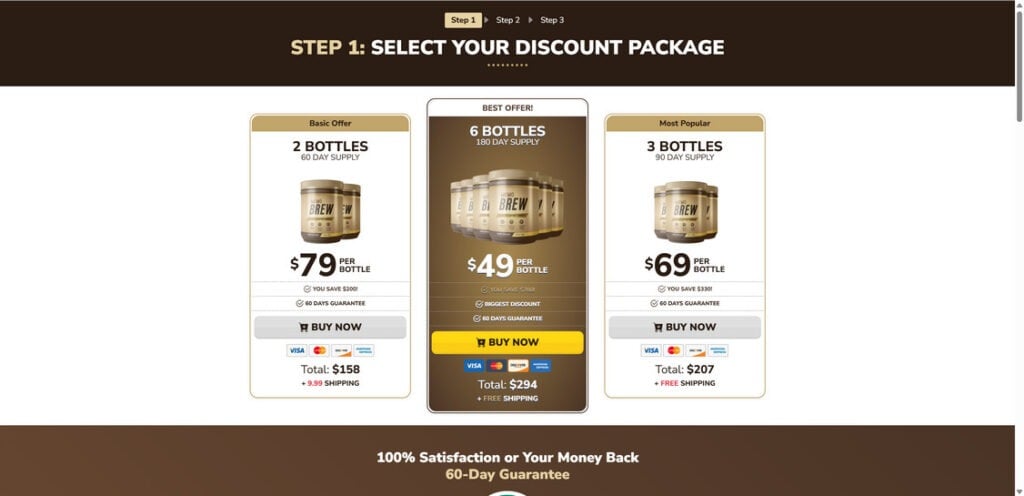
Step 10: Bundles push a bigger purchase
The pricing usually includes tiers like:
- 1 bottle for a high price
- 3 bottles as “recommended”
- 6 bottles as “best value”
This encourages you to spend more before you have any idea whether the product is legit or effective.
Step 11: Checkout flows create billing surprises
This is where many victims feel trapped later.
Common issues include:
- pre-selected quantities
- upsells disguised as confirmation steps
- fine print that introduces continuity billing
- vague merchant descriptors
The FTC has documented how deceptive marketing can lead consumers into recurring shipments they did not want, especially through “free trial” style offers.
And it has brought cases describing large-scale networks using fake news and celebrity endorsements alongside deceptive billing practices.
So if your statement shows repeat charges, you are not imagining things.
This is a known risk pattern.
Step 12: Refunds become slow or frustrating
After purchase, many people report:
- email-only support
- delayed replies
- unclear return instructions
- partial refunds offered instead of cancellation
- repeated stalling
This is why buyers describe returns as “impossible.”
The friction is not a bug.
It is often part of the model.
Step 13: The funnel disappears and reappears under a new name
When complaints build up, operators can rotate quickly.
New domain.
New product name.
Same honey trick storyline.
Same doctor framing.
Same urgency widgets.
Same billing risk.
That is why spotting the structure matters more than spotting one label.
What To Do If You Have Fallen Victim to This Scam
If you bought a supplement through a Dr. Gupta honey trick funnel, use this checklist to protect yourself.
- Save evidence immediately
Screenshot the ad, the landing page, the offer page, the checkout totals, and any terms you can still access. Save confirmation emails and receipts. - Check your statement for extra charges
Look for duplicate charges, split charges, shipping fees, or totals higher than expected. - Look for subscription or refill language
Search your emails for: autoship, membership, monthly, continuity, next shipment, refill. - Email the seller to cancel in writing
Include your name, order number, and a direct request: cancel any subscription and do not charge me again. Ask for written confirmation. - Contact your card issuer quickly if anything looks unauthorized
Ask about disputing charges, blocking future charges from the merchant, and whether a card replacement is recommended if repeat billing continues. - Monitor your account for at least 60 days
Many victims see follow-up charges weeks later. Set a reminder to check weekly. - Do not delay medical evaluation for real memory concerns
The FDA warns about false promises for Alzheimer’s cures and takes action against unapproved products making those claims. - Stop using the product if you feel unwell
If you have side effects or take prescription medications, seek guidance from a qualified clinician or pharmacist. - Report the ad on the platform where you saw it
If it used a fake doctor endorsement, mention that specifically. - Report fake endorsement scams
The FTC warns about doctored endorsement videos and encourages people to verify before buying. Reporting helps connect patterns.
The Bottom Line
The Dr. Gupta honey trick scam supplements are not a harmless recipe trend.
They are often a polished, repeatable funnel that uses a “golden honey recipe” hook, AI-generated endorsement-style content, and high-pressure checkout tactics to sell supplements with exaggerated claims.
CNN has stated that scammers are using Dr. Sanjay Gupta’s likeness in AI deepfake videos and doctored images to sell bogus health cures and fake health products.
If you already bought, focus on protection: save evidence, watch for unwanted refill billing, cancel in writing, and involve your bank early if charges look deceptive.
The product name will change. The pattern usually will not.
FAQ
What is the Dr. Gupta Honey Trick scam?
It is a recurring ad funnel that teases a “golden honey recipe” or honey “trick,” then pivots into selling an overpriced supplement using fake authority, urgency tactics, and exaggerated health claims.
Is Dr. Gupta actually endorsing these honey trick supplements?
Often not. Some campaigns use manipulated or AI-generated content to make it look like a real endorsement. If you cannot verify it outside the sales page, treat it as deceptive.
Is there a real honey recipe that can reverse memory loss, burn fat, or “reset” health conditions?
No. Ads that promise fast, dramatic results from a simple recipe are using marketing hype, not trustworthy medical evidence.
What are the biggest red flags on these pages?
Fake news-style layouts, “watch before it’s removed” messaging, countdown timers, “people watching now” counters, and claims like “clinically proven” without verifiable studies.
Why do these scams sell supplements instead of just sharing the recipe?
That is the bait-and-switch. The “recipe” is used to hook attention, then the funnel swaps it for a bottle sale.
Why do people receive more bottles than they ordered?
Checkout flows may include pre-selected quantities, bundle nudges, and upsells that look like required steps. On mobile, it is easy to miss the final total.
How do unwanted refill subscriptions happen?
Continuity terms are often buried in fine print or confusing screens, leading to recurring charges and monthly shipments buyers did not intend to join.
What should I do if I see repeat charges or a higher total than expected?
Save screenshots and receipts, email the seller to cancel in writing, and contact your card issuer to dispute unauthorized charges and block future billing if needed.
Are “FDA registered facility” and “GMP certified” badges proof the product works?
No. Those phrases are often used as credibility theater and do not prove effectiveness, safety, or that the claims in the video are true.
Where can I report these honey trick ads?
Report them on the platform where you saw them (Facebook, Instagram, TikTok, YouTube) and consider reporting deceptive endorsements and billing practices to consumer protection agencies in your country.

Join the discussion
0 commentsShare your experience or ask a question about this article.
Discussion
Start the conversation
Have a question or something useful to share? Add the first comment.