


A clothing deal can look perfectly ordinary until the parcel fails to arrive. Then the store name on your receipt suddenly becomes much more important.
Dreameous.com is one of those names worth checking carefully. Behind the old storefront is a more revealing trail than a discount banner or reassuring confirmation email.
Overview
Why you should avoid the old storefront
Dreameous.com presented itself as an online clothing store, complete with a recognizable shop name, support email, and terms of service.
Do not order through Dreameous or assume a replacement link is safe. Its historical support address appears in a federal judgment involving infringing online retail activity.
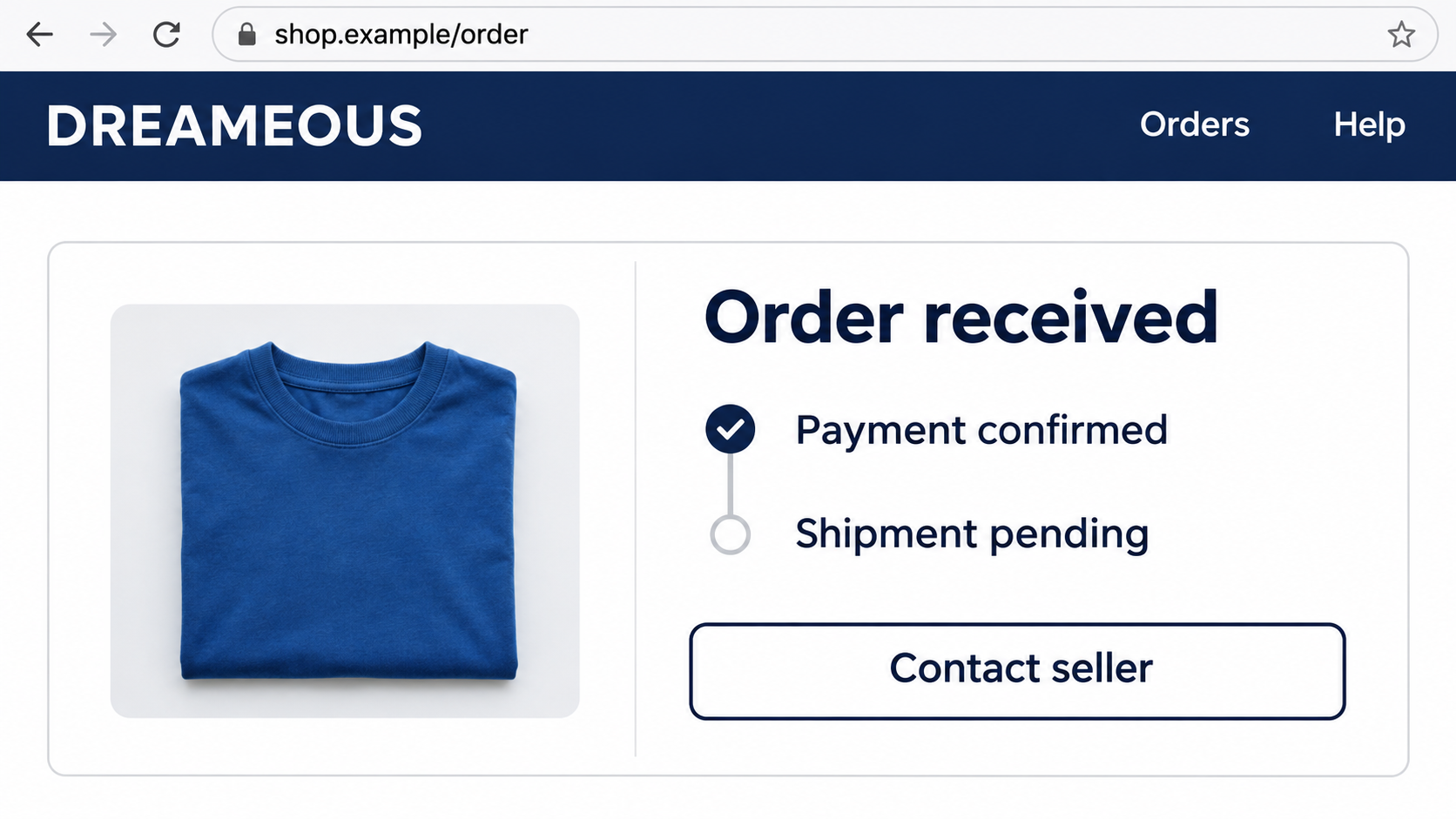
The opening order screen is an illustration. The historical terms screenshot later in this article is an actual retained Dreameous page with its address visible.
A support address connects the storefront to a court record
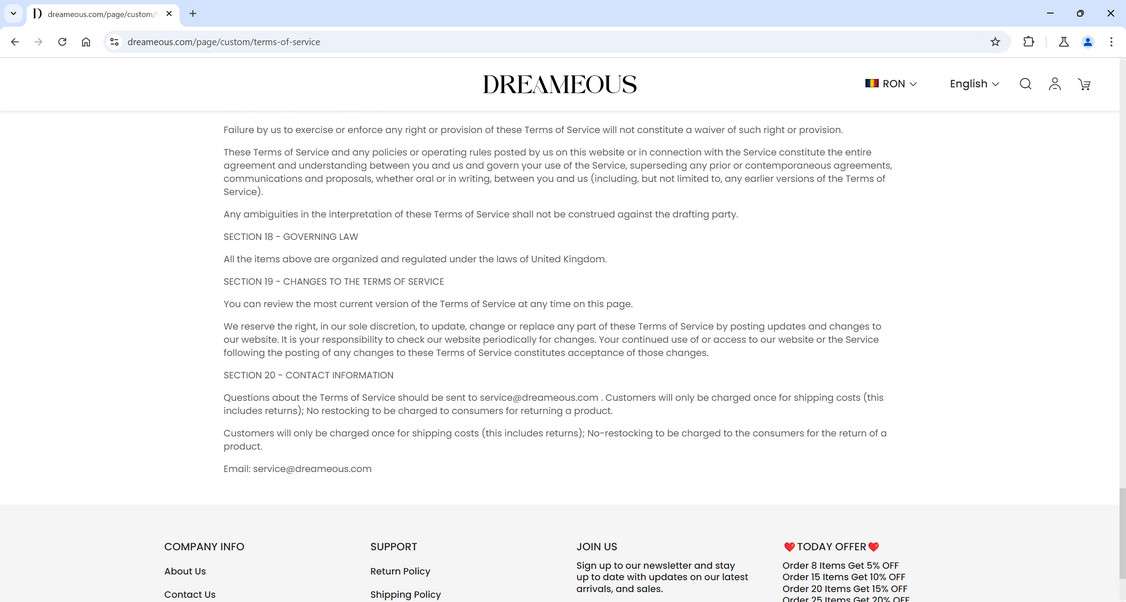
The archived terms identify service@dreameous.com. That same address appears in a September 27, 2024 judgment in Unicorn Egg, Inc. v. Loveinfaith.shop.
The order concerns cybersquatting and trademark counterfeiting involving Love in Faith. Its notification list includes addresses the defendant used in infringing activity or related retail promotion.
The match puts the store’s own contact information inside a documented counterfeit-retail case. That is the central warning behind this report.
What buyers need to do now
The domain currently does not resolve in direct checks. That prevents normal access to the old storefront, but does not explain why it disappeared.
- Keep the exact website address, purchase date, receipt, and payment entry together.
- Distinguish an order you authorized but never received from a charge you did not authorize.
- Use your payment provider’s genuine support channel, not a refund link sent by an unknown person.
- Do not treat the trademark judgment as a compensation fund for shoppers.
- Do not transfer this warning to a different company merely because its name looks similar.
The Evidence Behind the Dreameous Warning
The archived page gives us an exact contact match
The retained browser screenshot shows dreameous.com/page/custom/terms-of-service in its address bar. The page carries the Dreameous name and lists service@dreameous.com.
That matters because a support address is more specific than a common website theme. It gives buyers something concrete to compare with their own correspondence.
The legal wording sits beside ordinary shopping navigation, quantity offers, and return-policy links. It was designed to function as part of a retail website.
It also discusses return shipping and restocking charges. Those historical promises are useful evidence if they match your order, not a current invitation to shop.
The court connection is stronger than a copied warning
The five-page judgment identifies the case as 2:24-cv-00983-RGK-AJR in the Central District of California.
It orders relief against Loveinfaith.shop and addresses confusing uses of Love in Faith branding, infringing merchandise, and promotion through social media.
For service of the order, it lists service@dreameous.com among the defendant-used contact addresses. That independently reinforces concern about the store’s claimed retail legitimacy.
MalwareTips also covers Singulize, Cubitile, and Toughtion, names appearing in the same case. These reports provide related history, not shopping recommendations.
Keep the court finding attached to what it actually covers
This was a civil default judgment, not a criminal conviction. The monetary award belongs to the trademark case, not to every person who placed an order.
The court awarded $100,000 for bad-faith registration and use of the Loveinfaith.shop name, $1 million for trademark counterfeiting, and $27,600 in attorney fees.
The combined $1,127,600 concerns relief for the plaintiff. Shoppers still need to pursue their own transactions through the appropriate merchant, payment-provider, or reporting route.
The injunction covers confusing branding and infringing retail promotion, explicitly including Facebook, TikTok, and Instagram. Advertising placement did not make the defendant an authorized retailer.
Historical terms are not today’s checkout. The record does not resolve individual deliveries, establish a new Dreameous domain, or identify where a particular order was manufactured.
How the Dreameous Store Scam Worked
Step 1: A retail-looking page supplied an easy reason to trust
A recognizable product photograph, normal-looking navigation, and a page of legal terms can make an unfamiliar seller feel routine. None identifies who will fulfill an order.
The connected operation went further by using another retailer’s branding and imagery. The judgment specifically addresses the confusing association with Love in Faith.
A shopper who recognizes a shirt design may assume they have found a discount source for the genuine item. The seller still needs authorization to make that connection.
Buying through a familiar-looking promotion is not the same as buying from the brand itself. Check the merchant domain before the product photograph does the persuading.
Step 2: The offer encouraged the buyer to build an order
The archived Dreameous footer promoted quantity-based offers. That is a reason to inspect the whole cart rather than judging a purchase by one attractive item.
More items mean more money exposed if the seller does not deliver what was promised. A discount does not compensate for an unaccountable merchant.
Before paying, the meaningful details are the exact goods, quantities, full charge, delivery commitment, and identity of the party taking payment.
A multi-item purchase is not automatically a subscription. If later charges appear, investigate those actual transactions rather than assuming every order included recurring billing.
Step 3: A receipt could be mistaken for proof of fulfillment
An order email can confirm that information was submitted or payment accepted. It does not establish that the advertised goods exist in the seller’s inventory.
The next meaningful evidence is a genuine shipment tied to your order: a carrier, tracking history, destination, and eventual delivery of the correct goods.
If tracking says delivered but nothing arrived, ask the carrier about your address and delivery event. Preserve its answer instead of accepting a screenshot from the seller.
Keep a missing parcel, a substituted product, and an unauthorized payment separate in your records. They require different evidence when you seek assistance.
Step 4: Returns depended on an identifiable, responsive seller
The archived terms said customers would face one shipping charge, including returns, and no restocking charge. That wording should not be turned into a free-return guarantee.
If you saved the same terms when ordering, compare them with any later demand for additional fees. Keep the original wording and the seller’s response together.
Do not post goods to an address found in an unrelated review or printed on a shipping label without checking the return instructions.
A dispatch depot is not necessarily a return department. Ask your payment provider what evidence it needs before spending more on an uncertain international return.
Step 5: An inaccessible shop made outside records essential
When the storefront will not load, refreshing the order page cannot resolve the transaction. Your saved receipt and payment records become more important than the missing dashboard.
A new domain using the same name does not inherit your trust or establish responsibility for the old order. Match actual company and transaction details.
Do not send a small verification payment to someone offering to restore the account. A genuine refund should not depend on buying access to your own records.
The Company, Contact and Return Details That Matter
The store name did not identify an authorized brand seller
Dreameous branding is not authorization from Love in Faith. The court record concerns misleading brand associations and infringing retail activity, not an ordinary authorized stockist arrangement.
For an existing order, distinguish the brand pictured in the advertisement from the store that took payment. Contacting the genuine brand does not transfer the seller’s obligations.
A United Kingdom clause did not establish a local business
The historical page selected United Kingdom law, but that sentence did not identify a registered company, local office, or place where a buyer could return goods.
Likewise, a place name in a card entry is not a complete corporate address. The bank can help identify the merchant information associated with the transaction.
The support email had a documented history beyond this shop
Service@dreameous.com is visible in the archived terms and the court’s service list. That exact match is the useful connection, not a guess based on similar spelling.
Preserve messages from that address, including their original headers where available. A familiar sender address alone does not authenticate a new request for banking details.
The original promise and the actual return route are different questions
A policy can describe attractive terms without providing a workable resolution for your order. Keep the return promise, support exchange, and any proposed destination as separate evidence.
For example, a no-restocking-charge promise and a later percentage deduction belong side by side in your dispute evidence. Show the actual inconsistency, if one occurred.
What a DMM Dreameous or London Entry Can Tell You
If your statement includes DMM, Dreameous, or London, start with the complete entry, transaction date, amount, currency, and the card used.
Compare those details with your order confirmation and any payment-service receipt. Do not identify a company from three letters alone.
A descriptor can differ from a storefront name. Ask the issuer to explain the merchant details rather than treating an unfamiliar abbreviation as proof of a second payment.
However, do not dismiss a charge simply because one word looks familiar. Report a payment you did not authorize through the issuer’s genuine fraud channel.
Keep the merchant explanation with your case reference and receipt. This lets you follow a specific disputed transaction rather than chasing changing search results.
How to Spot Fake Clothing Stores
Fraudulent shopping websites often share common patterns that make them easier to detect once you know what to look for. Before entering personal information or making a payment, take a few minutes to check for these warning signs:
- Unrealistic prices and discounts
If a website offers products at prices far below trusted retailers, it’s often a red flag. Many of these sites advertise luxury or high-demand products at massive discounts to create a sense of urgency. A $300 product listed for $49.99 should immediately raise suspicion. - Recently registered or suspicious domain names
Many fraudulent websites operate on newly created domains that disappear after a few weeks. Look for signs like random characters in the URL, misspellings of well-known brands, or hyphenated domains.
You can check a site’s age with a WHOIS lookup, or run it through our free Scam URL Scanner. - Missing or vague company details
Legitimate businesses clearly display their company name, tax information, phone numbers, physical address, and return policies. Fraudulent sites often provide incomplete, fake, or no company details at all. A lack of verifiable contact information is a major warning sign. - No reliable customer service
Real businesses provide clear ways to contact support—email, phone, live chat, or physical return addresses. Fake stores often list nonfunctional contact forms, invalid phone numbers, or reply with generic automated messages. - Poor website quality and structure
Many fake stores are set up quickly with low-effort templates. Look for poor grammar, spelling errors, low-resolution product images, broken links, or missing legal pages (Terms of Service, Privacy Policy, Return Policy). A sloppy website often signals something isn’t right. - Copied product descriptions and images
Fraudulent sites often lift product listings directly from real retailers or marketplaces. If you reverse image search a product photo and find it on multiple unrelated websites, the listing is likely not original. - Lack of credible reviews or suspicious review patterns
A real store will usually have a mix of customer reviews across different platforms. Warning signs include no reviews at all, obviously fake five-star reviews, or multiple identical reviews posted on the same day. Searching “[website name] reviews” or “[website name] scam” on Google often reveals warnings from other consumers. - Unclear or unfair return and refund policies
Fake stores often use vague language around returns and refunds—or avoid the topic entirely. If you can’t easily find clear instructions for how to return an item or get a refund, proceed with caution. - Aggressive urgency and pressure tactics
Fraudulent websites commonly use fake scarcity (e.g., “Only 2 left in stock!”) or countdown timers (“Sale ends in 10 minutes!”) to push you to buy before you think it through. Legitimate stores don’t rely on fabricated urgency to make sales.
Quick Steps to Verify a Website’s Legitimacy
Before entering payment or personal details on a new shopping website, take a few simple precautions:
- Search for the store’s name along with words like “reviews” or “complaints” on Google and Trustpilot.
- Check the website’s domain registration using Whois.com.
- Use trusted tools to scan for malicious or fraudulent links:
- Malwarebytes ScamGuard – detect scams and unsafe links before they reach you on Android and iOS phone.
- Malwarebytes Browser Guard – block dangerous or fake websites on Windows and macOS browsers.
- Verify the business address on Google Maps to ensure it’s a legitimate location.
- Review the store’s accepted payment methods – credit cards and PayPal are traceable and safer than cryptocurrency or bank transfers.
- Trust your instincts; if something feels off, it’s better not to proceed.
How to Spot Similar Scams on Social Media
Many fraudulent shopping websites rely heavily on sponsored social media ads to draw in large numbers of potential buyers. These ads often promise extraordinary discounts—sometimes up to 90% off—and use emotionally charged language to push users into buying immediately.
They frequently appear on Facebook, Instagram, and TikTok, blending in with legitimate content. However, these ads follow predictable patterns that make them easier to identify once you know what to look for.
Spotting Fraudulent Facebook Ads
Facebook’s advertising platform is a favorite tool for fake online stores because of its massive reach. These ads often feature “unbelievable” offers designed to create urgency and bypass critical thinking. Warning signs include:
- Extreme, unrealistic discounts such as “90% OFF,” “Store Closing Sale,” or “Final Liquidation.” Real retailers rarely discount new products this aggressively.
- Poor grammar, awkward phrasing, or inconsistent language throughout the ad or website, indicating low-effort, mass-produced content.
- Generic stock photos or images with watermarks, suggesting the images were taken from legitimate brands or stolen from other sources.
- Recently created Facebook Pages, which is common for temporary fraudulent campaigns. Check the “Page Transparency” section to see when the page was created.
- Limited or no engagement from real customers. Authentic brands usually have reviews, comments, and visible user interaction.
If an ad raises doubts, search for reviews of the website or reverse image search the product photos to see if they’re copied from elsewhere. Never provide payment information until the site is verified.
Spotting Fraudulent Instagram Ads
Instagram is another major platform used to promote fake shopping sites through eye-catching visuals and short-lived “flash sale” captions. Warning signs to look for:
- New or disposable accounts with few posts and followers, often created just weeks or days before launching ads.
- Lack of tagged users in product posts. Legitimate stores often feature real customers, influencers, or product usage.
- Unsecured checkout pages. If the website linked in the bio does not use HTTPS, do not enter payment information.
- Fake or missing customer reviews. Fraudulent stores rarely have authentic purchase feedback.
- Unclear or restrictive return policies, often hidden or written vaguely to make refunds difficult.
When in doubt, search for independent reviews before buying, and only enter payment details on verified, secure websites.
Catching Fake TikTok Ads
TikTok is increasingly used to promote questionable shopping deals through short, persuasive videos. While many ads look polished, the same red flags apply:
- Links to unknown stores that don’t appear in search results or have no external reputation. Many of these sites are temporary and disappear after a short time.
- No verification badge on the TikTok account. While not every legitimate store is verified, the lack of a badge is one more indicator to check further.
- Aggressive countdown timers or “one-day only” promotions designed to rush decision-making.
- Lack of genuine customer reviews or real user content demonstrating the product in actual use.
- Comment sections filled with complaints or warnings from other users. This is often the first place victims speak up.
TikTok scams often rely on impulse buying. Take a moment to verify the website, read independent reviews, and use trusted browser protection before visiting external links.
What to Do If You Ordered From Dreameous
- Confirm the exact seller, not just a similar name.
Find the domain in your receipt or saved browsing record. Compare the complete payment entry with the order’s date, amount, and currency.
Identify the account or email used for the purchase. Check whether the payment went directly to the merchant or through a separate payment service.
- Rebuild what you were actually promised.
Save the item description, delivery estimate, return terms, and correspondence from your purchase. Note which files are originals and which are later screenshots.
The historical page shown here helps explain the case. Your own order-date terms are better evidence of the particular promise made to you.
- Record the outcome in concrete terms.
For non-delivery, retain tracking and the carrier’s response. For a wrong item, photograph the goods, packaging, labels, and differences from the listing.
Create a dated timeline of purchase, expected delivery, contact attempts, and outcome. This is more useful than repeating a general accusation to your bank.
More Steps If You Paid a Fake Shopping Site
- Explain the correct problem to the payment provider.
Use the number on your card or the provider’s genuine app. Explain whether goods never arrived, differed from the description, or the payment was unauthorized.
Give the actual dates and ask about deadlines and supporting documents. The court record can provide context, but does not automatically establish your individual claim.
- Request a remedy in writing when a valid merchant channel remains.
Identify the order and state whether you want cancellation, delivery information, or a refund. Preserve your request and any reply.
If messages bounce or the shop remains inaccessible, retain that result. Do not let repeated assurances cause you to miss the payment provider’s deadline.
- Keep any return proportionate and documented.
For wrong or poor-quality goods, photograph the item, packaging, labels, and discrepancies. Ask the provider what return evidence it requires.
Do not ship to a newly supplied address or pay additional fees solely because an unknown person says it will unlock your refund.
- Address actual card exposure with your issuer.
Review subsequent transactions and promptly report anything unauthorized. Ask whether the circumstances warrant locking, replacing, or otherwise protecting the card.
A missing order and a stolen card number are different problems. Let the issuer assess the relevant safeguards rather than assuming every buyer needs the same action.
- Protect a password only where it was exposed or reused.
If you created a shop account using a password also used elsewhere, replace that password on the legitimate services and enable available multifactor authentication.
Using the same email address alone is not a reason to reset every account. Never send a refund contact your email password or login code.
- Report the store with useful evidence.
In the U.S., use ReportFraud.ftc.gov; elsewhere, contact your appropriate consumer-protection or cybercrime reporting service.
Include the exact domain, transaction details, support messages, and what happened. Remove private banking details before posting publicly or warning other buyers.
- Reject paid recovery shortcuts and unexpected refund links.
Someone knowing your store name or order amount is not automatically authorized to help. Verify any claimed refund through an established channel.
Do not install remote-control software or send cryptocurrency to release compensation. A payment dispute must not become another transaction with an unverified stranger.
Frequently Asked Questions
Is Dreameous.com a legitimate store?
Do not order from it. The historical support address is linked in a federal judgment concerning infringing retail activity, and the old storefront is currently inaccessible.
A polished catalog or old confirmation email does not overcome that documented warning.
Has Dreameous.com closed permanently?
The domain does not currently resolve in direct checks. That explains the access problem, but does not establish permanent closure or the reason it disappeared.
Does the Love in Faith judgment refund Dreameous customers?
No automatic shopper compensation is established by that document. It concerns the trademark plaintiff’s relief against the defendant, not a refund program for every listed website.
What if my statement says DMM Dreameous London?
Give your issuer the complete transaction entry and compare it with your receipt. Ask whether you are dealing with a recognized purchase, billing dispute, or unauthorized payment.
Are Dreamz and Dreamus the same business as Dreameous?
Similar names do not establish that connection. Match the exact domain, receipt, support address, and identified merchant before applying this report to another business.
Can I recover money from an older Dreameous order?
Ask the payment provider about your particular transaction and applicable deadlines. Older orders may be outside ordinary dispute periods, and no article can guarantee recovery.
The Bottom Line
Do not buy through Dreameous or an unverified replacement storefront. The exact support-address match in the court record is a stronger warning than a generic reputation score.
If you already paid, preserve your order evidence and speak to the actual payment provider. Do not spend more money on a supposed refund, release fee, or recovery shortcut.
This article is for informational purposes only and should not be relied upon for financial or business decisions. We identify potential scams using research, user experiences, and expert analysis. However, all claims should be independently verified. Mistakes may occur, and legitimate products could be flagged. We strive for accuracy but make no warranties regarding the completeness or reliability of the information.

If you are the owner of the website or product in question and wish to offer clarifications regarding your business or website, please reach out to us via our Contact form.

Reviews & discussion
0 commentsShare a firsthand experience, or ask a question.
Community reviews
dreameous.com
Moderated reader experiences, not an editorial verdict.
Start the conversation
Have a question or something useful to share? Add the first comment.