

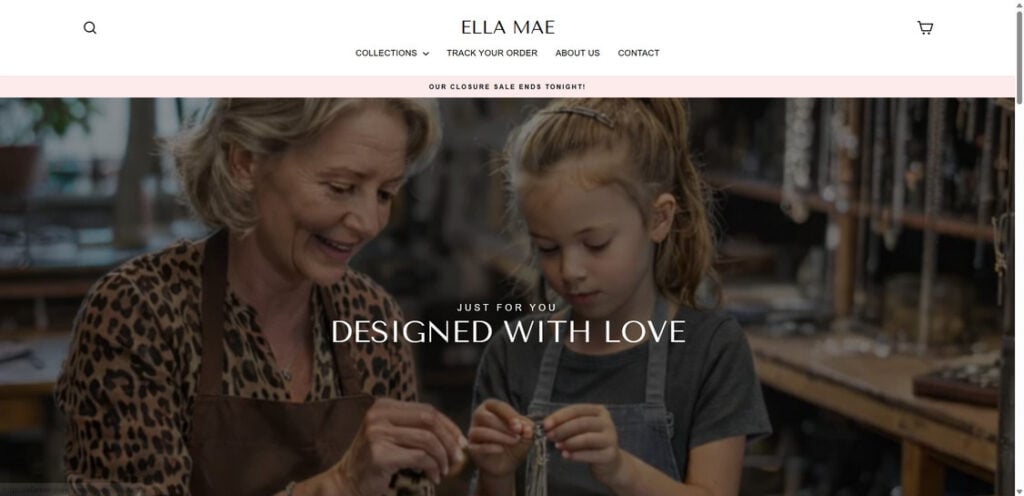
Ella & Mae Jewelry (located at ellamae-jewelry.com) shows up fast: polished ads, a sleek website, and a story built around “handcrafted” quality and timeless design.
Then comes the pressure. A closing sale, anniversary sale, or limited-time event with discounts like 70% off or 80% off, plus countdowns and stock warnings meant to push a quick checkout.
If you are seeing Ella & Mae Jewelry in your feed and wondering whether it is a real premium jewelry brand or another pop-up sale site, pause before you buy.
This article walks through the key signals to check, how these operations typically run, and what to do if you already placed an order.
Overview
Ella & Mae Jewelry fits a broader category of pop-up jewelry storefronts that look like boutique brands but behave like short-term sales funnels.
The promise is almost always the same: high-quality jewelry, “handcrafted,” “premium,” “designed with intention,” offered at steep discounts because the brand is “closing,” celebrating an anniversary, or running a special event sale.
The reality buyers commonly report across this category is also consistent: cheap items shipped from China, products that do not match the ad photos, quality far below expectations, and a return process that becomes expensive or practically impossible.
What these pop-up jewelry sale sites are really built to do
A legitimate jewelry brand usually invests in long-term credibility:
- A stable brand presence over time
- Clear ownership and business registration
- Consistent product photography across seasons and collections
- Transparent materials and manufacturing details
- Customer service that resolves problems without negotiation games
- Return logistics that make sense for the customer
A scammy or low-accountability jewelry storefront is built for a different purpose:
- Drive fast purchases through urgency and emotion
- Reduce comparison shopping
- Use storytelling as a substitute for proof
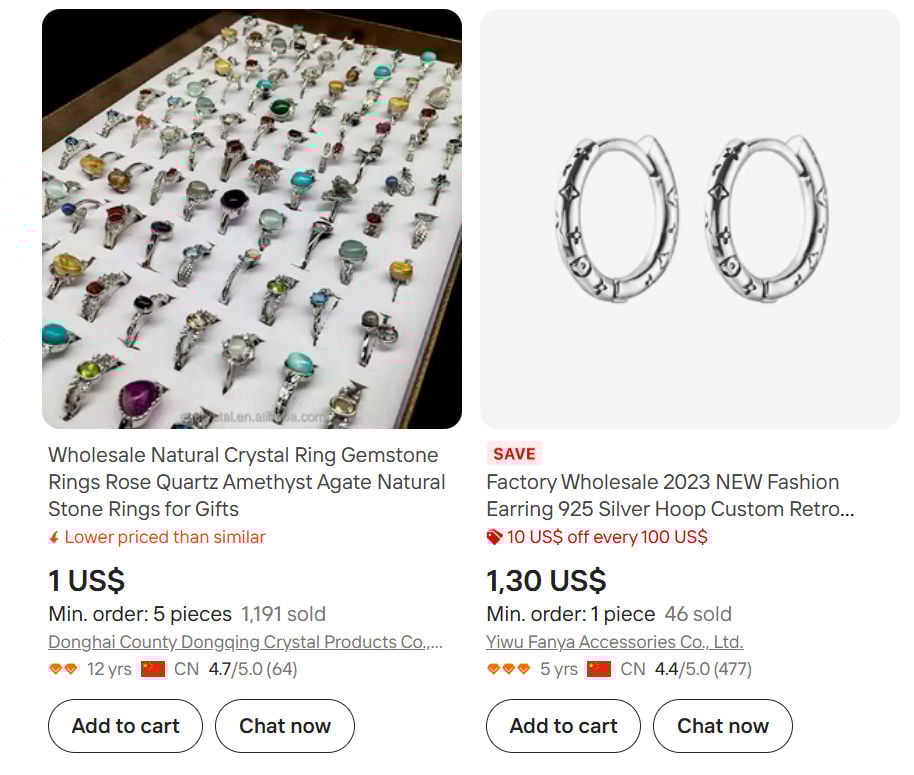
- Ship low-cost products from overseas suppliers
- Minimize refunds by making returns difficult
- Stall long enough to reduce chargebacks and disputes
Even when something arrives, the operation can still be abusive to customers if the product is misleading, the quality is not as advertised, and the seller makes refunds difficult.
The “intention and craftsmanship” narrative as a conversion tool
Jewelry is emotional by nature. People buy it to mark moments, relationships, self-image, and identity.
These scam networks use that reality to their advantage.
A typical Ella & Mae Jewelry-style site will describe jewelry in a way that triggers trust:
- “handcrafted”
- “timeless”
- “crafted with care”
- “made to last”
- “meaningful”
- “designed with intention”
- “not fast fashion”
- “a labor of love”
On its own, that language is not proof of wrongdoing. Many real jewelers write like that.
The red flag is when poetic copy replaces basic business transparency.
If the site is heavy on emotion but thin on verifiable details, you are not being asked to trust evidence. You are being asked to trust a feeling.
Why the sale story keeps changing
Not all of these sites use “closing sale.” Many rotate the reason depending on what converts best:
- Closing sale
- Farewell sale
- Anniversary sale
- Special event sale
- Holiday event sale
- Warehouse clearance
- Final collection release
- End-of-season reduction
The goal is always the same: justify massive discounts like 70% off or 80% off and create a sense of urgency.
A discount is not suspicious by itself. The pattern becomes suspicious when:
- The entire store is always deeply discounted.
- The sale is always “ending today.”
- The countdown timer seems to reset.
- The “limited stock” warnings appear on nearly everything.
- The discount story is not supported by any external footprint of a real company.
The most common red flags on these jewelry sale websites
When a site like Ella & Mae Jewelry is a scam or a high-risk dropshipping operation, it often shows a familiar cluster of signals.
You rarely need just one red flag. The risk becomes obvious when several appear together.
Common website and marketing signals:
- “Up to 80% off” across most of the catalog
- Countdown timers that pressure you to buy immediately
- “Only X left” stock notices that appear on many items
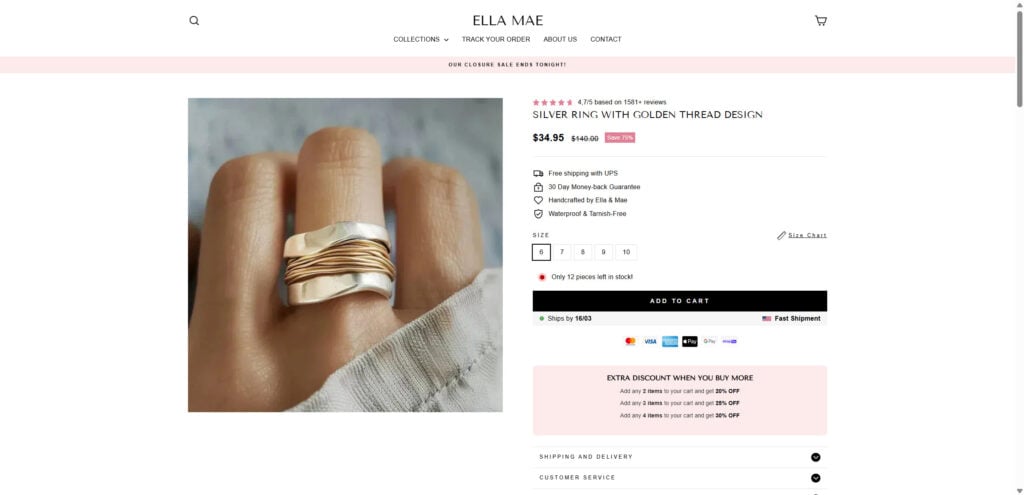
- Overly polished brand story, but no verifiable company details
- Generic “About Us” content that could apply to any brand
- A “30-day money back guarantee” badge with vague conditions
- Large review counts that are not linked to any independent platform
- Product names and descriptions that sound like generic template text
- A domain that looks new or unrelated to the “brand history” claims
- A contact page that provides only an email form, no real address
Common product presentation signals:
- Model photos that look like stock photography
- Jewelry images that look too perfect and overly glossy
- Inconsistent lighting and backgrounds across product photos
- “Before” prices that feel unrealistic for unknown brands
- No clear materials disclosure (or vague terms like “premium alloy”)
- Missing weight, dimensions, clasp details, or plating thickness
Common policy signals:
- Return policy that requires shipping to China
- Customer must pay return shipping and must use tracked shipping
- Refund only after inspection, with no clear timeline
- Ambiguous language about “hygiene items” to deny returns
- Policies that feel copied and pasted, with strange phrasing
One red flag can be a mistake. Five or six together is usually a pattern.
What buyers commonly report after ordering
When people purchase from these sites, complaints tend to fall into a few predictable categories.
1) The product is not what the ads showed
Common complaints include:
- The piece looks cheaper in real life than in photos.
- The item is smaller or thinner than expected.
- Stones look cloudy, plastic-like, or poorly set.
- The finish looks brassy or dull, not like real gold.
- Clasps feel flimsy or break quickly.
- The jewelry irritates skin, suggesting nickel or low-quality plating.
- The item arrives with cheap packaging that contradicts the “luxury” story.
2) Shipping is slower and more confusing than implied
Common issues include:
- Shipping takes weeks, not days.
- Tracking updates are delayed or inconsistent.
- Tracking numbers change mid-route.
- The package label shows overseas origins, often China.
- Customer support asks buyers to “wait a bit longer” repeatedly.
3) Returns become a trap
The most revealing pattern is how support handles refunds.
Instead of offering a normal return label and process, these stores often:
- Offer partial refunds of 15% to 30% if you keep the item
- Delay sending return instructions
- Provide a return address overseas
- Require tracked shipping at the customer’s cost
- Use inspection delays to postpone refund completion
That is not a customer-friendly return process.
It is a strategy to make returns feel not worth the effort.
Why the “partial refund” behavior is such a strong warning sign
Many buyers report the same sequence:
- They complain.
- Support apologizes.
- Support offers a partial refund if the buyer keeps the item.
- If the buyer insists on a full refund, the return process becomes complex and expensive.
This is not generosity. It is cost control.
International returns erase margins. Partial refunds preserve profit and reduce disputes.
Legitimate retailers sometimes offer partial refunds, but the difference is context:
- Real brands do not use partial refunds as the default response to dissatisfaction.
- Real brands do not “negotiate” refunds as if it is a bargaining game.
- Real brands do not hide behind overseas return friction.
What this means for shoppers
A site like Ella & Mae Jewelry might not steal your card details.
The risk is often more practical: you pay for “high quality handcrafted jewelry” and receive something cheap and misleading, and then you get pulled into a support loop designed to wear you down.
That is why this category belongs on a scam site.
The harm is financial, emotional, and time-based:
- You waste money on a product that does not match claims.
- You waste time chasing support.
- You may miss your dispute window if you wait too long.
- You may be exposed to follow-up phishing attempts.
How The Operation Works
This type of jewelry scam is less about instant fraud and more about engineering a regret purchase and making it hard to reverse.
Below is the typical step-by-step flow used by operations like Ella & Mae Jewelry.
Step 1: The ad sells a feeling, not a product
The ads usually lead with emotional positioning:
- “handcrafted jewelry”
- “made with intention”
- “timeless pieces”
- “closing sale”
- “anniversary event”
- “final collection”
- “up to 80% off”
The visuals are designed to feel premium:
- close-up shots that make plating look like solid gold
- dreamy lighting
- soft backgrounds
- “artisan” brand aesthetics
The goal is simple: get you to click before you verify the brand.
Step 2: The landing page quickly floods you with trust cues
Once you land on the site, it tries to remove hesitation fast.
Common trust cues include:
- a founder story that reads like a heartfelt letter
- big “sale ends today” messaging
- guarantee icons like “30-day money back guarantee”
- security badges
- large review counts and star ratings
- “as seen on” style visuals, sometimes without real citations
These elements are designed to create safety without providing proof.
Step 3: The story replaces verification
A real jewelry brand can be verified in multiple ways:
- a consistent presence across platforms
- independent customer reviews over time
- business registration details
- real store addresses or studios
- press coverage that exists outside the brand’s own website
A scammy storefront often tries to avoid those checks by keeping you inside the story.
It gives you something emotionally satisfying to believe, so you do not ask practical questions like:
- Who actually owns this business?
- Where is it located?
- Where does it ship from?
- What materials are truly used?
- What does “premium” mean in measurable terms?
- How exactly does the return work?
Step 4: Price anchoring makes you think you are getting luxury for cheap
This is where conversion usually happens.
Products are shown with heavy markdowns:
- “Was $199, now $49”
- “Was $275, now $55”
- “Save 80% today”
Even skeptical shoppers often think:
“If it’s half as nice as the photos, $49 is still worth it.”
That is the trap. The “original price” may not reflect real market value.
Price anchoring is not proof of a scam, but combined with the rest of the pattern, it is a key lever.
Step 5: The product descriptions use premium language but vague material details
High-risk jewelry sites tend to avoid precise claims that could be disputed.
Instead of clear material specs, they use phrases like:
- “premium metals”
- “high-quality plating”
- “crafted for durability”
- “hypoallergenic” without evidence
- “water resistant” without standards
- “luxury finish”
A real jewelry listing often includes details that are measurable:
- base metal type
- plating type and thickness
- stone type and grade
- weight in grams
- dimensions in millimeters
- clasp type
- care instructions matched to materials
Vagueness is useful for scam sellers because it gives them room to ship low-grade products while claiming the description was “interpreted.”
Step 6: Reviews act as a shortcut for trust
On these sites, reviews are often used as a conversion wall.
The buyer sees:
- 4.7 stars
- “9,000+ reviews”
- short glowing quotes
- occasional user photos
But the reviews are rarely verifiable. Common problems include:
- no link to an independent review platform
- repeated phrasing across many products
- reviews that feel generic and could fit anything
- high review volumes that do not match a brand’s apparent footprint
If reviews exist only on the seller’s website, treat them as marketing unless independently confirmed.
Step 7: Checkout is built to reduce careful thinking
At checkout, many of these stores push speed:
- bundle offers like “buy 2 get extra 10% off”
- upsells
- pop-ups that claim items are “in high demand”
- limited stock warnings
- vague shipping promises
Important details like international shipping and return addresses are often kept in policy pages that most buyers never read.
Step 8: Fulfillment routes through overseas suppliers
This is the operational core.
The store is often just a storefront and ad account.
The product is sourced and shipped through a supplier network, frequently overseas. That is why buyers often report:
- long shipping windows
- labels and tracking that indicate China-based fulfillment
- products that feel mass-produced and cheap
In a jewelry context, that might mean:
- low-grade alloys
- thin plating that wears quickly
- stones that look like plastic or glass
- inconsistent sizing
- poor finishing
Step 9: The delivery arrives and the “quality gap” becomes obvious
This is when most complaints start.
The “quality gap” is the difference between:
- what the ad visually implied
- what the product actually is
Common quality-gap scenarios in jewelry include:
- rings that tarnish quickly
- necklace chains that kink or break
- clasps that fail
- earrings that irritate ears
- plated finishes that rub off
- stones that arrive loose or misaligned
- the item looking far less “luxury” than the photo
Even when the item is wearable, it may not be remotely what a shopper believed they were purchasing.
Step 10: Support turns into a negotiation designed to exhaust you
Once buyers complain, the support script often looks like this:
- Apologize and request photos.
- Offer a partial refund, usually 15% to 30%, if the customer keeps the item.
- If the customer insists on a full refund, introduce friction:
- international return address, often China
- customer pays return shipping
- tracked shipping required
- refund only after inspection
- Offer a higher partial refund to end the case.
This is not a normal retail return experience.
It is a strategy to reduce refunds and chargebacks.
Step 11: Delay tactics aim to push buyers past dispute deadlines
Many payment methods have time limits for disputes.
These stores often rely on delay:
- “Please wait, shipping takes longer due to demand.”
- “Tracking will update soon.”
- “Our team is reviewing your case.”
- “We can offer a partial refund immediately.”
The danger for the buyer is waiting too long, then losing the ability to dispute effectively.
If you are dealing with a site like Ella & Mae Jewelry, the best approach is to document quickly and escalate on a strict timeline.
What To Do If You Have Fallen Victim to This Scam
If you already ordered from Ella & Mae Jewelry or a similar jewelry sale site, focus on protecting your payment method and building a clean dispute record.
Follow this checklist.
- Save evidence immediately
- Screenshot the product page, photos, and description.
- Screenshot the price, discount, and sale banner.
- Save the order confirmation page and email.
- Screenshot the return policy and shipping policy.
These pages can change or disappear.
- Check how the charge appears on your statement
- Note the merchant name and any unusual variations.
- Record the amount, date, and any extra charges.
Sometimes the billing name does not match the store name.
- Contact support and request a full refund in writing
Keep it short:- “The item is not as described. I am requesting a full refund.”
- “Please provide the refund timeline and return instructions.”
Do not write long emotional emails. Keep it factual.
- If the order has not shipped, request cancellation immediately
Ask directly:- “Cancel my order and confirm the refund today.”
If they refuse or stall, you have documentation for a dispute.
- “Cancel my order and confirm the refund today.”
- If the item arrives and it is not what you expected, document it clearly
- Take photos in good lighting.
- Photograph packaging labels and inserts.
- Capture close-ups showing poor finishing, discoloration, size mismatch, or defects.
- Compare against your saved product screenshots.
- Do not accept partial refunds if you want a full refund
If support offers 20% back to keep it, repeat:- “No partial refund. Full refund only.”
Partial refunds are commonly used to end complaints cheaply.
- “No partial refund. Full refund only.”
- Set a short deadline
Example:- “If I do not receive full refund confirmation within 48 hours, I will dispute the charge.”
Then follow through.
- “If I do not receive full refund confirmation within 48 hours, I will dispute the charge.”
- File a dispute or chargeback with your card issuer
Tell your bank the core facts:- item not as described
- misleading advertising
- return not honored or return process unreasonable
Provide screenshots and your email trail.
- If you used PayPal, open a PayPal dispute inside your account
Do not rely on email promises. Use the platform process.
Upload your documentation early. - Watch for follow-up scams
After purchases like these, some buyers receive:
- fake delivery problem texts
- fake “refund” emails
- requests to verify card details
Do not click unexpected links. Go directly to your bank or PayPal.
- Monitor your card for additional charges
Look for:
- small test charges
- repeat charges
- unfamiliar merchant names
If anything looks suspicious, replace the card.
- Report the ad
Report it on the platform where you saw it.
This helps reduce reach and creates a record.
The Bottom Line
Ella & Mae Jewelry follows a very common online jewelry scam pattern: a boutique-looking store that sells “handcrafted, premium, timeless” jewelry while running constant “closing,” “anniversary,” or “event” sales with steep discounts like 70% off or 80% off.
The red flags usually appear in clusters: emotional storytelling that replaces proof, inflated price anchoring, reviews that are hard to verify, and a return policy that becomes unrealistic, especially when it requires shipping to China at the customer’s expense.
If you have not ordered, pause and verify the brand outside its own website. If you already ordered, save evidence immediately and escalate on a tight timeline so you do not lose your dispute window.








