

Gum recession and bleeding can make you feel like you are on a timer. You notice pink in the sink, sensitivity that was not there before, and the nagging fear that a small problem is turning into an expensive one.
That is exactly the emotional pressure point products like Elycura Gum Protect Repair Gel target. The marketing promises a simple at-home gel that “repairs” gum tissue, tightens pockets, and reduces bleeding fast, sometimes framed as a breakthrough that helps you avoid painful procedures.
This review breaks down what Elycura is, how it is being sold, the most common red flags buyers report with similar products, and what to do if you already ordered. It is not medical advice. If you have persistent gum bleeding, swelling, loose teeth, pus, fever, or rapidly worsening recession, treat that as urgent and contact a dentist.
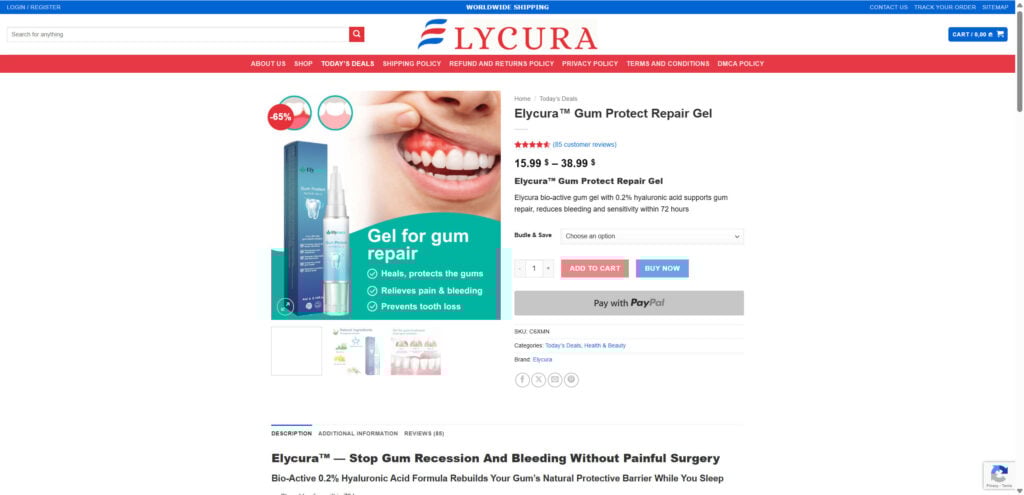
What Elycura Gum Protect Repair Gel Claims to Do
Elycura is advertised as a gum “repair” product designed to:
- Stop gum bleeding quickly (often “within 72 hours”)
- Reduce sensitivity
- Tighten or reduce gum “pockets”
- Support gum tissue repair and healthier-looking gums
- Deliver results fast, sometimes compared to doing nothing or waiting months for appointments
The formulation is frequently presented as “bio-active” and built around a low percentage of hyaluronic acid, with supporting ingredients like CoQ10, aloe, vitamin C, and chamomile.
On the surface, these ingredients sound plausible because they are common in skincare and oral care messaging. The issue is not whether hyaluronic acid exists or whether aloe can be soothing. The issue is the leap from “soothing” to “reverses recession” or “tightens pockets” and the way those claims are packaged to feel clinical and proven.
Why Gum Recession Is a High-Risk Category for Hype
Gum recession is not like dry skin. It is often driven by underlying causes that a topical gel cannot fix on its own, such as:
- Periodontal disease (bacterial infection and inflammation)
- Aggressive brushing or abrasive toothpaste
- Teeth grinding and clenching
- Orthodontic movement in thin gum biotypes
- Smoking or vaping
- Poorly fitting dental work, crowding, or bite issues
- Genetics and thin tissue
Even when symptoms improve (less bleeding, less irritation), it does not automatically mean recession reversed or bone loss stopped.
This is where marketing gets slippery. A product can reduce irritation and make gums look calmer while the root cause continues. That is not “scam” in the strict sense, but it is a mismatch between what people think they are buying and what the product can realistically deliver.
Trust Problems Seen With This Listing Style
Based on the page layout and the way this product category is commonly sold, several patterns tend to show up. A single red flag is not proof of fraud, but multiple together should put you on defense.
1) Big medical claims paired with thin proof
The sales copy often reads like a clinical brochure: talk of trials, validation, “measurable improvements,” and sometimes named doctors or journal references.
The problem is that these pages frequently do not provide the basics you need to verify the claims:
- A direct citation you can check
- A real study title
- A link to a DOI or journal page
- A clear statement that the study tested this exact branded product, not a general ingredient
- Transparent outcomes (what improved, by how much, compared to what control)
If a page says “published research confirms improvements,” but you cannot independently verify that Elycura itself was studied as sold, treat the claim as marketing.
2) “Journal namedropping” without traceable citations
It is common to reference a reputable-sounding publication (for example, Journal of Periodontology) to borrow credibility.
A legitimate brand that truly has product-specific clinical evidence usually makes it easy to verify, because that proof sells. When the proof is vague, you should assume the reference may be to general hyaluronic acid research, not the branded gel you are buying.
3) Aggressive discounting and urgency mechanics
Pages like this often stack incentives:
- “Big winter sale” or huge percentage-off badges
- Limited-time countdown timers
- “Today only” bundles
- Buy-more-save-more tiers
Urgency is not automatically shady, but it is a hallmark of dropship-style funnels. The goal is to get you to buy now, before you slow down and research.
4) Returns that look easy on paper but hard in reality
Many of these stores advertise a money-back guarantee and a “30-day return window.” Then you look closer and you see conditions that make returns difficult:
- You pay return shipping
- You must ship to an overseas address (often China)
- The item must be unopened
- You must obtain approval before returning
- You need tracking, signatures, and specific packaging rules
- The return window starts from delivery, not purchase, which matters if shipping takes weeks
5) Multiple bottles shipped even when you ordered one
A recurring complaint: customers order one unit, then receive multiple units, or see that their order was processed as a bundle they did not intend.
This can happen through:
- Bundle offers that “stick” when you click around
- Quantity defaults that revert
- One-click upsells after checkout
- “Free plus shipping” style add-ons that become paid items
Again, not guaranteed, but common enough that it should be part of your risk calculation.
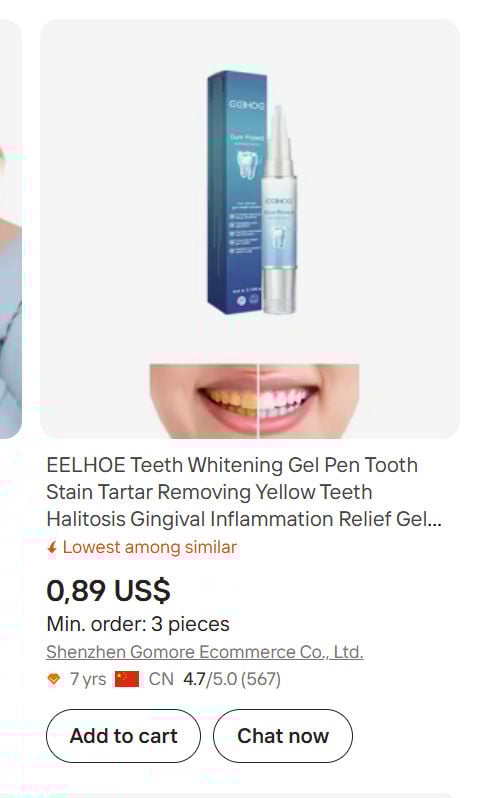
6) Product identity issues and cheap clones
With many health and beauty “miracle” products, the brand name is interchangeable.
You will often find:
- Identical packaging shapes across multiple brand names
- The same product images on different sites
- A product that resembles a low-cost generic item on global marketplaces
That does not automatically mean it is fake, but it can indicate private-label sourcing where the “brand” is mainly a marketing wrapper.
If the product is private-labeled, quality control, manufacturing transparency, and customer support become the deciding factors. Many of these funnels are weak on all three.
How Elycura Is Supposed to Work
The promise typically follows a simple narrative:
- Your gums are inflamed and bleeding because the tissue is “damaged.”
- Conventional care is expensive or slow.
- This gel delivers “bio-active” repair ingredients directly to the gum line.
- The ingredients form a protective layer and help tissue “regenerate.”
- You see visible improvement quickly and avoid surgery.
This story is designed to feel logical and inevitable.
The key question is what “repair” means in real dentistry.
What topical gels can realistically do
A topical product may help with:
- Temporary soothing of irritated tissue
- Reduced sensation of dryness or tightness
- Improved comfort while brushing
- Supportive care after a dental cleaning
- Reduced bleeding if inflammation decreases
What topical gels usually cannot do on their own
They generally cannot:
- Reverse significant gum recession
- Regrow lost bone
- Eliminate periodontal infection without professional treatment
- Fix deep pockets caused by periodontitis
- Correct mechanical causes like brushing trauma or grinding
If the product frames gum recession as something you can “reverse” at home without a dental evaluation, that is where the credibility starts to fail.
A Closer Look at the Ingredient Pitch
Many pages highlight a few “hero” ingredients. Here is what to keep in mind.
Hyaluronic acid (often around 0.2%)
Hyaluronic acid is widely used in wound healing and tissue hydration contexts, and it can support moisture and comfort. In dentistry, hyaluronic acid has been studied as an adjunct in certain periodontal care scenarios.
But there is a big difference between:
- Hyaluronic acid used as part of professional periodontal therapy, and
- A consumer gel sold online promising to “tighten pockets” and “stop recession” at home
If the marketing implies hyaluronic acid alone reverses recession, that is not a responsible claim.
CoQ10, aloe, chamomile, vitamin C
These ingredients are common in “anti-inflammatory” narratives. They may be soothing or supportive, but the presence of familiar ingredients does not prove the product is clinically effective for recession.
The more dramatic the promise, the higher the burden of proof should be.
How the Sales Funnel Usually Works
If you have seen other “miracle” products online, the structure will feel familiar.
Step 1: Trigger anxiety and urgency
The copy hits common fears:
- “Your gums are receding and you did not notice”
- “Bleeding means damage”
- “Pocket depth leads to tooth loss”
- “Dentists do not tell you this”
Then it gives you a comforting escape route: a simple gel.
Step 2: Borrow medical authority
The page may include:
- “Clinically validated” language
- Mention of dentists, specialists, or PhDs
- Charts, timelines, and “results vary” disclaimers that mimic real medical material
- References to journals
This is credibility theater unless you can verify it.
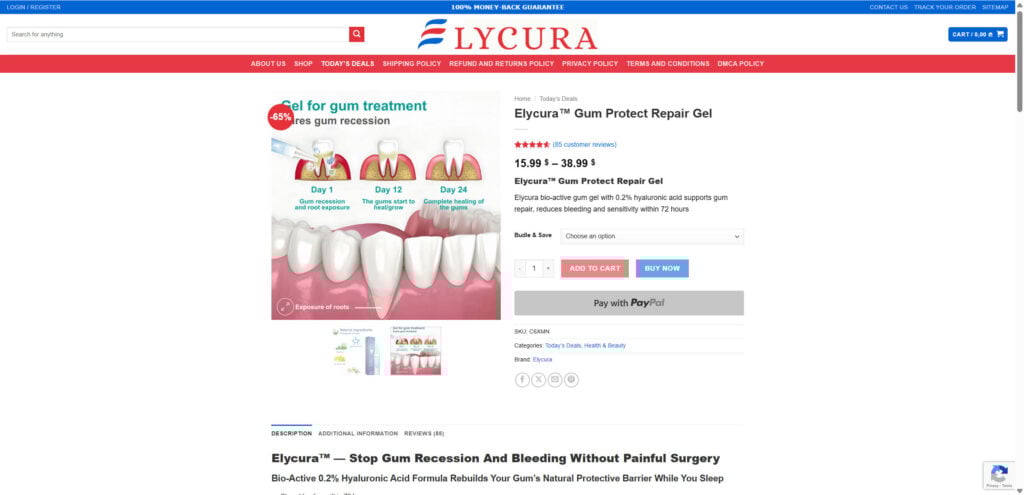
Step 3: Showcase dramatic “transformation” timelines
You often see a timeline like:
- First 72 hours: bleeding stops
- First week: sensitivity improves
- Weeks 2 to 4: pockets tighten
- Week 4 onward: lasting repair
Timelines create the feeling of inevitability, even when they are not supported by product-specific evidence.
Step 4: Push bundles and maximize cart value
The moment you are convinced, the funnel pushes:
- “Buy 2, get 1” tiers
- “Most popular” package highlighted
- A “free gift” that is actually part of the upsell sequence
This is where accidental multi-unit orders happen.
Step 5: Slow fulfillment and support friction
If the store uses overseas fulfillment, delivery can take weeks. When buyers try to return, support can become slow, scripted, or inconsistent.
This is where the “money-back guarantee” often breaks down in practice.
What To Check Before You Buy
If you are still considering Elycura or a similar gum gel, check these items first.
Company and policy transparency
- Is there a real company name and address, not just a contact form?
- Do policies clearly state where returns are shipped to?
- Is customer support reachable with a real email and response expectations?
Checkout risk controls
- Is any subscription option preselected?
- Is there any “subscribe and save” language near the total?
- Do you see shipping protection or VIP add-ons pre-checked?
Proof of claims
- Is there a verifiable clinical citation for this exact branded product?
- Are claims clearly framed as supportive care rather than replacement for dentistry?
Payment safety
If possible, use a payment method with strong dispute protection. PayPal and major credit cards generally offer better consumer protections than debit cards.
What To Do If You Already Bought Elycura
If you already placed an order and now you are concerned about legitimacy, returns, or subscription traps, take these steps immediately.
- Save evidence right now
- Screenshot the product page, price, guarantees, and all policy pages.
- Screenshot your order confirmation page and any upsell pages you saw.
- Save emails, invoices, and transaction IDs.
- Check for subscription language
- Review your confirmation email carefully for words like “subscription,” “recurring,” “auto-ship,” “every 30 days,” or “membership.”
- Log into your account on the site (if possible) and look for a subscription dashboard.
- Monitor your payment method
- Watch for additional charges over the next 2 to 30 days.
- If you see a second charge you did not authorize, document it immediately.
- Contact support in writing
- Request cancellation of any subscription and cancellation of any unshipped items.
- Keep the message short and specific:
- Order number
- What you want (cancel, refund, stop subscription)
- Ask for written confirmation
- If the order has not shipped, request cancellation
- Many stores will say “processing” for days. Push for cancellation before shipment.
- Ask for a cancellation confirmation email.
- If it shipped, evaluate the return reality
- If returns require shipping overseas at your cost, calculate whether it is financially rational.
- Ask for the return address and full instructions in writing.
- If they delay or provide unclear instructions, keep records.
- Use your payment protections if support fails
- If you cannot get a refund for unauthorized charges, open a dispute with your card issuer or payment provider.
- Provide screenshots and email records.
- If you suspect a subscription trap, consider replacing the card
- If repeated charges continue, call your bank and ask about stopping merchant-initiated transactions.
- In some cases, replacing the card is the cleanest way to cut off future billing.
- Talk to a dentist if symptoms are real
- If you have bleeding, swelling, bad breath that does not improve, loose teeth, pain, or visible recession, a gel should not be the main plan.
- Periodontal disease progresses quietly. Early intervention is cheaper than late intervention.
So, Is Elycura Legit or a Scam?
Here is the most accurate way to frame it.
Elycura looks like a product sold through a high-pressure marketing funnel that relies on big promises and credibility cues, while making returns and accountability difficult in practice. That combination is a common warning sign.
That does not mean every bottle is “fake,” or that no one will feel symptom relief. A topical gel can make gums feel less irritated. But the stronger the claims become, especially around reversing recession or replacing professional care, the more the offering veers into misleading territory.
If the store has limited transparency, overseas return friction, unclear clinical proof, and checkout tactics that increase the risk of subscriptions or unintended bundles, the safest recommendation is to avoid buying and instead use established oral care products from reputable brands while you get real dental guidance.
FAQ
Does Elycura actually regrow gums?
True gum regrowth and reversal of recession is complex and depends on the cause. A topical gel may reduce irritation and bleeding, but claims of regrowing gum tissue or reversing recession should be treated skeptically unless supported by verifiable, product-specific clinical evidence.
Can a gel “tighten gum pockets”?
Pocket depth is usually linked to inflammation and periodontal disease. Reducing inflammation can sometimes improve measurements, but “tightening pockets” as a consumer promise is often oversimplified. If you have pockets, you need a professional periodontal assessment.
Why do these sites mention clinical trials and journals?
Because it increases trust and reduces hesitation. Sometimes the references are vague or refer to general research on ingredients rather than the exact branded product. If you cannot verify the citation, treat it as marketing, not proof.
What is the biggest risk if I buy?
The biggest practical risks are:
- Spending money on exaggerated claims
- Return hassles, especially if the return address is overseas
- Subscription or recurring billing issues
- Receiving multiple units due to bundle or upsell mechanics
Should I see a dentist instead?
If you have ongoing bleeding, swelling, pain, loose teeth, bad breath that persists, or visible recession, yes. Topical products should not replace diagnosis and treatment. Periodontal issues are easier to manage early.
The Bottom Line
Elycura Gum Protect Repair Gel is marketed with strong, medical-sounding promises that are difficult to verify and easy to overinterpret. The storefront style and policies commonly associated with this category can create real buyer risk, especially around returns and exaggerated expectations.
If you want to reduce your risk, skip the funnel, protect your payment method, and focus on proven oral hygiene plus a dental evaluation to address the real cause of gum recession and bleeding.

Join the discussion
2 commentsShare your experience or ask a question about this article.
Community experiences
Did this happen to you?
Your experience could help someone recognize the same scam. Submit a private report for our team to review.
I experienced this tooReports are reviewed before publication. Sharing publicly is always your choice.
Discussion
The difference in what the product claims to have as ingredients is vastly different than the ingredients label – you need to add that information to your post. The products sold under this name and fake knock-offs deliberately do not post an image or list actual ingredients. so yeah, Scam!
In reply to Jeannie K
Hi Jeannie, thank you for pointing that out.
That is an important red flag. When the advertised claims do not match the actual ingredient label, or when sellers avoid clearly showing the real ingredients at all, that raises serious questions about transparency and trust. I agree that it adds to the scam warning signs.
Thanks for adding that detail for other readers.