

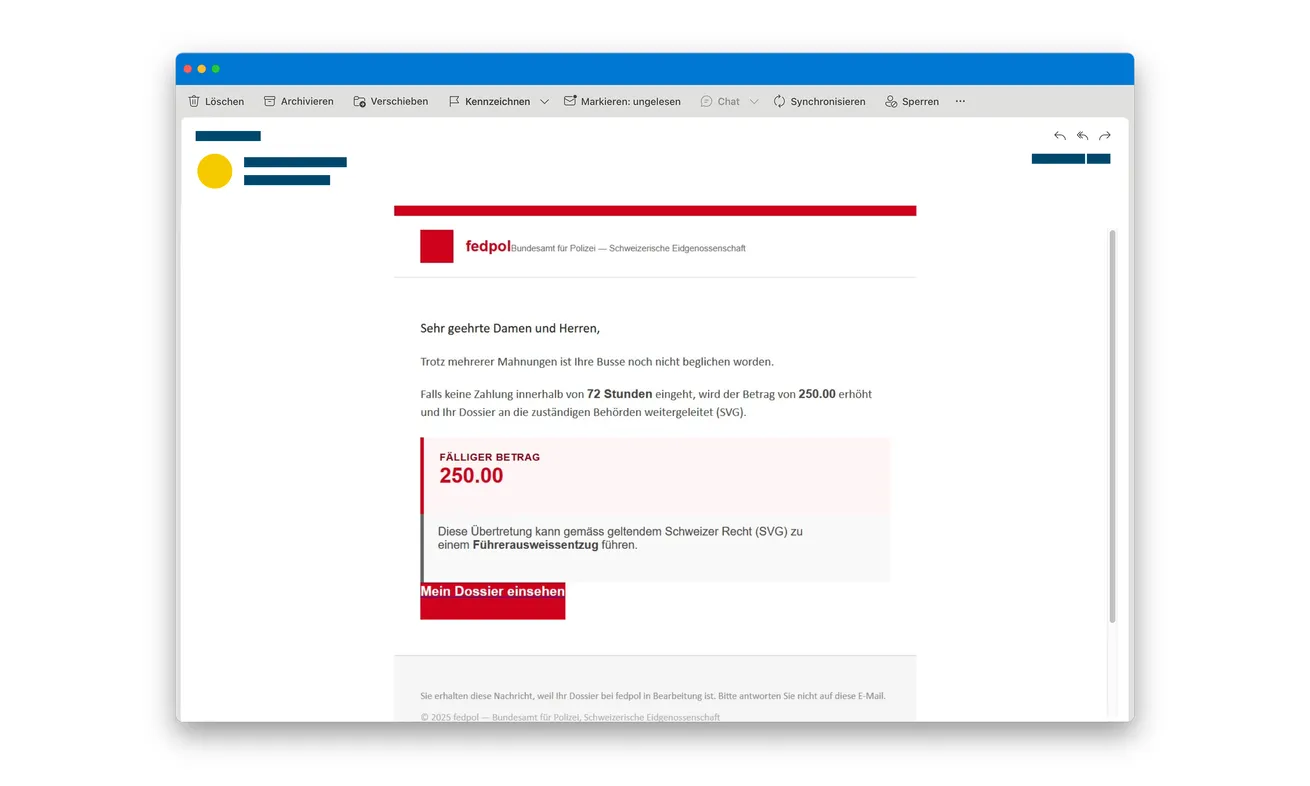
An email carrying the fedpol name says an unpaid fine needs attention within 72 hours. Ignore it, the message warns, and the consequences could become more expensive.
Even if you don’t remember a violation, a police-branded notice can make paying seem easier than asking questions. Check the supposed case before opening its payment page.
Overview
The fedpol fine email scam uses a false enforcement deadline
The message impersonates Switzerland’s Federal Office of Police and claims that reminders about a fine have gone unanswered. Its button leads to a counterfeit website.
Police document the email and financial-data collection. The fraudulent page requests personal information and card details under the excuse of settling the supposed fine.
The genuine police authority is not running this payment scheme. The threatening email is also not proof that the recipient committed an offense.
The payment form asks for more than money
The documented fields include a name, address, date of birth, AHV number, and card information. These details can create risks beyond the advertised payment.
Police also describe some pages showing a substantially higher figure than the email. Don’t assume the number in the message limits the attempted charge.
The original email above shows the pressure and case button. Its amount is part of the fraudulent claim, not an independently verified debt.
Check a real fine with the authority that issued it
Fedpol’s own information directs traffic-fine questions to the issuing police authority. It doesn’t authenticate this supposed national payment request.
- Don’t use the email’s button to pay or provide identity information.
- Verify any actual fine through independently obtained official contacts.
- Contact the card issuer after entering payment details on the false page.
- Tell support about codes or banking approvals separately.
- Preserve the threat without treating it as a real legal decision.
Why the 72-Hour Warning Gets Your Attention
A message about a missed fine carries a different pressure from an ordinary sales email. It suggests you may already have failed to do something required.
The claim of earlier reminders adds to that feeling. You may wonder whether a notice went to an old address or disappeared into spam.
That uncertainty can make the next instruction feel reasonable. Opening a case file sounds like checking the facts, even when the sender controls the file.
The deadline narrows your attention further. Rather than asking who issued the fine, you begin comparing the cost of paying with the threatened consequences.
But the message hasn’t established either side of that comparison. It has supplied an allegation and a payment route, not independent proof of a case.
A case number can look convincing without identifying a real case. Ask the genuine authority about it, not the website repeating the email’s number.
If you have a genuine traffic matter, use its original paperwork or the responsible authority. You don’t need to finish a disputed checkout to ask a question.
Someone helping you can locate those contacts and records. They don’t need your card security code or banking approval to organize the inquiry.
How the Fedpol Fine Email Scam Works
Step 1: A police identity makes the unpaid-fine claim seem authoritative
The email uses fedpol branding and formal wording. It presents the alleged nonpayment as a matter already handled by an enforcement process.
Recognizing the authority’s name doesn’t authenticate the particular message. Logos and public descriptions can be reproduced without permission.
The threat can work even when details are vague. A worried recipient may supply a possible explanation from their own recent travel or driving.
Keep that guess separate from the message’s evidence. A journey you remember doesn’t connect a new payment page to an actual issuing authority.
Step 2: The deadline and threatened costs push the reader toward the button
The message says action is needed within 72 hours and suggests higher costs or legal consequences if payment isn’t made.
The button offers the apparent solution: inspect the file and deal with the problem. It makes following the link feel like taking responsibility.
Instead, establish the source outside the email. A real question about a fine deserves a verified official answer, not a faster unverified payment.
If you’re reading the message after its claimed deadline, don’t assume you must rush through the form. The sender hasn’t established a genuine clock.
Step 3: A counterfeit case page requests identity and card details
The linked site collects information supposedly needed to settle the fine. Its formal layout can make each requested field feel mandatory.
A request for an AHV number is particularly worth pausing over. Don’t provide an official identifier simply because the page uses a police name.
Ask the real authority what information is needed through its verified process. Avoid sending a full identity file just to prove that the email concerns you.
The card request also needs its own trust check. An encrypted connection can deliver information securely to a dishonest operator.
Step 4: The supposed fine becomes a financial and identity-data exposure
The police warn about direct card charges and later misuse of personal information. The website’s result screen is not a reliable record of either.
A failed payment may still leave submitted information with the operator. Don’t try another card or provide a fresh code to finish the supposed settlement.
If a higher amount appears, stop rather than accepting it as an automatic penalty. The false site doesn’t have authority to determine your actual liability.
After a disclosure, check real financial records and contact the appropriate provider. Treat the card exposure and identifying information as related but distinct problems.
Fedpol’s Real Role Doesn’t Match the Payment Story
Fedpol’s practical information says traffic-fine questions belong with the authority that issued the fine.
It also explains that Switzerland has no national database of issued traffic fines. Fedpol’s work on these matters is with authorities, not private individuals.
That gives you a concrete reason not to accept this email’s payment process. You aren’t left trying to decide from the quality of its logo.
Contact the actual issuing authority if you have a genuine notice. Use details you find independently or already hold from confirmed correspondence.
Don’t invent an issuing authority from the sender’s threats. If the email doesn’t provide a verifiable case, say that when asking the real police for guidance.
A fraudulent email doesn’t cancel another valid fine. Keep any genuine paperwork separate and follow the responsible authority’s verified instructions for it.
If you are outside Switzerland, explain where the alleged incident occurred and where you received the message. Those facts help direct the inquiry without assuming jurisdiction.
This warning doesn’t decide an individual’s legal obligations or appeal rights. It identifies a counterfeit email and the appropriate way to check a real case.
For a shared or company vehicle, find out who normally receives genuine notices. The email recipient may not be the person responsible for the vehicle’s paperwork.
Have that person check existing records without forwarding the suspicious payment button as an instruction. A routine internal handoff shouldn’t turn an unverified demand into an approved expense.
If an employee already used a company card, alert the authorized cardholder or finance contact. They may need to arrange issuer protection while someone else verifies the alleged fine.
Keep the two conversations distinct in your records: whether a genuine traffic case exists, and what financial information was submitted to the impostor.
The Amount in the Email Is Not the Amount You Should Report to the Bank
The original message displays a figure intended to make the fine tangible. The actual financial event, if any, needs to come from your account records.
Check attempted authorizations as well as completed transactions through the issuer’s genuine service. Ask support to interpret anything you don’t recognize.
Record the currency and recipient exactly as shown there. Don’t convert the email’s unlabeled amount into a confirmed charge in a currency it never specified.
If two cards were entered after an error, mention both. A false website rejecting a payment doesn’t establish that it failed to collect the details.
If you supplied only personal information, say that clearly. The response may involve monitoring for misuse rather than disputing a transaction that doesn’t exist.
If a bank approval or code was involved, describe its real wording where available. The fake fine’s explanation cannot tell support what the code authorized.
A short list of actions is enough to start: fields completed, cards entered, approvals accepted, and money actually observed leaving.
Protecting Identity Details After the Fake Case Form
Keep a private note of the identifying fields you supplied. Include the AHV number only in a secure record, not in a public warning about the scam.
If an identity document was additionally uploaded, contact its issuer about the disclosure. Don’t assume a new card number addresses that separate record.
Watch for unexpected invoices, orders, or account correspondence using your details. Verify each with the real provider rather than answering a new sender’s demand.
Correct information can make a later message more convincing. It may have come from the false form, not a genuine police or banking investigation.
If you share household finances, tell the cardholder what happened. They may need to speak to the issuer even if someone else completed the page.
Keep the conversation factual. Knowing which details were entered is more useful than asking why a frightened person believed a police-branded deadline.
Receiving the email alone isn’t evidence of device infection. This documented route concerns payment and identity phishing, not a proven computer-locking virus.
What to Do if You Have Fallen Victim to This Scam
-
Leave the false fine page. Don’t submit more fields, repeat a payment, or follow a new link offering to correct the case.
Keep the email and existing screenshots. Avoid returning to the site just to see whether the deadline or amount has changed.
-
Contact your card issuer after entering card information. Explain that a fedpol impersonation led to a counterfeit fine payment.
Ask how to protect every affected card and review authorizations. Mention attempts that appeared unsuccessful and any card substituted after an error.
Use the issuer’s genuine contact route. The false page’s help button isn’t independent financial support.
-
Describe banking codes or approvals explicitly. Tell the institution what the original request said and whether you accepted or refused it.
Ask which account or payment safeguards apply. Don’t authorize another outgoing action because someone claims it will reverse the fine.
Follow the provider’s dispute procedure and time limits. Reporting the email to police isn’t the same as asking the issuer to protect payment access.
-
Preserve actual transaction evidence. Note the date, currency, amount, recipient, and reference from genuine financial records.
Keep the advertised fine as a separate claim in the email. A fake payment confirmation doesn’t establish that a debt was paid or money was returned.
-
Record the personal information disclosed. List identity fields, address details, official identifiers, and any documents supplied.
Ask the relevant issuer or provider about safeguards appropriate to those records. Don’t circulate complete documents among unverified helpers.
Investigate unexpected orders or invoices through the real organizations involved. Keep evidence of concrete misuse for a police report.
-
Verify genuine fine questions independently. Fedpol’s official guidance points readers to the issuing police authority, not this emailed checkout.
If a real case exists, handle it through that authority. Rejecting this fraudulent demand doesn’t settle an unrelated genuine notice.
-
Report the impersonation and any harm. Use your mail provider’s phishing controls and the official reporting routes identified by Swiss authorities.
Contact the appropriate local police for a criminal report. Save the case reference and provide necessary evidence through the verified submission process.
-
Reject later offers to cancel the case for a fee. An unexpected caller may reuse the same deadline or information from your report.
Check later contacts through the bank or authority you reached yourself. Don’t provide new codes merely because the caller knows the fine story.
Frequently Asked Questions
Is the fedpol fine email scam confirmed?
Yes. Police publish the fraudulent message and describe its counterfeit form collecting card and personal information.
Does the 72-hour deadline mean I must pay immediately?
No. It is a claim made by the fraudulent email. Verify any real fine with the responsible authority through independent contacts.
Can I check every Swiss traffic fine in one fedpol database?
Fedpol says there is no national database of issued traffic fines. Questions should go to the authority that issued the particular fine.
Why does the page ask for my AHV number?
The false payment process collects identifying information as well as card details. Don’t provide official identifiers through that unverified route.
What if the payment failed after I entered my card?
Tell the issuer anyway. A failure message doesn’t prove that the operator failed to collect your information or attempt another financial action.
Does this mean a genuine fine can be ignored?
No. Handle a real notice through its verified issuing authority. The phishing email doesn’t determine the outcome of another case.
The Bottom Line
Don’t pay the fedpol fine email or complete its case form. The 72-hour warning leads to identity and card collection, not a verified enforcement process.
If you entered payment details, contact the issuer promptly. Check any genuine fine separately with the responsible police authority and report the impersonation.

Join the discussion
0 commentsShare your experience or ask a question about this article.
Discussion
Start the conversation
Have a question or something useful to share? Add the first comment.