

A FlavorHB $2 charge is easy to dismiss. It is small enough to look like a temporary authorization, an old purchase, or a fee that is not worth the time needed to investigate.
But the descriptor on this charge led to a new recipe-membership website with a much larger monthly price, a legal operator, a residential-looking address, and terms that deserve to be read before anyone treats the transaction as harmless.
Overview
The cardholder did not recognize FlavorHB
A September 2026 consumer report describes an unfamiliar charge whose bank descriptor pointed to flavorhb.com.
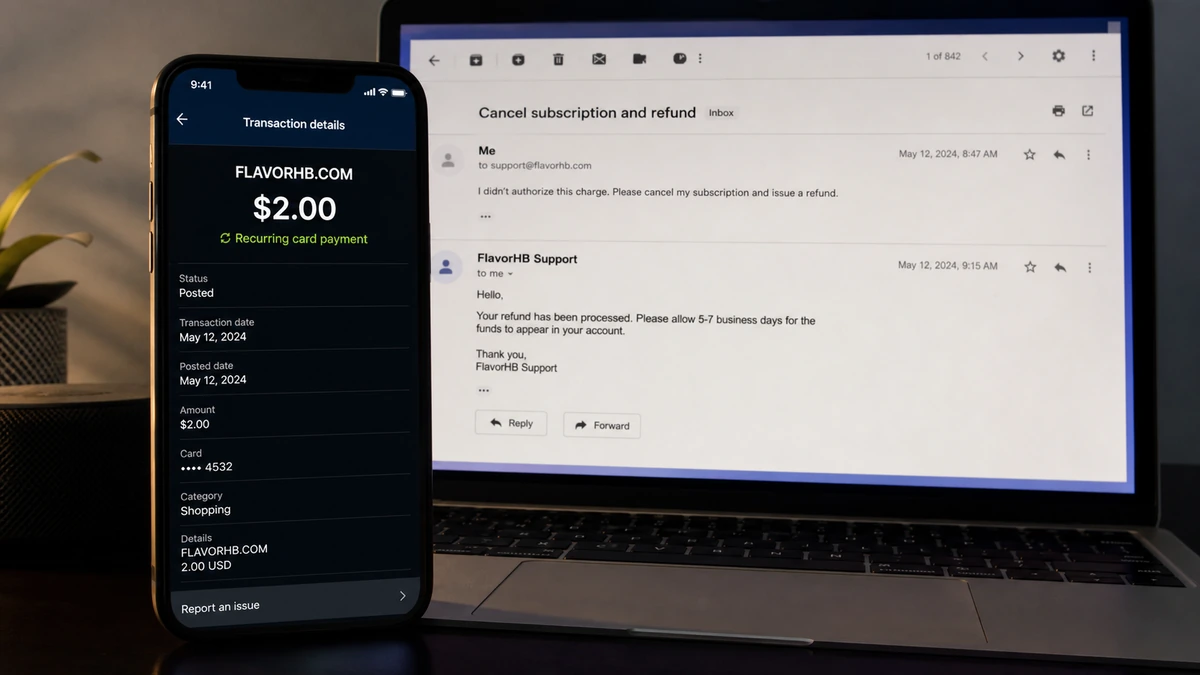
The cardholder said customer support described the service as digital entertainment, claimed to issue a refund, and would not provide the additional corporate information requested.
The report mentions a $2 transaction, while the public FlavorHub site advertises a recipe, ebook, and video membership at $39.99. That mismatch is the most important fact to resolve with the card issuer.
The public terms describe a recurring $39.99 membership
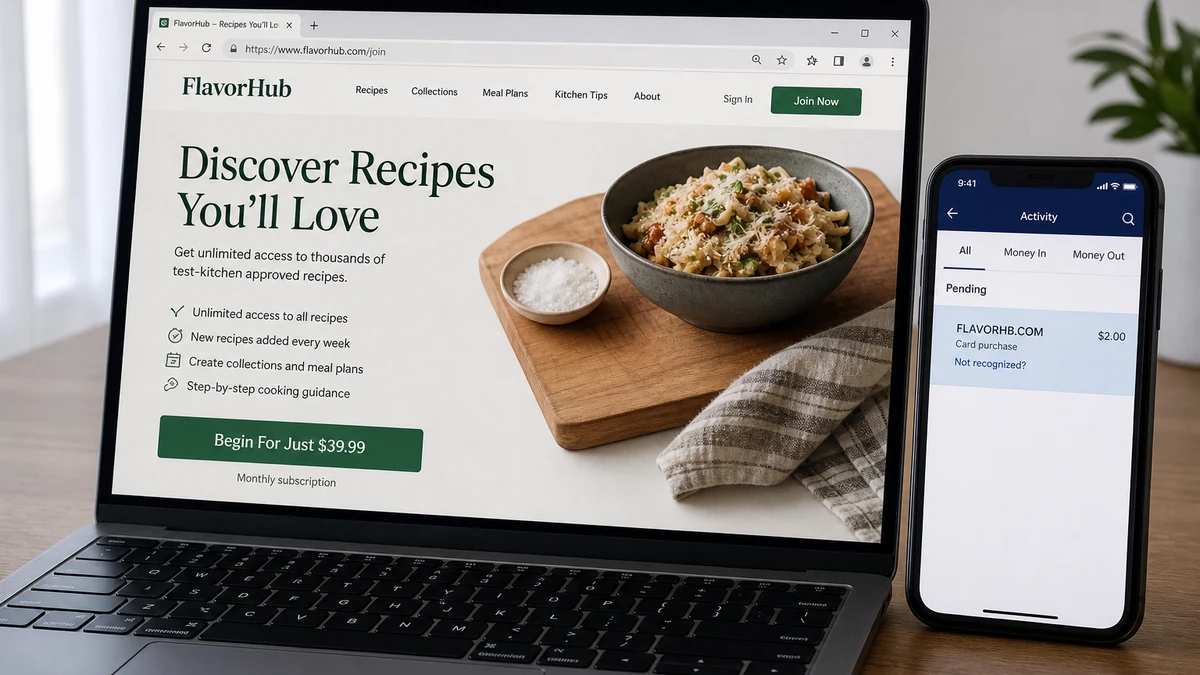
FlavorHub’s homepage says “Begin For Just $39.99.” Its Terms and Conditions identify Razor Gate LLC as the operator and describe a $39.99 monthly subscription that renews every 30 days until canceled.
The same terms say the statement descriptor will appear as flavorhb.com. They also say unsuccessful recurring payments may be retried at a discounted membership rate and may lead to a $3 administrative fee.
The published terms do not explain a standard $2 plan. A small charge could have several causes, but the cardholder should not guess which one applies.
The evidence supports caution, not an automatic verdict
The site is live, displays a price, names an operator, lists a phone number and email, and publishes cancellation and refund pages. Those facts distinguish it from a completely anonymous one-page checkout.
At the same time, an unrecognized charge is serious even when the named merchant has a functioning website. It can result from an accidental enrollment, misleading funnel, stolen card, billing-descriptor confusion, or unauthorized use.
Warning signs and open questions include:
- A cardholder reporting no memory of subscribing to FlavorHub.
- A $2 charge that does not match the site’s advertised $39.99 price.
- A new domain with little independent history.
- A broad “digital entertainment” explanation for a site presented as a recipe library.
- Support allegedly declining to explain the original acquisition path.
- Terms that allow retrying an unsuccessful recurring payment at a discounted rate.
- A residential-looking address that needs corporate verification.
- A refund claim that should be confirmed on the actual card statement.
What We Verified on FlavorHB.com
As checked for this article, FlavorHub markets access to recipes, video tutorials, ebooks, and cooking guides. The public page uses a direct $39.99 call to action rather than advertising a free membership.
The footer lists Razor Gate LLC, 24311 Millsap Drive, Moreno Valley, California 92553, a toll-free support number, an email address, and daily support hours.
The terms state that the $39.99 subscription renews every 30 days. Cancellation is offered through account settings, phone, or email.
The refund policy says requests are reviewed and an approved refund is processed within seven days, although the financial institution may take longer to post it.
The domain was registered on February 27, 2026, according to the public registration data surfaced during our check. A young domain is not proof of fraud, but it limits the amount of long-term customer history available.
Razor Gate LLC also operates its own agency-style website at razorgatellc.com using the same address and a different phone number. Another Razor Gate-branded membership site, ProfitPath, was publicly indexed at the same address.
That network does not prove that the cardholder enrolled. It does show that FlavorHub is part of a broader web operation rather than an isolated page with no named owner.
We did not see a public page that explained the reported $2 amount as a normal FlavorHub price. The card issuer and merchant records are therefore more important than speculation about what the charge “must” mean.
How the FlavorHB $2 Charge Problem Can Unfold
Step 1: Card details enter a checkout somewhere
The starting point may be FlavorHub itself, an affiliate funnel, another site using the same payment ecosystem, an accidental signup, or stolen card data.
Without the card network’s merchant details and the cardholder’s browser or receipt history, the public report cannot establish the exact path.
Step 2: A small transaction tests the payment route
Small charges are sometimes temporary authorizations, retry attempts, discounted billing, or card-testing transactions. The amount alone does not identify which explanation applies.
The danger is psychological: a cardholder may ignore $2 and leave the payment credential active.
Step 3: The descriptor sends the victim to a real-looking site
FLAVORHB.COM is also the descriptor the site’s terms say members should expect. The cardholder can therefore find a polished recipe service when searching the statement.
A functioning website can explain who submitted a charge, but it does not prove the cardholder authorized that charge.
Step 4: Support focuses on cancellation or refund
A merchant may offer to cancel and refund rather than explain how the account was opened. That can resolve the immediate amount while leaving the acquisition question unanswered.
Keep the support case number, exact cancellation wording, date, and promised refund time.
Step 5: A recurring plan may remain active
If an account exists under the cardholder’s details, stopping one charge is not always the same as canceling the underlying subscription.
The user should obtain written confirmation that the membership is closed and no future recurring charge will be submitted.
Step 6: Card-updater services can follow a replacement card
Card networks offer updater services that can provide participating merchants with new card credentials after a replacement. That is convenient for genuine subscriptions but frustrating when a disputed recurring merchant follows the new card.
Ask the issuer whether it can block the specific merchant token or recurring agreement, not merely replace the plastic card.
Step 7: The victim must choose between a merchant dispute and fraud claim
If the cardholder knowingly enrolled but disputes cancellation or disclosure, the issuer may treat it as a merchant dispute. If the cardholder never authorized the transaction, it may be handled as fraud.
Describe the facts accurately. Do not claim card theft if the real issue was a misunderstood trial, and do not accept “subscription” as proof of consent if no enrollment occurred.
Why the Amount Mismatch Deserves an Answer
FlavorHB’s public page advertises access for $39.99, and its terms describe renewal every 30 days. The reported card transaction was only $2. Those facts do not explain each other without additional evidence from the merchant or issuer.
A small amount can be a temporary authorization, a discounted retry, a separate service, or an unauthorized card test. The transaction status and merchant data held by the issuer can help distinguish those possibilities.
The site’s terms say an unsuccessful recurring payment may be retried at a discounted rate and may involve a $3 administrative fee. That language is worth noting, but it still does not prove why one particular card showed $2.
Support should be able to identify the account, enrollment date, checkout source, consent record, service delivered, and reason for the exact amount. A generic promise to refund is not a substitute for those details.
The cardholder should not create a new account or submit more personal data merely to investigate. Start with the issuer’s merchant information and contact the merchant through details independently found on its public site.
If the merchant claims a refund, verify it on the statement. A cancellation email, support ticket, or pending credit is useful evidence, but the account is not financially resolved until the credit posts and recurring billing is stopped.
Questions That Separate a Billing Error From an Unauthorized Charge
Ask the issuer whether the transaction is pending or posted, whether the merchant attempted other amounts, and whether a recurring-payment indicator is attached. The bank may see details that are not displayed in the consumer app.
Ask the merchant for the email address and timestamp associated with enrollment without first volunteering every possible address. If no account can be located, preserve that response for the dispute.
Ask whether any product was accessed. FlavorHB describes digital recipes, videos, and ebooks, so access logs should exist if a membership was genuinely used. Absence of use does not by itself prove fraud, but it helps document the case.
Finally, ask the issuer which route preserves your rights: a merchant dispute for a misunderstood subscription or a fraud claim for a transaction you never authorized. The truthful answer matters because the investigation and card-replacement steps may differ.
Why a $2 Charge Should Not Be Ignored
Fraud teams often use transaction size, merchant category, location, and account history to decide whether a charge is suspicious. A cardholder sees only part of that picture.
A small amount can be a probe before larger spending. It can also be the first visible sign of a recurring agreement the customer did not understand or authorize.
FlavorHub’s advertised membership is $39.99 monthly. If the $2 transaction is connected to an account on the site, the financial question is not limited to $2.
The site’s terms also contain a provision allowing a discounted membership rate after an unsuccessful recurring payment. That makes it important to ask whether the small amount was tied to an attempted recurring charge.
Do not rely on a pending transaction disappearing. Some authorizations fall away; others settle later under a slightly different amount or descriptor.
Take a screenshot of the pending charge, then check the posted transaction. The posted entry may reveal a merchant phone number, location, category, recurring indicator, or dispute link.
This resembles the early-warning logic in the Cash App and Facebook card-testing report: a small event matters because it can reveal an active payment credential.
How to Investigate the Charge Without Creating More Risk
Start inside the bank or card issuer’s official app. Open the transaction details and record the full descriptor, date, amount, currency, status, merchant category, and listed contact information.
Search your email for flavorhb, FlavorHub, Razor Gate, recipe membership, welcome, receipt, cancellation, and the last four digits of the card. Check spam and trash as well.
Review browser history around the transaction date. Affiliate funnels may use a different brand during the ad or checkout, while the final statement shows the legal merchant descriptor.
Do not type card details into a “lookup” page reached from an ad or search result. Use the merchant’s public homepage only, and do not create a new account merely to investigate an old charge.
If you contact FlavorHub, ask for the enrollment date, email attached to the account, IP or device record if available, checkout source, amount schedule, and written cancellation confirmation. Do not send a full card number by email.
Confirm a promised refund on the statement. A support email saying “refunded” is not the same as money posted back to the account.
If you never authorized the charge, call the number on the back of the card. Ask whether the issuer sees a recurring-payment flag, card-on-file token, or other merchant identifiers.
The FTC’s subscription guidance recommends disputing charges that were made without consent when the company does not resolve them.
Subscription Terms Worth Reading Closely
The main price is straightforward on the current homepage: $39.99. The recurring nature appears in the terms and in smaller wording around the membership process.
Users should understand when billing begins, whether the first payment is refundable, how cancellation affects the current period, and whether any retry or reduced-rate charge may be attempted.
FlavorHub says cancellation can be made in account settings, by phone, or by email. Use a route that creates evidence, such as a saved confirmation page or sent email.
The refund policy says cancellation does not automatically guarantee a refund. A customer seeking both cancellation and money back should request each one explicitly.
Keep a copy of the terms that applied on the transaction date. Policies can change, and the current page may not match the checkout the cardholder saw.
Watch statements after cancellation. Other MalwareTips investigations, including the Flix Stick monthly-fee case, show why the merchant descriptor and recurring amount matter more than the marketing headline.
If the card was used for a different online offer shortly before the charge, tell the issuer. The link between brands may exist only in payment records unavailable to the public.
Company, Address, and Fulfillment Checks
Razor Gate LLC is named as the operator
FlavorHub’s terms and privacy policy identify Razor Gate LLC as owner and operator. The Razor Gate website uses the same name and address.
This is more disclosure than an anonymous checkout provides, but cardholders should still verify that the entity matches the transaction records.
The listed address appears residential
The public pages list 24311 Millsap Drive, Moreno Valley, California 92553. The cardholder said public property records made the location look like a family home.
A home-based business is not inherently illegitimate. An address is a verification clue, not proof that residents personally handled a disputed charge.
The domain and support trail are recent
Flavorhb.com was registered in February 2026 and had limited independent history at the time of our check. The site publishes a toll-free number, email, privacy policy, terms, and refund policy.
That contact trail should be compared with the merchant details supplied by the card issuer.
Fulfillment is digital, not physical
The service promises digital recipes, videos, ebooks, and guides. There is no parcel, warehouse, shipping record, or return address to confirm.
For digital fulfillment, the key evidence is account creation, login history, welcome email, content access, consent record, and billing confirmation.
What to Do if You Have Fallen Victim to This Scam
- Lock the card temporarily. Use the issuer’s official app while you investigate.
- Save the transaction details. Record the full descriptor, amount, date, status, and merchant information.
- Search for enrollment evidence. Check email, spam, browser history, password manager, and receipts.
- Cancel any identified FlavorHub membership. Request written confirmation that recurring billing has ended.
- Verify the refund. Watch the statement until the credit actually posts.
- Tell the issuer whether the charge was unauthorized. Ask about a fraud claim or merchant dispute based on the facts.
- Block the recurring merchant token if necessary. Ask whether replacing the card alone will stop account-updater billing.
- Review nearby transactions. Look for other small tests or unfamiliar subscription descriptors.
- Change reused passwords. Protect the email and any account connected to the checkout.
- Report unresolved unauthorized billing. In the United States, use ReportFraud.ftc.gov and the state consumer-protection office.
- Run a Malwarebytes scan. This is appropriate if the original signup came through a suspicious ad, download, or browser redirect.
- Use AdGuard after cleanup. It can reduce exposure to deceptive ad funnels, but it cannot cancel a recurring card agreement.
- Avoid recovery services. No outside “card tracing” company needs an upfront fee to dispute a transaction.
Frequently Asked Questions
Is FlavorHB definitely a scam?
The public evidence does not justify that absolute conclusion. The verified concern is an unrecognized $2 charge reported by one cardholder and a $39.99 recurring service that needs authorization confirmed.
What does FlavorHB say it sells?
It markets a digital membership for recipes, video tutorials, ebooks, and cooking guides.
Why was the charge only $2?
The public report and current site do not establish the reason. Ask the card issuer and merchant whether it was an authorization, retry, discounted billing attempt, or unauthorized transaction.
Who operates FlavorHB?
The site’s legal pages identify Razor Gate LLC and list a Moreno Valley, California address.
Will replacing my card stop the subscription?
Not always. Ask the issuer to block the merchant’s recurring agreement or token and whether an automatic card-updater service applies.
What if support says the charge was refunded?
Keep the message, note the promised timing, and verify that the credit posts. Contact the issuer if it does not arrive.
The Bottom Line
The FlavorHB $2 charge is not something to wave away simply because it is small. The descriptor points to a real $39.99 monthly recipe membership, while the reported amount and claimed enrollment remain unexplained.
Treat the transaction as an evidence problem. Confirm whether an account exists, cancel any recurring agreement, verify the refund, and let the card issuer decide the correct dispute path if you never authorized the charge.








