


Someone you know introduces an investment app, shows growing returns, and says your money could double within weeks. The balance on the screen makes the pitch tangible.
Then you try to take money out. The FQL investment and VG app case matters because the withdrawal request, not the attractive dashboard, reveals the real problem.
Overview
This is the Tamil Nadu FQL and VG investment case
The reported investigation names FQL Investment Trading, FQL Exchange App, and VG Investment Group Syndicate. It concerns an alleged app-based investment operation, not every business using FQL.
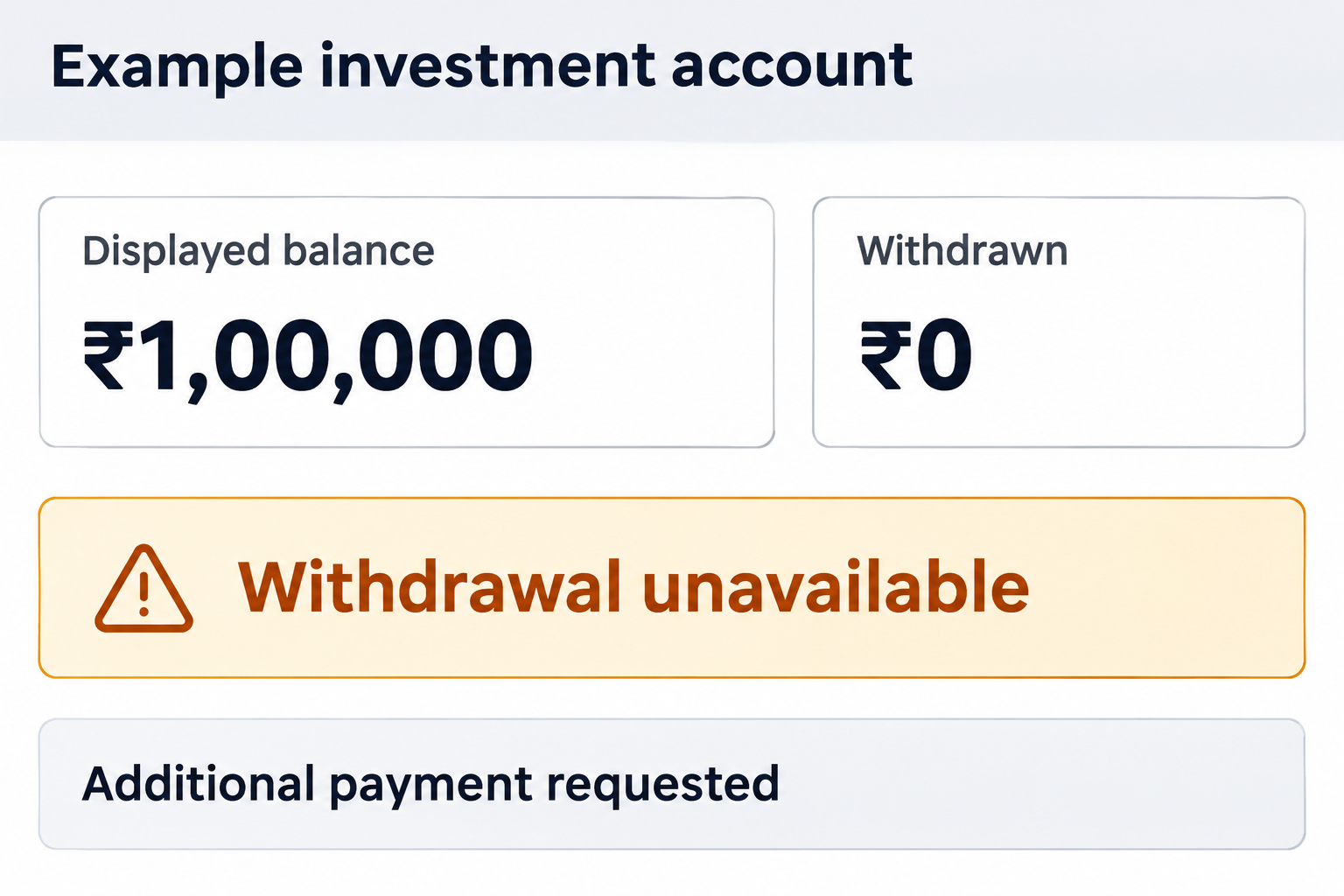
The illustration above is a fictional example, not a captured FQL interface. Its amounts are examples, not a victim’s loss or an official case total.
The relevant identity is the offer you received, its app, the person promoting it, and the recipient of your payment. A similar name alone proves little.
Police allegations go beyond ordinary investment losses
The allegations concern unusually fast returns, withdrawal failures, inaccessible balances, and requests for additional money. These are not merely complaints that cryptocurrency prices fell.
The police case supplies strong reasons not to deposit. It does not permit treating each accused person as convicted or announcing a guaranteed compensation program.
Your next decision should not require another payment
- Do not invest in this offer to test whether withdrawals work.
- Do not pay a release, activation, or supposed recovery fee to access an existing balance.
- Preserve the exact app details, payment records, and messages before accounts or groups disappear.
- Contact the financial provider that handled your transfer, then use verified police reporting channels.
- Keep deposited money, money actually received, and displayed profits separate in your records.
You do not need a final courtroom decision before refusing an investment with unresolved access to funds. Protecting your remaining money comes first.
What Was Reported About the FQL Investigation?
A September 1, 2026 NDTV report by J Sam Daniel Stalin described a Tamil Nadu police statement about the operation.
It reported six cases transferred to the Economic Offences Wing, covering Madurai, Dindigul, Virudhunagar, and Sivagangai. The stated pitch included doubling investments within 40–45 days.
Police preliminarily alleged cash and G-Pay/UPI collections, with some funds converted into Tether, or USDT. Withdrawals reportedly failed and further payments were demanded.
Reporting the same police statement, PTI’s August 31 dispatch recorded 17 arrests and 13 frozen bank accounts. These are dated figures, not a current running total.
Crucially, the police statement did not state a final loss amount. Estimates from different reports should not be added together or presented as audited losses.
A later October 4 report described detention orders against two accused already in custody. Detention is not a criminal conviction or a repayment announcement.
For someone affected, the distinction is practical: an investigation can examine where money went, but it does not make a dashboard balance immediately payable.
A frozen bank account is also not your personal refund account. Ownership of funds and any lawful return process still need to be established.
How the Reported FQL Investment Pitch Worked
Step 1: An introduction makes the offer feel local
The reported agent-driven approach puts a familiar person between the investor and the app. That can make questioning the investment feel like questioning a relationship.
Separate those two decisions. A relative can sincerely believe a pitch without having inspected the operator’s accounts, custody arrangements, or ability to repay everyone.
Ask what the person actually knows. Did they receive a transfer into their own bank account, or are they showing a balance inside the app?
Those are different forms of evidence. Neither a confident explanation nor a crowded messaging group replaces independent information about who is holding the money.
If you introduced others, stop forwarding the offer. Tell them about the withdrawal concerns without promising you can recover their payments or speaking for investigators.
Step 2: A short doubling deadline crowds out risk
A promise to double capital in roughly six weeks makes waiting seem expensive. You may feel that every day spent checking is a day of missed earnings.
But a stated return is a promise, not a source of profit. The explanation must connect money paid in with independently understandable activity and genuine withdrawal rights.
Cryptocurrency terminology does not fill that gap. Naming a token or exchange cannot demonstrate that a particular operator traded successfully, controls sufficient assets, or owes you a payout.
Do not borrow, pledge household assets, or send a larger amount because an app displays a profitable example. The possible loss is your actual payment.
Step 3: The payment record becomes more important than the logo
Once money leaves your bank or wallet, the useful trail is the transfer itself. Save the transaction reference and beneficiary details, not only the investment’s name.
An agent may describe a payment as a deposit while the receiving account uses another name. Record both descriptions rather than silently treating them as identical.
If you paid cash, preserve receipts and messages acknowledging receipt. Write down when, where, and to whom it was handed over while the details remain clear.
For a cryptocurrency transfer, retain the network, destination address, transaction hash, amount, and time. A wallet address by itself does not identify its legal controller.
Use your own bank or exchange history to verify these details. Do not ask a promoter to generate the only record of what happened to your money.
Step 4: The displayed return distracts from money actually received
An investment app can display a deposit, profit, referral reward, or pending withdrawal. Those labels do not tell you whether funds are available outside the platform.
Build a simple personal ledger with three columns: payments sent, withdrawals actually received, and amounts merely displayed. Keep the dates and supporting records beside each entry.
Do not count a pending request as a successful withdrawal. Check whether the claimed payment appears in the receiving account you control.
Likewise, an early payout cannot demonstrate that every later balance is backed. It should not become a reason to increase your exposure after access problems emerge.
If a balance changes to zero, capture that change and any explanation already available. Do not make another deposit simply to recreate the former display.
Step 5: Getting out becomes a request to put more in
The most important stop signal is a demand for new money before existing funds can be released. Renaming that demand does not solve the withdrawal problem.
A claimed tax, account upgrade, verification deposit, or settlement charge needs independent verification. Do not accept the requester as the authority for its own payment demand.
If someone proposes moving your balance into another app, ask whether that requires a new transfer. A displayed migration can conceal a second financial decision.
Do not follow a fresh link or install a replacement app to preserve supposed eligibility. Keep the proposal as evidence and raise it through your existing reporting route.
If your agent makes one of these demands, save its exact wording. Do not assume another participant received an identical request.
Which App, Agent, and Payment Recipient Are Involved?
FQL and VG names do not supply a complete company identity
The names are linked in the reported police investigation. That does not establish a verified corporate structure, current official website, or licensed exchange behind every similar search result.
Do not choose a supposed support site merely because its initials match. Look for identifiers tied to your original installation, transaction, and correspondence.
Keep the app’s full name, version, installation source, and any publisher information already recorded. Do not download another copy to obtain details for a complaint.
The person who introduced you is part of the timeline
Save the promoter’s messages, payment instructions, and promises in their original context. Distinguish what you personally heard from what another participant later reported.
An introduction alone does not prove criminal responsibility. Investigators need evidence of each person’s actions, not a public list declaring every participant guilty.
Keep conversations civil and preserve records. Threats or public exposure of private details can create additional harm without returning the original investment.
The receiving account needs its own record
A bank beneficiary, UPI identifier, agent, app publisher, and cryptocurrency address can represent different parts of a payment journey. Do not collapse them into one guessed owner.
Give the financial provider the exact recipient shown in its system. Give investigators the accompanying explanation that connected that payment with the investment.
If several transfers used different recipients, list them individually. A single rounded total can hide the references needed to trace each transaction.
A new support identity is not proof of a rescue
A message claiming to represent an administrator, investigator, or replacement platform should be checked outside that conversation. Knowing the app’s name does not authenticate the sender.
MalwareTips has covered fake police-backed recovery advertisements. That is a separate documented pattern, not evidence that a specific new FQL message came from those advertisers.
Contact your established reporting office using independently obtained details. Do not send identity documents, bank credentials, or wallet secrets to a stranger offering preferential recovery.
What to Do If You Paid an FQL or VG Investment Offer
-
Stop sending money and pause referrals.
Do not pay a fee to restart withdrawals or test a replacement service. Tell anyone you introduced that you cannot verify the offer’s repayment claims.
Do not promise a deadline for returns on another person’s behalf. Keep future decisions separate from the amount already committed.
-
Contact the bank or payment provider promptly.
Use the genuine bank app, its published fraud channel, or the number on your card. Describe the investment representation and identify each relevant transfer.
Ask what action remains possible, what records are required, and which time limits apply. Keep the complaint number and the response.
Be accurate about authorization. If you personally approved a payment after a misleading pitch, explain that instead of reporting that your phone acted without permission.
Do not assume an investment loss receives the same treatment as a failed technical payment. Let the provider explain the process applicable to your transaction.
-
Use India’s established cybercrime reporting channels.
For financial cyber fraud in India, call 1930 and use the National Cyber Crime Reporting Portal. Follow the official instructions and retain the acknowledgment.
The Ministry of Home Affairs describes these reporting channels and coordination with financial institutions. Reporting is assistance, not a promise that every payment will be recovered.
If you already reported locally, provide that reference and ask how new evidence should be added.
Outside India, contact your own police and financial-fraud reporting services as well. A foreign app or recipient does not make your local payment record irrelevant.
-
Prepare a concise evidence packet.
Include your chronology, transaction references, recipients, app identifiers, withdrawal attempts, fee demands, and relevant conversations. Keep original files and an additional backup.
Label screenshots with what they show, not what you hope they prove. A dashboard balance, a bank transfer, and a promoter’s claim are different records.
Send sensitive documents through the official submission process. Redact identity numbers, account details, and private correspondence before sharing a warning publicly.
-
Preserve account access and protect exposed credentials.
If you reused an investment-app password elsewhere, replace those reused passwords through the genuine services. Use a trusted device if someone obtained remote access.
Tell your bank about any authentication codes, account credentials, or remote access you disclosed. Do not approve another request described as a refund verification.
A police report does not itself change passwords or end account sessions. Follow the affected provider’s security instructions separately.
-
Refuse anyone selling guaranteed recovery.
Reject demands for advance crypto payments, wallet deposits, or a place on an alleged refund list. Verify any claimed official appointment through the actual agency.
If a genuine professional is needed, select and verify that person independently. An unsolicited contact should not become the gatekeeper to your existing police complaint.
Keep a later recovery demand separate from the original investment in your records. That helps explain a second approach without confusing the first payment trail.
Frequently Asked Questions
Is FQL Investment a legitimate crypto exchange?
Do not treat this reported operation as a safe place to invest. The police allegations and withdrawal concerns justify refusing further deposits without declaring individual suspects convicted.
Are FQL and VG Investment the same company?
Both names appear in the reported investigation. That establishes a case connection, not a complete verified legal ownership map or a current official support domain.
Does the balance in my app prove what I can recover?
No. Preserve the display, but distinguish actual payments and received withdrawals from advertised profits. Investigators and providers need the underlying transaction records.
Should I pay a fee to release my FQL balance?
No. Do not send additional money because an agent or app says it will unlock existing funds. Preserve the demand and consult your established reporting channel.
Do the arrests and frozen accounts guarantee refunds?
No. Those are reported investigative actions at a stated date. They do not establish your individual entitlement, available assets, distribution schedule, or eventual recovery amount.
How should someone in India report an FQL payment?
Contact the payment provider promptly, call 1930, and use cybercrime.gov.in. Keep acknowledgments and supply accurate transfer details through the official process.
The Bottom Line
Do not deposit into the reported FQL investment or VG app offer, and do not pay to unlock a balance. Attractive numbers do not resolve inaccessible money.
If you already paid, preserve the payment trail, contact your provider, and use verified reporting channels. Pursue the actual transaction, not another promise of guaranteed recovery.

Join the discussion
0 commentsShare your experience or ask a question about this article.
Discussion
Start the conversation
Have a question or something useful to share? Add the first comment.