


The page looks like it belongs to a company that ships food around the world. Then you notice the buttons for deposits, withdrawals and inviting friends.
If someone sent you the Cargill app link, you might recognize the name before you recognize what the page wants you to do.
Overview
A food company’s logo on an investment screen
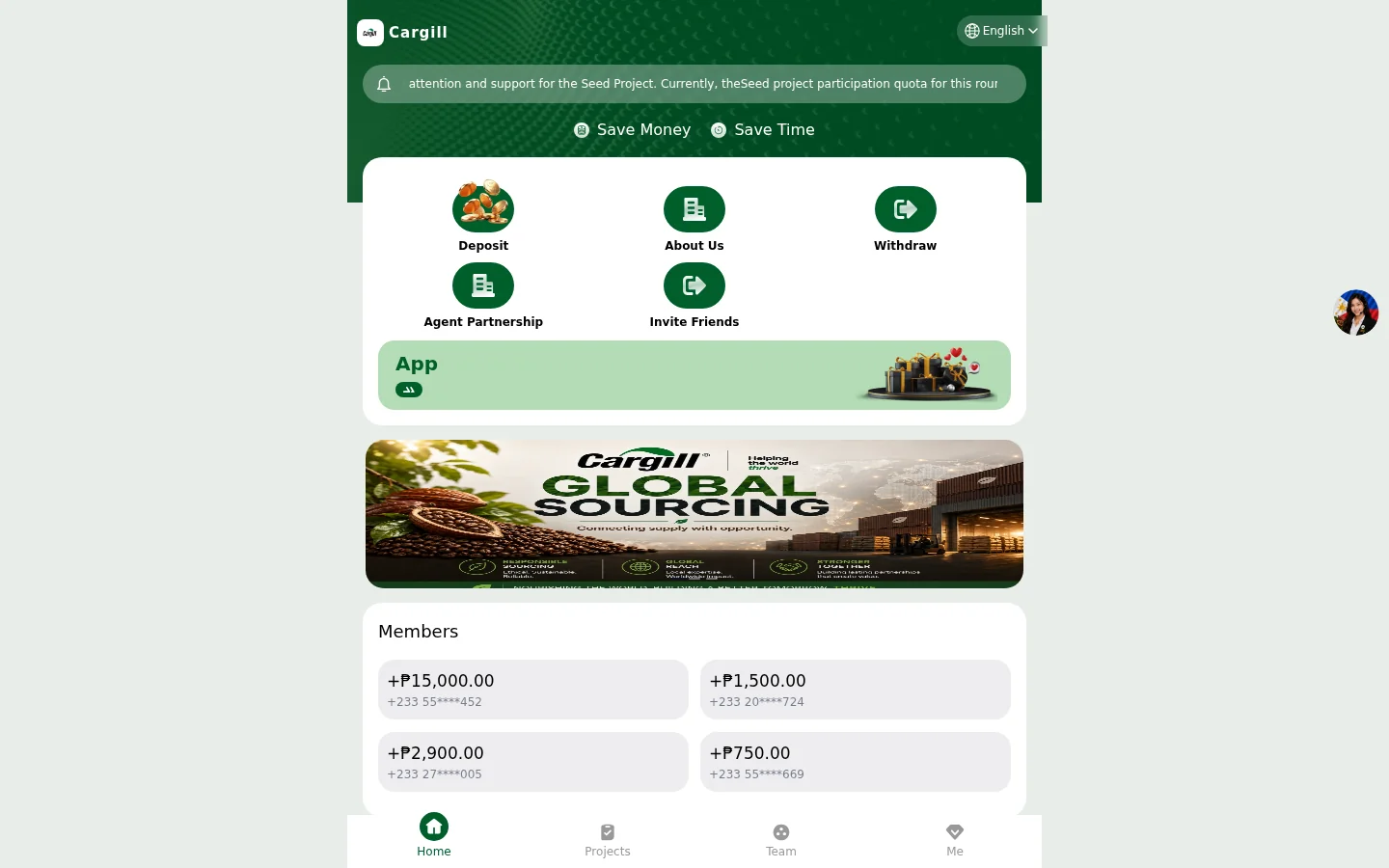
A site at fbkkk[.]com presents itself as Cargill. Its homepage puts Cargill Global Sourcing artwork next to a menu for deposits, projects, withdrawals and invitations.
The same sourcing artwork appears behind an invitation offer at fincfinc[.]com. The two addresses present similar pitches, but an image match does not identify who controls them.
The real Cargill describes a business that works across agriculture, food and related industries. Its corporate material does not authenticate either of these two investment addresses.
That distinction matters even if a search for Cargill returns a legitimate company. You are checking whether that company operates the page asking for money, not whether the name exists.
What you can see without paying
Three parts of the pitch are visible before a reader needs to create an account. Each answers a different question about what the page is selling.
- The projects menu shows that the page offers something beyond corporate information. A menu does not disclose what a buyer owns after paying.
- The deposits and withdrawals menu suggests a marketplace for moving funds. It does not confirm the recipient or prove the withdrawal feature works.
- The invitation rewards are tied to other people putting money in. They are not described as a commission on cocoa you sell to a customer.
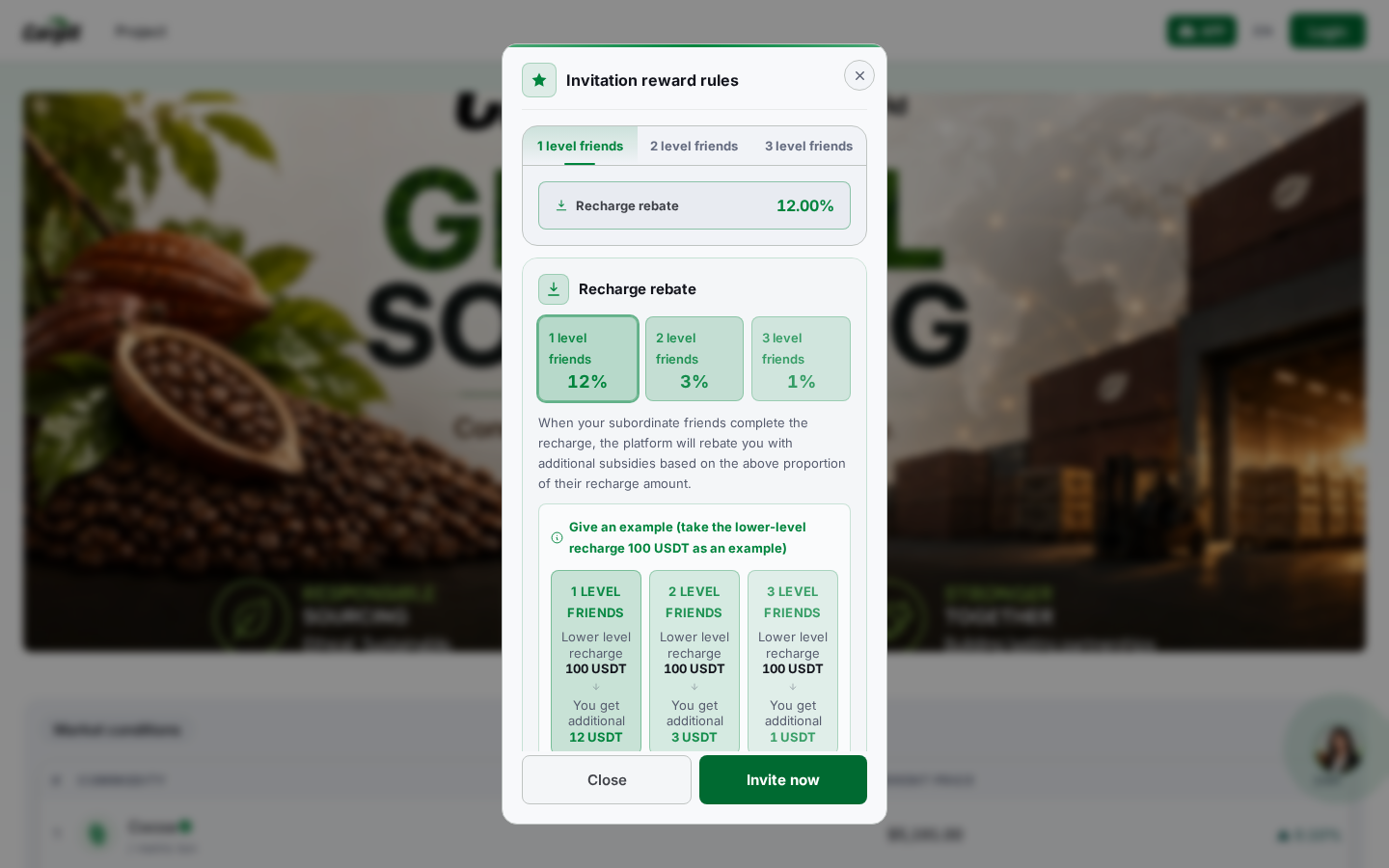
The second site’s public invitation window shows 12%, 3% and 1% across three referral levels. It explicitly uses the recruited person’s recharge to calculate an example.
That is a sharper warning than the unfamiliar address alone. The page puts a price on bringing someone else’s money into a system whose operator is unclear.
The feed is not an independent payout record
The fbkkk[.]com homepage displays a Members panel with positive amounts in Philippine pesos and partly masked phone numbers. There is no transaction receipt attached to those figures.
The displayed numbers begin with +233, which is Ghana’s country calling code. That combination does not tell you where anyone lives or where the operation is based.
What it does show is that the page combines different regional cues. Neither the currency nor the phone prefix establishes that real members received those amounts.
A feed entry cannot tell you whether an amount was a deposit, a real payout or a number displayed for effect. Check what reached an account outside the platform.
How the Cargill Investment App Scam Works
Step 1: The name makes the invitation look familiar
Imagine someone says they found a way to put money into an established agricultural business. When the first page shows familiar branding, the proposal can sound plausible.
The Global Sourcing banner uses the language of cocoa, warehouses and trade. It gives the project a real-world setting without providing a contract for a real-world transaction.
Do not try to verify the invitation by searching only the brand name. Copy the domain as text and compare it separately with the company’s own site.
A copied mark is designed to survive a quick glance. What it cannot supply is a confirmation from the genuine company that the recruiter, website or account represents it.
Step 2: The deposit becomes a project contribution
The public menus describe money going in and out, while the homepage mentions a Seed project. The agricultural wording is part of the offer’s presentation.
BehindMLM documented project tiers with advertised daily returns, including versions pitched in Nigeria and the Philippines. That report is not a contract stating what every account receives today.
Do not assume you are buying cocoa or funding a shipment because the banner shows beans and containers. A transaction should identify the seller and what you receive.
Nor should you assume an amount displayed with a national currency means that country has approved the offer. Websites can show local prices without holding local authorization.
Step 3: The screen gives you something easy to check every day
Reports on the offer describe a daily button that participants use to qualify for earnings. Pressing a button does not make an investment produce revenue.
There is a difference between an activity rule and a business result. A site can require a daily action and still show a number it controls entirely.
A shipment would leave documents and a counterparty you could verify. The activity reported here tells you what the participant is supposed to do inside the app.
Neither a screen balance nor a countdown shows what funded the balance. No trades, commodity purchases or withdrawal were performed to test the app’s claims.
Step 4: Inviting someone else can increase the advertised reward
On fincfinc[.]com, the public invitation example starts with 100 USDT being added by someone in the referral chain. It shows 12, 3 or 1 USDT for different levels.
The relevant condition is that another person adds money. The illustration does not say the reward comes from a shipment, a customer invoice or a settled commodities trade.
Older reporting lists 10% for the direct referral level. The page captured here says 12%, so do not assume a chart forwarded in a chat is the current offer.
Look at the transaction, not what the button is called. Whether an invitation is framed as helping a friend or joining a team, the example rewards a deposit.
Step 5: A withdrawal request tests something the sales page cannot establish
You may meet someone who says they received a payment. Even a genuine early transfer would show one transaction, not a reliable business capable of paying everyone.
If you are asked to add funds first, stop. The Philippine SEC describes recharge demands in tasking scams as a way to get more money after apparent earnings.
That advisory explains the wider pattern, not a fee verified on these two pages. An unlock request deserves scrutiny even if no such charge appeared in the public menu.
Who Takes the Money Behind the Cargill Branding?
The logo and the deposit recipient are different checks
If you already sent a payment, the bank or wallet receipt is more useful than the lobby. It shows the receiving party or the address used.
If two transfers show different recipients, save each record. The details you submit should identify where the money went, not how the promoter described the account.
A bank descriptor can show a processor or account holder without naming the ultimate operator. Ask your provider what record it can supply rather than guessing from an abbreviation.
The genuine company has a fraud notice page for suspicious offers. Its general advice is useful, but it does not name these investment sites.
Warehouses in a banner do not identify an office
The warehouse and food photography are visual cues. They do not identify a company address where you can serve a complaint, inspect a shipment or request money back.
Look for the legal name that signed the agreement and an independently verifiable address. A website address is not a replacement for a responsible entity.
Separate where the payment was received from where the promoter claims to be located. A mobile prefix, national flag or preferred currency is not evidence of the operator’s location.
A messenger avatar is not an independent help desk
Do not take a support address from a person urging you to buy another project. Use the bank or wallet app that you already know to be legitimate.
If you want to report the apparent branding misuse to Cargill, navigate there yourself. Do not attach an unredacted bank statement to a public post or contact form.
For your report, distinguish the handle that recruited you from the one that replied about a withdrawal. Save the full messages privately without continuing the conversation.
What would link a project to real agricultural revenue?
Look for who buys and sells the goods, what you own, how the revenue is calculated and who verifies it. Nothing about a sourcing photograph answers those questions.
Nigeria’s SEC warns about unregistered online investment schemes and directs readers to its registers. Search the exact legal operator, not the name on a borrowed banner.
That public warning is not a naming of either site. It explains why you need to identify the entity before a licensing claim can be checked at all.
What to Do if You Have Fallen Victim to This Scam
- Stop transfers and do not recruit anyone else. Save the pitch and the page you saw. Tell people you invited not to make a deposit.
- Raise the issue with the service that sent your money. Use its official support channel and ask urgently whether it can stop or trace the transfer.
- Keep evidence in the currency used for each payment. Record the date, amount, recipient and reference. Do not combine pesos, naira and USDT into an unexplained total.
- Change any app password you also used elsewhere. Start with email if it used that password. Sign out unfamiliar sessions and turn on two-step verification.
- Report any request to pay for a release. Keep the new quote, date and destination with your original evidence. Decline anyone who demands advance payment to recover it.
- Report both the solicitation and the payment when relevant. The securities regulator needs the pitch; the bank, wallet provider or police also need the actual transfer record.
How to Report a Payment Without Losing the Trail
If you used a bank transfer or e-wallet, open the account’s transaction history. Note whether the payment says pending, completed or reversed before asking it to investigate.
Say that you authorized the transfer but believe the investment was misrepresented, if that is what happened. If someone accessed your account without permission, report that separately.
For a regulated Philippine provider, complain to it first and get a reference. If it remains unresolved, the BSP’s assistance page explains how to escalate through BSP Online Buddy.
On the BSP site, open the Online Buddy chat and follow its complaint prompts for the financial institution. Keep any acknowledgement with your provider’s first reference.
If you transferred USDT, open the exchange or wallet history and copy the transaction ID, network and public recipient address. A screenshot of your balance will not identify the transfer.
Never reveal a seed phrase, private key or one-time code to someone who offers to trace your money. Those details are not required to identify a public transfer.
If you used an exchange, ask its support team whether the destination can be flagged. A confirmed blockchain transfer generally cannot be reversed by the sender.
If the wallet shows several references, the on-chain transaction ID is separate from the exchange’s internal order number. Keep both so support can match the records.
If you received anything back, save where it came from and when. Do not subtract a fictitious dashboard balance when you are documenting what you actually lost.
If the same person sends a different website later, record the new link without signing in. A changed address does not settle a withdrawal request from the earlier account.
For your bank’s investigation, save the app’s screenshots next to the corresponding real transfers. The dates make it easier to tell an original charge from a later recovery demand.
If you only saw the site, there is no payment to dispute. You can report the invitation where it arrived and block the person who sent it.
Frequently Asked Questions
Is the Cargill investment app run by the real Cargill?
Do not treat either of the two addresses as an official Cargill investment service. The trading name and images do not connect their deposits to the genuine company.
What does a recharge mean on the invitation screen?
The example uses it to mean money added by someone in the referral chain. It does not show a delivery, completed sale or share of an agricultural business.
What does the 12% invitation reward apply to?
The public example applies 12% to a direct referral’s recharge. Rates shown for the second and third levels are lower, at 3% and 1% respectively.
Are the Members entries proof that someone withdrew money?
The page does not show a bank or blockchain record for those entries. A positive number next to a partially masked phone number cannot verify a payout.
Can a recruiter prove legitimacy by sending a payment screenshot?
A screenshot is not proof that the real Cargill endorses the offer, even if the transfer was real. Verify the company and the specific activity separately.
Should I pay a charge to unlock a withdrawal?
Do not pay an additional charge demanded in a chat. Save the demand, then contact the bank, wallet or exchange that processed your original payment.
The Bottom Line
Do not put money into the Cargill-branded investment app. The sites borrow a familiar name and offer rewards for bringing in deposits without identifying a verifiable agricultural investment.
If you paid, stop sending money and contact the provider you used. Give it the actual transaction references rather than relying on the balance shown by the app.

Join the discussion
0 commentsShare your experience or ask a question about this article.
Community experiences
Did this happen to you?
Your experience could help someone recognize the same scam. Submit a private report for our team to review.
I experienced this tooReports are reviewed before publication. Sharing publicly is always your choice.
Discussion
Start the conversation
Have a question or something useful to share? Add the first comment.