

The Fuelify Card is being pushed online as a simple way to cut fuel costs without tools, tuning, or mechanical work. According to the ads, you just stick a small card inside your vehicle’s fuel door and it somehow improves combustion, boosts gas mileage, and saves money on every drive.
That pitch is attractive for an obvious reason. Fuel costs are a real pressure point for millions of drivers, and any product that promises easy relief is going to get attention. The problem is that easy savings claims often come wrapped in misleading marketing, fake urgency, and technical language that sounds impressive but falls apart under scrutiny.
In this article, we will take a close look at how the Fuelify Card is sold, why the claims do not hold up, what warning signs appear throughout the sales funnel, and what you should do if you already ordered one. If you are wondering whether Fuelify Card is legit, this breakdown will help you separate the sales story from reality.
Scam Overview
What Fuelify Card claims to be
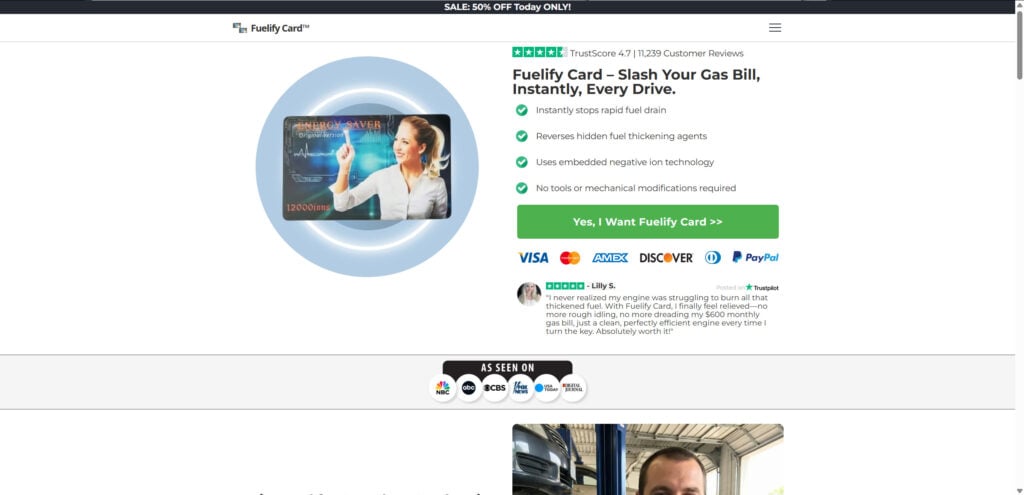
Fuelify Card is advertised as a compact “energy saver” card that sticks inside your vehicle’s fuel door. The marketing claims it can instantly reduce fuel waste, improve mileage, smooth out engine performance, and help your tank last much longer.
The product page uses bold claims that sound both technical and convenient. It says the card stops rapid fuel drain, reverses hidden fuel thickening agents, uses embedded negative ion technology, and works without any tools or modifications. That combination is not accidental.
It is designed to appeal to people who want a high-tech solution without having to understand how it works.
The message is simple: this is not just a sticker or a gadget, it is a secret automotive breakthrough that experts supposedly know about and ordinary drivers are only now discovering.
That framing is one of the first major red flags.
The claims sound scientific, but they are not supported
A common pattern in product scams is the use of technical words without credible proof. Fuelify Card does this repeatedly.
Terms like “negative ions,” “molecular fuel smoothing,” “complete combustion,” “fuel thickening agents,” and “instant restoration of natural fuel efficiency” are sprinkled throughout the marketing. These phrases sound advanced enough to impress a buyer who is not an auto engineer, but the sales material does not provide real scientific evidence behind them.
There are no published test results.
There are no independent lab reports.
There are no reputable engineering evaluations.
There are no links to automotive research institutions validating the product.
Instead, the page relies on broad promises and vague pseudo-scientific language. That is important because when a company makes extraordinary performance claims, the burden is on that company to prove them.
Fuelify Card does not do that.
Why the core promise does not make practical sense
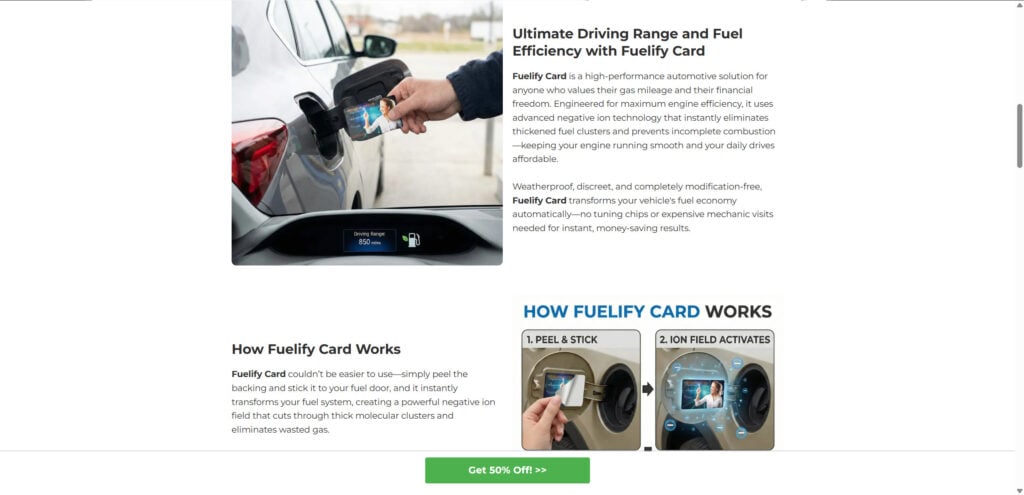
The central idea behind the Fuelify Card is that a small card placed inside the fuel door can alter the behavior of fuel and improve combustion. That is a serious claim because it suggests an external object can influence what happens inside a sealed and complex fuel system.
Modern vehicles do not work that way.
Fuel delivery, ignition timing, air-fuel mixture, emissions management, and engine performance are controlled by integrated mechanical and electronic systems. A thin card stuck near the fuel opening is not physically connected to the engine, injectors, pump, lines, sensors, or control systems in the way a real performance device would need to be.
That matters because the product is not merely claiming to freshen the appearance of your fuel door or act as a reminder to drive efficiently. It is claiming to change how fuel behaves and how the engine burns it.
That is a much larger claim, and nothing on the page credibly explains how a passive card could achieve it.
The entire offer is built around urgency and emotion
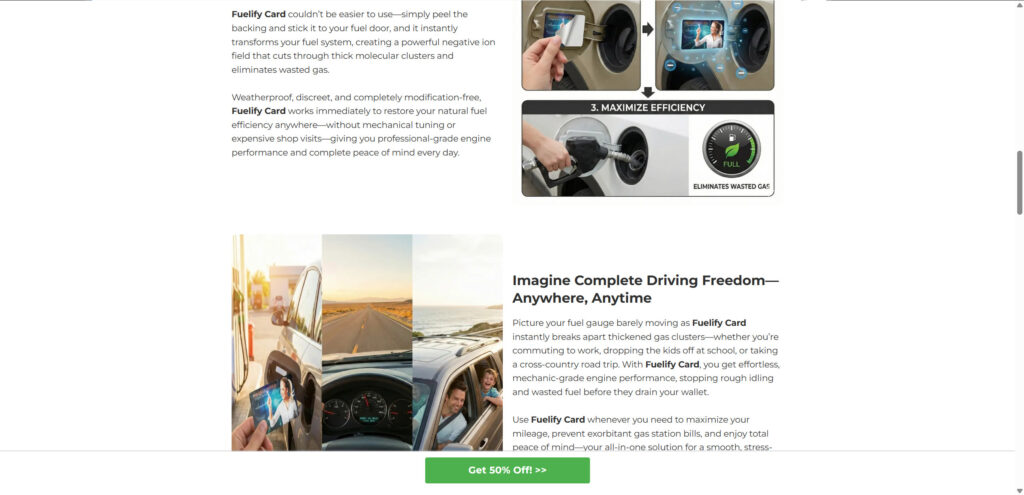
The screenshots reveal a very familiar scam playbook. The product is sold with pressure tactics from the first glance.
You see a banner pushing “50% OFF Today ONLY!”
You see glowing customer ratings that appear high and impressive.
You see polished benefit bullets.
You see green buttons encouraging immediate purchase.
You see bundles with deeper discounts for buying more.
You see a checkout structure that pushes upgrades and extra purchases.
This kind of setup is not proof of fraud on its own, but in this case it works alongside impossible product claims, fake-looking credibility markers, and a lack of verifiable evidence. That combination turns standard marketing pressure into something more deceptive.
The page is not just selling a product. It is trying to rush the buyer past skepticism.
The testimonials are central because real proof is absent
Another obvious pattern is the heavy dependence on testimonials.
The sales page shows positive customer quotes with names, profile photos, and statements about lower gas costs, smoother engine performance, and major monthly savings. The Facebook-style ad copy does the same thing by telling a personal story about a coworker who supposedly discovered the trick and nearly doubled tank life.
This storytelling approach is not accidental either.
When real proof is weak or nonexistent, sellers often lean hard on emotional anecdotes.
That is what happens here.
The ads want you to imagine yourself in the story. You are frustrated by gas prices. A trusted friend tells you about a hidden solution. You feel skeptical at first. Then you try it and become a believer. The story is designed to lower resistance, bypass technical questions, and move you toward an impulsive purchase.
Instead of evidence, you get a narrative.
Instead of documentation, you get a “real person” who swears it works.
That is not how credible automotive products are normally established.
Fake authority is everywhere in the presentation
Fuelify Card also tries to borrow trust it has not earned.
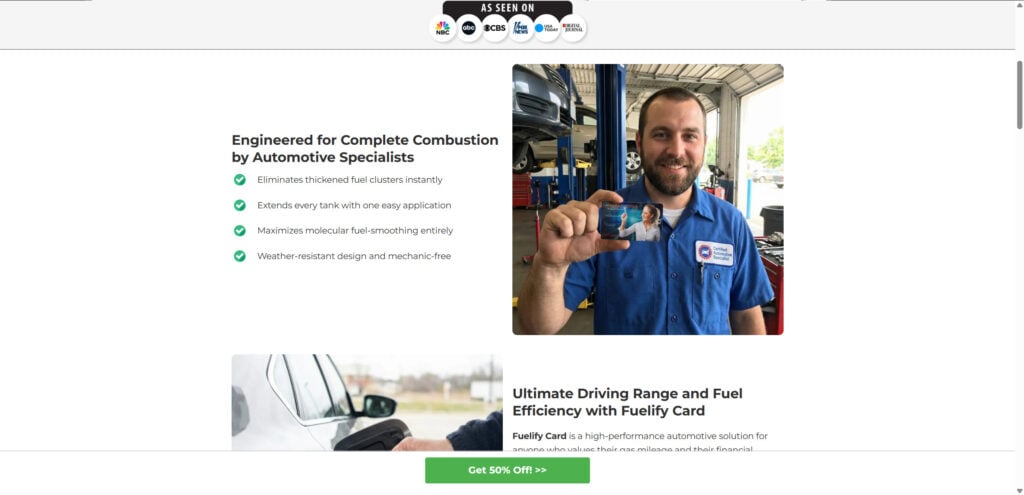
The page uses phrases like “engineered by automotive specialists” and “engineered by automotive efficiency experts.” It shows images of mechanics, technicians, garages, vehicles, and dashboards. It also displays logos from major media outlets under an “As Seen On” style section.
These visual cues are powerful because they imply legitimacy without actually proving anything.
A consumer glancing at the page may subconsciously assume:
- mechanics endorse this
- the media covered it
- specialists tested it
- the product comes from a serious company
But the page does not provide verifiable details behind those impressions.
Who are the specialists?
What are their names and qualifications?
Where are the test reports?
Which media outlets reviewed the product?
What exact articles or segments featured it?
None of that is clearly established.
This is a common deception tactic. Instead of showing real authority, the page creates the feeling of authority.
The TrustScore and reviews create a false comfort zone
The sales page prominently displays a strong TrustScore and thousands of customer reviews. That is meant to reduce fear at the exact moment a buyer is deciding whether to spend money.
But one of the biggest concerns with this type of offer is that these review elements often appear as static claims rather than independently verifiable ratings. A number on a product page is not the same as a trustworthy review platform listing that consumers can inspect for real feedback, complaint patterns, and business responses.
The glowing reviews on the page also fit too neatly into the sales story. They repeat the exact benefits the marketer wants you to believe: fewer fill-ups, smoother running, bigger savings, and a simple installation process.
That does not automatically prove fabrication, but it does create a credibility problem when there is no solid product evidence behind the claims.
When a product claims dramatic results but depends mostly on internal testimonials, skepticism is warranted.
The social media ad angle is especially deceptive
The ad copy shown in the Facebook-style promotion is one of the clearest signs that this is not a straightforward product listing. It is written like a confession from an ordinary person who discovered something unbelievable but true.
That style works because it does not sound like a formal ad. It sounds like a personal recommendation.
The story uses several persuasion triggers:
- rising gas prices
- a relatable complaint
- a trusted coworker
- skepticism turning into belief
- before-and-after receipts
- “I am not a car person” language
- a limited-time discount
- a 180-day money-back guarantee
Every element is there to make the message feel human and credible.
But when scam advertisers use this style, the “human” voice is often synthetic, scripted, AI-generated, or otherwise fabricated. The purpose is not to inform. It is to create emotional buy-in.
This is why many scam products today no longer lead with technical detail. They lead with a story.
The “mechanic” narrative fits a common fake expert template
You also provided details about a mechanic named “Marcus” from a Phoenix auto shop who supposedly reveals this hidden fuel-saving trick. Whether that exact character appears in all versions of the campaign or only some, the pattern is familiar.
Scam marketers know that people trust perceived insiders.
If a random ecommerce page says a sticker saves gas, most buyers will hesitate.
If a mechanic says he discovered the trick used by professionals, the message feels more believable.
That is why these scams often invent characters such as:
- mechanics
- engineers
- ex-industry employees
- local shop owners
- fleet managers
- “auto efficiency specialists”
The fake expert becomes a bridge between the impossible claim and the buyer’s emotions.
The product itself appears to be little more than a card or sticker
The images show what looks like a thin card with flashy graphics and buzzwords printed on it. It resembles the kind of cheap novelty item that can be mass-produced for very little and sold at a huge markup through aggressive ads.
That matters because scammy offers often depend on very low-cost physical objects paired with high-margin storytelling. The seller does not need the item to work. It only needs to look technical enough to support the pitch.
If the buyer receives something at all, it may be a generic card with no electronics, no measurable mechanism, and no meaningful function.
At that point, the seller has already won the most important part of the transaction.
The bundle pricing is a huge clue
The checkout page offers multiple bundles: 2x, 4x, 7x, and 10x Fuelify Cards, with deeper discounts as you buy more. This is another classic tactic.
If a product truly delivered dramatic fuel savings, it would not need such aggressive volume-based pressure right at checkout. But scammy product funnels often push bundles because they want to maximize revenue before the buyer has time to rethink the purchase or test whether the product works.
The psychology is simple.
A consumer thinks, “If one saves money, maybe several are even better.”
Or they think, “I should get extras for my other car, spouse, or family.”
The seller benefits because the average order value climbs sharply.
That is why checkout pages like this are built to reward bigger purchases, not careful decision-making.
The hidden costs and add-ons make the offer worse
The checkout page also includes an optional extended warranty and may expose buyers to further hidden charges or continuity offers. That is a known risk area with these kinds of funnels.
The core product itself is already questionable.
Then the buyer is encouraged to add more paid extras.
In some cases, consumers later report recurring charges tied to unfamiliar merchant names or “VIP” membership programs tucked into the checkout process or fine print. Whether every Fuelify Card buyer experiences that outcome or not, the structure described here is a serious warning sign because deceptive sellers often monetize the same customer more than once.
The first charge gets the sale.
The second charge gets buried later.
The refund promise is not the same as real protection
The offer highlights a 180-day money-back guarantee. On paper, that sounds reassuring. In practice, long refund guarantees are often used to reduce hesitation at checkout, especially when the seller expects a meaningful number of customers will never pursue the refund process or will struggle to complete it.
A refund guarantee only matters if:
- the company is reachable
- the terms are clear
- the return address is usable
- the merchant responds promptly
- the charge is actually reversed
Scam-like sellers know that most buyers do not aggressively fight small or medium-sized purchases, especially if the process becomes confusing, slow, or frustrating.
So the guarantee functions more as a sales tool than a reliable safety net.
The overall picture
Taken together, the Fuelify Card offer shows nearly every warning sign associated with modern ecommerce scams and deceptive product funnels:
- impossible or unproven technical claims
- vague science language
- fake expert framing
- emotional storytelling
- social media ad bait
- review inflation
- borrowed authority
- pressure pricing
- bundle upsells
- unclear checkout practices
- questionable refund confidence
That does not look like a breakthrough automotive product.
It looks like a highly polished scheme built to turn consumer frustration about gas prices into impulse sales.
How The Scam Works
Step 1: The scam starts with a highly relatable pain point
The Fuelify Card scam begins where many successful scams begin: with a real-world frustration.
Gas prices are expensive.
People feel the pressure every week.
Commuters, parents, rideshare drivers, delivery workers, and anyone who depends on a car are all vulnerable to ads promising relief. That is the emotional opening the marketers exploit.
They do not begin by selling a “card.”
They begin by selling hope.
The message is carefully structured around the idea that you have been overpaying for fuel and that a simple overlooked solution can finally change that.
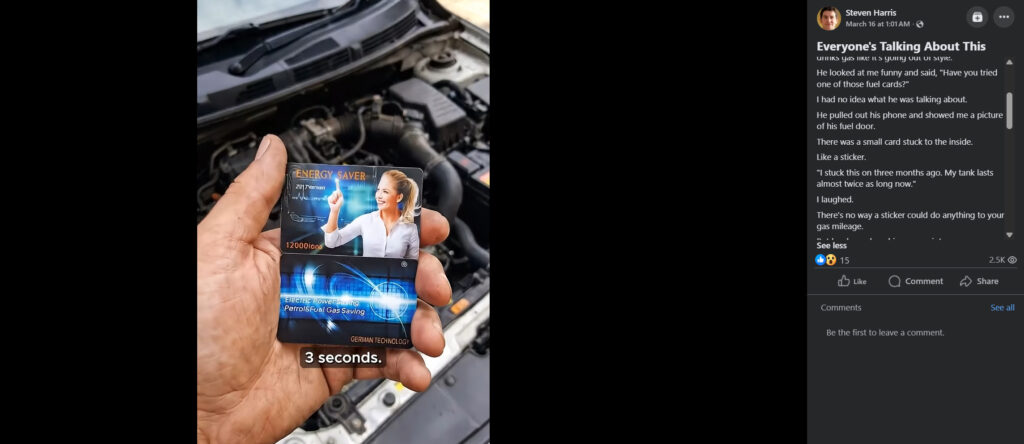
Step 2: Social media storytelling lowers your defenses
Next comes the ad itself.
Instead of looking like a traditional product ad, it often appears as a personal story, testimonial, or quasi-viral post. The example you shared uses a long narrative about someone talking with a coworker about fuel costs, discovering a small card in the coworker’s fuel door, and then watching their own fuel use supposedly improve after trying it.
This format works because it feels casual.
It does not feel like a hard sell at first.
It feels like one person sharing a discovery.
That distinction matters. Consumers tend to be more guarded with formal ads and less guarded with personal stories. Scam advertisers know this, so they use “native-feeling” content that blends into a social feed and looks like ordinary user conversation.
Step 3: A fake or exaggerated expert gives the story credibility
Many versions of this scheme also rely on a mechanic or auto expert figure to reinforce the claims. That person may appear in videos, landing pages, or scripted testimonials.
The supposed expert may say things like:
- fuel thickens over time
- drivers do not know the hidden cause of poor mileage
- professionals have used this trick for years
- major oil companies do not want you to know about it
This is a powerful tactic because it gives the scam a voice of authority.
The expert does not need to be real.
The story only needs to feel believable long enough to get the click.
In today’s scam environment, that “expert” may be completely fabricated through AI-generated video, deepfake voice work, synthetic scripts, and staged imagery. When you notice warped logos, unnatural speech rhythm, strange facial movements, or awkward visual details, that is often a clue that the expert is not real at all.
Step 4: The landing page shifts from curiosity to pressure
Once the user clicks, the next stage is the product page or advertorial-style sales page.
This is where the scam turns up the pressure.
The page usually includes:
- a big discount banner
- countdown-style urgency
- dramatic fuel-saving claims
- bold technical language
- review ratings
- strong call-to-action buttons
- a clean-looking layout
- mechanics and car imagery
- money-back promises
At this point, the seller is trying to control the buyer’s emotional state. The goal is not to encourage careful research. The goal is to keep the buyer excited, hopeful, and slightly rushed.
That is why the page often looks polished and professional. Scam pages are rarely sloppy now. Many are visually cleaner than legitimate small-business websites.
Step 5: Pseudo-science fills the gap where proof should be
A key part of the conversion process is replacing real proof with scientific-sounding language.
Fuelify Card’s marketing does this by talking about “negative ions,” “fuel thickening agents,” “molecular smoothing,” and “complete combustion.” These phrases give the product a high-tech aura, even though they are not backed by serious engineering documentation on the page.
Most buyers are not going to run a chemistry analysis or inspect automotive design principles in the middle of a checkout process.
Scammers count on that.
They know that for many consumers, vague technical complexity is enough to create plausibility. The buyer may think, “I do not fully understand it, but maybe it is advanced.”
That uncertainty helps the seller, not the customer.
Step 6: Testimonials replace test data
Because real evidence is missing, the page shifts hard into testimonials.
The testimonials serve several functions at once:
- they reassure the buyer that other people took the risk first
- they create social proof
- they describe the exact benefits the buyer wants
- they make the product feel normal and popular
The names and profile photos are there to make the reviews feel concrete.
But internal testimonials on a seller’s own page are weak evidence, especially when the product claims major real-world performance changes. Genuine proof would include independent tests, reproducible results, technical specifics, and recognized third-party validation.
Fuelify Card relies on stories instead.
That is a major part of how the scam works. It turns opinion into proof.
Step 7: Fake credibility markers make the page seem established
At this stage, the scam adds borrowed trust.
The page may show:
- a high TrustScore
- thousands of reviews
- media logos
- secure checkout language
- satisfaction guarantees
- expert phrasing
- specialist visuals
These elements are designed to answer the buyer’s private fears before the buyer voices them.
A person may think:
“Is this site legitimate?”
The page responds with ratings and media logos.
A person may think:
“What if it does not work?”
The page responds with a money-back guarantee.
A person may think:
“Is this just a gimmick?”
The page responds with technical jargon and specialist claims.
This is not transparent persuasion. It is structured reassurance meant to overcome buyer hesitation without providing real accountability.
Step 8: Checkout is engineered to maximize revenue
Once the buyer clicks through, the checkout process does not just aim to complete the purchase. It aims to increase the total amount charged.
The bundle structure is a major part of that strategy.
Instead of simply selling one card for one price, the page presents:
- 2 cards
- 4 cards
- 7 cards
- 10 cards
with more dramatic per-unit discounts on larger bundles.
This tactic creates a perception of smart shopping. The buyer feels they are getting more value by spending more. In reality, they are often just multiplying their exposure to a product that does not work.
The extended warranty add-on is another clue.
Real value is questionable at the product level, yet the buyer is pushed to purchase protection on top of it. That move makes financial sense for the seller, not the customer.
Step 9: Fine print can hide the real damage
One of the more dangerous parts of similar ecommerce scams is what happens after the visible purchase.
The buyer thinks they are paying once for a product.
Later, additional charges may appear under unfamiliar merchant names or tied to memberships, subscriptions, trial offers, or “VIP” programs buried in fine print. You specifically referenced reports of charges associated with names like Aviroo Home or Daily Savvy Buys, with monthly fees such as $49.99.
This matters because many scam funnels do not stop at selling a useless item.
They use the initial transaction to gain payment details, then monetize the customer again through confusing billing arrangements. Sometimes the buyer misses the disclosure entirely. Sometimes it is disclosed in a misleading or low-visibility way. Sometimes support becomes difficult once the charge appears.
Whether hidden continuity billing occurs in every variation of the Fuelify Card funnel or only some, consumers need to understand the risk. It is a known pattern in this category.
Step 10: The product arrives and disappointment sets in
If the buyer receives anything at all, the reality often becomes obvious at this stage.
What was pitched as advanced automotive technology turns out to be a thin card or sticker-like item with printed graphics. There may be no meaningful electronics, no installable hardware, no credible instructions, and no measurable mechanism that could affect engine efficiency.
Now the buyer has two problems:
- the product seems useless
- the seller already has the money
This is the point where many consumers start searching for reviews, discovering complaints, and realizing they were sold a story rather than a solution.
Step 11: The promised results never materialize
Because the product lacks credible function, buyers usually do not see the spectacular results advertised.
They do not suddenly double miles per tank.
They do not transform their monthly fuel bill overnight.
They do not unlock hidden engine efficiency with a five-second installation.
At best, nothing changes.
At worst, the buyer may convince themselves for a short time that the product is working because of normal changes in driving conditions, route length, weather, fuel prices, tire pressure, or simple expectation bias.
That is another reason these scams target areas like fuel economy, wellness, posture, and “energy” products. Results can be subjective enough that some people will hesitate before admitting they were fooled.
Step 12: Refund attempts become difficult
After disappointment comes the refund stage.
This is where the difference between marketing promises and real consumer protection often becomes painfully clear.
The site may have advertised:
- 180-day money-back guarantee
- satisfaction guarantee
- easy returns
- risk-free purchase
But once the buyer tries to act on those promises, they may encounter:
- delayed responses
- unclear instructions
- return shipping obstacles
- support silence
- confusing merchant information
- charges that are hard to trace
- cancellations that do not stick
This is one of the most common features of scam-like product funnels. The sale is optimized. The customer service is not.
Step 13: The seller can disappear or rebrand
Another reason these schemes are dangerous is that they are often portable.
A seller can change:
- product name
- domain name
- checkout brand
- ad creative
- testimonial story
- merchant label
very quickly.
That means even if one version attracts complaints, another version can appear with a fresh name and the same underlying tactics. Today it is Fuelify Card. Tomorrow it may be another “fuel saver card,” “negative ion mileage booster,” or “engine efficiency sticker.”
The product shell may change.
The scam logic stays the same.
Why this format keeps working
The Fuelify Card scam works because it combines several highly effective persuasion elements into one funnel:
- a real financial pain point
- a simple solution
- a dramatic promise
- a relatable story
- a fake expert
- pseudo-science
- social proof
- urgency
- bundle pricing
- weak post-sale accountability
That combination is powerful because it targets both emotion and impatience.
People do not buy because the science is convincing.
They buy because the offer is emotionally convenient.
It tells them what they want to hear, at the moment they most want to hear it.
The deeper reason these claims are so dangerous
Products like Fuelify Card are not harmless just because the individual purchase may seem relatively small.
They are dangerous for three reasons.
First, they exploit financial stress. They target people who are actively trying to save money.
Second, they normalize deceptive commerce. The more these schemes succeed, the more aggressively they spread.
Third, they can expose buyers to more than product disappointment. Personal details, billing information, and hidden charges may all become part of the damage.
That is why these schemes deserve to be called out clearly.
They are not just selling junk.
They are selling false hope at a time when many consumers are looking for practical help.
What To Do If You Have Fallen Victim to This Scam
If you already ordered Fuelify Card, do not panic. Many people get caught by polished product funnels, especially when the offer plays on everyday expenses like fuel. The most important thing now is to act quickly and methodically.
1. Review your bank and card statements immediately
Check the exact amount you were charged and the name that appears on the transaction.
Look for:
- the original purchase amount
- separate charges from unfamiliar merchant names
- recurring monthly fees
- test charges or pending transactions
- upsells you did not knowingly approve
Do not stop at one statement. Check recent activity and keep watching for several weeks.
2. Take screenshots of everything
Save evidence now before pages disappear or change.
Capture:
- the ad you clicked
- the product page
- the checkout page
- the refund promise
- the order confirmation
- your transaction record
- any customer service emails
- any strange subscription language
This documentation can help if you need to dispute the charge.
3. Contact the seller and request cancellation in writing
If the company provides a support email, contact form, or help portal, send a clear written request.
State:
- your order number
- the date of purchase
- that you want to cancel
- that you want a full refund
- that you do not authorize recurring charges
- that you want written confirmation
Keep the message short and direct. Save a copy of what you send.
4. Call your bank or credit card issuer if anything looks wrong
If you see unauthorized charges, hidden subscription billing, or if the seller does not respond, contact your card issuer promptly.
Tell them:
- you believe the product was misrepresented
- the claims appear deceptive
- you may have been enrolled in unauthorized recurring billing
- you want to dispute the charge
- you want future charges blocked if necessary
Banks and card issuers deal with this type of complaint regularly. Acting early improves your chances.
5. Ask specifically about recurring billing blocks
Do not assume disputing one charge automatically stops future ones.
Ask whether the merchant can continue billing under the same or related descriptor. If there is any risk of additional charges, request a block, merchant-specific stop, or card replacement based on your issuer’s guidance.
This step matters because some scam-related sellers try to continue billing after the initial transaction.
6. Watch your email for misleading follow-up offers
After a purchase, some questionable sellers send more promotions, upgrade offers, or confusing messages that make cancellation harder.
Do not click random links in those emails.
Do not provide more information than necessary.
If you need to contact the seller, use the contact details already documented from your order confirmation or the original site, and verify them carefully.
7. Be realistic about the refund timeline
Even if the site promised a generous guarantee, getting the money back may take time.
Be persistent, but organized.
Maintain a file with:
- dates
- screenshots
- emails sent
- responses received
- bank dispute records
- shipping information if applicable
A clean paper trail strengthens your position.
8. Report the ad and merchant where possible
If you found the product through Facebook or another social platform, report the ad for misleading claims.
You can also report suspicious merchant behavior to:
- your payment provider
- your consumer protection authority
- platform complaint systems
- scam reporting websites
This may not solve your refund issue immediately, but it can help reduce harm to others.
9. Do not blame yourself
These offers are built by people who understand consumer psychology. They use polished visuals, fake authority, professional-looking checkouts, and emotionally persuasive storytelling.
Getting caught does not mean you were careless or foolish.
It means the funnel was designed to override normal skepticism.
That is exactly why these schemes keep spreading.
10. Treat future “instant savings” claims with extra caution
Scams like this are rarely one-offs. Once you have seen the pattern, it becomes easier to recognize related offers.
Be wary of products that claim to:
- dramatically cut fuel use
- boost engine performance instantly
- work with no installation
- rely on “secret” science
- lack verifiable testing
- use heavy discounts and countdown pressure
The safer approach is simple: if a product promises major mechanical results without meaningful integration into the vehicle or credible test evidence, assume the claim is false until proven otherwise.
The Bottom Line
Fuelify Card is marketed as a breakthrough gas-saving solution, but the pitch falls apart under examination. The product relies on unproven technical claims, emotional storytelling, fake-looking authority signals, aggressive discount tactics, and a checkout structure that raises serious consumer protection concerns.
A small card stuck inside a fuel door is not a credible way to transform fuel chemistry, improve combustion, or double mileage. What the Fuelify Card offer really sells is the idea of effortless savings at a time when people badly want that idea to be true.
If you are researching whether Fuelify Card is legit, the safer conclusion is clear: this offer shows the classic hallmarks of a deceptive product scam, not a real automotive breakthrough. Avoid it, monitor your accounts if you already purchased, and treat any similar “fuel saver card” promotion with extreme caution.
Fuelify Card Scam FAQ
Is Fuelify Card legit?
Fuelify Card does not appear to be a legitimate fuel-saving breakthrough. The claims rely on vague science, unrealistic promises, and marketing tactics that raise serious red flags.
Does Fuelify Card really save gas?
There is no credible evidence that Fuelify Card improves gas mileage. The product claims are not backed by reliable scientific testing or independent proof.
How is Fuelify Card supposed to work?
The ads claim it uses “negative ions” to break up fuel thickening agents and improve combustion. That explanation is not supported by real automotive science.
Is Fuelify Card just a sticker?
In many cases, it appears to be little more than a thin card or sticker-like item with no proven technology that could affect fuel performance.
Are the Fuelify Card reviews real?
The reviews shown on the sales page should be treated with caution. They appear designed to build trust, but there is no clear proof that they come from independent, verified review platforms.
Does Fuelify Card have hidden charges?
Some buyers report concerns about unexpected extra charges or recurring billing tied to similar product funnels. Check your bank or card statements carefully after any purchase.
Can I get a refund for Fuelify Card?
The website may advertise a money-back guarantee, but getting a refund may be difficult in practice. If you were charged, contact the seller in writing and dispute the charge with your bank if needed.
What should I do if I already bought Fuelify Card?
Review your statements, save all screenshots and emails, request cancellation in writing, and contact your card issuer quickly if anything looks unauthorized.

Join the discussion
4 commentsShare your experience or ask a question about this article.
Discussion
Bought this. Put it in a 2020 Toyota Camry Hybrid. Toyota claims that the maximum MPG for highway is 66mpg. I went on a long mileage trip and got 90mpg. It was the only thing that I changed. Please explain.
In reply to Jerry McCreery
Happy to explain, because the arithmetic is where this falls apart. 90 mpg in a Camry Hybrid rated at 66 mpg highway would be roughly a 36% improvement in fuel conversion – not a small gain but a violation of what the engine and the fuel are capable of. No device plugged into a cigarette-lighter socket can do that, because that socket carries power only; it has no data connection to the engine control unit and cannot alter fuelling, timing or anything else. Inside the housing of these products is typically a resistor and an LED.
What almost certainly changed was the measurement. On a long highway trip a hybrid genuinely does much better than in mixed driving – steady speed, no cold starts, minimal battery cycling, and often lower speeds than usual, and a 10 mph reduction alone is worth a large percentage. The dashboard readout is also not a measurement but an estimate, and it is optimistic by 5-10% on many Toyotas; if it was reset at the start of the trip it will read very differently from a tank-to-tank calculation. Tailwind, terrain and a warm engine for most of the drive all push in the same direction.
If you want to settle it: fill the tank to the same click, note the odometer, drive the same route with the device fitted, brim it again and divide miles by gallons actually pumped. Then repeat without the device. That measures fuel rather than a computer’s guess, and it is the test the sellers of these things never publish.
Well, I did receive my card, did you even get one, or you just “reviewing” it to gather attention to your site? If you can’t back up what you post, are you no better than the “scammers”?
Mine works…
Maybe you need to research stuff better before posting “false” claims against others…
In reply to Randy Warnan
Thanks for commenting, Randy. Receiving a physical product does not automatically make the advertising or the claims legitimate. The concern raised in the article is about how these products are marketed and whether the promised benefits are credible, not just whether an item arrives in the mail. Still, I appreciate you sharing your experience.