

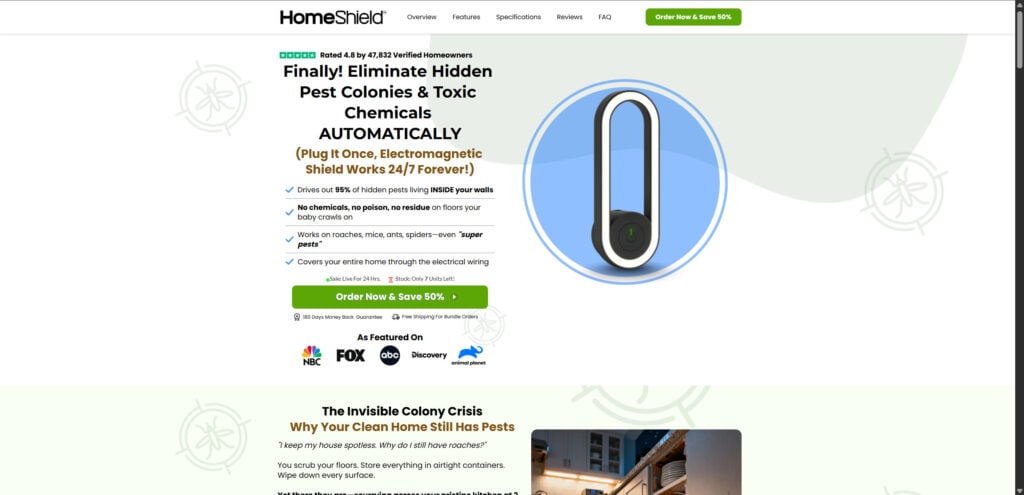
HomeShield Ultrasonic Pest Killer is promoted as a simple plug-in device that eliminates hidden pests “inside your walls” without chemicals, traps, or ongoing service.
The issue is not the idea of a pest repeller. It is the way this product is sold.
HomeShield is commonly pushed through fear-based advertorials and aggressive ads, supported by inflated review graphics, unverified “as featured on” logos, and sweeping claims that do not match what a low-cost plug-in device can realistically deliver. The same device also appears across multiple websites under changing names, and some buyers report being charged for multiple units they did not intend to order.
This article breaks down how the HomeShield funnel works, the red flags to watch for, and what to do if you already paid.
Scam Overview
HomeShield is marketed as an “ultrasonic pest killer,” but the sales pages often go further than that. The pitch blends “ultrasonic,” “electromagnetic,” “frequency oscillation,” and “wall penetration technology” into a story that sounds advanced, scientific, and permanent.
That combination is exactly what makes this operation so effective: it takes a cheap, mass-produced gadget and wraps it in a premium narrative, then uses fear and urgency to push the purchase.
Below is what the HomeShield Ultrasonic Pest Killer scam typically looks like, based on the sales materials and the broader pattern behind these campaigns.
What HomeShield claims to be
The HomeShield marketing commonly promises results that sound absolute and immediate.
Examples of the types of claims and “feature” statements used in the funnel include:
- “Eliminate hidden pest colonies and toxic chemicals automatically”
- “Plug it once” and the “electromagnetic shield works 24/7 forever”
- “Drives out 95% of hidden pests living inside your walls”
- “Covers your entire home through the electrical wiring”
- “Whole-home coverage” with one device that “protects your entire electrical circuit”
- “Silent to humans”
- “100% chemical-free,” framed as safe for babies and pets
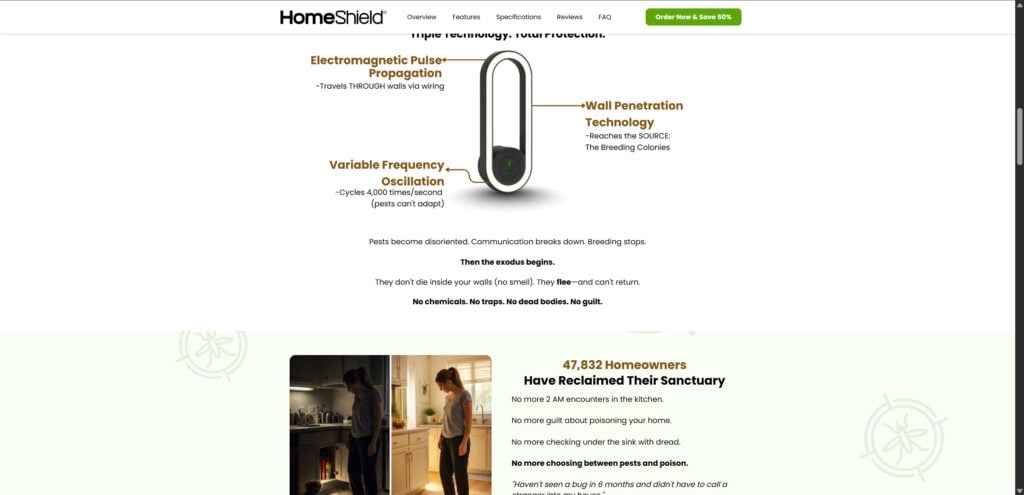
- “Penetrates 12 inches into your walls via wiring”
- “Variable frequency oscillation” cycling at specific kHz values, presented as a way pests “can’t adapt”
- “Cycles 4,000 times/second,” again presented as “pests can’t adapt”
- A confident review panel claiming 4.8 out of 5 with thousands of ratings, plus a “verified homeowners” number in the tens of thousands
This is not how legitimate pest control products are typically presented.
Real products tend to define a narrow use case, explain boundaries, list test conditions, and avoid sweeping “works on everything” claims, because overpromising creates refunds, complaints, and regulatory trouble.
HomeShield leans hard in the opposite direction. It positions itself as a universal solution that replaces sprays, exterminators, DIY remedies, and “generic ultrasonics” all at once.
That alone is a major warning sign.
The fear-based “pediatrician warning” funnel
A big part of what makes HomeShield feel convincing is the way it is introduced.
Instead of a straightforward product page, many buyers are pulled in through an “advertorial,” meaning a page designed to look like an article, but built to sell.
These pages typically use:
- A bold medical-style headline (for example, a “pediatrician warning” about a child’s rash)
- A “reporter” byline and a date
- A story structure that escalates anxiety before revealing the product
- A “recommended” widget on the side with a big green button and a “50% off” discount
The goal is not education. It is emotional momentum.
The page pushes you into a simple mental frame: “My child might be suffering because of hidden pests, and I need to act right now.”
Once you are there, a cheap plug-in gadget feels like a low-risk “why not” purchase, especially when the page shows thousands of five-star reviews and a long “money back guarantee.”
The “double toxin trap” story and why it matters
These campaigns often use what I call a “two-threat trap.”
First threat: pests are everywhere, hiding in your walls, breeding, spreading, and contaminating your home.
Second threat: traditional pest control is framed as dangerous, because it involves “toxic chemicals” around children and pets.
Now you are boxed into a corner.
If you do nothing, the pests supposedly keep poisoning your home.
If you spray, you are supposedly poisoning your family.
That is the emotional pressure point.
Then HomeShield arrives as the “third door” that magically solves both problems, with no trade-offs. No poison, no mess, no recurring bills, no effort.
This is a classic persuasion structure used in scammy dropshipping funnels. It is designed to create urgency, not clarity.
The “proof stack” that looks convincing but is not verifiable
HomeShield pages often throw multiple types of “proof” at you in rapid succession:
- Huge review counts and high average star ratings
- “Verified homeowners” numbers, sometimes extremely specific
- “As featured on” media logos (NBC, FOX, ABC, Discovery, Animal Planet, and others)
- A comparison chart that makes every alternative look useless or harmful
- Diagrams showing “electromagnetic pulse propagation” and “wall penetration technology”
- Claims about what pests “use to navigate,” followed by a statement that HomeShield “jams that signal”
- Scarcity cues like “sale live for 24 hours” and “stock only 7 units left”
- A “180 days money back guarantee” badge
Each element is meant to make you stop questioning and start trusting.
But here is the key: most of this “proof” is not independently verifiable on the page itself.
A legitimate brand that is truly “as featured on” major networks can usually show a specific segment, a link, a date, or a credible press page.
A legitimate review system typically has traceable reviews, not just a graphic.
A legitimate product with scientific backing can point to testing standards, lab reports, or measurable claims that can be checked.
In these funnels, the proof is mostly visual. It is designed to feel true, not to be confirmed.
What the device appears to be in reality
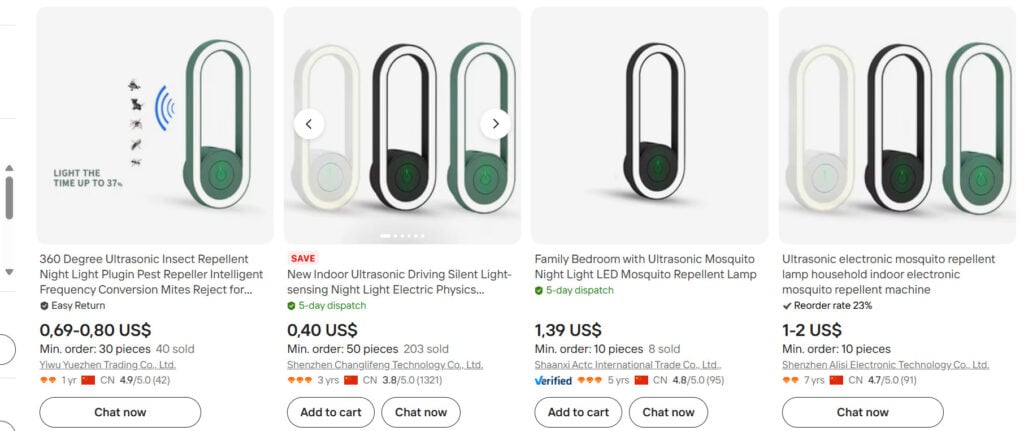
When you strip away the branding, HomeShield looks extremely similar to generic plug-in “ultrasonic pest repeller” night light devices sold in bulk on wholesale marketplaces.
These devices often sell for around $0.40 to $2 per unit at wholesale pricing, depending on order quantity and supplier.
That gap is the business model.
A product that costs under a couple dollars at the source can be sold for $29, $39, $59, or more per unit on a slick landing page, especially when buyers are pushed into bundles.
Even if the gadget does anything at all, it is not doing what the sales page describes.
A cheap plug-in repeller is not turning your home wiring into a “force field.” It is not driving pests out of wall colonies “permanently.” It is not delivering a guaranteed “95%” result across multiple pest species and home layouts.
What you are typically buying is a low-cost commodity product, presented like a breakthrough.
The dropshipping operation behind HomeShield
This is where the “scam” part becomes clearer.
HomeShield is not just “a product that overpromises.” It follows a broader pattern seen in high-volume dropshipping funnels:
- Create a brand name that sounds established
“HomeShield” sounds like a mature home protection brand. That is intentional. - Build a template landing page
The page is designed to maximize conversion: big promises, big buttons, big ratings, little detail. - Run aggressive ads
Often fear-based, sometimes involving children, pets, or “hidden dangers” in your home. - Push bundles and urgency
“50% off,” “only 7 left,” “sale ends today,” and other pressure cues. - Fulfill cheaply from China
Long shipping times, limited tracking, and low-cost packaging. - Reduce refunds with friction
Slow support, confusing policies, and return requirements that make it impractical. - Rebrand and repeat
When complaints pile up, ad accounts get shut down, or chargebacks rise, the same product returns under a new name and new website.
That last point matters a lot.
Because HomeShield does not appear in isolation. The same device and same page structure show up under other names and other “purposes.”
Why the product name and “what it’s for” keep changing
One of the strongest tells that you are looking at a dropshipping scam operation is how quickly the branding shifts.
Today it is HomeShield for roaches, mice, and “super pests.”
Tomorrow it is PawShield for fleas.
Next week it is a mosquito repeller.
Same shape. Same product photos. Same promises. Same “as featured on” row. Same “50% off” button.
That is not how real pest control brands behave.
A legitimate company does not repeatedly rename the same product to target whatever pest is trending in ads. They build trust by being consistent, not by constantly reinventing their identity.
Rebranding is useful for scammers and shady sellers because it:
- Separates the new campaign from past complaints
- Makes it harder to search for warnings
- Lets them create new “review” graphics from scratch
- Allows them to dodge refunds and chargeback patterns
- Helps them survive platform bans
If you found HomeShield on one site and later saw the same device sold as something else, that is not a coincidence. It is the operation.
The “multiple units charged” problem
A very common complaint with these campaigns is that people intend to order one unit but end up:
- Being charged for 2, 3, or 4 units
- Receiving multiple devices unexpectedly
- Discovering extra charges that were not obvious at checkout
This can happen in several ways, and in scammy funnels it is often by design:
- A bundle option is pre-selected by default
- A “most popular” package is presented as the standard choice
- A quantity selector resets when you move between steps
- An “order bump” is added with unclear language
- A post-purchase upsell is designed to look like a confirmation step
- A discount is tied to ordering multiple units, framed as “the only way it works”
- Some checkouts split the order into multiple transactions
If you were charged for more than you intended, treat it as a billing dispute issue, not just “buyer’s remorse.” You did not agree to that total.
We will cover exactly what to do later in this article.
The returns trap: “money back guarantee” that is hard to use
The HomeShield pages often highlight a long guarantee period, like 180 days.
That sounds reassuring, but in dropshipping operations the guarantee can become marketing decoration.
Here is how it often plays out for buyers:
- Support is slow, generic, or unresponsive
- You are asked to “try it longer” or “follow steps” before a refund is considered
- You are offered a partial refund to keep the product
- If a return is allowed, it may require shipping the item back to China
- The shipping cost can be higher than the refund
- Tracking and delivery confirmation become your burden
- The seller may claim the return was not received, or arrived “outside the window”
Even when a refund happens, the process is designed to wear you down.
That is not accidental. It reduces refunds and protects the operation’s profit.
Why calling it a “scam” is reasonable
Some people hesitate to use the word “scam” because a physical product exists.
But scams are not always imaginary products.
A scam can be a real item sold through deception: fake authority, manipulated reviews, fake urgency, exaggerated claims, and billing practices that cause unwanted charges.
HomeShield fits that pattern.
The most accurate way to describe it is:
- A cheap, generic product, likely sourced from China at very low cost
- Marketed with exaggerated and unverified performance claims
- Sold through rotating domains and brand names
- Wrapped in fear-based advertorials and fake social proof
- Paired with refund friction and return barriers
- Frequently associated with unwanted multi-unit charges
If that is your experience, your instincts are right to question it.
How The Scam Works
This section walks through the HomeShield Ultrasonic Pest Killer scam step by step, so you can recognize the structure when it shows up again under a different name.
Step 1: The ad that triggers anxiety, not curiosity
Most buyers do not find HomeShield by searching for “HomeShield Ultrasonic Pest Killer.”
They find it because an ad hits an emotional nerve.
Common hooks include:
- A child-focused “warning” about rashes, coughing, or sleep issues
- A “hidden infestation” storyline about pests inside walls
- A fear-heavy kitchen or bedroom scenario
- A “clean home, still has roaches” shame trigger
- A claim that sprays are poisoning your family
These ads are designed to create urgency, not to provide balanced information.
If the first thing you feel is panic, that is the funnel working as intended.
Step 2: The advertorial that looks like a neutral article
The next click often lands on an “advertorial” page.
The page includes elements that mimic real journalism:
- A headline that sounds like a public health alert
- A byline and a date
- A story format with a slow reveal
- A sidebar “recommended” product widget
- A big discount button
This format makes people lower their guard.
They think they are reading, not being sold.
But the page is written like a sales script. The pacing, the bolded lines, and the “do this immediately” language are all conversion tools.
Step 3: The “two threats” trap locks in the narrative
Once you are reading, the page escalates the problem.
It does not just say “pests are annoying.”
It says something closer to:
- There are far more pests than you can see
- They are breeding inside your walls
- They are medically dangerous
- Your child may be reacting
- Your home may be “poisoning” your family
Then it introduces the second threat: chemicals.
It frames standard pest control methods as toxic and unsafe, especially around kids and pets.
Now you feel trapped.
You want pests gone, but you are told traditional methods are dangerous.
That emotional tension makes the reader ready for a miracle solution.
Step 4: The miracle device is presented as “new technology”
This is where HomeShield appears.
The product is framed as a breakthrough:
- Not “random ultrasonic noise”
- Not a gimmick
- “Real electromagnetic technology”
- “Electromagnetic fortress technology”
- “Wall penetration technology”
- Precision frequencies
- Whole-home coverage
This is high-tech language used to sell a low-tech commodity.
The point is not to explain how it works in a testable way.
The point is to sound advanced enough that you stop asking basic questions.
Questions like:
- How does a plug-in device affect pests inside walls across an entire home?
- Why would “electrical wiring” repel pests?
- Where is the independent testing?
- Why does it work on roaches, mice, ants, spiders, and fleas all at once?
- How do they measure “95%”?
A legitimate product expects these questions.
A scam funnel tries to outrun them.
Step 5: The fake-proof cascade makes you feel “safe to buy”
Right after the big claims, the page floods you with “proof.”
This is not one strong piece of evidence.
It is ten weak signals stacked together:
- A 4.8 out of 5 rating graphic
- Thousands of “customer ratings”
- “Verified homeowners” counts like 47,832
- A breakdown that shows 90% five-star reviews
- A “by feature” panel where everything is rated 5.0
- “As featured on” logos
- A long guarantee badge
- A chart that claims alternatives cannot reach wall colonies
- Diagrams that suggest scientific credibility
- A story that “the pest control industry doesn’t want you to know this”
This is persuasion by volume.
It is meant to create a feeling: “So many people love it, it must be real.”
But if you cannot verify the reviews, cannot confirm the media features, and cannot find independent testing, then the “proof” is just graphic design.
Step 6: The scarcity and urgency cues force a rushed purchase
A huge part of these pages is pressure.
Common examples:
- “Sale live for 24 hours”
- “Only 7 units left”
- “Order now and save 50%”
- Countdown timers
- “Bundle” messaging that implies you need more than one
Even when the numbers are fake, they work because they target human behavior.
People do not want to miss a deal.
They do not want to risk waiting and “losing” the discount.
So they click.
Step 7: The checkout is engineered for higher totals
This is where many buyers get hit with unwanted charges.
Scammy checkouts maximize order value through design tricks, including:
- Bundles presented as the default
- “Most popular” packages highlighted with stronger discounts
- Quantity selectors that are easy to misread
- Add-ons placed close to the final button
- Upsells that look like order confirmation pages
- “Protection,” “insurance,” or “priority processing” add-ons
- Confusing summary screens where totals are easy to miss
This is not always technically “illegal,” but it is ethically ugly.
The goal is to make it easy to spend more than you intended.
If you were charged for 3 or 4 units, this is the most likely reason.
Step 8: Fulfillment from China reveals what you really bought
Once the payment clears, many buyers notice the first practical clue: shipping.
Dropshipping operations often ship from China because:
- The product is sourced from a Chinese supplier
- The seller does not hold inventory
- They are forwarding orders to a fulfillment partner
That is why delivery can take longer than expected, and why the package may arrive with:
- Generic packaging
- Minimal instructions
- A different brand name
- A product that looks cheaper than the ad photos
This is also where buyers realize something else: the device is often just a night light style plug-in repeller, not a sophisticated “home shield.”
Step 9: The performance gap becomes obvious
Even if the gadget emits sound or light, that does not mean it solves infestations.
In real-world homes:
- Sound does not travel well through furniture and walls
- Rooms are separated
- Pests hide in cracks, behind appliances, and inside structures
- Many insects and rodents adapt to environmental stimuli over time
- A single plug-in device cannot override the biology of multiple species across an entire home
So the buyer experience often looks like:
- No noticeable change in pest activity
- Short-term placebo effect (you expect improvement, so you notice less)
- Results that do not match the marketing promises
- Frustration, then a refund attempt
Step 10: Refund friction protects the seller, not the customer
Now the second part of the scam kicks in: keeping the money.
Common patterns include:
- Support emails that feel automated
- Long response delays
- Requests for videos, photos, and troubleshooting steps
- Partial refund offers if you “keep the product”
- Statements that the item must be returned, sometimes to China
- Requirements that you cover return shipping
- Denials based on timing or “policy” language
This is how a high-markup dropshipping operation survives.
Not by making a great product.
By making refunds hard enough that many people give up.
Step 11: The rebrand resets the whole game
Finally, when a domain gets too toxic, the same product returns under a new name.
HomeShield becomes PawShield.
Or it becomes a mosquito repeller.
Or the product name changes completely, while the device remains the same.
New domain, new template, new set of “reviews,” same funnel.
That is how this operation scales.
It is not one shady website. It is a repeatable system.
What To Do If You Have Fallen Victim to This Scam
If you bought HomeShield (or a rebrand like PawShield) and now regret it, or if you were charged for multiple units, take action quickly and methodically.
Here is a practical plan that works in most cases.
- Confirm exactly what you were charged forLook at your order confirmation email and your card statement.Write down:
- The merchant name shown on the charge
- The date and amount
- The quantity the confirmation claims you ordered
- Any separate charges (some sellers split orders)
- Check for additional pending chargesSome buyers only notice the first charge, then get hit again later.Review your statement for:
- Duplicate charges
- Charges with similar merchant names
- Small “test” charges that might indicate a billing token saved
- Save evidence immediatelyBefore anything changes, capture:
- The sales page (screenshots of the major claims)
- The checkout page (especially bundles and totals)
- The order confirmation screen
- The confirmation email
- Any refund policy language
- Tracking information, if provided
- Email the seller and request a written resolutionKeep it short and direct.If you were charged for more units than intended, state that clearly:
- “I authorized 1 unit. I was charged for 3.”
- “I did not consent to additional units.”
- “I am requesting a full refund for the unauthorized portion.”
- If the order has not shipped, request cancellationMany sellers claim they “cannot cancel,” but that is often just resistance.Use direct language:
- “Cancel the order and refund my payment.”
- “I do not authorize shipment.”
- If you receive multiple units, document itTake photos of:
- The shipping label
- The contents
- The number of units received
- Any paperwork in the box
- Start a chargeback or payment dispute if support stallsIf the seller ignores you, delays, or offers only partial refunds, escalate through your payment method:
- Credit card dispute
- Debit card dispute (rules vary, but still worth attempting)
- PayPal dispute, if used
- Product not as described (claims vs reality)
- Unauthorized additional quantity or add-ons
- Misleading advertising
- Refund refusal inconsistent with the guarantee
- Consider replacing your card if you see suspicious behaviorIf you notice:
- Unexpected new charges
- Multiple merchant names connected to the same purchase
- Attempts that look like subscription billing
- Report the ad and the siteReporting does not always get your money back, but it helps reduce harm.Useful places to report include:
- The platform where you saw the ad (Facebook, Instagram, TikTok, and others)
- Consumer protection agencies in your country
- Your state attorney general (US buyers)
- The FTC (US buyers)
- If you actually have a pest problem, switch to proven methodsA scammy gadget wastes time, and pests do not wait.Consider a practical approach:
- Seal entry points (cracks, gaps, pipe penetrations)
- Reduce food and water sources (crumbs, standing water, pet food left out)
- Use targeted traps or baits appropriate to the pest
- If the issue is significant, contact a reputable local pest control provider
The Bottom Line
HomeShield Ultrasonic Pest Killer is marketed like a breakthrough: one plug-in device that eliminates pests in your walls, protects your whole home through wiring, and delivers near-guaranteed results without chemicals.
But the sales strategy tells a different story.
The operation relies on fear-based advertorials, exaggerated claims, inflated review graphics, fake-seeming social proof, and aggressive scarcity tactics to sell what appears to be a cheap, mass-produced gadget sourced from China at a huge markup.
Then it protects profits with the second half of the system: confusing checkouts that can lead to multi-unit charges, slow support, and refund processes that often feel designed to exhaust the buyer.
If you are researching HomeShield before buying, the safest move is simple: do not purchase from these rotating, high-pressure sites.
If you already bought and regret it, focus on documentation and disputes, especially if you were charged for more than you intended. The faster you act, the better your odds.
FAQ
Is HomeShield Ultrasonic Pest Killer legit or a scam?
HomeShield is best described as a dropshipping-style operation that uses fear-based ads, inflated social proof, and exaggerated performance claims to sell a cheap plug-in device at a high markup. The product may exist physically, but the marketing tactics and promises are the issue.
What is HomeShield actually selling?
Based on the visuals and how it is marketed, it appears to be a generic plug-in ultrasonic pest repeller / night light device commonly found on wholesale marketplaces, then rebranded and sold through multiple domains.
Does an ultrasonic plug-in device really eliminate pests in your walls?
A single plug-in device cannot realistically deliver the sweeping claims shown on these pages (whole-home coverage, driving pests out of walls, “works 24/7 forever,” near-guaranteed % results). Pest problems usually require targeted, proven control methods, not a one-device promise.
Why does HomeShield show up on different websites and under different names?
This is a common pattern with dropshipping scam funnels. When complaints rise or ads get flagged, the same product is rebranded and relaunched on a new domain with a new name and slightly changed story (roaches today, fleas tomorrow, mosquitoes next week).
Is get.pawcify.com connected to HomeShield?
Sites like get.pawcify.com are part of the same pattern: single-product funnels, heavy urgency, and rebranding. Even when the brand name changes, the device and the sales script can stay nearly identical.
Are the “As Featured On” logos and review counts real?
In many scam funnels, media logos and review panels are used as visual trust props without verifiable sourcing. If there is no direct, traceable evidence (real segments, links, independently hosted reviews), treat those elements as unverified marketing graphics.
Why do people get charged for 2, 3, or 4 units when they ordered 1?
This often happens through:
- Bundle options that are preselected
- “Most popular” packages pushed as default
- Quantity toggles that reset during checkout
- Upsell screens designed to look like confirmation steps
If you were charged for extra units you did not knowingly approve, treat it as a billing dispute, not just dissatisfaction.
Does HomeShield ship from China?
These funnels commonly fulfill from China, which can mean longer delivery times, inconsistent tracking, and returns that are costly or impractical.
Can I return HomeShield and get a refund?
Many buyers run into friction: slow support, partial refund offers, or return requirements that involve shipping to China at your cost. If the seller stalls or refuses, a card dispute / chargeback is often the most effective path.
What should I do if I already bought it?
- Save screenshots of the page claims, your checkout, and your confirmation email
- Document any extra units received and all charges
- Email the seller with a direct refund demand (especially for unauthorized quantity)
- If support delays or denies, dispute the charge with your card or payment provider quickly








