

An email about a missing bank detail can feel like ordinary office friction: a customer is ready to pay, one field is incomplete, and accounting needs a quick answer. That familiar story is exactly what makes the “Invoice Do Not Bear Your Company’s Bank Details” email dangerous.
The invoice bank details email scam is not a real payment request. The form is not a banking form. It is a phishing trap built to steal the password to your email account, then use that inbox as a doorway into the rest of your business.
Overview
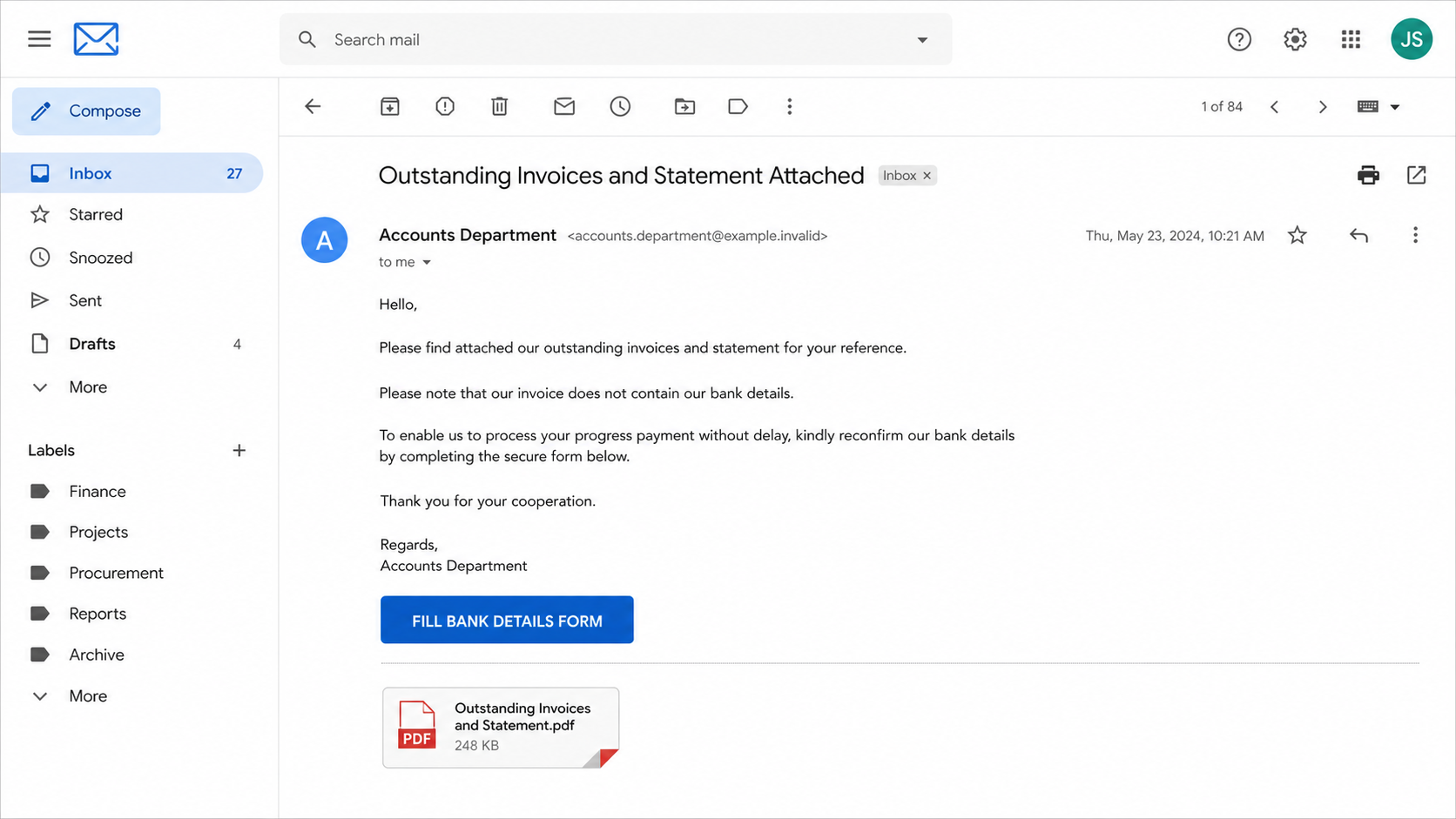
The “Invoice Do Not Bear Your Company’s Bank Details” email scam poses as a message from a customer, contractor, or accounts department. It says an invoice cannot be processed because it does not show the recipient company’s banking details.
The observed message refers to a progress payment and asks the recipient to fill in a bank-details form as soon as possible. A button appears to offer the missing form, but it sends the victim toward a fake file-sharing page designed to capture an email password.
This is primarily a credential-phishing attack, not a genuine request to update an invoice. The criminals may mention bank details to catch the attention of someone in finance, but the immediate target is often the company email account.
Invoice bank details scam at a glance
- Fake claim: Your invoice is missing company bank details, so a payment cannot be completed.
- Common subject: “Outstanding Invoices and Statement Attached,” although wording can change.
- Call to action: Click a button to fill in or reconfirm the bank-details form.
- What opens: A fake download or file-sharing page, sometimes styled to resemble WeTransfer.
- Information targeted: Email address and password, followed potentially by financial information.
- Main risks: Email takeover, invoice fraud, data theft, password resets, and attacks on coworkers or customers.
The names, company details, signatures, and phone numbers in different copies may vary. Criminals frequently reuse the same story while replacing the visible sender or the website behind the button.
Why This Email Can Look Convincing
Business inboxes are full of invoices, statements, purchase orders, and payment questions. A short message about a missing field does not initially feel extraordinary, especially when it lands near month-end or during a busy project.
The scam also creates a positive kind of urgency. Instead of threatening to close an account, it implies that money is waiting to be paid. A busy employee may click because solving the supposed issue appears helpful to the company.
It borrows the language of real accounting work
Terms such as “progress payment,” “payment certificate,” “invoice details,” and “bank-in the payment” make the request sound connected to a genuine commercial relationship. A detailed signature can add another layer of credibility.
None of those details proves the sender has an outstanding payment. They can be copied from public websites, old emails, business directories, or a compromised mailbox.
The fake page may recognize your email address
Some phishing links carry the recipient’s address as a hidden parameter. The fraudulent page can then display that address automatically, making the login box feel personalized and familiar.
A prefilled username is not proof that a page is connected to your email provider. It usually means the attacker already knew where the phishing message was sent.
How the Invoice Bank Details Email Scam Works
Step 1: The scammers choose a finance-related pretext
The attack begins with a story that fits a working day. The sender claims to be trying to pay an invoice but says the recipient’s company bank details are absent or cannot be certified.
The message may refer to a specific claim number, project, statement, or attached invoice. These details are meant to stop the recipient from asking the most important question: “Do we actually know this payer?”
Step 2: The email creates pressure to respond quickly
The sender may say they already tried to call the office, that a payment is waiting, or that the details must be confirmed “ASAP.” This creates the impression that the recipient is delaying legitimate money.
Urgency also discourages the normal internal checks used for changes to payment information. The criminals want the employee to act from the email instead of contacting the supposed payer through a trusted channel.
Step 3: A button hides the true destination
The email contains a button with wording such as “Fill Bank Details Form.” The label describes a routine task, but the underlying address can point to a recently created or compromised domain unrelated to the claimed companies.
On a computer, hovering over the button may expose the destination. On a phone, press and hold the link without opening it to preview the address. A strange domain is a strong warning, but even a familiar-looking name can be misspelled or deceptive.
Step 4: The victim sees a fake file-sharing page
The landing page may imitate WeTransfer or another recognized document service. It can claim that the bank-details form is sensitive, protected, or available only after the recipient verifies their identity.
That is the pivot in the attack. What began as an invoice question has quietly become a request for an email password. A genuine document sender does not need the password to your mailbox to let you download a file.
Step 5: The fake form captures the email password
When the victim submits the form, the credentials are sent to the scammers. The page may show an error and ask for the password again, redirect to a harmless website, or display a generic document to reduce suspicion.
The absence of an obvious confirmation does not mean the information was safe. The first submission may already have been recorded.
Step 6: Criminals test the mailbox and connected accounts
Attackers may sign in immediately or use automated tools to test the password. Once inside, they can search for invoices, payment discussions, customer lists, password-reset emails, and valuable attachments.
If the password was reused, they may try the same combination against cloud storage, payroll, accounting, shopping, social media, and other services. A single reused password can turn one phishing page into several account takeovers.
Step 7: The stolen inbox becomes a fraud platform
A compromised business mailbox is valuable because messages sent from it inherit the victim’s reputation. Criminals can reply inside real payment threads, replace bank details on genuine invoices, or send new phishing links to coworkers and customers.
They may also create forwarding rules or filters that hide security alerts and copies of their replies. This allows the intrusion to continue even when the mailbox owner sees nothing unusual.
Red Flags That Expose the Scam
The sender and the story do not match your records
Check whether your company issued the invoice mentioned in the email, whether the sender is an approved customer, and whether the claim number exists. A professional signature does not replace those checks.
Look at the full sender address, not only the display name. A reply-to address that differs from the sender, an unrelated domain, or a recently registered web address should stop the conversation.
The message asks for a mailbox password
This is the clearest warning. A payer, supplier, document service, or bank does not need your email password to show you an invoice form. The password authenticates you to your email provider, not to an unrelated file.
WeTransfer’s official phishing guidance says it will not ask users to confirm an email password to download a transfer. A genuine WeTransfer download also points to its real service domain, though a familiar brand name alone is never enough to establish trust.
The request bypasses normal payment controls
Any request involving bank details deserves an independent verification. The FTC recommends clear procedures for approving invoices and checking payment requests, especially when an unexpected message attempts to change the normal process.
Call a known contact using a number already in your records. Do not use a phone number, link, or contact detail supplied by the suspicious email.
How to Check the Message Safely
- Do not use the button. Leave the message open only long enough to inspect it, without downloading the form or replying.
- Find the alleged invoice internally. Check your accounting system, sent mail, and approved customer list for the referenced document.
- Inspect the actual sender and reply-to addresses. Expand the header details and compare the domain with the organization’s official website.
- Preview the link. Look for unrelated hosting, misspellings, extra words, or a domain that has nothing to do with the claimed service.
- Contact the payer separately. Use a saved number or existing conversation that predates the suspicious email.
- Ask finance or IT to review it. A second person can often spot a mismatch that urgency caused the first reader to miss.
If the supposed customer cannot confirm the request, report the message as phishing and delete it. Do not forward it casually, because another employee may click the live link.
What to Do if You Have Fallen Victim to This Scam
- Change the exposed email password immediately. Open your email provider from a trusted bookmark or by typing its address yourself. Choose a new, unique password that you have never used on another account.
- Sign out other sessions and revoke suspicious access. Use the account security page to end unknown sessions, remove unfamiliar devices, revoke third-party applications, and generate new app passwords where applicable.
- Turn on multi-factor authentication. Prefer an authenticator app, passkey, or hardware security key. If multi-factor authentication was already enabled, review whether a new method, phone number, or recovery address was added.
- Inspect mailbox rules, forwarding, and delegates. Delete unauthorized forwarding addresses, inbox filters, automatic replies, and delegated users. Check the Sent, Deleted, Archive, and Trash folders for messages you did not create.
- Reset every account that reused the password. Start with banking, accounting, payroll, cloud storage, domain management, and social networks. Use different passwords for every service.
- Alert your company’s security and finance teams. Ask them to review sign-in logs, payment changes, outgoing messages, OAuth grants, and recent password resets. Preserve the phishing email, its headers, and screenshots as evidence.
- Warn affected customers or suppliers. If attackers sent messages from your account, notify recipients through a clean channel. Tell them not to use any bank details, links, or attachments received during the compromised period.
- Contact your bank quickly if payment details were changed or money moved. Ask the fraud department to recall or freeze transfers. For U.S. incidents, report business email compromise to the FBI’s IC3 and the scam to the FTC; use the equivalent national reporting service elsewhere.
- Scan devices if you opened or downloaded anything. Credential phishing does not always install malware, but a malicious attachment or download can create a second problem. Run a full scan with reputable, updated security software.
Is Your Device Infected? Run a Free Malware Scan
Slow performance, constant pop-ups, or strange behavior? These are classic signs of a malware infection. The fastest way to find out is to scan your device with Malwarebytes Free — one of the most trusted malware removal tools available.
The free version detects and removes the most common threats, including:
- Adware — the cause of those annoying pop-ups
- Browser hijackers — unwanted redirects and changed homepages
- Trojans and spyware — hidden programs stealing your data
- Potentially unwanted programs (PUPs) — software you never asked for
👉 Select your device below — Windows, Mac, or Android — then follow the simple steps to download Malwarebytes, scan your system, and remove any threats it finds. The scan usually takes 5 to 20 minutes.
Run a Malware Scan with Malwarebytes for Windows
Malwarebytes is one of the most popular and trusted anti-malware tools for Windows — and it’s completely free for removing infections. It catches threats that many antivirus programs miss, including adware, browser hijackers, and trojans. Follow the steps below to scan and clean your PC in just a few minutes.
Download Malwarebytes
Click the button below to download the latest version of Malwarebytes for Windows from the official source. The free version is all you need — it will scan your computer and remove adware, browser hijackers, and other malicious software at no cost.
Download MalwarebytesOfficial installer for Windows 11 and 10. Your download starts right away.Want real-time protection? See Malwarebytes Premium Malwarebytes Free for WindowsScans and removes malware at no cost
-
Install Malwarebytes
When the download finishes, open your Downloads folder and double-click the MBSetup file. If Windows shows a User Account Control pop-up, click “Yes” to allow the installation.

Follow the On-Screen Prompts to Install Malwarebytes
The setup wizard will walk you through a few quick screens:
-
Choose where you’re installing the program — “Personal Computer” or “Work Computer” — then click Next.

-
Malwarebytes will now install on your device. This usually takes under a minute.

-
When installation is complete, the “Welcome to Malwarebytes” screen will open automatically.

-
On the final screen, click Open Malwarebytes to launch the program.

-
Enable “Scan for Rootkits”
Before scanning, turn on rootkit detection so Malwarebytes can find even the most hidden threats. Click the Settings gear icon on the left side of the screen.

In the settings menu, find “Scan for rootkits” and click the toggle so it turns blue.

Done? Click “Dashboard” in the left pane to return to the main screen.
Start the Scan
Click the blue Scan button. Malwarebytes will automatically update its virus database and start checking your computer for malware.

-
Wait for the Scan to Finish
The scan checks your entire system for browser hijackers and other malicious programs, so it can take 5 to 20 minutes depending on your computer. Feel free to do something else — just check back occasionally to see the progress.

-
Quarantine the Detected Threats
When the scan is done, you’ll see a list of everything Malwarebytes found — malware, adware, and potentially unwanted programs. Click the “Quarantine” button to remove all of them at once.

Malwarebytes will now remove the malicious files and registry entries and move them safely into quarantine.

-
Restart Your Computer
Some threats can only be fully removed after a reboot. If Malwarebytes asks you to restart, click Yes. Once you’re logged back in, Malwarebytes has finished removing the threats it found.

That’s it — your Windows PC is now clean of trojans, adware, and other malware, and should be back to running smoothly.
If you are still having problems with your computer after completing these instructions, then please follow one of the steps:
- Run a computer scan with ESET Online Scanner
- Ask for help in our Windows Malware Removal Help & Support forum.
Run a Malware Scan with Malwarebytes for Mac
Malwarebytes for Mac is a free on-demand scanner that removes the malware other security software tends to miss — adware, browser hijackers, and unwanted programs included. Cleaning an infected Mac with Malwarebytes has always been completely free, and it’s our go-to recommendation. Follow the steps below to scan and clean your Mac in just a few minutes.
-
Download Malwarebytes for Mac
Click the button below to download the latest version of Malwarebytes for Mac.
Download MalwarebytesOfficial installer for macOS. Your download starts right away.Want real-time protection? See Malwarebytes PremiumMalwarebytes Free for MacScans and removes malware at no cost -
Open the Malwarebytes setup file
When the download finishes, open your Downloads folder and double-click the setup file to begin the installation.

-
Follow the On-Screen Prompts to Install Malwarebytes
The Malwarebytes for Mac Installer will guide you through a few quick screens. Click “Continue” and keep following the prompts until the installation completes.



When the installation is complete, Malwarebytes opens to the Welcome to Malwarebytes screen. Click “Get started“.
-
Select “Personal Computer” or “Work Computer”
Malwarebytes will ask what type of computer you’re installing it on. Click either Personal Computer or Work Computer, whichever applies.

-
Start the Scan
Click the “Scan” button. Malwarebytes will automatically update its detection database and begin checking your Mac for malware.

-
Wait for the Scan to Finish
Malwarebytes will scan your Mac for adware, browser hijackers, and other malicious programs. This can take a few minutes, so feel free to do something else — just check back occasionally to see the progress.

-
Quarantine the Detected Threats
When the scan is done, you’ll see a list of everything Malwarebytes found. Click the “Quarantine” button to remove all the threats at once.

-
Restart Your Mac
Malwarebytes will now remove all the malicious files it found. Some threats can only be fully removed after a reboot — if Malwarebytes asks you to restart, allow it. Once you’re logged back in, your Mac is clean.

That’s it — your Mac is now free of adware, rogue browser extensions, and other potentially harmful software.
If you are still experiencing problems while trying to remove a malicious program from your computer, please ask for help in our Mac Malware Removal Help & Support forum.
Run a Malware Scan with Malwarebytes for Android
Malwarebytes for Android automatically detects and removes dangerous threats like malware and ransomware so you don’t have to worry about your most-used device being compromised. Aggressive detection of adware and potentially unwanted programs keeps your Android phone or tablet running smooth.
-
Download Malwarebytes for Android.
You can download Malwarebytes for Android by clicking the link below.
Get Malwarebytes for AndroidOpens Google Play in a new tab.Want real-time protection? See Malwarebytes Premium for AndroidMalwarebytes for AndroidScans your phone and removes malware at no cost -
Install Malwarebytes for Android on your phone.
In the Google Play Store, tap “Install” to install Malwarebytes for Android on your device.

When the installation process has finished, tap “Open” to begin using Malwarebytes for Android. You can also open Malwarebytes by tapping on its icon in your phone menu or home screen.

-
Follow the on-screen prompts to complete the setup process
When Malwarebytes will open, you will see the Malwarebytes Setup Wizard which will guide you through a series of permissions and other setup options.
This is the first of two screens that explain the difference between the Premium and Free versions. Swipe this screen to continue.
Tap on “Got it” to proceed to the next step.
Malwarebytes for Android will now ask for a set of permissions that are required to scan your device and protect it from malware. Tap on “Give permission” to continue.
Tap on “Allow” to permit Malwarebytes to access the files on your phone.
-
Update database and run a scan with Malwarebytes for Android
You will now be prompted to update the Malwarebytes database and run a full system scan.

Click on “Update database” to update the Malwarebytes for Android definitions to the latest version, then click on “Run full scan” to perform a system scan.

-
Wait for the Malwarebytes scan to complete.
Malwarebytes will now start scanning your phone for adware and other malicious apps. This process can take a few minutes, so we suggest you do something else and periodically check on the status of the scan to see when it is finished.

-
Click on “Remove Selected”.
When the scan has been completed, you will be presented with a screen showing the malware infections that Malwarebytes for Android has detected. To remove the malicious apps that Malwarebytes has found, tap on the “Remove Selected” button.

-
Restart your phone.
Malwarebytes for Android will now remove all the malicious apps that it has found. To complete the malware removal process, Malwarebytes may ask you to restart your device.
That’s it — your Android phone is now clean — no more malicious apps, adware, or browser redirects.
If you are still having problems with your phone after completing these instructions, then please follow one of the steps:
- Restore your phone to factory settings by going to Settings > General management > Reset > Factory data reset.
- Ask for help in our Mobile Malware Removal Help & Support forum.
Stay Protected: Block Ads and Malicious Sites
Now that your device is clean, keep it that way. Most infections start with a malicious ad or a fake download button — so blocking them at the source is your best defense.
We recommend AdGuard, which blocks malicious ads, phishing pages, and dangerous redirects before they can reach you.
👉 Download AdGuard and browse safely
How Businesses Can Reduce the Risk
Separate document access from payment approval
Employees should never approve new bank details merely because a document arrived by email. Require an independent callback and, for high-value changes, approval from a second authorized employee.
Keep trusted supplier details in the accounting system. When an email presents different information, treat the difference as an exception that must be verified, not a shortcut that needs to be followed.
Protect email as financial infrastructure
Business email is often connected to invoicing, cloud storage, and password recovery, so it should be protected like a financial account. Use unique passwords, phishing-resistant multi-factor authentication, and alerts for new forwarding rules or unusual sign-ins.
Domain owners should configure SPF, DKIM, and DMARC to reduce spoofing of their own addresses. These controls do not stop every phishing email, but they make it harder for attackers to impersonate the company convincingly.
Give staff a safe way to pause
Finance employees should be encouraged to question urgent requests without being blamed for slowing down a payment. A two-minute verification call costs far less than recovering a hijacked mailbox or fraudulent transfer.
Run short exercises using realistic invoice and document lures. The goal is not to trick staff; it is to build the habit of checking the sender, destination, business context, and requested action.
Common Questions About the Invoice Bank Details Email
Can opening the email alone compromise my computer?
Reading an ordinary phishing message is generally not the same as submitting information or running a file. The greatest risk begins when you follow the link, open a malicious attachment, enable document content, or install something it provides.
Modern email clients can load remote images that tell a sender the message was opened, so blocking automatic remote content still provides privacy value. If you only read the email, report and delete it; if you interacted with its content, follow the recovery steps above.
Is it safe if the fake form no longer loads?
No. A dead page can return later, redirect to a new destination, or work only for selected visitors. Security services and hosting providers frequently disable phishing pages, but the email remains fraudulent even after its link stops responding.
What if the email names a real customer?
That may indicate the attacker used public information, obtained an old contact list, or accessed one party’s mailbox. Treat the message more seriously, but verify it through the customer’s known phone number and review the entire payment conversation for tampering.
Should I reply to test whether the sender is genuine?
No. A reply confirms that your address is monitored and keeps you inside a channel the attacker may control. Start a new conversation using contact information already stored in your accounting or customer-management system.
Official Sources and Further Reading
- WeTransfer: Spam, phishing, and fake WeTransfer emails
- FTC: Fake invoices and phishing aimed at small businesses
- FTC: How to recognize and avoid phishing scams
- FTC: Report fraud and scams
The Bottom Line
The “Invoice Do Not Bear Your Company’s Bank Details” email is not a routine request to complete a payment. It uses a believable accounting problem to steer the recipient to a fake file-sharing page and steal an email password.
Do not use the embedded form. Verify the invoice and sender through records you already trust. If you entered a password, secure the mailbox immediately, inspect forwarding rules, alert your organization, and check whether criminals used the account to target anyone else.

Join the discussion
0 commentsShare your experience or ask a question about this article.
Discussion
Start the conversation
Have a question or something useful to share? Add the first comment.