

Iron Eraser is promoted with the kind of demonstration that performs extremely well in short videos: spray a dirty wheel or rusty-looking surface, wait for the liquid to turn purple, rinse it away, and reveal cleaner metal underneath.
The color change is real chemistry used by many automotive iron removers. It indicates that the cleaner is reacting with iron contamination such as embedded brake dust and rail dust. What it does not prove is that deep rust, pitting, weakened metal, or damaged paint has somehow been restored.
That difference is the heart of this review. Iron Eraser is a real detailing product from a seller with public contact information and a U.S. return address. The questionable part is the way “iron remover” can be interpreted in ads as “rust repair,” even though those are very different jobs.
If you buy the spray for contaminated wheels or paint, it may perform as intended. If you buy it expecting a $20 bottle to reverse structural corrosion, the result is likely to be disappointing.
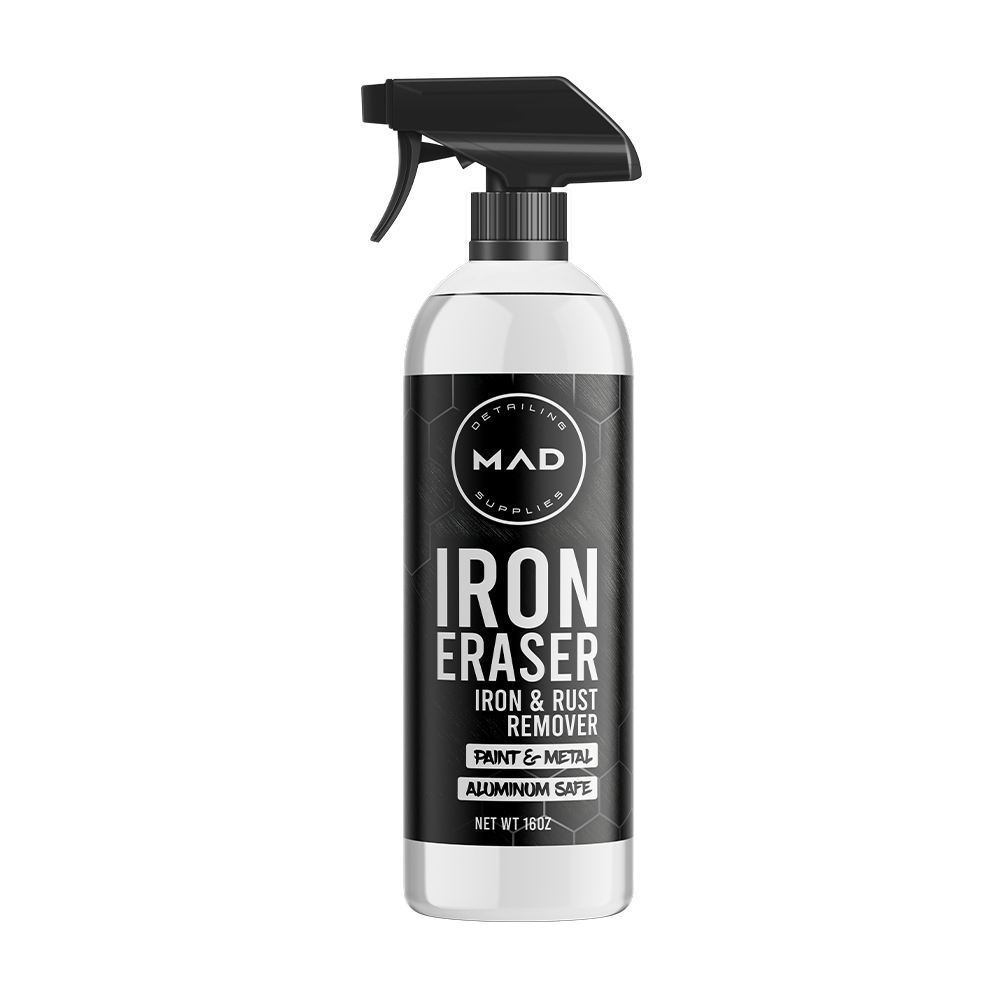
Overview
Iron Eraser is sold by MAD Detailing as an automotive decontamination spray for wheels, brakes, suspension parts, tires, and painted body panels. The official listing says it removes iron deposits, brake dust, and other bonded contaminants. It also instructs users not to let the product dry and to test it first on a small, inconspicuous area.
On July 30, 2026, the official product page listed the 16-ounce bottle at $20 and marked it sold out. The page displayed 148 customer reviews and a 4.7 rating. Seller-hosted ratings are useful context, but they are not the same as independent testing.
What Iron Eraser Is Designed to Remove
- Brake dust embedded in wheel finishes
- Iron fallout bonded to automotive clear coat
- Small ferrous particles from roads, rail transport, and industrial exposure
- Surface contamination that ordinary car shampoo may leave behind
What It Cannot Repair
- Deep corrosion that has eaten into the metal
- Rust holes, flaking panels, or weakened structural parts
- Paint failure, clear-coat damage, or exposed bare metal
- Pitting that remains after loose oxidation is cleaned away
A cleaned rust spot can look dramatically better because orange residue and loose contamination are gone. That is not the same as restoring the missing metal. Once corrosion has removed material, a spray cannot put it back.
Why Iron Eraser Turns Purple
Iron-removal products react with ferrous contamination and create the characteristic purple or red “bleeding” effect seen in detailing videos. The color is a useful sign that the cleaner has encountered iron particles.
However, the dramatic color change is also a powerful marketing visual. A surface can bleed heavily even when the product is mainly reacting with brake dust rather than repairing visible rust. The purple runoff proves a reaction occurred; it does not measure how much permanent corrosion was fixed.
MAD Detailing publishes ingredient and hazardous-product information for its line. That transparency is a positive sign compared with anonymous novelty sprays that provide no instructions or safety information.
How the Iron Eraser Marketing Funnel Works
Step 1: A Short Video Shows an Extremely Dirty Surface
The demonstration usually starts with a wheel, brake component, tool, or metal surface covered in dark grime and orange staining. The “before” condition is selected to create the biggest possible visual contrast.
Step 2: The Spray Immediately Begins to Bleed Purple
The reaction looks like the contamination is dissolving in real time. This is the moment viewers remember, and it can make the product seem more revolutionary than an ordinary detailing chemical.
Step 3: The Video Compresses the Cleaning Process
Ads may skip agitation, pressure washing, repeated applications, drying, or follow-up protection. The official directions actually require rinsing, a dwell period, possible brush agitation on wheels, and a final wash on paint.
Step 4: “Iron Remover” Is Mentally Translated Into “Rust Remover”
Many buyers use the words iron and rust interchangeably. The product name benefits from that confusion even when the official description focuses on iron deposits and brake dust.
One review on the seller’s own product page captured the limitation clearly: the spray did a good job cleaning aluminum wheels but did not do as well removing rust. That is exactly what should be expected from an iron fallout remover.
Step 5: A Real Cleaning Result Is Treated as Proof of Rust Repair
After rinsing, the surface may be cleaner and brighter. If corrosion is still present, it must be mechanically removed, chemically converted where appropriate, sealed, refinished, or repaired by replacing the affected part.
Why Some Iron Eraser Ads Deserve Extra Skepticism
Some Iron Eraser promotions circulating online appear far more dramatic than the instructions and claims on MAD Detailing’s own product page. Viewers have questioned clips in which corrosion seems to disappear instantly, including from areas that were not clearly sprayed. Others have pointed to unnatural voiceovers, abrupt visual changes, and imagery that looks AI-generated or heavily edited.
Those visual oddities do not prove that the bottle is fake. They do mean the advertisement should not be treated as a controlled product demonstration. A legitimate cleaner can still be promoted with manipulated footage that creates an unrealistic impression of speed, coverage, or permanent repair.
Repeated Reviews and Generic Alternatives
Another concern raised around the campaign is the appearance of very similar testimonial wording and product images across different ads or sales pages. Reviews that cannot be tied to a verified purchase provide weak evidence, especially when the same photograph or phrase is reused.
Iron fallout removers are also a common product category. Similar sprays are sold under many brands, sometimes for less money. Countdown timers, oversized discounts, or “breakthrough formula” language do not prove that Iron Eraser is unique. Compare the ingredient and safety information, bottle size, price, and return terms with established detailing alternatives before buying.
Is Iron Eraser a Scam or Legit?
Iron Eraser is a legitimate automotive detailing product. MAD Detailing operates a broader product catalog, provides a support phone number and email, publishes instructions and hazardous information, and lists a physical return address in DeBary, Florida.
There is no evidence that the bottle is fictitious or that the store exists only to collect card details. The product category is also well established. Professional and enthusiast detailers commonly use iron fallout removers on wheels and paint.
The realistic concern is expectation inflation, made worse by promotional clips that may be edited or AI-assisted. If an ad implies that Iron Eraser can erase serious corrosion in seconds, treat the footage as marketing rather than proof. The official use case is contamination removal, not structural restoration.
Our Verdict
Legitimate for brake dust and iron fallout; not a cure for rust damage. Buy it only for the job described on the official page. Do not purchase it as a substitute for sanding, rust conversion, refinishing, welding, or replacement of damaged parts.
Iron Eraser Red Flags and Buying Considerations
- The name can create the wrong expectation: “Iron Eraser” sounds broader than an iron fallout decontaminant.
- Short videos may omit important work: Rinsing, agitation, repeat treatment, and follow-up protection matter.
- Some promotional footage looks manipulated: Unnatural transitions and instant changes outside the sprayed area make the ads unreliable as performance evidence.
- Testimonials may be repeated or unverifiable: Similar wording and imagery across ads should not be mistaken for independent customer testing.
- The formula may not be unique: Comparable iron fallout removers are widely available, sometimes at lower prices.
- Purple runoff is not proof of rust repair: It mainly shows a reaction with ferrous contamination.
- Seller-hosted reviews are not independent tests: Consider them alongside detailing guidance and your specific surface.
- The return policy favors unused products: Eligibility requires the item to be unused and in original packaging, which may complicate a return after testing it.
- The official page listed the product as sold out on July 30: Avoid lookalike stores claiming to have exclusive stock.
How to Use Iron Eraser More Safely
Work on a Cool Surface
Do not apply a detailing chemical to hot wheels or panels unless the manufacturer specifically permits it. Heat can accelerate drying and increase the risk of spotting or finish damage.
Test a Hidden Area First
The official directions explicitly recommend a small test spot. This is especially important on unknown wheel finishes, uncoated metals, repainted panels, older clear coat, and delicate trim.
Do Not Let It Dry
Allow the product to dwell only for the stated time, keep an eye on the surface, and rinse thoroughly. More dwell time is not automatically better.
Use Appropriate Protection
Wear gloves and eye protection, avoid inhaling mist, and work with ventilation. Keep the spray away from children and pets. Read the current label and safety information rather than relying on a social-media demonstration.
Protect the Surface After Decontamination
An iron remover cleans contamination but does not necessarily leave durable protection. Paint may need a proper wash and protective wax, sealant, or coating. Bare metal with corrosion may need immediate treatment to stop moisture from restarting the process.
How to Tell Surface Contamination From Serious Rust
Small orange specks on otherwise intact paint can be embedded iron particles. These may respond well to an automotive fallout remover.
Bubbling paint, flakes, deep pits, swelling around seams, holes, and soft metal indicate actual corrosion damage. A cleaner might remove staining around the area, but the affected material still needs repair.
Rust on brake components, suspension parts, frames, or load-bearing structures should be evaluated carefully. A cosmetically cleaner part is not necessarily a safer part.
What to Do If Iron Eraser Did Not Work as Expected
1. Stop Reapplying It Blindly
Repeated chemical exposure can damage a finish without solving the underlying problem. Identify whether you are dealing with bonded fallout, ordinary grime, mineral deposits, paint failure, or true corrosion.
2. Photograph the Surface and Product Label
Take clear before-and-after photos, save the batch information, and note how the product was diluted or applied. This will help the support team assess whether the issue is technique, compatibility, or a defective item.
3. Contact MAD Detailing in Writing
The store lists an email and telephone support line. Explain the surface type, application time, temperature, and result. Do not ship anything back without authorization.
4. Review the Return Restrictions
The published policy gives 30 days from shipment to start a return and states that eligible products must be unused and in original packaging. A product already opened and tested may not qualify under the standard return language, so ask for a written decision before paying return postage.
5. Use the Correct Repair Method
If the issue is real rust, consult an automotive body specialist or mechanic. Surface rust may require abrasion and coating; structural corrosion may require part replacement or professional repair.
6. Watch for Copycat Listings
Purchase only from the official MAD Detailing store or an authorized marketplace account. A sold-out label on the official page can attract imitators using stolen videos and unusually low prices.
Frequently Asked Questions
Does Iron Eraser Remove Rust?
It may clean loose orange staining and iron contamination from a surface, but it cannot rebuild metal removed by corrosion. Deep rust, pits, holes, and weakened parts remain after cleaning.
Why Does Iron Eraser Turn Purple?
The formula reacts with ferrous contamination. The visible reaction is common among automotive iron removers and helps show where iron particles are present.
Can Iron Eraser Be Used on Car Paint?
The official page includes body panels in its intended uses, but it also says to test a hidden area, avoid letting the product dry, rinse thoroughly, and rewash with soap and water. Follow the current label for the exact bottle received.
Is MAD Detailing a Real Company?
The store provides a product catalog, support phone number, email, safety information, and a U.S. return address. Those are stronger legitimacy signals than an anonymous one-product store.
Is the $20 Price Reasonable?
It falls within the broad range of specialty detailing chemicals, but value depends on bottle size, shipping, and how much surface you need to treat. Compare it with established iron fallout removers rather than with structural rust treatments.
The Bottom Line
Iron Eraser is not a fake miracle liquid. It is a real automotive decontamination spray whose purple reaction can produce satisfying cleaning results on wheels and paint.
The mistake is expecting it to reverse corrosion. Use it for brake dust and bonded iron fallout, follow the safety directions, and treat any claim that it “repairs” deep rust as marketing exaggeration.

Join the discussion
0 commentsShare your experience or ask a question about this article.
Discussion
Start the conversation
Have a question or something useful to share? Add the first comment.