

A wave of “closing sale” jewelry boutiques has been spreading through social media feeds, all built around the same irresistible pitch: a beloved small business is retiring, everything must go, and you can claim high-priced jewelry for $0 if you only cover shipping. JackAndJenJewelry.com fits that pattern closely, right down to the emotional backstory and the urgency-heavy storefront.
What makes this scheme effective is not just the marketing. It is the checkout design, which can steer shoppers into a recurring membership charge many people do not notice until later.
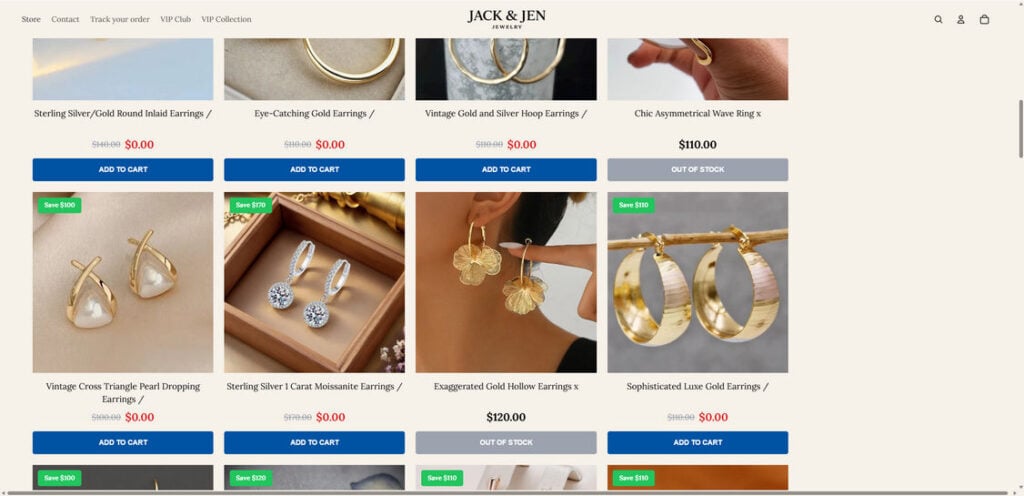
What JackAndJenJewelry.com promises
On the storefront, visitors are met with “closure sale ends today” language and a narrative about a couple stepping away from a boutique they “nurtured for nearly three decades,” offering the final collection “for free.”
Products are displayed with dramatic markdowns, such as $120.00 to $0.00, reinforcing the idea that you are getting a luxury item for almost nothing.
This framing matters because it lowers a shopper’s defenses. Paying a small shipping fee feels “safe,” especially when the product page piles on trust language like guarantees, high review counts, and big customer claims.
The real engine: the VIP Club subscription
The membership page explains the key mechanic plainly:
- “Join today, only $29.99 per month.”
- “Yes, you will be charged $29.99 per month until you cancel.”
- Cancellations “will be honored” only if done at least 3 business days before the next billing.
That is the “subscription trap” risk in a nutshell. Even if someone intended to pay only shipping, the flow can be structured to make VIP enrollment easy to miss, easy to accept, and hard to unwind.
How the Jack & Jen funnel works
1) The social ad pulls you in with a retirement story
The ads lean on nostalgia and credibility: “27 years,” handcrafted jewelry, and a final goodbye. There are multiple versions of this pitch circulating on social platforms.
This is a classic persuasion setup: it frames the purchase as support for a couple’s “last chapter,” not as a risky impulse buy.
2) The storefront reinforces urgency and “too good to miss” value
Once you land on the site, urgency is pushed immediately (“closure sale ends today”), and products are positioned as nearly gone.
The $0 pricing is the hook. The site can still collect money through shipping fees and, more importantly, through membership billing.
3) The product page adds manufactured trust signals
A typical product page layers in signals that discourage second-guessing:
- Large review count displays (example: “245 Reviews”)
- Big “customers love our craftsmanship” claims (“100,000+ customers”)
- Artificial demand cues (“431 items purchased in the last 24 hours”)
None of these are proof of wrongdoing by themselves, but in combination with a brand-new domain and a “free jewelry” pitch, they are a strong warning pattern.
4) Checkout can route through a separate ordering flow
The checkout is hosted on a separate ordering subdomain.
In many subscription-trap storefronts, that checkout step is where membership language is minimized, preselected, collapsed, or presented as a “perk” rather than a recurring paid commitment. The membership page itself describes joining via “VIP Add to Cart” and completing checkout “like any other purchase,” which matches that style of funnel.
5) Recurring billing starts, and canceling becomes its own project
When a shopper discovers unexpected charges, the next hurdle is stopping future billing.
The site’s own membership page sets expectations that:
- billing continues until canceled, and
- cancellation timing matters (3 business days before renewal).
In practice, that kind of rule increases the chance of at least one more charge after someone tries to cancel.
Evidence the “27 years” story does not align with the domain footprint
The domain is extremely new
Third-party analysis shows a creation date of January 12, 2026, and labels the site as a “young domain.”
A new domain is not automatically a scam. But a brand-new domain conflicts with the site’s “nearly three decades” narrative and the long-history positioning in the marketing.
The site runs on a templated ecommerce setup
A reputation scan identifies the platform as Shopify, which is commonly used by legitimate stores and by short-lived scam storefronts because it is quick to deploy.
The scarcity and social proof feel engineered
The combination of “ends today,” giant markdowns, “last chance,” high-volume purchase counters, and huge customer totals is a familiar playbook in pop-up scam shops.
What to do if you already bought from JackAndJenJewelry.com
If you paid a shipping fee or completed checkout, treat this as a potential recurring billing incident and move fast.
- Check your card statement for recurring charges.
Look for any monthly billing that you do not recognize, especially amounts around $29.99. The membership page confirms that as the stated monthly fee. - Contact your bank or card issuer and dispute unauthorized or misleading charges.
Ask about chargeback options for a subscription you did not knowingly agree to. - Request a new card number if you see ongoing billing or suspicious activity.
Stopping the payment method is often the cleanest way to prevent repeated charges. - Cancel the membership in writing and keep proof.
Take screenshots of the membership cancellation instructions and send a clear email stating you are canceling effective immediately. The site lists email and other cancellation routes, plus the 3-business-day rule. - Document everything.
Save:- order confirmation emails
- screenshots of product pricing ($0 offers)
- screenshots of the membership terms
- timestamps of your cancellation request
- Report the ad where you found it.
If it appeared on Facebook or Instagram, report it as a deceptive offer and subscription trap. - Report the site to consumer protection channels.
In the US, that usually means the Federal Trade Commission and the FBI Internet Crime Complaint Center (IC3) if money was lost.
How to spot the next “closing sale” jewelry scam before you pay
Use this checklist any time you see “free” luxury goods in ads:
- Check the domain age. A brand-new domain paired with a “decades-old business” story is a major mismatch.
- Read every checkbox and expandable line item at checkout. Look for “club,” “VIP,” “membership,” “subscription,” or “monthly.”
- Be skeptical of $0 pricing plus shipping. That structure is frequently used to monetize through subscriptions.
- Treat big urgency and big social proof as marketing, not evidence. “Ends today,” “last chance,” and huge counters are easy to fake.
- Search the brand name plus “scam” or “subscription” before paying. Tools like reputation checkers can also surface “young domain” flags.
FAQ
Is JackAndJenJewelry.com a legitimate long-running jewelry boutique?
The site presents a “nearly three decades” story, but third-party domain data shows a very recent creation date, which does not align with that narrative.
Why is the jewelry priced at $0?
The $0 price works as bait. It makes shoppers focus on “just shipping,” while the funnel can monetize through a paid VIP membership.
What is the Jack & Jen VIP membership?
The membership page states it is a recurring plan billed at $29.99 per month until canceled.
Can I cancel after I notice the subscription?
The site claims you can cancel, but it also states cancellations must be honored only if done at least 3 business days before the next billing cycle.
I only paid shipping. Can I still be charged monthly?
Yes. The membership page explicitly describes a recurring monthly fee. If you went through a VIP enrollment path, recurring billing is the risk to check for.
Why do these ads look so convincing?
They use emotional storytelling, “retirement” framing, urgency, and “free” pricing. This combination reduces skepticism and speeds up checkout decisions.
Does the site show signs of manufactured social proof?
Some product pages display high purchase counters (for example, “431 items purchased in the last 24 hours”) and very large customer totals, which are common persuasion tactics on short-lived scam stores.
What should I do first if I see unexpected charges?
Call your card issuer, dispute the charge, and ask how to block future recurring billing. Then document your cancellation request.
Where should I report it?
Report the ad on the platform where you saw it, and file consumer fraud reports (FTC in the US, plus IC3 if you lost money).
How can I protect myself next time?
Avoid “free luxury item” offers from ads, verify domain age, and scrutinize checkout checkboxes and membership language before submitting payment.

Join the discussion
0 commentsShare your experience or ask a question about this article.
Discussion
Start the conversation
Have a question or something useful to share? Add the first comment.