

If the Kojeva Face Brush keeps showing up in your feed, it is easy to see why. The ads promise visible de-puffing in about 90 seconds, a more defined jawline, and a cleaner alternative to gua sha, with no oils and no learning curve.
This review looks past the marketing. We will break down what the brush actually is, how these campaigns typically work, what results are realistic, and what to do if you already ordered, especially if you were charged for more units than you intended to buy.
Overview
What the brand is promising
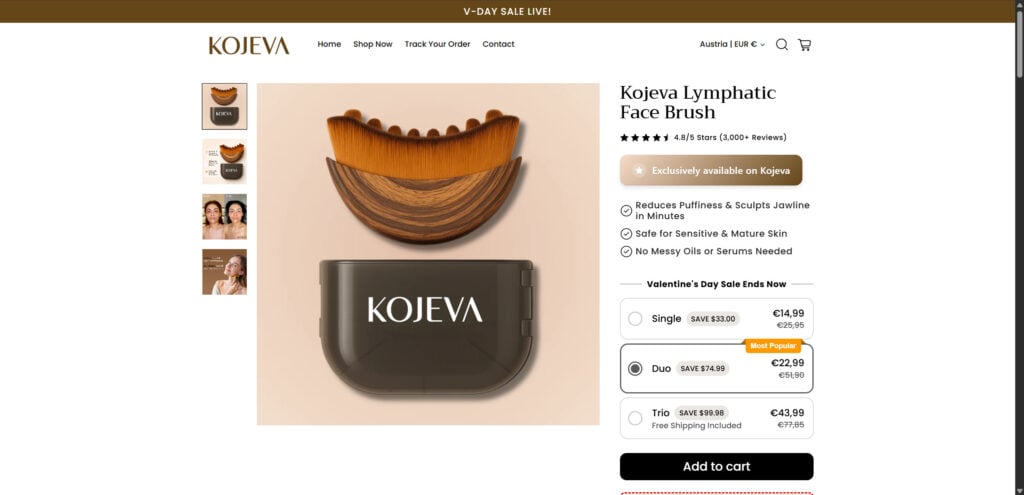
The product page positions the brush as a “lymphatic” tool that can change how your face looks, fast.
Here are the core claims, summarized plainly:
- It “reduces puffiness” and helps “sculpt” or “define” the jawline and cheekbones. (Kojeva)
- It works in about 90 seconds as a quick morning routine. (Kojeva)
- It is “safe for sensitive and mature skin,” with ultra-soft bristles. (Kojeva)
- It is cleaner and easier than gua sha or oil-based tools because you can use it dry. (Kojeva)
- It may help with jaw or temple tension through light strokes. (Kojeva)
Then come the “numbers” designed to remove doubt:
- 96% saw visible de-puffing after one use (about 90 seconds).
- 91% reported a more defined jawline/cheekbones within one week.
- 86% said it was easier and gentler than oil-based tools.
The fine print matters: the page frames these as “internal studies and customer feedback surveys,” not independent clinical research.
That distinction changes how much weight those percentages deserve.
What you are actually buying
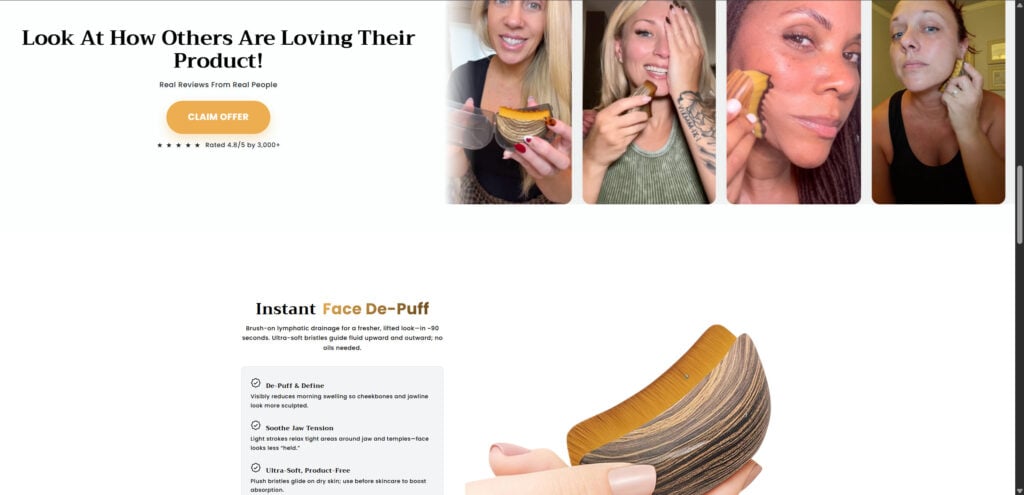
Functionally, this is a small facial brush with very soft bristles and an ergonomic handle, paired with a plastic travel case.
That is it.
There is nothing wrong with a simple product, but simplicity matters because it sets expectations. A soft brush can provide a light massage. It can feel soothing. It can temporarily reduce the look of puffiness in some people, especially if their puffiness is fluid-related and they respond well to gentle movement.
What it cannot do is permanently “sculpt” your face in the way that the ads often imply.
Bone structure does not change from brushing.
Fat distribution does not meaningfully shift from a 90-second routine.
And if your puffiness is driven by inflammation, allergies, sleep, alcohol, hormones, or skin irritation, a brush is not solving the root cause.
So the real question becomes: are you paying for a brush, or are you paying for the story built around it?
The “exclusive” claim vs how widely this product exists
The product page uses language like “exclusively available,” which implies uniqueness. (Kojeva)
But the exact same style of brush and case is openly sold as a generic item on wholesale marketplaces, including listings offering custom logos and bulk pricing under about $1 per unit.
That does not automatically mean “scam,” but it strongly suggests a private-label model: a mass-produced product sourced from China, rebranded, and sold at a high markup.
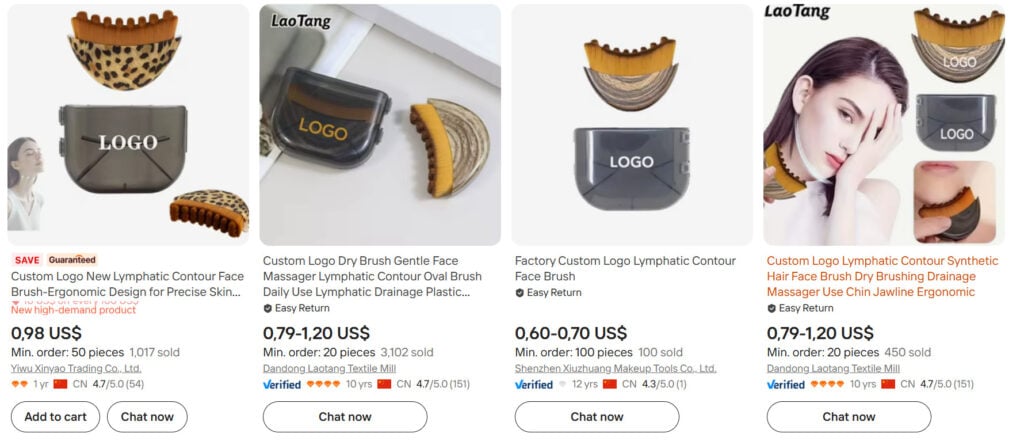
In other words, you are not buying a proprietary invention. You are buying branding, packaging, and a marketing funnel.
What “lymphatic drainage” can realistically do for your face
The lymphatic system is part of how your body moves fluid and supports immune function. When you wake up puffy, it is often fluid sitting in the tissues, especially around the eyes and cheeks.
Gentle massage can sometimes help move that fluid. That is why many people notice a temporary “less puffy” look after a cold splash, light facial massage, or time upright in the morning.
A soft brush can be one way to do that massage.
So yes, a facial brush might help with:
- Temporary morning puffiness
- The look of “tired” under-eyes caused by fluid
- A mild, short-term “more awake” look
But there is a hard limit:
- It will not permanently reshape your jawline.
- It will not replace professional treatment.
- It will not deliver consistent results across all skin types and lifestyles.
- It will not erase structural under-eye hollows, true skin laxity, or deeper aging changes.
That is where the marketing crosses into exaggeration, because it blurs “temporary de-puffing” into “jawline sculpting.”
The review count and social proof problem
On-site, the product is framed as having thousands of reviews, with ratings like 4.8/5 and a “based on 3,598 reviews” style widget.
Here is what to keep in mind:
- On-site reviews are controlled by the seller. They can be curated, filtered, and displayed selectively.
- “Verified buyer” badges are not universal proof of authenticity. They can simply mean the review was submitted through the store’s system.
- High counts do not automatically equal independent validation, especially when the product is a trendy, easily rebranded item.
A more useful signal is off-site discussion, especially from places not controlled by the seller.
For example, a thread on Reddit includes people saying the brush may arrive and may feel nice, but the ads appear more dramatic than real life.
That is the exact pattern you should expect with this category: mild benefit, inflated narrative.
Pricing and bundling: why the “Duo” is always the hero
Your screenshots show the classic bundle ladder:
- Single unit at a “discount”
- Duo marked “Most Popular”
- Trio with an added incentive like free shipping
This structure is not accidental. It is designed to:
- Anchor your brain to a higher “regular” price
- Make the middle option feel rational
- Increase average order value quickly
The listicle-style landing pages push the same tactic even harder: limited-time pricing, countdown timers, “sell-out risk,” and “high demand” language.
A legitimate brand can run promotions, but when urgency is constant, it is a sign you are in a performance marketing funnel, not a product-first business.
Policies and trust signals: what stands out
The site lists “Store Information” like customer support hours, a general U.S. location, and a support email.
That sounds reassuring until you look at the policy details.
The shipping policy states processing takes 2 to 4 business days and delivery estimates can range roughly from about 5 to 18 days depending on region, with a “delays outside our control” clause.
That delivery window is consistent with overseas fulfillment or extended logistics, even if the site presents as a U.S.-based store.
Then there is a more serious red flag in the refund policy: it instructs customers to start a return by contacting an email address at an entirely different domain (hello@snapskinbeauty.com).
That mismatch is not a minor typo.
It suggests one of the following:
- The store is running a reused template from another brand and did not fully update it.
- The operation is connected to other storefronts.
- Support and returns are not handled in a clean, consistent way.
On top of that, the refund policy states that personal care goods (including beauty products) may be non-returnable, which can conflict with the implied “30-day guarantee” vibe used in the marketing.
When policies are messy, returns often become messy.
So, should you buy it?
If you want the honest answer:
- As a de-puffing brush: it might provide mild, temporary benefit for some people.
- As a sculpting tool that changes your jawline: no.
- As a purchase experience: you are likely buying into a high-markup dropshipping funnel with aggressive marketing tactics and potentially frustrating customer support.
If you still want to try a brush like this, you can often find similar products on mainstream marketplaces like Amazon at lower prices, with clearer return systems.
That alone should make you pause before paying boutique-brand pricing.
How The Operation Works
This section is the “why it feels convincing” breakdown.
The Kojeva brush is not unique in what it sells. It is more interesting in how it sells.
Step 1: Short-form ads manufacture urgency and emotion
These campaigns usually begin on platforms like Instagram, where the goal is not education. It is a fast emotional hit.
The ad typically frames a relatable problem:
- “My face looks puffy in the morning.”
- “I look tired even when I sleep.”
- “My jawline disappeared.”
- “Gua sha is too hard and too much work.”
Then it promises a solution that fits modern attention spans:
- 90 seconds
- No oils
- No learning curve
- Immediate visual payoff
This style of creative is designed to be shared, saved, and impulsively purchased.
It is not designed to be scrutinized.
Step 2: The advertorial listicle, positioned as authority
Instead of sending you to a simple product page, many campaigns route traffic through a “story” page.
Kojeva uses listicle-style pages framed as advice content, including one attributed to Dr. Tara Flannery and marked “Updated today.” (Kojeva)
This is a common credibility hack:
- A medical title implies expertise.
- “Updated today” implies freshness and relevance.
- A list format feels like editorial content, not an ad.
But the page ultimately functions as a sales page with a big call-to-action button, price framing, and scarcity triggers.
If the “doctor” has no verifiable clinic, licensing info, or external presence, treat it as branding, not medical authority.
Step 3: Scarcity mechanics that push you into a fast decision
On these pages you will see:
- Countdown timers
- “Deal ending” warnings
- “Sell-out risk: very high”
- “Stock keeps selling out”
- “New customer only” disclaimers
Kojeva’s listicle page explicitly uses these tactics, along with a steep “was $49.98, now $16.99” framing.
This is how the funnel blocks careful thinking.
It tries to make “wait and research” feel like “miss out and regret.”
Step 4: Social proof that is impressive but not independently verifiable
Next comes the review wall.
“Thousands of reviews” sounds like a moat.
But in funnels like this, reviews are part of the conversion system:
- They reduce hesitation.
- They normalize buying.
- They provide scripts for what you should feel and say after purchase.
Notice how the reviews often repeat the same themes:
- “De-puffed fast”
- “No oil, no mess”
- “Jawline showed up”
- “Travel case wins”
That repetition can happen organically, but it can also be a sign that the review set is curated to reinforce the marketing narrative.
Again, off-site discussion is more informative, and it often lands on the same conclusion: the product may be okay, the ads are overstated.
Step 5: “Science-like” language that sounds specific but stays vague
The product page uses language like:
- “Stimulate lymphatic flow”
- “Guide fluid upward and outward”
- “Enhance definition”
- “Internal studies”
These phrases feel scientific, but they avoid testable details:
- Who was studied?
- How many people?
- What outcomes were measured?
- Compared to what?
- For how long?
- With what controls?
Instead, you get percentages.
That is not how strong evidence is normally presented.
The fine print admitting it is based on internal studies and customer surveys is doing a lot of work here.
Step 6: Price anchoring using unrelated high-cost services
One Kojeva listicle page compares the brush to expensive services like professional lymphatic massage and even injectables, implying the brush can replace those costs.
This tactic is powerful because it changes the value frame:
- If you think in terms of “a $15 brush,” it seems overpriced.
- If you think in terms of “replacing $100 to $600 sessions,” it seems like a bargain.
The comparison is not medically equivalent, but it is persuasive marketing.
Step 7: Bundles, upsells, and “I ordered one but got charged for more”
This is where many buyers get confused.
These funnels often include:
- A preselected bundle (Duo highlighted as “Most Popular”)
- Add-on offers after checkout
- “Protection” add-ons
- One-click upsells that feel like confirmation screens
When someone later says, “I ordered one but got three,” it can be caused by:
- Selecting a bundle without noticing
- Accepting an upsell
- Misreading the final confirmation
- A genuine billing or fulfillment error
Any of these scenarios are more likely in high-pressure funnels, because the entire design is optimized for speed, not clarity.
If you are buying anyway, slow down at checkout and screenshot the final order summary before paying.
Step 8: Fulfillment that looks normal, but behaves like dropshipping
Here is the operational reality behind many private-label beauty gadgets:
- Ads generate purchases.
- Orders flow into a storefront (often a lightweight ecommerce setup).
- Fulfillment is handled by a third-party supply chain, commonly from China or via global logistics networks.
- Delivery takes longer than people expect, especially compared to established retail.
Kojeva’s shipping policy lists estimated delivery windows that can extend into multiple weeks depending on region
That does not prove “dropshipping” by itself, but it matches what consumers typically experience with overseas-sourced items.
Step 9: Returns that are “allowed,” but practically difficult
On paper, the shipping policy says returns are accepted within 30 days if unused, with the buyer covering return shipping.
In practice, three issues often appear in this model:
- Return shipping can be expensive, especially if the return address is international.
- Beauty products are frequently excluded or limited by policy language.
- Support can be slow, inconsistent, or template-driven.
Kojeva’s refund policy raises an additional concern because the “start a return” email address points to a different domain entirely, which is a strong signal of a loosely managed operation. (Kojeva)
Even if you can return it, the friction may be enough that many buyers simply give up.
Step 10: Why the same product keeps reappearing under new names
When a product is generic and sourced at very low wholesale cost, the brand name becomes disposable.
That is why you see:
- “Exclusive” brushes that are not exclusive
- Multiple near-identical storefronts
- Recycled templates
- Similar claims and the same structure of urgency and reviews
This is not how a product-first brand behaves.
It is how a media-buying operation behaves.
What To Do If You Have Bought This
If you already ordered the Kojeva brush, the goal is simple: protect your money, limit the hassle, and document everything.
Here is the cleanest path.
- Save your proof immediately
Screenshot the order confirmation page, the product page, the price you paid, and the final order summary showing quantity. Save the confirmation email too. - Check the exact quantity and total charged
Look at your card statement or payment account and confirm whether you were billed for one unit or a bundle. - If the quantity or price looks wrong, email support the same day
Ask for cancellation or correction before shipment. Keep it short: order number, what you expected, what you were charged, and the resolution you want. - If you used a credit card, set a reminder to review the transaction window
Card disputes have time limits. You want to stay inside them if the merchant does not cooperate. - Track shipping and keep a timeline
The shipping policy says tracking may take up to 48 hours to populate and suggests contacting support if the item has not arrived within 30 days of shipping confirmation.
Keep dates: order date, shipping confirmation date, delivery date. - When it arrives, photograph everything before using it
Take photos of the packaging, shipping label, and the product in the box. If something is missing or damaged, those photos help. - Test it safely, not aggressively
If you choose to try it, use light pressure. Stop if you see redness, irritation, broken capillaries, or increased sensitivity. Clean the bristles as recommended (gentle soap or cleanser and lukewarm water, then air dry). - If you want a return, request it in writing and ask for the return address
Do not assume the return location. Ask:- Where do I send the return?
- Who pays return shipping?
- Do you require an RMA number?
- What qualifies as “unused” for this product?
- Watch for policy conflicts and call them out politely
The refund policy contains conflicting signals, including a different-domain email for starting returns and exclusions for personal care goods.
If support gives you the runaround, reference their own posted policy language and ask for a clear, written instruction. - Escalate if you are ignored
If support stalls, refuses to clarify returns, or you were charged incorrectly, escalate through your payment provider. Provide your screenshots, emails, and dates. - Report patterns if you believe the marketing was deceptive
If you feel you were misled by fake authority claims, false scarcity, or inflated results, you can file a complaint with the Federal Trade Commission (U.S.) or your local consumer protection authority. Keep it factual and attach documentation. - Leave an off-site review to help other buyers
On-site reviews help the seller. Off-site reviews help consumers. If you share your experience, include: shipping time, what arrived, whether the brush matched the claims, and whether support resolved issues.
The Bottom Line
The Kojeva Face Brush is best understood as a simple, generic soft facial brush wrapped in a high-pressure marketing funnel.
Could it help some people look a little less puffy in the morning? Yes, temporarily. A gentle massage can do that, and a soft brush can be a convenient way to apply it.
But the page’s bigger promise, especially around sculpting and dramatic transformation, is where expectations get inflated. The “internal study” percentages and the heavy social proof are not the same as independent evidence.
Add in the private-label signals, the scarcity tactics, the policy inconsistencies (including a different-domain email in the refund policy), and the likely markup, and the purchase starts to look less like a smart skincare upgrade and more like a gamble
If you want a brush like this, the safer move is usually to buy a comparable product from a marketplace with straightforward shipping and returns, then judge it on what it actually does, not what the ad implies.








