

LumoPeak GHK-Cu Peptide Serum is marketed as an advanced skin repair solution designed to support overnight regeneration, fade post-acne scars, and improve firmness using copper peptides and hyaluronic acid. The website positions it as dermatologist tested and clinically proven, backed by glowing testimonials and aggressive discounts.
On the surface, it looks like a premium anti-aging breakthrough. But once you step back and examine the sales structure, sourcing signals, and verification gaps, several red flags emerge.
This review breaks it down objectively so you can decide whether it is worth your money.
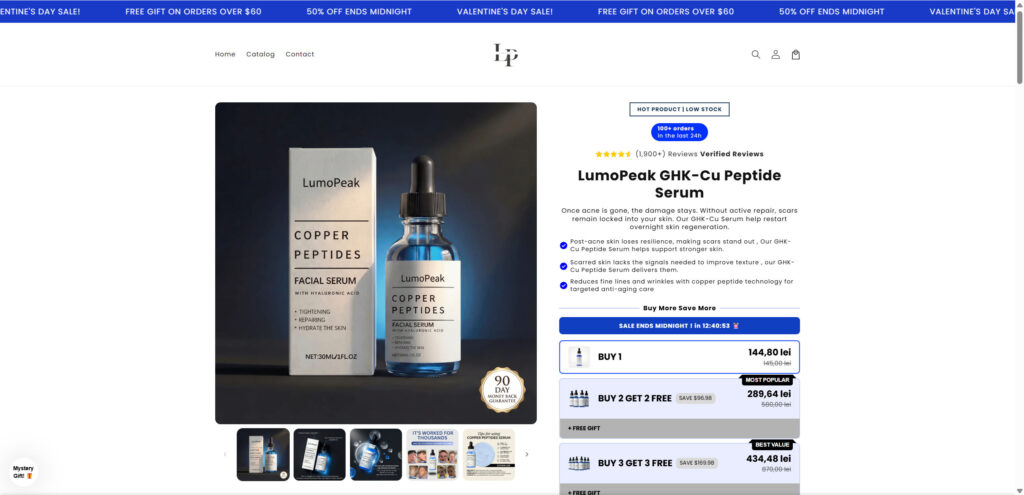
What LumoPeak Claims
The product page typically promotes:
- Overnight skin regeneration
- Reduced appearance of acne scars
- Boosted collagen production
- Firmer, tighter skin
- Smoother texture
- Dermatologist tested
- Clinically proven results
The formula highlights GHK-Cu (copper tripeptide-1), hyaluronic acid, and sometimes niacinamide.
On paper, those ingredients are not inherently suspicious. Copper peptides are widely used in skincare and have legitimate research supporting their role in wound healing and collagen signaling. Hyaluronic acid is a common humectant that hydrates the skin.
The issue is not the ingredient names. The issue is how the product is being marketed and whether the brand itself is credible.
Red Flag 1: Product Images Appear Copied or Generic
One of the first warning signs is the packaging and product photography.
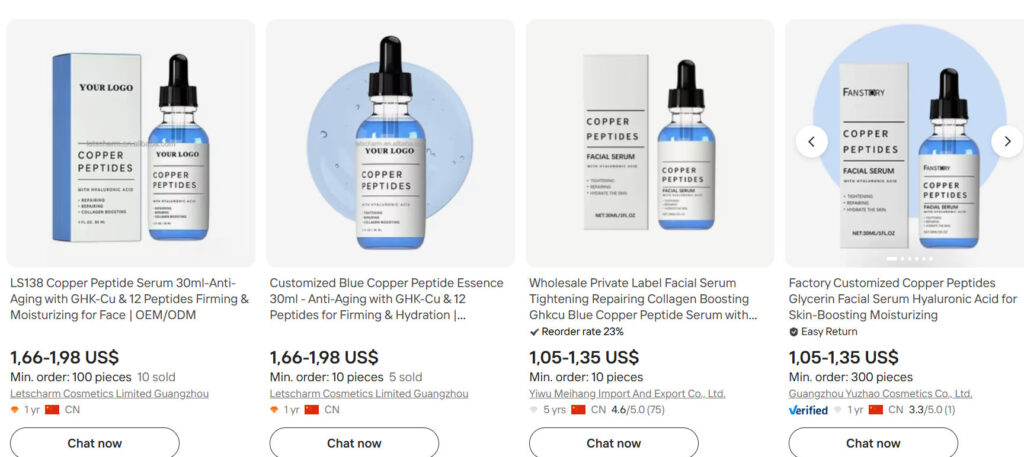
The bottle design closely resembles generic private-label copper peptide serums widely available from overseas manufacturers. In fact, identical bottle shapes, label layouts, and blue liquid designs can be found on wholesale platforms offering customizable branding for under $2 per unit in bulk.
When a “premium” brand uses packaging that matches generic factory listings, it raises legitimate questions:
- Does LumoPeak manufacture this product?
- Is it a private-label dropship item?
- Is the markup purely marketing?
Private labeling itself is not illegal. Many legitimate brands do it. The problem arises when the brand presents itself as a clinically developed innovation while using stock product imagery.
If original lab photos, production facilities, or formulation transparency are missing, credibility drops.
Red Flag 2: Heavy Discount Tactics
The pricing structure is another concern.
Common offers include:
- 50% OFF ends at midnight
- Buy 2 Get 2 Free
- Buy 3 Get 3 Free
- Free mystery gift
- Countdown timer resetting daily
These urgency triggers are classic high-pressure ecommerce tactics.
If a product is truly in demand and clinically validated, it does not need permanent “flash sale” banners and expiring midnight deals that refresh the next day.
Large bundle discounts often serve two purposes:
- Increase average order value quickly
- Reduce refund risk by making returns complicated
Aggressive discount stacking combined with countdown timers is a behavioral tactic designed to reduce rational evaluation time.
That does not prove it is a scam. But it strongly suggests a conversion-optimized dropship model.
Red Flag 3: “Dermatologist Tested” Without Proof
“Dermatologist tested” sounds authoritative. But what does it actually mean?
It can mean:
- A dermatologist reviewed the ingredient list
- A dermatologist participated in a small internal test
- A third-party lab conducted patch testing
- Or simply that someone with a dermatology background evaluated the formula
Without documentation, certifications, named dermatologists, or published reports, the claim is unverifiable.
Similarly, “clinically proven” requires:
- Published study references
- Identifiable trials
- Clear methodology
- Transparent results
If no links to real studies are provided, the phrase functions as marketing language, not medical evidence.
Copper peptides do have scientific literature behind them. But that does not automatically validate this specific product.
Red Flag 4: Lack of Independent Reviews
On-site reviews often show thousands of 5-star ratings.
However:
- No verified Trustpilot presence
- No external Reddit discussions
- No third-party retail listings
- No dermatology community feedback
When positive testimonials exist only on the brand’s own website, it becomes difficult to independently verify authenticity.
Legitimate brands typically leave a broader digital footprint.
Red Flag 5: Limited Customer Support Transparency
The website often lists:
- Email-only support
- No phone number
- No physical company address
- No corporate registration details
If you experience:
- Delayed shipping
- Wrong item delivered
- Refund disputes
- Multiple charges
Resolution may be slow or difficult.
Transparent skincare brands typically list company information clearly.
The Dropshipping Pattern
When you combine:
- Generic private-label packaging
- Extreme bundle discounts
- Countdown timers
- Emotional before-and-after images
- Limited company transparency
You get a pattern commonly associated with dropshipping skincare funnels.
The typical structure works like this:
- Source generic serum from overseas supplier
- Apply custom brand label
- Build high-converting Shopify landing page
- Run social media ads targeting acne and aging concerns
- Use urgency tactics to increase conversion
- Fulfill from third-party warehouse
This model can deliver a real physical product. But the value proposition often does not match the premium claims.
Ingredient Reality Check
Now, to be balanced:
GHK-Cu (copper tripeptide-1) is a legitimate skincare ingredient. Research suggests it may:
- Support wound healing
- Improve skin elasticity
- Reduce inflammation
- Signal collagen production
However:
- Effects are gradual, not overnight
- Concentration matters
- Formulation stability matters
- Quality control matters
If the product does not clearly state concentration levels or provide stability testing, the actual efficacy is uncertain.
Hyaluronic acid hydrates. It does not regenerate skin tissue overnight.
Claims like “overnight skin regeneration” are marketing exaggerations.
Are the Before-and-After Photos Reliable?
Many skincare funnels use:
- Stock models
- AI-enhanced images
- Lighting manipulation
- Makeup differences
- Skin filtering
Without timestamped clinical photos or verified user uploads on independent platforms, before-and-after visuals should be treated cautiously.
Acne scarring improvement takes months, not days.
Is LumoPeak an Outright Scam?
There is no evidence suggesting that LumoPeak does not ship a product at all.
However, there are significant indicators that:
- It is likely a private-label serum
- It is heavily marked up
- Marketing exaggerates results
- Claims lack transparent verification
That places it closer to “overhyped ecommerce funnel” than a medical breakthrough.
For some buyers, it may function as a basic hydrating serum. For others, it may not meet expectations built by dramatic claims.
What to Do If You Already Bought It
If you ordered LumoPeak, take these steps:
1. Save all receipts and screenshots
Document pricing, claims, and confirmation emails.
2. Monitor your bank statement
Ensure no unexpected repeat charges appear.
3. Check for subscription language
Some offers include auto-ship fine print.
4. Photograph packaging upon arrival
If you need to dispute quality, documentation helps.
5. Use cautiously
Patch test before applying fully.
6. Act quickly if refund is needed
Many ecommerce stores have short dispute windows.
Safer Alternatives
If you are looking for copper peptide skincare:
- Buy from established brands sold in reputable retailers
- Look for transparent ingredient percentages
- Check for third-party lab testing
- Read independent reviews
For acne scars specifically, treatments with stronger evidence include:
- Retinoids
- Chemical exfoliants
- Microneedling
- Laser treatments
- Dermatologist-guided therapy
Serums can support skin health. They rarely erase established scarring alone.
Final Verdict: Scam or Legit?
LumoPeak GHK-Cu Peptide Serum shows multiple red flags:
- Copied or generic product imagery
- Aggressive discount stacking
- Countdown urgency tactics
- Unverified “dermatologist tested” claims
- No visible independent reputation
While the ingredient itself is legitimate, the brand’s presentation suggests a marketing-driven operation rather than a clinically established skincare company.
If you choose to purchase, do so with caution and realistic expectations.
If you prefer safety and accountability, established dermatology brands with transparent sourcing are the smarter route.








