

The Lux Cove 7-in-1 LED Facial Sculptor claims to be a breakthrough in at-home skincare. Marketed as a device that can instantly lift your face, smooth wrinkles, reduce acne, and improve skin tone, it has been promoted as a best-seller with “over 1 million happy customers.” Add in supposed media features from Vogue and Glamour, flashy discounts, and glowing reviews, and it’s easy to see why people are intrigued.
But how much of this is real, and how much is just clever dropshipping marketing? Is the Lux Cove 7-in-1 LED Facial Sculptor truly effective, or is it just another overpriced gadget sourced from wholesale sites for a fraction of the price?
This article takes a deep dive into what the Lux Cove facial sculptor really is, how the operation works, and what you should do if you’ve fallen victim to misleading claims.
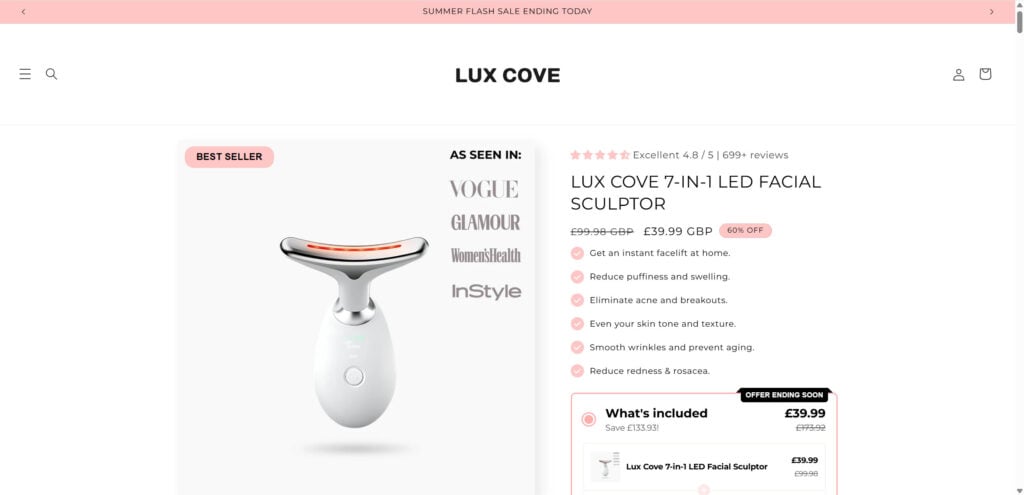
Overview of the Lux Cove 7-in-1 LED Facial Sculptor
On its website, Lux Cove promotes the device as a professional-grade skincare tool designed to deliver visible results in as little as 30 days. The product description makes several bold promises, including:
- Instant facelift at home
- Reduction in puffiness and swelling
- Elimination of acne and breakouts
- More even skin tone and texture
- Fewer wrinkles and signs of aging
- Reduction of redness and rosacea
The device is marketed as a 7-in-1 tool with multiple light therapy modes:
- Red light: Stimulates collagen and reduces wrinkles
- Blue light: Targets acne-causing bacteria
- Green light: Evens out skin tone and pigmentation
- Cyan light: Soothes sensitive skin and reduces inflammation
- Yellow light: Improves circulation and lymphatic drainage
- Purple light: Combines anti-aging and acne-fighting benefits
- White light: Promotes rejuvenation and skin elasticity
On top of light therapy, the product claims to use EMS (electro muscle stimulation), heat mode, and clean mode to enhance skincare results.
Pricing and Discounts
The official website lists the product at around £99.98 GBP, but offers a 60% discount, dropping the price to £39.99 GBP. They also push urgency with messages like “offer ending soon” and “only 7 left in stock.”
However, similar devices can be found on wholesale sites like Alibaba and AliExpress for as little as $1.50–$5 per unit, proving this is yet another dropshipping operation with a massive markup.
Claims of Media Features
Lux Cove claims the device has been “as seen in Vogue, Glamour, and Women’s Health.” Yet no official coverage exists on these outlets. If it were truly featured, direct links would be available. This is another marketing tactic designed to create false authority.
Customer Reviews
The website and social media ads are filled with glowing testimonials and videos of women using the device. Many reviews claim “visible results in 30 days.” However:
- Some reviews appear scripted or fake, with repeated wording.
- Independent reviews on Trustpilot are mixed, with customers reporting slow shipping, poor customer service, and faulty devices.
- Positive reviews often lack detail, while negative ones highlight frustration with refunds and support.
How the Operation Works
To understand Lux Cove’s business model, let’s break it down.
Step 1: Sourcing from Wholesale Sites
The Lux Cove 7-in-1 LED Facial Sculptor is not an original invention. Identical devices are available on Alibaba for $1.50–$5. Sellers buy these in bulk, rebrand them with sleek packaging, and resell them for 10–20 times the cost.
Step 2: Rebranding and Glamour Marketing
Once sourced, the product is marketed as a luxury beauty tool. Lux Cove adds:
- A high-end name and minimalistic logo
- Bold promises of clinical testing and visible results
- Fake media endorsements from Vogue and Glamour
- Overly positive “customer reviews” with stock photos
The goal is to make a $4 device look like a £100 medical-grade treatment tool.
Step 3: False Scarcity and Discounts
To push buyers into purchasing quickly, the website uses:
- Fake countdown timers
- “Flash sales” that reset daily
- “Only 7 left in stock” alerts
- Claims of millions of happy customers without evidence
These are classic dropshipping urgency tactics designed to trigger impulse buying.
Step 4: Inflated Claims Without Evidence
Lux Cove markets the device with clinical-sounding language, but fails to provide credible scientific proof.
- “Clinically tested” is mentioned, but no actual studies are linked.
- Claims of “90% saw results” come from an unverified survey of only 60 people.
- There are no published dermatological trials backing the claims.
Step 5: Limited Customer Support
Support is restricted to email only. There’s no phone number, no live chat, and no guarantee of timely responses. Many buyers report being ignored after purchase, especially when requesting refunds.
Step 6: The Refund Trap
While the website promises a money-back guarantee, reviews show customers face:
- Refusals or partial refunds instead of full ones
- Long delays in communication
- Conditions that make refunds nearly impossible
Once the payment is made, recovering your money is an uphill battle.
Step 7: Social Media Advertising
Lux Cove spends heavily on Facebook, Instagram, and TikTok ads, showing “real customers” using the device. Many of these videos are influencer collaborations or scripted ads that mimic authentic user reviews.
What to Do If You Have Fallen Victim
If you purchased the Lux Cove 7-in-1 LED Facial Sculptor and feel misled, here’s what you should do:
1. Request a Refund Immediately
- Contact Lux Cove via their support email.
- Demand a refund under their advertised money-back guarantee.
- Keep a record of all communication.
2. Dispute the Charge
- Credit Card: Call your bank and dispute the transaction as “goods not as described.”
- PayPal: File a claim under “Item not as described.” PayPal often sides with customers in dropshipping disputes.
3. Report the Scam
- Better Business Bureau (BBB): File a complaint.
- Federal Trade Commission (FTC): Report deceptive practices.
- UK Trading Standards (if purchased in the UK).
4. Leave Reviews to Warn Others
- Post your experience on Trustpilot, SiteJabber, and Reddit.
- Share on social media to alert friends and family.
5. Explore Real Alternatives
If you want LED facial therapy, choose legitimate brands with clinical testing, such as:
- CurrentBody Skin LED Mask
- Dr. Dennis Gross SpectraLite
- Foreo UFO 2
These are FDA-cleared devices with transparent clinical backing.
The Bottom Line
The Lux Cove 7-in-1 LED Facial Sculptor is not the groundbreaking skincare tool it claims to be. It is a generic $4 LED device repackaged and sold for £39–£99 with inflated promises and fake urgency.
Key takeaways:
- It does not provide instant facelifts or guaranteed acne removal.
- Claims of clinical testing and media features are unverified.
- Refunds are difficult, and customer support is limited.
- Identical products are available for a fraction of the price on wholesale sites.
While the device may provide some mild cosmetic benefits, it is not worth the inflated markup or misleading marketing tactics. If you are serious about skincare, look for proven, dermatologist-backed devices from reputable brands.
Verdict: The Lux Cove 7-in-1 LED Facial Sculptor is a classic dropshipping product with exaggerated claims. Buyers should proceed with extreme caution.
Frequently Asked Questions About the Lux Cove 7-in-1 LED Facial Sculptor
Is the Lux Cove 7-in-1 LED Facial Sculptor a scam?
The Lux Cove 7-in-1 LED Facial Sculptor is considered by many to be a dropshipping scam. The company claims it can deliver instant facelifts, reduce acne, eliminate wrinkles, and improve skin tone. In reality, the same device is available on wholesale sites like Alibaba and AliExpress for $1.50 to $5, but Lux Cove resells it for £39–£99. This huge markup, combined with unverified claims and poor customer support, raises serious red flags.
Does the Lux Cove facial sculptor really work?
The device may provide temporary cosmetic effects, such as mild skin stimulation or a warm sensation from its heat and vibration modes. However, it does not deliver the dramatic results it promises. Claims of instant facelifts, acne elimination, and wrinkle removal are not backed by credible clinical evidence. Most dermatologists agree that true skin improvement requires FDA-cleared devices, medical-grade treatments, or prescription skincare, not low-cost LED gadgets.
Is the Lux Cove 7-in-1 LED Facial Sculptor FDA approved?
No, the Lux Cove facial sculptor is not FDA approved or medically certified. The company markets it as a professional-grade skincare tool, but there is no evidence of regulatory approval. Trusted LED skincare devices from brands like Dr. Dennis Gross or CurrentBody are FDA-cleared, which makes them much safer and more reliable.
Why does Lux Cove claim their device was featured in Vogue and Glamour?
Lux Cove’s website lists media outlets such as Vogue, Glamour, and Women’s Health, suggesting it has been featured in these publications. However, there is no proof or direct links to any articles. These claims appear to be false endorsements designed to build trust and make the product look credible.
How much does the Lux Cove facial sculptor actually cost to make?
Wholesale suppliers list identical devices for as little as $1.50 to $5 per unit. Lux Cove inflates the price to £39.99–£99.98, creating a markup of over 1,000%. The high retail price is not due to advanced technology but rather marketing, branding, and fake exclusivity.
Can Lux Cove’s LED device remove wrinkles and acne permanently?
No. Wrinkles, acne, and skin texture issues require consistent dermatological treatment. A low-cost LED device with 1–2 watts of power cannot permanently eliminate wrinkles or acne. At best, it may provide mild stimulation. Lux Cove’s advertising exaggerates results to make the product sound more effective than it is.
What do real customer reviews say about Lux Cove?
Reviews are mixed. On the official site, testimonials are overwhelmingly positive, but many appear scripted or fake. Independent reviews on platforms like Trustpilot show complaints about slow shipping, non-functional devices, and unresponsive customer service. While a few buyers report satisfaction, the majority warn others to avoid the brand.








