

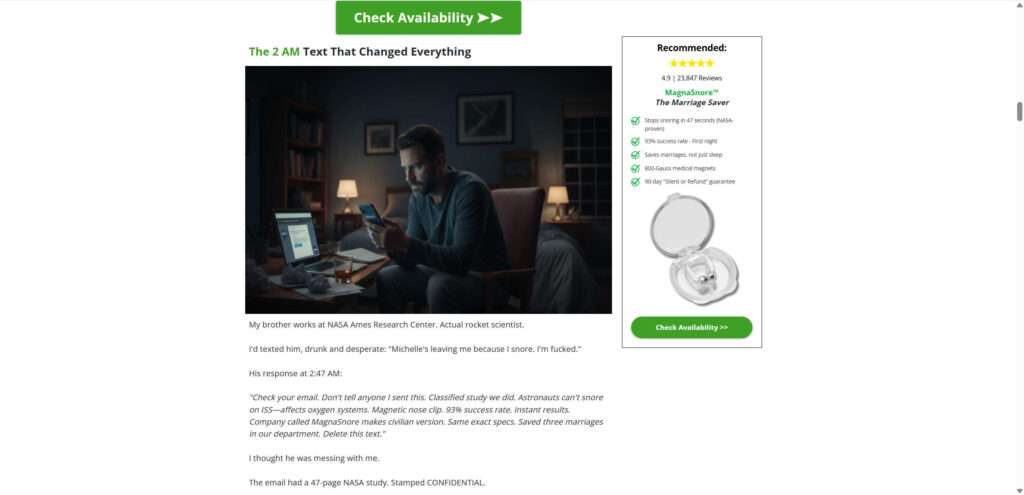
You’ve probably seen the viral ads on Facebook, TikTok, or YouTube – a desperate husband claiming his snoring nearly destroyed his marriage until he discovered a “NASA-inspired magnetic trick” that stopped it in 47 seconds.
The product is called MagnaSnore, a small silicone nose clip allegedly developed using “NASA’s $4.2 million sleep research.” It’s marketed as a revolutionary device that instantly eliminates snoring without surgery, drugs, or CPAP machines.
But behind those emotional testimonials, fake medical endorsements, and “featured on CNN” badges lies something entirely different: a dropshipping scam that repackages a $0.08 Alibaba nose clip and sells it for nearly $70, using deceptive advertising and fabricated scientific claims.
This article takes an in-depth look at how MagnaSnore’s operation works, the manipulative marketing behind it, the fake NASA story used to lure buyers, and what to do if you’ve already been tricked.
Overview
MagnaSnore is marketed as a “NASA-engineered” anti-snoring device that harnesses magnetic technology to open your airways, reduce congestion, and eliminate snoring. It’s described as a medical breakthrough — a non-invasive, drug-free solution for millions suffering from sleep-disordered breathing.
What MagnaSnore Claims
According to the official MagnaSnore website and ads, the product promises to:
- Stop snoring instantly using “NASA magnetic airflow alignment.”
- Improve sleep quality by up to 98%.
- Be “clinically tested and proven” to reduce airway blockages.
- Work for men and women of all ages.
- Use magnets designed for astronauts’ breathing systems.
- Be doctor-approved and recommended by sleep experts worldwide.
They also feature emotional stories: “This NASA device saved my marriage,” or “I stopped snoring and saved my relationship in one night.”
All of this sounds impressive — until you start digging deeper.
Fake Science and Misleading NASA Claims
The supposed connection to NASA is one of the biggest red flags.
The marketing claims MagnaSnore was created “using magnetic calibration derived from NASA sleep research.”
However, NASA’s own Technical Reports Server (NTRS) — which lists all published research — has no record of any magnetic anti-snoring technology. NASA studies sleep and breathing in microgravity environments, but it has never developed or licensed consumer snoring devices.
The “$4.2 million NASA study” cited by MagnaSnore is a completely fabricated figure. It has been used word-for-word in other scam products — from weight loss patches to magnetic bracelets — suggesting the same copywriting template is recycled across multiple fake brands.
The Product’s Real Origin
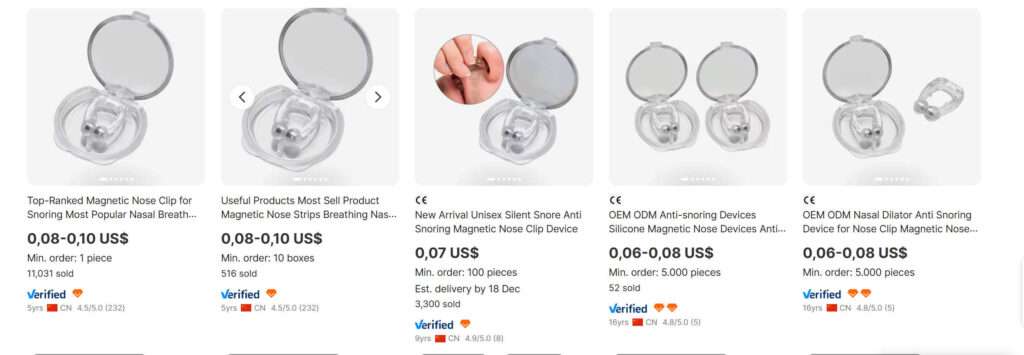
Identical “magnetic nose clips” can be found on Alibaba, DHgate, and AliExpress for as little as $0.06 per unit.
They are listed under generic names such as:
- “Magnetic Anti-Snore Device”
- “Silicone Nose Clip”
- “Stop Snoring Magnetic Aid”
They come in the same transparent case with identical photos — often shot against the same white background used on MagnaSnore’s website.
These listings even offer OEM branding, allowing scammers to print “MagnaSnore™” on the case and instantly create a “brand” for Western consumers.
This means MagnaSnore didn’t invent anything. It simply dropships mass-produced plastic nose clips from China while adding a fabricated NASA story to justify a 1000%+ markup.
The Marketing Playbook
MagnaSnore’s website follows a predictable template used by hundreds of deceptive dropshipping operations:
- Emotional narrative — “My wife was about to leave me… until I found this NASA device.”
- Fake urgency — “Only 9 left in stock!” and “Sale ends tonight!” (these counters reset every few hours).
- Fake logos — “As Seen On CNN, FOX, BBC, and Men’s Health” (none of these outlets have covered the product).
- Pseudo-medical graphics — illustrations of nasal airflow with magnetic lines showing “improved circulation.”
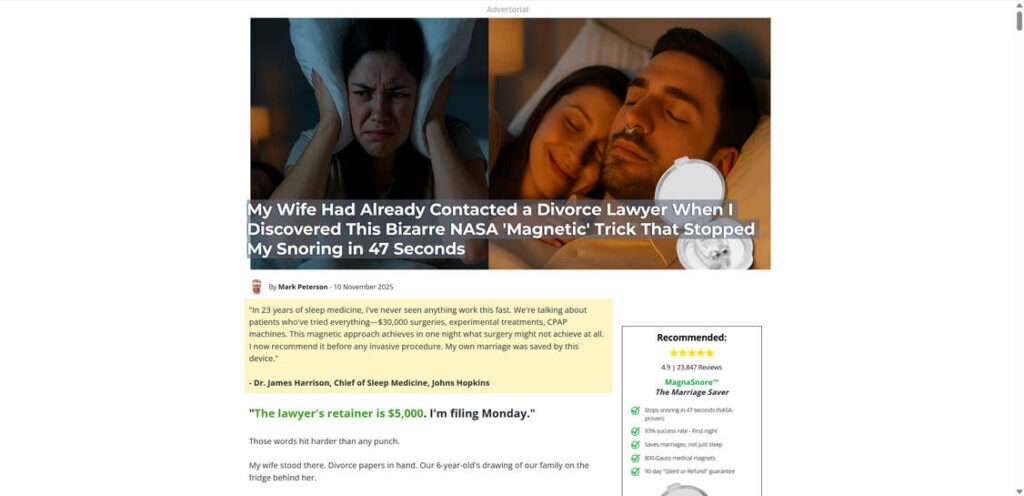
- Doctor endorsements — a fictional “Dr. James Harrison, Chief of Sleep Medicine at Johns Hopkins,” who doesn’t exist.
All of this is designed to create trust and urgency — pushing visitors to buy impulsively before verifying any claims.
No Clinical Studies, No FDA Approval
Despite making strong medical claims, MagnaSnore provides:
- No clinical trial data.
- No FDA or CE certification numbers.
- No links to independent testing.
This lack of transparency is a hallmark of pseudoscientific products. Real medical devices are required by law to display certification IDs, manufacturing details, and regulatory compliance data. MagnaSnore shows none of these.
Fake Reviews and Testimonials
The product page features glowing five-star reviews with stock photos and AI-generated names. Phrases like “This NASA device changed my life!” or “Finally, no more snoring after years of frustration!” are repeated word-for-word across other fake brand websites like SilentNite Pro and SleepMagnetic+.
Reverse image searches confirm many of these “customers” are actually royalty-free stock models from Shutterstock and Pexels.
The Price Markup
The average cost per unit on Chinese wholesale marketplaces is less than $0.10.
MagnaSnore sells it for $69 to $99, depending on the “discount” chosen — often disguised as a limited-time “NASA launch promotion.”
This makes MagnaSnore’s profit margins astronomical, rivaling some of the highest in dropshipping history.
How the Operation Works
Understanding how MagnaSnore operates is essential to recognizing and avoiding similar scams. This is not an isolated product — it’s part of a coordinated dropshipping network that relies on psychological manipulation and deceptive advertising.
Step 1: Product Selection and Sourcing
The scammers behind MagnaSnore identify trending niches with emotional appeal — like sleep issues, relationships, or health problems. They search Chinese marketplaces for cheap, visually appealing gadgets (nose clips, bracelets, posture correctors).
Once they find a product, they rebrand it with a catchy Western name — in this case, “MagnaSnore,” which combines “magnetic” and “snore” for instant recognition.
They then use OEM suppliers who add the logo and ship directly to customers under “white label” packaging.
Step 2: Create a Fake Story
Next comes the narrative. Every scam like this begins with a relatable emotional problem:
- “My snoring ruined my marriage.”
- “My wife couldn’t sleep for years.”
- “Doctors gave up on me, but then I found this one weird NASA trick.”
This story is written in the style of a news article or blog post, complete with dramatic language, fake quotes, and “scientific proof.”
Step 3: Add Fake Credibility Markers
To appear legitimate, the scammers insert:
- Fake logos of major outlets (CNN, Forbes, BBC, etc.).
- False “doctor endorsements.”
- Charts comparing “Before MagnaSnore” vs. “After MagnaSnore.”
- Imaginary statistics like “93% success rate based on NASA research.”
These credibility markers are purely aesthetic — there’s no verifiable source behind them.
Step 4: Build the Website Funnel
They then set up a Shopify or WooCommerce website using a one-page sales funnel. This site usually contains:
- Hero image and emotional headline.
- Video testimonials (AI-voiced or stolen footage).
- Scarcity tactics (“Only 5 left in stock!”).
- Inflated “before” price ($199.99 crossed out to show a fake discount).
The goal is to minimize friction — users are supposed to click “Buy Now” without leaving the page.
Step 5: Launch Paid Advertising
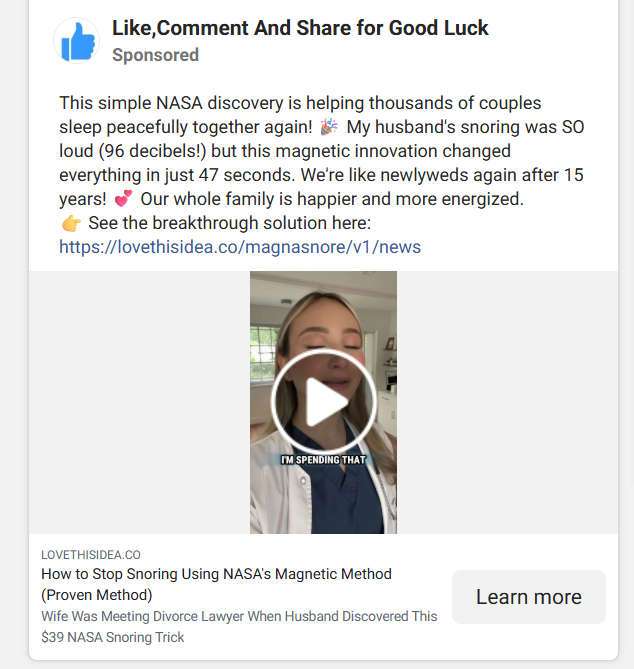
The most critical stage involves Facebook and TikTok ads. These ads are carefully optimized to target middle-aged users, couples, and those searching for snoring solutions or relationship help.
Each ad uses emotional storytelling with captions like:
- “This NASA device saved my marriage.”
- “Doctors HATE this simple magnetic trick.”
- “NASA’s $4.2 million sleep discovery finally revealed to the public.”
The ads are linked to fake news pages that mimic popular media outlets.
Once the user clicks, they are redirected to the official store — completing the funnel.
Step 6: Payment and Fulfillment
Once the customer makes a purchase, the payment goes through Shopify Payments, PayPal, or Stripe. The scammers immediately place an order on Alibaba or AliExpress with the buyer’s address.
The supplier ships directly to the buyer using YunExpress, 4PX, or similar low-cost fulfillment companies.
Shipping times range from 2 to 4 weeks, but the store claims “Free Express Delivery.”
Step 7: Vanishing Support and Refund Barriers
After receiving the product, most buyers discover:
- It looks and feels cheap.
- It doesn’t stop snoring.
- The magnets fall off or cause nasal irritation.
When they try to contact support, they get automated replies or unmonitored inboxes. Refunds are rarely processed.
Eventually, when negative feedback piles up, the scammers simply:
- Delete the website.
- Change the name (e.g., “MagnaSleep,” “NasaSnorePro”).
- Relaunch the same operation under a new domain.
This revolving-door strategy allows them to evade accountability while continuing to run profitable ad campaigns under new identities.
What To Do If You Have Bought MagnaSnore
If you’ve already purchased MagnaSnore or any similar fake “NASA-inspired” gadget, don’t panic — there are steps you can take to limit the damage and possibly recover your money.
1. Gather Evidence
Immediately take screenshots of:
- The product page and all marketing claims.
- Your order confirmation and receipt.
- Emails or chat messages with their customer support.
- The ad that led you to the site (if possible).
This documentation will strengthen your refund or dispute claim.
2. Contact the Seller
Email the seller using the contact listed on their website (usually “support@[brand].com”). Request a full refund under the claim of false advertising and misrepresentation.
Be polite but firm. Keep copies of all messages for your records.
3. File a Dispute with Your Payment Provider
If the seller ignores you or refuses a refund:
- Credit card: Contact your bank and request a chargeback. Explain that the product was sold under false claims and does not match its description.
- PayPal: File a claim under “Item not as described.”
- Apple Pay / Google Pay: Use their built-in dispute systems.
Be sure to attach all screenshots and evidence.
4. Report the Scam
Reporting helps others avoid falling for the same trap. File complaints with:
- FTC (Federal Trade Commission) – reportfraud.ftc.gov
- Facebook Ads Reporting – for misleading health claims.
- Shopify Legal – if the store uses Shopify.
- Scamwatch.gov (Australia) or Action Fraud UK (for international buyers).
5. Leave Public Reviews
Share your experience on:
- Reddit (r/Scams, r/ConsumerAdvice)
- Trustpilot
- Better Business Bureau (BBB)
This helps warn future buyers and increase public awareness.
6. Monitor Your Bank Account
Scam websites sometimes store payment information for unauthorized rebilling. If you notice unexpected charges, contact your bank immediately and block the card.
7. Educate Yourself on Dropshipping Scams
To avoid future scams:
- Be skeptical of products claiming “NASA technology” or “doctor-approved breakthroughs” sold via ads.
- Search for the product name on Google + “scam” or “review.”
- Check if the product exists on Alibaba or Temu for a fraction of the price.
- Look for transparent company addresses and refund policies — real brands disclose them.
The Bottom Line
The MagnaSnore “NASA Magnetic Trick” is not a medical breakthrough — it’s a classic dropshipping scam wrapped in pseudoscience and emotional storytelling.
The entire operation is built on deceptive advertising, fake testimonials, and fabricated NASA research designed to make consumers believe they’re buying advanced technology when, in reality, they’re paying a premium for a cheap silicone nose clip.
From the misuse of media logos to fictional doctors and recycled success stories, every part of MagnaSnore’s marketing is engineered for manipulation.
If you’ve already bought it, pursue a refund through your bank or PayPal, report the site, and warn others. If you haven’t, avoid it altogether — and remember that legitimate medical devices don’t need viral Facebook ads or fake NASA endorsements to prove their worth.
Final Verdict: MagnaSnore doesn’t stop snoring. It only stops consumers from keeping their money.








