

The phone rings again, and another caller wants to discuss your Medicare benefits. You are tired of answering, but worried the next call might actually matter.
Medicare scam calls create that uncomfortable choice. You can reduce the interruptions without handing strangers your information or cutting yourself off from genuine healthcare conversations.
Overview
The real program is not selling benefits through a surprise call
Medicare is a genuine federal health insurance program. Impostors borrow its name to make requests for personal information sound like routine administration.
Medicare’s fraud guidance says it will never call to sell you anything or visit your home to do so.
It also explains limited situations in which Medicare or its representative may call for information, such as returning contact after an enrollment, fraud report, or message.
That distinction matters. A blanket rule that every healthcare call is fake can make life harder, while trusting everyone who says Medicare creates a different risk.
Call filtering helps, but it cannot authenticate a person
A spam label can help you decide whether to answer. A number without that label is not automatically safe, and a familiar-looking number is not sufficient identification.
The FTC explains that scammers spoof caller ID, sometimes using names and numbers belonging to people or organizations uninvolved in the fraud.
Set up the phone so unwanted calls interrupt you less, while keeping a way for your clinic to reach you. No filter can promise silence.
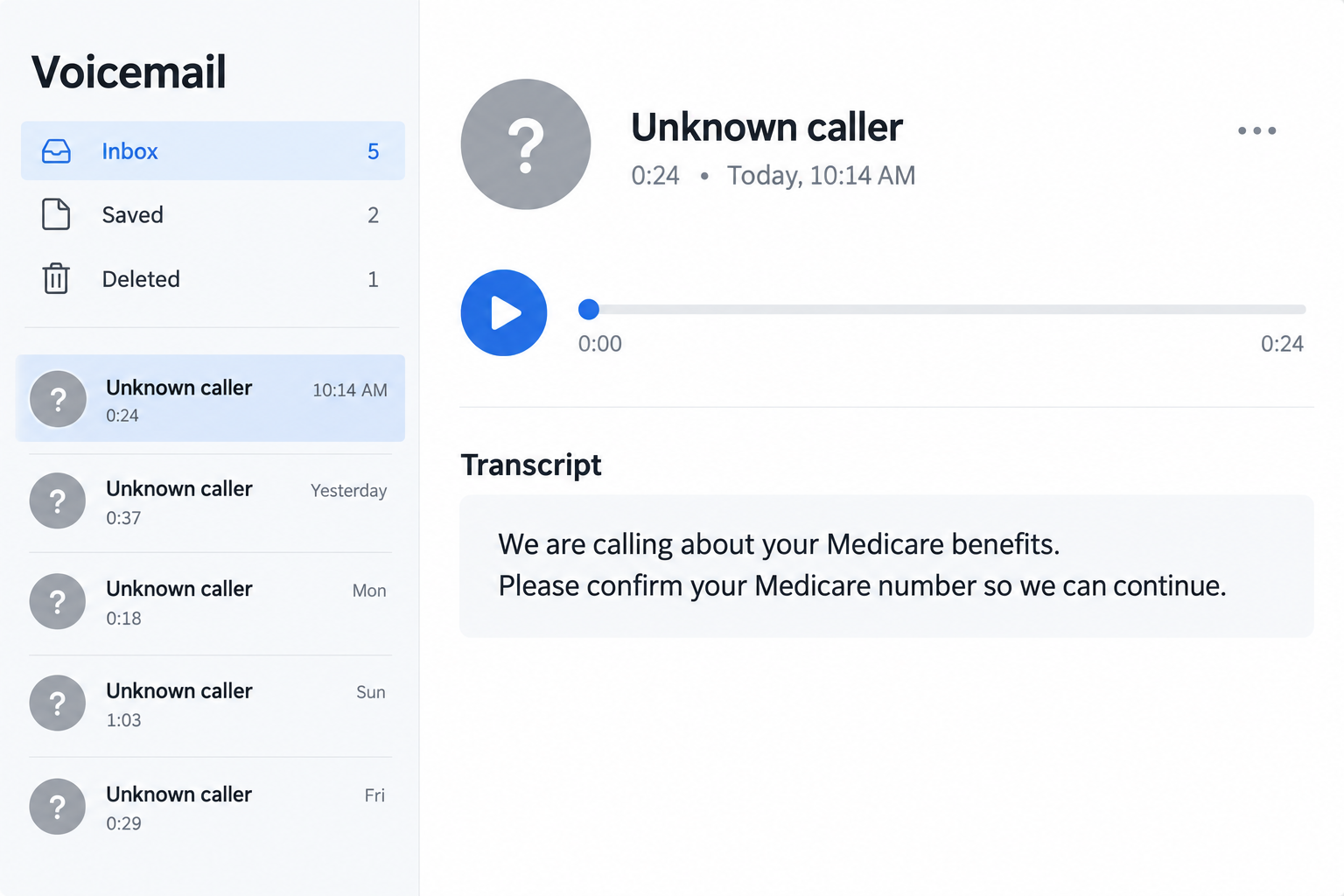
The voicemail illustration contains invented wording. It is not a recording, an authenticated transcript, or evidence about a particular caller’s identity.
Your Medicare number deserves the same pause as a financial detail
A caller may describe the number as a harmless way to locate your file. In the wrong hands, Medicare information can be misused for fraudulent healthcare billing.
Pause when someone unexpectedly asks you to:
- Read the number from your Medicare card to receive a supposed benefit.
- Confirm private information before explaining who requested the call.
- Accept medical services or equipment you did not discuss with your provider.
- Pay to resolve an alleged coverage problem immediately.
- Stay on the line instead of contacting Medicare through its published number.
These are reasons to end the unsolicited conversation and check independently. You do not need to prove the caller’s motive before refusing a request.
Why Blocking One Number May Not End the Calls
The displayed number may not belong to the caller
After several interruptions, adding a number to your block list feels like progress. It may prevent further calls displaying that number, but another display can appear later.
That does not necessarily mean the same person has acquired another genuine line. Caller ID can be manipulated, and you cannot reliably trace ownership from the display alone.
Avoid calling back to argue with whoever answers. You could reach an unrelated subscriber whose number was copied, not the person who contacted you.
Keep the time, displayed number, and nature of the request for a report. Those observations are useful without turning a number lookup into an accusation.
The Do Not Call Registry is not a barrier criminals must obey
The Registry tells law-abiding telemarketers which numbers not to call. It does not physically stop a fraudster who has already decided to break the rules.
Registration can still reduce lawful sales contact, making unwanted calls easier to recognize. It should be one part of your plan, not your only protection.
Be skeptical of anyone charging to remove you from every scam list. A promise of complete silence is not something an unknown caller can guarantee.
A helpful filter can also hide a call you want
You may be expecting a clinic, pharmacy, transport service, or relative calling from a new number. Broadly silencing unfamiliar callers has a real tradeoff.
Review missed calls and voicemail through your usual service. If a message concerns care, contact the organization using details you already trust.
A voicemail is not proof of identity either. It simply gives you information to check without remaining inside a live, high-pressure conversation.
How the Medicare Scam Call Works
Step 1: A reassuring role gets the conversation started
The caller introduces themselves with a Medicare-related role, benefits department, or other authoritative-sounding label. The opening makes a stranger seem connected to something important in your life.
A familiar area code or professional greeting can help the story feel local and routine. Neither establishes employment by Medicare or permission to handle your information.
The caller may already know an ordinary detail about you. Accurate background information still does not explain why you should provide the number printed on your card.
Ask yourself whether you requested this contact. If you did not, you can stop the conversation and choose your own way to check the matter.
Step 2: A benefit or problem supplies a reason to act
The story might involve a benefit review, a supposed replacement card, or an offer presented as part of your coverage. Versions differ, so focus on the request.
Promises make saying yes attractive. Threats make saying no uncomfortable. Either approach can move the conversation forward before you have confirmed who is speaking.
A caller’s warning is not a verified decision about your benefits. If you are worried about coverage, ask the genuine program or plan through an independently reached contact.
You can simply say you will call Medicare yourself, then hang up. You do not need to win an argument before ending the conversation.
Step 3: Verification becomes a request for valuable details
The caller frames your Medicare number, birth date, or another identifier as necessary to complete the task. You may feel that refusing will delay something beneficial.
But giving the information away can create a problem that did not exist before the call. Calling a request verification does not make the recipient trustworthy.
Do not read a card aloud, send a photo of it, or disclose banking information to an unverified caller. Use the provider’s genuine process when information is legitimately needed.
If you already supplied something, write down exactly what it was. A Medicare number and a bank password require different recovery conversations.
Step 4: The effects may appear later in records or follow-up contact
You might not see an immediate charge in your own bank account. Misuse of Medicare information can involve healthcare claims rather than a direct purchase you recognize.
Compare statements with appointments and services you actually received. Keep a simple calendar so an unfamiliar entry is easier to discuss with the appropriate provider.
An incorrect entry can also be a billing mistake. Ask for clarification and report suspected fraud without assuming every discrepancy proves a deliberate crime.
Later callers may promise to fix the first problem for a fee or ask for more information. Continue through Medicare, your plan, or providers you contacted yourself.
Build a Call-Handling Plan You Can Actually Use
Start with the service already connected to your number
Ask your phone provider what blocking or labeling options it offers for your line. Mobile phones, internet-based home services, and traditional landlines may need different solutions.
Find out whether a feature stops calls, silences them, or merely adds a label. Those differences affect what happens when a genuine healthcare caller tries to reach you.
Check any charges and privacy terms before activating an additional service. A feature described as helpful does not automatically need access to your entire contact list.
Use the provider’s established website or customer service, rather than a call promising a special Medicare-only filter. No new stranger needs your Medicare number to discuss phone settings.
Make room for the calls you are expecting
Keep known healthcare contacts organized and ask providers how they normally return calls. Do not assume they always use the exact number shown on a business card.
If you missed a call, use the clinic’s published contact to ask about it. This avoids treating an unfamiliar callback number as the only way to continue care.
Tell a trusted family member how you plan to handle uncertain calls. Agreeing on a simple routine is easier than deciding under pressure every time the phone rings.
Give yourself permission to end the conversation
You can say that you will contact Medicare directly and hang up. You do not owe an unverified caller a long explanation or another chance to reassure you.
If someone claims to be returning your call, check that against your own recent contact. Then reconnect through the number or service you used originally.
Do not let politeness override a request that makes you uncomfortable. Genuine assistance remains available through the actual program, plan, and healthcare providers.
What to Do if You Have Fallen Victim to This Scam
-
End further contact and preserve a short record. Save the voicemail if available and note the time, displayed number, claimed role, and information requested.
Do not call the person again to obtain a confession or a clearer explanation. That can reopen the pressure without helping protect your records.
If someone helps you prepare a report, keep medical and identifying details private. A public warning does not need a photo of your Medicare card.
-
Tell Medicare if you disclosed your number or suspect misuse. The official reporting contact is 1-800-MEDICARE, which is 1-800-633-4227.
Explain what happened and ask which protective steps apply. Do not rely on a stranger’s claim that you must buy a replacement card or pay to retain coverage.
For questions involving a Medicare Advantage or drug plan, use the plan’s established contact as well. Keep each genuine conversation’s reference and instructions.
-
Review claims and statements against care you received. For Original Medicare, a secure Medicare.gov account can show claims once they are processed.
Compare providers, dates, services, and other details with your own records. Ask a known provider about an apparent error before concluding what caused it.
Report unexplained activity through Medicare’s fraud process. A caller saying the matter is resolved is not a substitute for checking the actual records.
-
Contact your financial institution if money or banking details were involved. Tell it whether you made a payment, supplied card information, or disclosed an account credential.
Use the bank’s verified app or the contact on your card. Ask about protection and available recovery options without expecting a guaranteed refund.
Preserve receipts and transaction references. Medicare reporting and a bank dispute serve different purposes, so one does not automatically complete the other.
-
Address other identity information according to what you shared. If you disclosed a Social Security number or identity document, seek guidance beyond changing a phone setting.
IdentityTheft.gov provides situation-specific protective and recovery steps. Include confirmed misuse if any, while distinguishing it from information you are worried might be misused.
A Medicare number does not, by itself, prove that someone can enter your bank account. Protect each affected service based on its actual exposure.
-
Set up filtering after dealing with urgent exposure. Review built-in phone options and your carrier’s features, choosing how to handle unfamiliar calls and voicemail.
Check missed communications afterward so important care is not disrupted. Adjust the approach if legitimate providers are being silenced along with unwanted callers.
Blocking helps reduce contact, but it cannot correct an improper claim or take back information already supplied. Keep those recovery tasks on your list.
-
Plan for another approach without blaming yourself. A new caller may refer to the previous conversation, offer help with fraud, or ask for another confirmation.
Go back to the official contact you established. Knowledge of the incident is not permission to charge you for recovery or collect another identifier.
Let anyone sharing responsibility for your care know the agreed routine. A calm explanation makes it easier to ask for help promptly if another call arrives.
Frequently Asked Questions
Does Medicare ever make a legitimate phone call?
Yes, in limited situations described by Medicare, including certain callbacks after contact you initiated. It does not call to sell you something.
Will the Do Not Call Registry stop Medicare impostors?
It cannot stop criminals from ignoring the rules. Combine it with suitable filtering, careful handling of requests, and independent verification of important matters.
Why do calls continue after I block a number?
Another number can appear, and caller ID can be spoofed. One blocked display does not identify or stop every person behind the calls.
Can I trust a caller who knows my name?
A correct name is not proof of authority. Confirm the claimed role separately before discussing information from your Medicare card or other private records.
What should I do first if I gave my Medicare number?
Contact Medicare through 1-800-MEDICARE, explain the disclosure, and ask about appropriate protection and claim review. Address any financial information separately with your bank.
Should I silence every unknown caller?
Consider the tradeoff for your care and circumstances. Review voicemail and verify important messages independently so filtering does not cut off legitimate assistance.
The Bottom Line
Do not give private information to someone just because they mention Medicare. Reduce Medicare scam calls with sensible filtering, and verify important requests through the genuine program.
If you already shared your number, contact Medicare and check the relevant records. Handle any payment or additional identity exposure separately instead of waiting for the caller’s reassurance.

Join the discussion
0 commentsShare your experience or ask a question about this article.
Discussion
Start the conversation
Have a question or something useful to share? Add the first comment.