


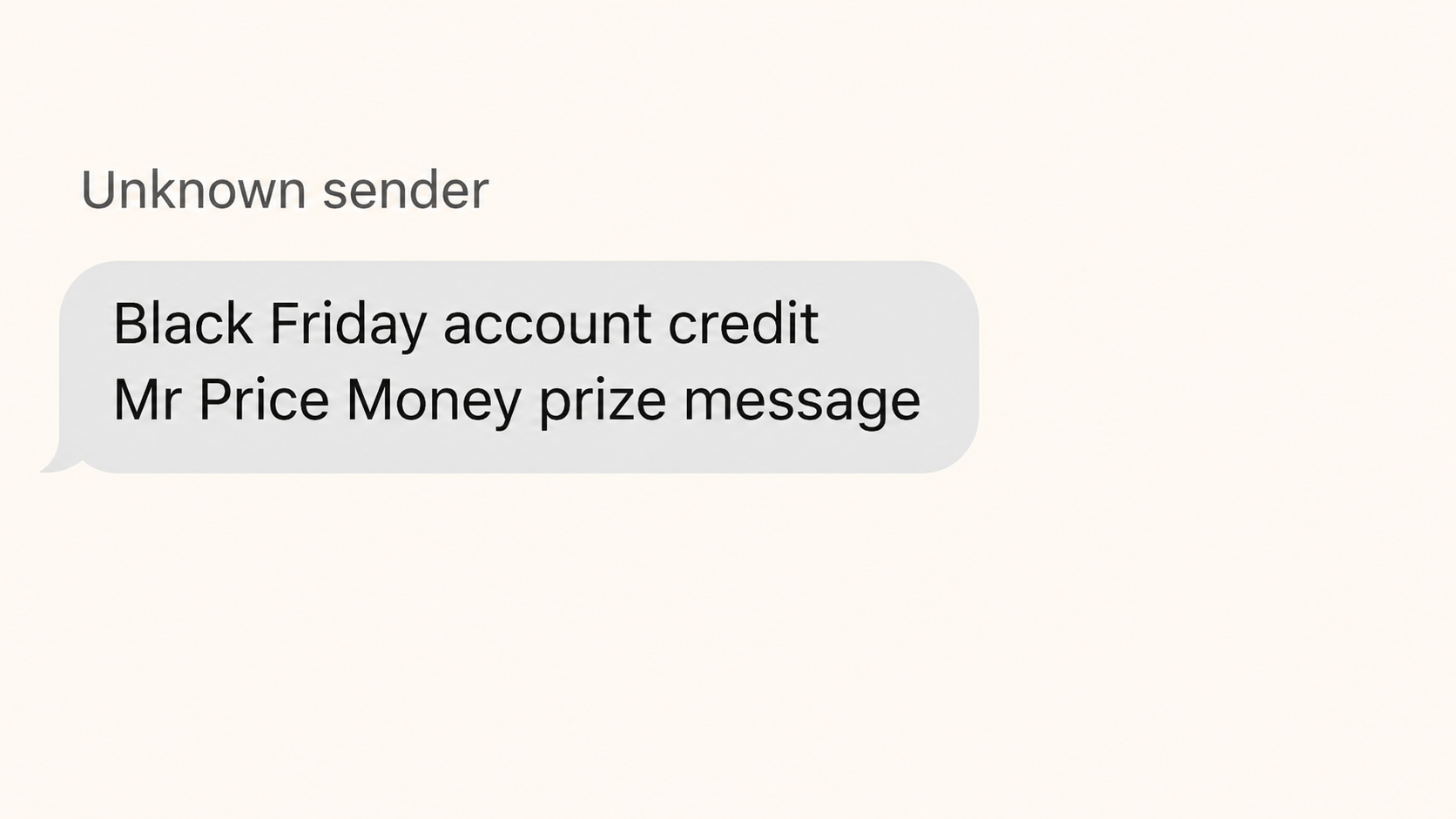
The text greets you by name and mentions your Mr Price Money account. If you’ve been waiting for the Black Friday offers, that sounds like good timing.
Then you read the amount again. Is it a prize, money you can spend, or something else entirely? The wording makes those things surprisingly easy to mix up.
Overview
The text makes two separate promises
One part says you could win up to R500,000. Another says there’s credit on your account. Those claims sit side by side, but they don’t mean the same thing.
In its Black Friday scam report, Bitdefender Labs identified the South African message as an impersonation of Mr Price Money. The retailer’s financial services business wasn’t behind it.
R500,000 is the highest figure mentioned in the text. The account credit is a separate amount, redacted in the published example. Neither line proves you can collect money.
It has the details you expect from a shop
There’s a personal greeting, a familiar retail name and an opt-out line. All three look ordinary if you’ve ever signed up for a store account or a shopping newsletter.
The familiar details are what make it persuasive. The message sounds as though it belongs in an ongoing relationship with a company, even though you haven’t established who sent it.
Mr Price Money does use SMS in some circumstances. Telling everyone to ignore every text from the retailer would be bad advice. Verify the claim somewhere other than the message.
Here’s what the sample proves
- The text used the Mr Price Money name and Black Friday promotions as cover.
- It mentioned a possible prize and a supposed credit, then supplied a link.
- The published report didn’t establish what the destination asked visitors to submit.
- It’s the message that’s fraudulent, not the genuine retailer or its store account.
That’s enough to reject the link. It’s not enough to tell someone who tapped it that they definitely gave away their login, shared a card number or lost money.
How the Mr Price Money SMS Scam Works
Step 1: Your name makes the text seem like account mail
When a message calls you by name, you may read it as notice about an account you already have. That’s different from how you’d read a generic ad.
The text doesn’t say how its sender obtained the name. Knowing it doesn’t prove the sender can see an account, and it doesn’t establish that a retailer was breached.
Two people in the same household could see the same approach with different names. The important question is whether the claimed credit appears in the genuine account.
Step 2: Black Friday gives the message a reason to arrive now
A prize text in an ordinary week might feel out of place. In November, a message about store deals arrives among offers you genuinely expected to see.
You may also be out shopping when it arrives. It’s easy to open a short text and assume the quickest way to check it is the link underneath.
Don’t mistake that convenience for proof of anything. If you’re near a store, ask staff how to reach account support without giving them your password or banking code.
Step 3: The prize and credit blur together
The phrase “up to” isn’t a statement that anyone has won the full amount. Still, it’s the large number most likely to stick when you read quickly.
The account credit line offers a second reason to keep going. Even if you doubt the grand prize, perhaps you think there’s a smaller balance you can use today.
A real store account can involve a credit limit, an amount available to spend, an outstanding balance or a credit adjustment. Those aren’t interchangeable, and none is necessarily free cash.
An independently accessed statement gives you labels and transaction history. The unsolicited SMS supplies a number and asks you to trust what it means.
Step 4: The sender puts its link next to the money
This is where the promise becomes a request. You’re invited to use the destination the sender chose, rather than a retailer’s app or an address you already know.
Bitdefender didn’t publish the actual destination. We aren’t claiming the published sample delivered a particular fake login or a specific checkout screen. The invitation itself isn’t a safe account check.
If a page asks for an account password, card details, an ID number or an approval code, close it. Don’t submit anything to see what happens next.
Step 5: An opt-out line makes the text feel routine
The example ends with an opt-out instruction. Familiar marketing language can make the whole text sound more believable, even though anybody writing an SMS can add those words.
You don’t need to reply to test it. Save a private screenshot, then use your phone’s spam reporting controls where available instead of starting a conversation with the sender.
If the text is followed by a call about a voucher or reversal, verify that call independently too. Don’t use a number the first message provided.
How to Check Your Actual Account Credit
Start with the account you already use
Open the genuine app if that’s how you normally manage the account. Otherwise, use the independent contact details in Mr Price Money’s fraud guidance.
Keep the message closed while you check. If someone else is helping you, start a fresh browser tab instead of letting them tap the SMS on your behalf.
Look at recent transactions and the wording attached to any credit. Ask verified support to explain a change you can’t identify, especially if there’s an account entry you don’t recognize.
If you have no Mr Price Money account, don’t open one just to see whether a balance transfers over. Nothing in the text establishes that credit exists in your name.
A small matching detail doesn’t verify the whole claim
A real promotion may mention Black Friday, and a fraudulent message may mention the same dates. Finding a sale on the actual site doesn’t validate the text you received.
Look for terms spelling out who can enter, how winners are informed and where account adjustments appear. A seasonal banner doesn’t answer any of those questions.
If you find an account balance that looks similar to the number quoted, check its source separately. The text doesn’t become trustworthy just because it happens to match.
Be careful with a genuine approval prompt
A phone can show a real bank notification while you’re dealing with a fake offer. That notification may be asking whether you authorize a transaction, not confirming a prize.
Read it as a separate instruction from the bank. An operation you didn’t initiate should not be approved just because somebody says the prompt is needed to refund you.
Mr Price Money says it may notify customers about abnormal activity. Use its independently reached channels when a message leaves you unsure what your account is asking you to do.
What to Do If You Responded to the Text
-
If you only read it: Keep the text long enough to report it, then block or delete it. Reading a message isn’t the same as submitting something.
There’s no reason to reset your whole phone because it received this SMS. Check the actual account if the claim still bothers you, but don’t call back the sender.
-
If you opened the page: Close it and think about what you actually did. Did you merely look, or did you submit a form, install anything or grant a permission?
Don’t reopen the page to reconstruct the visit. If there was a download or permission prompt, address that separately and identify the file or permission without running it again.
-
If you entered a store login: Use the real account channel to change the password. Tell customer service an impersonation text directed you to the page.
Review account activity and changes to your contact details. If the same password works for email or other stores, replace it on those accounts as well.
-
If you supplied card details or a bank code: Contact your bank using its app or a number you already trust. Describe exactly which details you gave.
Ask how to secure the card or account, whether a payment is pending and how to dispute anything wrong. The retailer can’t make those decisions for your bank.
-
If you disclosed identity information: Write down exactly which details you shared. A name alone is different from a full identity number, a document photo or account recovery answers.
Explain the exposure to the affected provider. Be alert to later messages that quote your own details back to you and insist that’s proof they’re genuine.
-
If your phone unexpectedly loses service: Contact your mobile provider from another phone, particularly if the loss follows requests for identity details or codes.
Ask whether anything changed on your line. Tell your bank too if you suspect your number was moved without permission and you rely on it for account access.
-
Keep a clean record: Save the message, time received, any payments and the sequence of events. Share private records only with verified support, your bank or investigators.
When warning other shoppers, crop your name and account information. Leave the link out rather than forwarding an invitation somebody else could accidentally open.
Make the First Call Count
People often start with the biggest name in the message. A better way to choose is to ask which organization can contain what happened first.
Call the bank first if there was a card disclosure, a payment or a banking approval. Call account support if you can see changes to the store account itself.
Gather the time and amount from the genuine statement, not the payment story in the SMS. If there are two entries, don’t assume they are duplicates without asking.
Be precise about whether you approved a transaction yourself after being misled or found a payment you didn’t make. Both deserve a report, but support needs the correct facts.
Ask for a reference and note what the organization told you to do next. A later call quoting this reference still needs to come through a channel you independently verify.
Yes, Mr Price Money Has a Real R500,000 Prize Pool
This is the wrinkle that makes the text particularly believable. Searching for its biggest number can lead you to a genuine competition, even though the text you’re holding isn’t genuine.
The published Credit Spend Campaign rules say R500,000 is the combined prize pool across the spring and Black Friday periods. Ten selected winners receive R50,000 each.
The rules describe an entry period from September 8 through November 30, 2026. Entry follows shopping on an eligible account, not an account credit assigned by text.
The organizer selects winners after the competition closes and contacts them by December 15. Winners can opt for account credit instead of taking the R50,000 in cash.
That’s why a real contest matters here. The amount isn’t an invented number pulled out of thin air. It’s real information that doesn’t authenticate the sender or the link.
If you entered independently and get a notification, contact the genuine business. Ask support when winners are contacted and where to handle any required verification.
The rules call for documentation for selected winners. That isn’t permission to send an identity document to anyone who quotes the rules or claims to verify a prize by text.
For a relative who forwarded the notification, the distinction is simple: the contest exists, but the link in this message isn’t a reliable way to enter, check credit or collect.
Frequently Asked Questions
Is the Mr Price Money R500,000 prize SMS genuine?
The text Bitdefender described was an impersonation. The real contest has a R500,000 pool, not a R500,000 prize for one recipient. Verify independently instead of tapping the message.
Does the sender knowing my name prove I have credit?
Knowing your name doesn’t prove anything about your available credit. Only the actual account records, checked through a retailer channel you trust, can confirm a balance.
Is Mr Price Money itself a scam?
This warning is about a text using its name. The real financial services business isn’t the sender of the documented message, and genuine store accounts aren’t the issue.
Should I reply to the opt-out at the end?
Don’t reply to this suspicious text. Use the reporting or blocking options on your phone, and manage real marketing preferences separately through the official service.
What if the real account shows available credit?
Ask support what the figure represents if you’re unsure. Available credit may be spending capacity rather than a prize or cash balance. The SMS doesn’t explain which it is.
Do I need a new card if I simply clicked?
A click by itself doesn’t show that card information was submitted. If you typed it, sent an approval or see an unfamiliar charge, contact the bank immediately.
The Bottom Line
Do not use the Mr Price Money Black Friday prize link. Check any claimed credit in your actual account, and don’t treat a personalized greeting as proof.
If you handed over a password or banking information, go straight to the provider that can protect it. You don’t need to hear another word from the sender.

Join the discussion
0 commentsShare your experience or ask a question about this article.
Community experiences
Did this happen to you?
Your experience could help someone recognize the same scam. Submit a private report for our team to review.
I experienced this tooReports are reviewed before publication. Sharing publicly is always your choice.
Discussion
Start the conversation
Have a question or something useful to share? Add the first comment.