

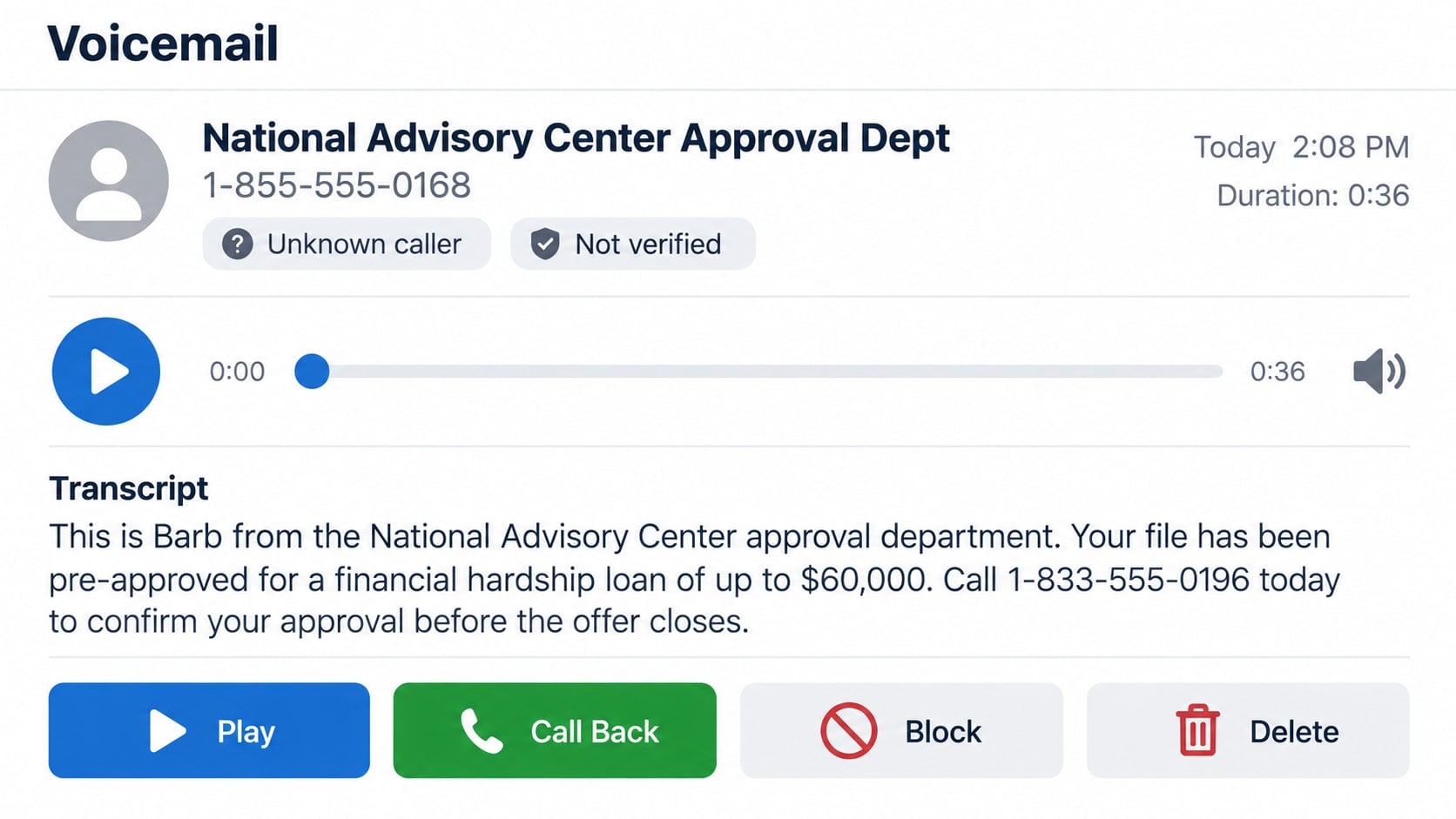
The call arrives with unusually good news: a “National Advisory Center” says you have been preapproved for as much as $60,000, even if your credit is imperfect. An adviser only needs to complete a quick activation.
The institutional name makes the offer sound reviewed and official. Before believing it, look for the lender, application, written terms, and licensing trail that a real loan should leave behind.
Overview
The caller says a large personal loan has already been approved
The National Advisory Center scam uses calls, voicemail, text messages, and online forms to offer debt consolidation or personal loans. The recipient may be told that an approval remains available despite poor credit or previous rejections.
No genuine application may exist. The amount is selected to be useful for credit cards, medical bills, repairs, or household expenses, making the unexpected offer emotionally difficult to ignore.
The name sounds official without identifying an actual lender
Words such as national, advisory, center, relief, and approval can create the impression of a public program or established financial institution. A name alone does not reveal who funds the loan or which company is legally responsible.
The operator may describe itself as a matching service rather than a lender when challenged. That ambiguity allows the caller to collect information first and postpone basic questions about licensing, rates, and underwriting.
An activation fee or identity check becomes the price of receiving funds
Victims may be asked for a $495 origination deposit, insurance payment, processing fee, or refundable good-faith amount. The FTC warns that a guaranteed or preapproved loan requiring payment before the borrower receives money is a classic advance-fee loan scam.
Another version gathers a Social Security number, bank login, card details, or online banking security code. The promised loan then becomes a route to identity theft and unauthorized withdrawals.
- You are approved even though you never completed a loan application.
- The caller will not clearly name the licensed lender.
- Approval is guaranteed regardless of credit history or income.
- A fee must be paid before funds can be released.
- The operator requests gift cards, cryptocurrency, a wire, or payment to an individual.
- The loan agreement, APR, repayment schedule, and total cost are missing.
Why the Name Creates False Confidence
“National Advisory Center” sounds like a central office that helps consumers compare or obtain government-supported financing. The words are broad enough to suggest authority while saying very little about the legal entity.
Scammers often choose names that become awkward when spoken aloud but look respectable in a caller-ID label or website header. A seal, flag colors, registration number, or picture of an office can deepen the impression without proving anything.
The term “adviser” can also lower a recipient’s guard. It suggests a person who will explain options rather than sell a loan or collect a fee. During the call, however, the adviser may focus almost entirely on completing an activation payment.
A legitimate broker or matching service should still identify itself, explain how it is paid, state whether it is a lender, disclose how information is shared, and name any lender making an actual offer.
How the National Advisory Center Scam Works
Step 1: An unsolicited message announces preapproval
The voicemail uses a personal first name or reference number and says funding from $10,000 to $60,000 is waiting. It may mention a low monthly payment, debt consolidation, or no hard credit inquiry.
The message gives a short deadline and a callback number. The urgency creates the impression that underwriting has already happened and only acceptance remains.
Step 2: A loan adviser collects basic financial details
The agent asks about income, employment, monthly debt, housing, and bank use. These are plausible loan questions, but they can also help a criminal judge how much the victim can pay and which story will be most effective.
The caller may avoid a genuine credit check because one would expose the absence of a licensed lender. Instead, the victim is congratulated for meeting an internal program threshold.
Step 3: A guaranteed offer is described without complete terms
The adviser quotes an attractive rate or payment but omits the APR, term, total repayment, finance charge, late fees, and identity of the creditor. Questions are answered with promises that the full agreement appears after activation.
The caller may say the program is federally backed, privately funded, or available through a network of community lenders. Those descriptions sound reassuring but are not a substitute for a named lender and written disclosure.
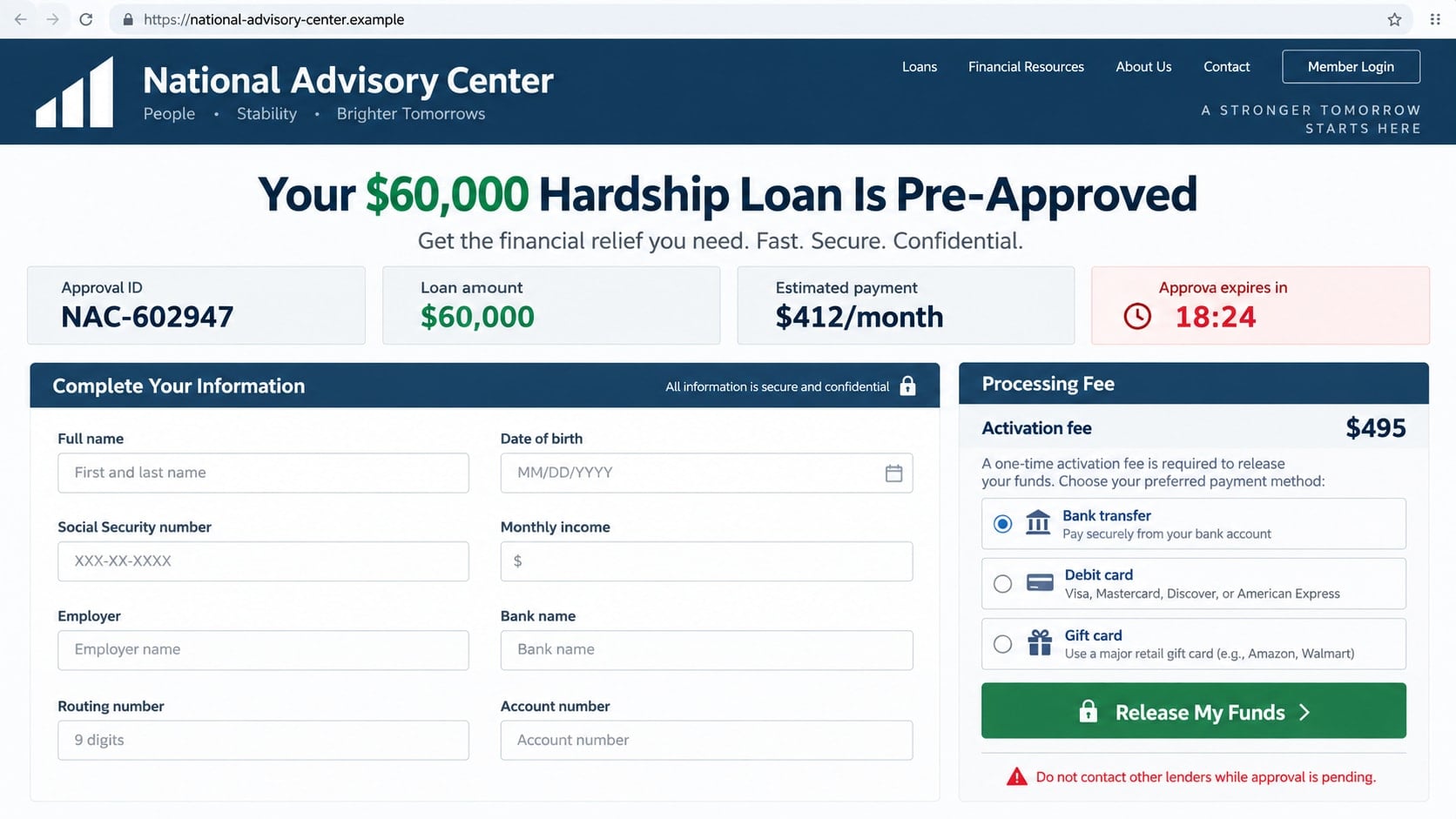
Step 4: A fake portal requests identity and banking information
The victim receives a link to review the approval. The page may display a progress bar, assigned adviser, loan amount, monthly payment, and electronic signature box.
To “verify deposit capability,” it requests a bank account and routing number, card details, online banking credentials, Social Security number, or driver’s license. A real lender may need identity and banking information, but only after its identity and secure process are established.
Step 5: An advance fee is required before disbursement
The operator says a $495 activation fee, insurance premium, tax, collateral deposit, or first installment must clear before the loan can be released. It may promise the amount will be refunded with the deposit.
Payment is directed to a person, wallet, gift card, payment app, or unfamiliar merchant. If the victim objects, the caller says the fee is required by the funding department rather than by the adviser.
Step 6: New obstacles replace the promised deposit
After the first payment, the loan is delayed by an invented credit issue, transfer hold, verification charge, state tax, or insufficient insurance. Each obstacle requires another payment.
No loan arrives. The operator eventually stops responding or returns as a recovery specialist who claims the missing funds can be retrieved for one more fee.
Identity, Contact, and Payment Checks
Identify the legal lender before discussing sensitive information
Ask for the creditor’s complete legal name, physical address, website, licensing details, and customer-service number. A marketing name or “funding network” is not enough.
Search official state financial-regulator and business records where appropriate. Confirm that the address, telephone number, domain, and license belong to the same entity that contacted you.
Require a real application and complete written offer
A legitimate prequalification can be based on limited information, but final approval normally requires identity, income, credit, and fraud checks. Approval for a large sum without an application deserves skepticism.
Read the APR, term, payment schedule, amount financed, finance charge, fees, late-payment terms, and total repayment. Do not pay to unlock disclosures that should be available before commitment.
Verify the website and communication route independently
Do not trust a domain because it contains the organization name. Check when it was established, whether contact information is consistent, and whether the privacy policy names the same legal company.
Call a regulator-listed or independently published number. Do not rely on the callback number, portal chat, and email address supplied by the same unsolicited message.
Reject any fee required to release the loan
Legitimate lenders can charge disclosed fees, and some costs may be deducted from loan proceeds. A demand to send money first as the condition for receiving promised funds is the defining danger in an advance-fee loan scam.
Gift cards, cryptocurrency, cash transfers, and payments to individuals provide little consumer protection. A caller who guarantees funding after such a payment is not offering a safe loan.
Preapproval Is Not the Same as Guaranteed Funding
Financial companies sometimes send legitimate prescreened credit offers. Those offers are based on limited criteria and remain subject to identity verification, updated credit information, income, debt, and other requirements.
A real prescreened offer identifies the creditor and provides important terms. It does not promise that every recipient will receive any amount regardless of ability to repay.
Scammers remove all uncertainty because certainty sells. They say the funds are already assigned, the transfer is queued, or a confirmation number proves approval. None of those statements matters if there is no verifiable lender and no enforceable agreement.
Be especially careful when the loan appears immediately after you completed an online quote form. That form may have distributed your information to many marketers, including operators who use it to create a highly targeted scam.
Warning Signs in the Loan Portal
A fake portal may look polished while providing almost no legal information. Check the footer for the company name, address, licensing, privacy policy, terms, and the jurisdictions in which credit is offered.
Look for mismatched names. The voicemail may say National Advisory Center, the payment page may name a consulting company, and the receipt may go to an individual. Each unexplained identity weakens the claim that one accountable lender is involved.
Security logos and bank icons can be copied. Clicking a badge should not be your only check, because even linked certificates may describe a technical service rather than endorse the lender.
Do not connect a bank account by giving an adviser the online banking username, password, or one-time code. A legitimate deposit can be arranged without letting a caller sign in as you.
Be suspicious if the portal displays a “funds reserved” balance before verifying your identity and ability to repay. A dashboard can show any number its operator chooses; it is not proof that money exists.
Save any written offer before closing the page. If the supposed agreement disappears, changes after payment, or cannot be downloaded until a fee is sent, do not proceed.
What to Do if You Have Fallen Victim to This Scam
- Stop paying and end contact. Do not send another fee for tax, insurance, verification, transfer release, or a refund. Every new obstacle is part of the same advance-fee pattern.
- Contact the bank or payment service immediately. Ask whether transfers can be recalled, cards replaced, pending withdrawals blocked, or unauthorized transactions disputed. Explain that online banking information may also be exposed.
- Change banking and email credentials. Use a clean device, choose unique passwords, review recovery options, sign out unfamiliar sessions, and enable strong multi-factor authentication.
- Tell the bank about every security code shared. Provide the wording and time of each message. A code may have authorized a login, new payee, digital wallet, account connection, or transfer.
- Protect identity records. If a Social Security number, driver’s license, or tax document was submitted, place fraud alerts or security freezes and follow the FTC identity-theft recovery plan.
- Watch for new credit activity. Review credit reports, bank alerts, and mail for accounts or inquiries you do not recognize. Dispute fraudulent records with the lender and credit bureau promptly.
- Remove files and remote-access tools. Uninstall anything the adviser required for document signing, bank verification, or technical help. Revoke unattended access and inspect browser extensions.
- Run a full Malwarebytes scan. Update Malwarebytes and scan the device for information stealers, malicious installers, unwanted programs, and remote-control components. Change sensitive credentials from another device if malware is found.
- Use AdGuard for an extra layer against scam pages. AdGuard can block many known phishing domains, malicious advertising routes, and deceptive redirects. It cannot confirm that a lender is licensed, so complete the identity checks separately.
- Report the operation and preserve evidence. Keep voicemail recordings, texts, URLs, agreements, payment instructions, receipts, and claimed license numbers. Report the matter to the FTC, IC3 when appropriate, state financial regulators, and local police for significant losses.
Frequently Asked Questions
Is the National Advisory Center a government agency?
Do not infer government status from the name. Ask for the complete legal entity and verify it through official records. Government-style words, seals, and colors can be used by private marketers and scammers.
Can I be preapproved without applying?
Legitimate creditors sometimes send prescreened offers, but final approval still depends on stated conditions. An unsolicited guaranteed loan with no identifiable creditor or underwriting is a major warning sign.
Do legitimate lenders charge fees before funding?
Loan costs must be clearly disclosed, and some may be deducted from proceeds. A demand to send an activation or insurance payment before receiving a guaranteed loan matches an advance-fee scam pattern.
Why does the caller want my online banking login?
The credentials could allow account access and theft. A legitimate lender does not need an adviser to sign in as you or ask you to read a bank security code over the telephone.
What if I paid the $495 fee but no loan arrived?
Stop further payments and contact the bank or payment provider immediately. Preserve the offer and payment instructions, report the fraud, and expect attempts to demand another release fee.
Can a loan recovery company get the fee back?
Be cautious with anyone who contacts you unexpectedly and guarantees recovery for an upfront fee. Use the original payment provider, law enforcement, regulators, or a verified attorney rather than a second unknown caller.
The Bottom Line
The National Advisory Center scam uses an official-sounding name and a large preapproved loan to make an advance fee feel like the final step in a real financial transaction. Without a verified lender and complete written terms, there is no reliable offer.
Never pay to release guaranteed loan funds, and never give an unsolicited adviser access to online banking or security codes. Verify the legal company, license, agreement, and payment route before sharing sensitive information.

Join the discussion
1 commentShare your experience or ask a question about this article.
Discussion
Susan is current scammer what get me is how i rings 1 or 2 times and gets in my phone voicemail , i even had there help with income tax bill saver