

At first glance, the NeoSocket Fuel Saver looks like a clever little automotive upgrade. The sales pitch is simple, appealing, and easy to believe. Plug it into your car, let it “optimize” performance, and start saving money on fuel without changing how you drive.
That is exactly why products like this keep resurfacing.
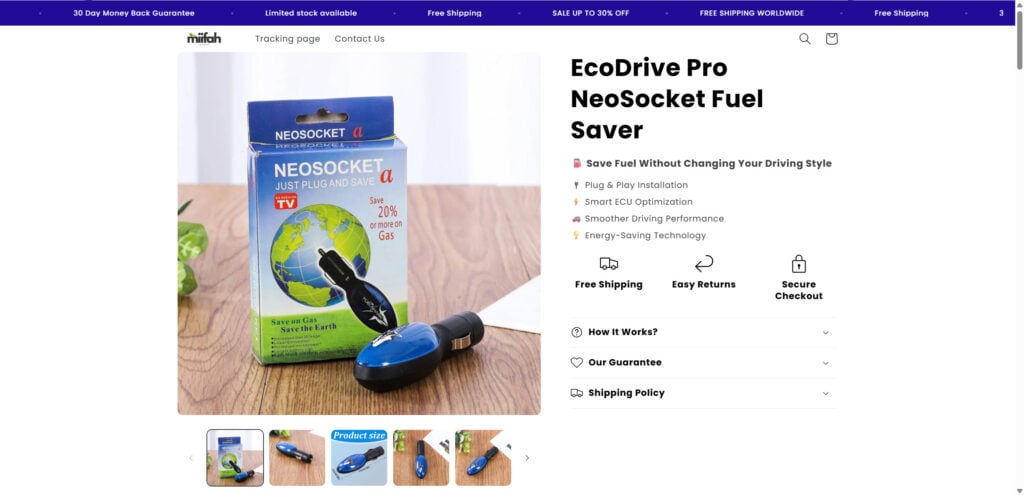
The NeoSocket is not a new breakthrough. It fits a much older pattern. A cheap plug-in gadget is given a fresh name, wrapped in polished marketing, and sold as a high-tech shortcut to better gas mileage. The promise sounds practical. The product page looks reassuring. The device itself even appears custom-made, which can make it feel more legitimate than many other low-effort scam products.
But once you slow down and examine the claims, the story starts to fall apart.
This article breaks down how the NeoSocket Fuel Saver scam works, why the product’s technical promises do not hold up, what red flags stand out on the sales page, and what to do if you already bought one.
Scam Overview
What NeoSocket claims to do
The NeoSocket Fuel Saver is marketed as a tiny plug-and-play device that supposedly improves fuel efficiency by reading data from your vehicle and helping it run more efficiently over time. The sales language usually sounds modern and technical.
You will often see phrases such as:
- smart ECU optimization
- smoother driving performance
- energy-saving technology
- better fuel economy over time
- save 30% to 70% on gas
- works with most cars
On the surface, that sounds plausible enough to many buyers. People know modern cars use computers. They know fuel costs matter. They also know small efficiency gains can add up. So when a product claims it can deliver better mileage with no effort, it lands on a very real pain point.
That is what makes this kind of product effective as a scam.
It does not rely on a wild fantasy. It relies on a half-believable shortcut.
The problem is that the product’s core claim does not stand up to even basic scrutiny. A tiny plug-in gadget like this is not going to transform your car’s fuel economy simply because it lights up and sits in a socket.
The marketing follows a familiar scam template
One of the biggest warning signs is that NeoSocket looks like yet another rebranded version of a fuel saver gimmick that has circulated for years under different names.
This category of device has been around for a very long time. The branding changes. The packaging changes. The promises stay the same.
The formula is familiar:
- claim a dramatic fuel savings range such as 30% to 70%
- say the device uses advanced electronics or ECU communication
- insist installation takes seconds
- promise that it “learns” your driving habits
- show a glowing light or polished casing to suggest sophistication
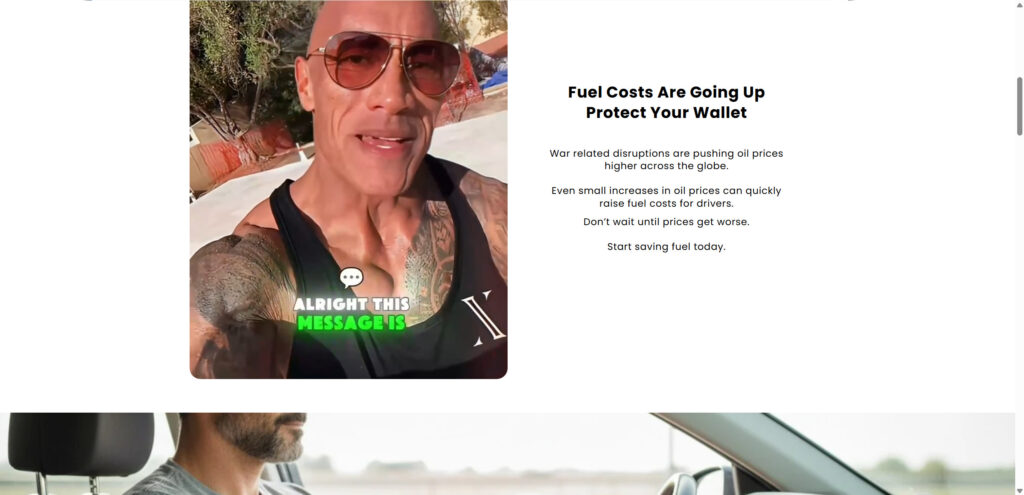
- create urgency with fuel price fears and limited stock language
This is not how serious automotive engineering products are typically sold. Real efficiency improvements usually involve careful tuning, measurable testing, specific compatibility information, and clear technical explanations. Scammy plug-in fuel savers, by contrast, rely on vague buzzwords and emotional selling.
The NeoSocket page shown here is a good example. It talks about protecting your wallet, rising fuel costs, easy installation, and broad compatibility. It also claims huge numbers like “100,000+ drivers” and leans on presentation rather than proof.
That is a major red flag.
The product itself is designed to look more impressive than it is
One thing that makes NeoSocket more convincing than some other junk gadgets is that the casing actually looks custom-designed.
That matters.
Many low-quality scam products look like generic factory leftovers. NeoSocket looks more polished than that. It has a shaped shell, a glossy translucent dome, branded packaging, and a visual style meant to suggest some hidden internal technology. The packaging even uses phrases like “Just plug and save” and references saving 20% or more on gas.
For some buyers, that polished design lowers suspicion.
It should not.
A custom case does not prove the underlying product works. It only proves somebody invested in making it look sellable. In fact, presentation is often one of the strongest tools these products use. If the device looks engineered, many buyers assume it must do something meaningful.
That is the trap.
A nice shell can hide a useless product just as easily as a cheap shell can.
The technical explanation is weak and contradictory
The sales page tries to sound technical, but the explanation quickly runs into problems.
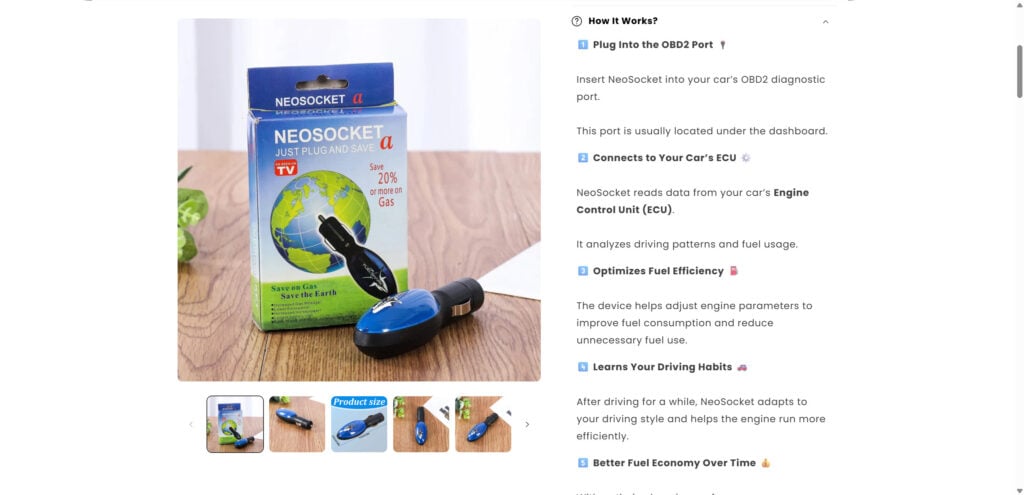
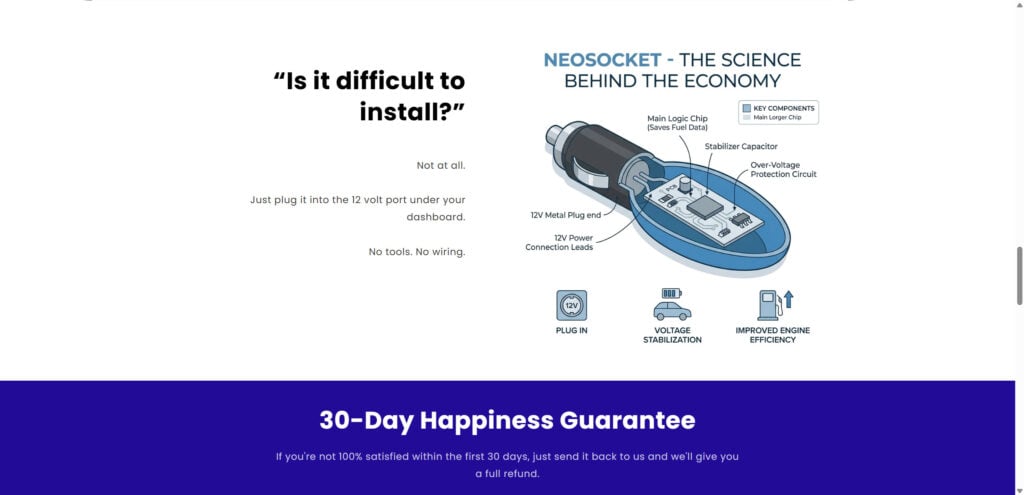
In one section, it says to plug the device into the OBD2 port. In another, it says to plug it into the 12 volt port under the dashboard. Those are not the same thing.
That contradiction matters because it exposes how little care went into the technical story.
An OBD2 port is a diagnostic interface with a specific connector shape and function. A 12 volt accessory outlet is a power socket. The NeoSocket shown in the product photos clearly has the form factor of a cigarette lighter style 12 volt plug, not an OBD2 diagnostic connector.
That means the page is mixing together two different ideas in a way that sounds impressive to non-technical buyers but makes very little sense in practice.
If a seller cannot even keep straight where the device plugs in, you should not trust their claims about ECU communication, adaptive learning, or fuel optimization.
Why the core claim does not hold up
The big promise behind NeoSocket is that it somehow smooths power, stabilizes your vehicle’s electrical system, communicates with the engine computer, and helps reduce fuel consumption.
That sounds advanced. In reality, it is the kind of explanation that depends on the buyer not asking too many questions.
Modern vehicles already have electrical systems built around a battery, alternator, voltage regulation, control modules, and designed operating tolerances. The engine control system is not sitting there waiting for a tiny gadget in an accessory socket to suddenly unlock dramatic fuel savings.
A small plug-in device with a token capacitor is not going to meaningfully reshape the electrical behavior of an entire vehicle in a way that cuts fuel use by 30% to 70%.
That is the central problem.
Even if the device contains a capacitor, an LED, and a few basic components, that does not make the claim real. A tiny capacitor in a consumer gadget is not some hidden fuel economy breakthrough. In the context of a car’s overall electrical system, such a component is trivial.
It may light an LED. It may make the device appear active. It does not suddenly optimize combustion, injector timing, air-fuel ratios, drivetrain efficiency, or engine mapping in a magical way.
And that is before you get to the other obvious issue.
If a product could really deliver major fuel savings this easily, it would not be sold primarily through dramatic landing pages, generic ads, and low-cost marketplace channels. It would be a mainstream automotive breakthrough.
The internal parts are part of the illusion
Products like NeoSocket often contain just enough internal hardware to seem believable to a casual buyer.
That is important to understand.
Scam gadgets do not always need to be completely empty. Sometimes they include a token component so the seller can point to “real electronics” if challenged. In this case, the device appears to rely heavily on the visual impression of electronics rather than any credible engineering function.
The small capacitor becomes part of the story.
The LED becomes part of the story.
The extra resistors or board layout become part of the story.
To a non-technical customer, that can look like proof. To anyone familiar with electronics, it proves much less than the marketing suggests.
A blinking or glowing device is not evidence of performance. It is often just evidence that the seller understood one very simple truth: buyers feel more confident when they can see that something lights up.
That may be the main function here.
The pricing gap is another major clue
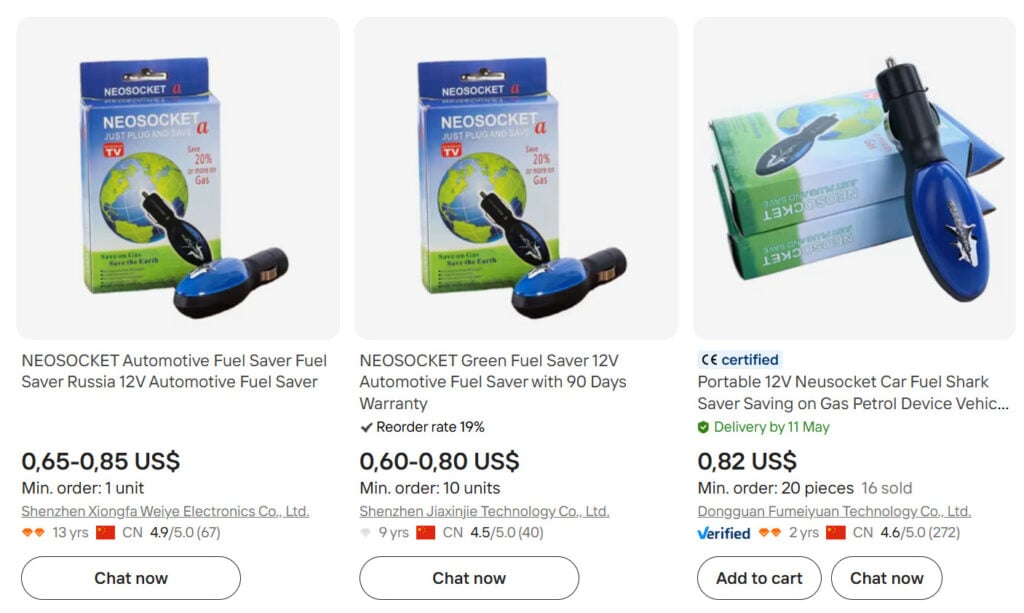
The screenshots you provided make another point very clear. Very similar NeoSocket-style devices appear available through wholesale marketplaces for roughly $0.60 to $0.85 per unit, depending on quantity and seller.
That does not automatically prove every retail listing is dishonest. Cheap manufacturing exists in many industries.
But when you combine extremely low wholesale pricing with inflated miracle claims, the picture becomes much clearer.
You are not looking at a premium automotive efficiency breakthrough. You are looking at a very cheap gadget that can be marked up heavily and sold through emotional advertising.
That business model matters because it helps explain why these products keep coming back. The margins can be strong even if many buyers eventually realize the device does nothing useful. Sellers do not need long-term trust. They just need enough impulse purchases.
That is why rebranding is so common.
Rebranding keeps the scam alive
NeoSocket does not stand out as a one-off product with unique technical credibility. It stands out as one more version of an old fake fuel saver concept that has simply been renamed and repackaged.
This is how many long-running product scams survive.
Once one name picks up complaints, bad reviews, or platform enforcement, the seller can shift to a fresh name, a new storefront, a revised landing page, or a slightly different casing. The story remains the same, but the identity changes just enough to keep new buyers from immediately recognizing it.
That is why consumers often feel like they have seen these products before. They probably have.
The branding may say NeoSocket today. In another version, it may be sold as a “fuel shark,” “eco drive” device, “voltage stabilizer,” “fuel saver chip,” or some other shiny label. The heart of the pitch remains unchanged: plug this into your car and save money effortlessly.
That pitch has staying power because it targets a universal frustration.
Drivers hate spending more on fuel.
Fake authority and fake confidence do much of the work
The NeoSocket sales page also uses familiar credibility shortcuts.
Examples include:
- “As seen on TV” style packaging cues
- large adoption claims like “100,000+ drivers”
- pseudo-scientific diagrams
- bold statements about engine efficiency
- polished lifestyle imagery
- simple testimonial-style review cards
- guarantee language meant to reduce hesitation
None of those elements prove the product works.
They are there to lower resistance.
A seller knows that many people will not investigate a product deeply if the page appears professional, the guarantee sounds reassuring, and the price feels low enough to be worth a gamble. That is especially true when the purchase is framed as a money saver rather than a luxury item.
The customer thinks, “If this cuts my gas bill even a little, it pays for itself.”
That mental shortcut is exactly what the scam depends on.
The contradictions are too big to ignore
Taken together, the NeoSocket offer raises too many concerns to treat as a serious automotive product.
The main issues are hard to dismiss:
- the product makes very large fuel-saving claims without credible evidence
- the technical language is vague and inconsistent
- the page confuses the OBD2 port with a 12 volt accessory plug
- the device’s likely electrical effect is trivial
- the design emphasizes appearance over demonstrated function
- similar items appear to be sold cheaply in bulk under generic branding
- the product category has a long history of rebranding and recycled claims
That does not look like innovation.
It looks like a very old scam idea wearing a nicer jacket.
Why this scam keeps finding buyers
NeoSocket is effective because it sells hope, not engineering.
It offers the fantasy of beating fuel costs without changing anything. No driving adjustments. No maintenance plan. No real upgrade. No trade-offs. Just plug in a tiny gadget and let it quietly save money in the background.
That is a powerful message.
People are busy. Cars are expensive to maintain. Fuel prices can feel unpredictable. So when a product promises a painless fix, some buyers want it to be true badly enough that they overlook the warning signs.
That does not mean they are careless. It means the pitch is designed to exploit ordinary frustration.
And that is why NeoSocket deserves scrutiny.
It is not just selling a device. It is selling a shortcut that has no credible reason to work the way it claims.
How The Scam Works
Step 1: Start with a real problem drivers care about
Every effective product scam begins with a real-world pain point.
In the case of NeoSocket, that pain point is fuel cost.
Drivers do not need to be convinced that gas is expensive. They already know. They feel it every time they fill up. They notice it in household budgets, commuting costs, delivery expenses, and road trip planning.
That makes fuel economy a perfect target for manipulative marketing.
A seller does not have to invent anxiety. They only have to attach their product to it. Once the ad frames NeoSocket as a simple way to fight rising costs, the device starts to feel practical before the buyer has even examined it.
This is the first step in the scam. The seller positions the product as a solution to an existing frustration, not as a novelty item. That makes the purchase feel rational.
Step 2: Wrap an old gimmick in a fresh brand name
The second step is rebranding.
The “plug this into your car and save fuel” gimmick has been around for years. Many buyers would ignore it if it appeared under an old, recognizable name. So sellers keep relaunching the same basic concept under new labels.
NeoSocket is the kind of name that works well for this strategy.
It sounds technical but accessible. It suggests a smart connection between electronics and your vehicle. It feels modern enough to pass at a glance, especially when paired with product titles like “EcoDrive Pro NeoSocket Fuel Saver.”
That branding is deliberate.
A fresh name helps separate the product from older complaints, previous storefronts, and years of skepticism surrounding nearly identical devices.
Step 3: Build a clean, reassuring sales page
Once the product has a name, the next step is presentation.
The product page is designed to make the buyer feel safe, not informed.
That is why you often see:
- free shipping
- easy returns
- secure checkout
- money-back guarantee
- limited stock notices
- large, clean product photos
- short benefit bullets instead of technical detail
This kind of page is not trying to educate you on automotive engineering. It is trying to make the decision frictionless.
Notice how carefully the emotional tone is managed.
The page creates urgency with fuel-price concerns and stock language. At the same time, it reduces fear with return policies and guarantees. That combination is common in online product scams because it corners the buyer psychologically.
The message becomes: act now, but feel safe doing it.
Step 4: Add just enough technical language to sound credible
The average buyer is not going to audit an engine management claim in detail. Scam sellers know this.
So they use language that sounds advanced without being specific enough to verify.
Terms like these are common:
- ECU optimization
- engine data reading
- voltage stabilization
- adaptive learning
- fuel efficiency enhancement
- power smoothing
- better performance over time
Each phrase sounds plausible in isolation. Together, they create a fog of competence.
But when you ask concrete questions, the explanation falls apart.
How exactly does a device in a 12 volt socket alter fuel mapping?
How does it “learn” driving habits?
How does it interact with the ECU if the physical connector does not match the OBD2 port?
Why are the claimed savings so large if the hardware is so simple?
The scam works because many buyers never get to that stage. The wording is meant to feel technical enough to prevent deeper questioning.
Step 5: Use visual design to substitute for evidence
A lot of people underestimate how powerful visual cues are in online scams.
NeoSocket benefits from a more polished physical design than many fake gadgets. The shaped housing, glossy top, and packaged presentation make it appear more considered than a generic plastic trinket.
That visual polish does real work.
It encourages buyers to assume there must be meaningful electronics inside. It also makes the product feel more proprietary, as if somebody engineered it for a real purpose rather than copied it from a bargain bin design.
Then the seller adds diagrams, icons, and simple illustrated “science” panels to reinforce the illusion. A cutaway image of internal parts looks authoritative even when it proves almost nothing. Labels like “main logic chip,” “stabilizer capacitor,” or “over-voltage protection” sound impressive to non-specialists.
But a labeled diagram is not performance proof.
This is a key part of how the scam operates. It uses the aesthetics of engineering in place of engineering itself.
Step 6: Make the product sound effortless
Real improvements to fuel economy usually involve trade-offs, maintenance, tuning, driving behavior, load reduction, tire pressure, or vehicle condition. They take effort, knowledge, or money.
NeoSocket rejects all of that.
Its appeal is built on effortlessness.
The pitch is always some variation of this:
- no tools
- no wiring
- plug and play
- no change to your driving style
- starts learning automatically
- saves fuel in the background
That matters because it removes the biggest objection many buyers would normally have. If a product required expertise or installation time, more people would hesitate. If it claims to work instantly and passively, hesitation drops.
This is scam psychology at work.
The easier the promise, the more emotionally attractive it becomes.
Step 7: Create confusion that favors the seller
One of the strangest details on the NeoSocket page is the confusion between OBD2 and the 12 volt accessory port.
A real automotive product would be very clear about this because the connector determines how the device functions. A diagnostic port is not the same as a power outlet.
But scam pages often contain this kind of confusion because accuracy is not the real priority. Impression is.
If the product says “OBD2,” it sounds smart and computer-linked. If it looks like a cigarette lighter plug, it still seems familiar and easy to use. The seller borrows authority from one concept and convenience from another.
That hybrid story may not survive technical inspection, but it does not need to. It only needs to survive long enough to secure the sale.
This is one of the clearest signs that the marketing is built for persuasion first and product truth second.
Step 8: Lean on social proof, even when it is weak
Most buyers feel safer when they believe other people have already tried the product successfully.
So the sales page often includes social proof cues such as:
- “trusted by 100,000+ drivers”
- simple customer review tiles
- broad compatibility statements
- testimonial language
- video ad clips or influencer-style footage
These elements create a sense of momentum. The buyer begins to feel late to something other people already know about.
That feeling is powerful.
It is also very easy to manufacture online.
Generic testimonials, inflated usage numbers, and highly polished ad creatives are not hard to produce. They look persuasive because most people scan product pages quickly. Sellers understand this and design pages to be skimmed, not investigated.
The result is a false sense of consensus.
Step 9: Price it low enough to encourage impulse buying
Many scam products live in a sweet spot where the price is high enough to produce strong margins but low enough that the buyer will not spend days researching.
NeoSocket fits that model well.
If a consumer sees a claim that a small device could save them fuel every week, even a moderately inflated purchase price may feel acceptable. The buyer starts doing simple mental math:
“If this saves me a little on each tank, it pays for itself.”
That logic breaks down if the product does not work. But it is persuasive in the moment.
The low manufacturing cost matters here too. If similar devices can be sourced wholesale for less than $1, the seller has plenty of room to spend on ads, still make profit, and absorb some refunds or disputes.
That is why this kind of scam remains attractive to sellers. The economics can still work for them even if many buyers are disappointed.
Step 10: Deliver a product that appears functional at first glance
When the package arrives, the scam enters a new phase.
The device is not always obviously fake in the way a blank box or empty shell would be. Instead, it often appears superficially functional. It plugs in. It lights up. It has a circuit board. It may feel surprisingly solid for what it is.
That helps reduce immediate backlash.
A buyer may think:
- maybe it needs time to “learn”
- maybe the savings are gradual
- maybe I just need to drive more to notice
- maybe I installed it slightly wrong
- maybe my car is not responding yet
This delay in disillusionment helps the seller.
Unlike a broken product, a useless product can be hard to challenge immediately. Fuel savings are not always easy to isolate in day-to-day driving. Mileage varies with traffic, weather, route, load, tire condition, driving style, and countless other factors.
That uncertainty creates cover for the scam.
Step 11: Shift the burden of proof onto the buyer
This is one of the smartest parts of the scheme.
The seller makes the claim, but the buyer ends up carrying the burden of disproving it.
If the device clearly fails, the buyer can complain easily. But if the claim involves gradual efficiency changes over time, vague engine optimization, or smoother performance, the seller benefits from ambiguity.
How do most people prove that a plug-in gadget did not save 15% on fuel?
They usually cannot do it cleanly.
Most drivers are not running controlled comparisons across identical routes, temperatures, traffic conditions, and fill-up methods. So the scam lives in that gray area where disappointment is real, but proof feels annoying to gather.
That is not an accident. It is part of the design.
Step 12: Hide behind guarantees and support friction
At first glance, the guarantee looks like a strong consumer protection feature.
In practice, many questionable online stores use guarantee language mainly to increase conversions.
Even when the words sound reassuring, the real refund experience may involve:
- delayed responses
- return shipping costs
- strict return windows
- unclear return addresses
- partial refunds
- requests for photos or repeated troubleshooting
- silence after purchase
This is especially effective with low-cost imported goods. A buyer may conclude that fighting over a disappointing gadget is simply not worth the time.
That is another reason scams like this survive. Many people chalk it up as a lesson and move on.
Step 13: Recycle the formula under new storefronts
Once complaints build up, the product does not need to disappear forever. It only needs to move.
A new brand name, a new product title, a refreshed theme, and a few revised ad creatives are often enough to restart the cycle.
That is why consumers should judge products like NeoSocket by the pattern, not just the page in front of them.
The pattern is what matters:
- miracle savings with no effort
- vague technical language
- cheap hardware
- dramatic markup
- high emotional appeal
- weak evidence
- repeat rebranding
When you look at it that way, the scam becomes easier to spot.
Why so many people still fall for it
It is tempting to think only careless shoppers buy products like NeoSocket. That is not true.
These scams work because they are engineered around ordinary human instincts.
People want simple savings.
People trust polished design.
People assume visible electronics mean real technology.
People want to believe there is still a clever bargain out there.
And many people do not have the time or technical background to dismantle every claim before buying.
The NeoSocket Fuel Saver scam takes advantage of that gap between what sounds possible and what is actually credible.
That is how it keeps going.
What To Do If You Have Fallen Victim to This Scam
If you bought the NeoSocket Fuel Saver and now suspect you were misled, do not panic. This is frustrating, but it is manageable. The best response is calm, organized, and practical.
1. Gather everything related to the purchase
Start by collecting all the evidence you can while it is still easy to access.
Save or screenshot:
- the product page
- the order confirmation
- the price you paid
- the product claims
- any guarantee or refund language
- shipping emails
- tracking information
- ads or social media posts that led you to the purchase
This matters because product pages often change after complaints start coming in. If the seller later removes bold savings claims or edits the return policy, your screenshots can help show what was promised at the time of sale.
2. Test your expectations against the actual product
Be honest with yourself about what you received.
Ask simple questions:
- Does this product physically match the listing?
- Does it appear to do anything beyond lighting up?
- Is there any measurable reason to believe it changes fuel use?
- Did the seller promise results that are not realistically supported?
This step helps you move from vague disappointment to a clear complaint. Instead of saying “I do not think it works,” you can say, “The product made specific fuel-saving and ECU-related claims that are not supported by the device delivered.”
That is a much stronger position.
3. Contact the seller in writing
Reach out to the seller through email or the store contact form and keep your message concise.
Include:
- your order number
- the date of purchase
- a short statement that the product does not perform as advertised
- a request for a full refund
- a deadline for response, such as 5 to 7 business days
Keep the tone professional. Do not overexplain. Do not argue about automotive engineering unless necessary. Focus on misleading advertising and non-performance.
A simple message works best:
“I am requesting a full refund because the product does not perform as advertised and the technical claims used to sell it appear misleading. Please confirm the refund process within 7 business days.”
4. Read the payment method options you used
Your next move depends a lot on how you paid.
If you used a credit card, you may have chargeback rights.
If you used PayPal, you may be able to open a dispute for item not as described.
If you used a debit card, bank protections may still exist, but the process can vary.
Do not wait too long. Many dispute systems have time limits. Even if the amount feels small, it is worth checking your options because sellers count on people assuming the hassle is not worth it.
5. Open a payment dispute if the seller stalls or refuses
If the seller ignores you, delays endlessly, or offers a weak response, escalate through your payment provider.
When filing a dispute, stay factual.
Useful points include:
- the product made unsupported fuel-saving claims
- the technical explanation was contradictory or misleading
- the item appears to be a generic, low-value gadget sold as a high-performance solution
- the device does not function in the way advertised
- the page used claims about ECU optimization or measurable fuel savings without credible substantiation
Attach screenshots whenever possible.
The stronger your documentation, the easier it is for the payment provider to understand that this is not just buyer’s remorse.
6. Do not rely on the device in your vehicle
Even if the NeoSocket does not appear harmful, you should not keep using a questionable gadget simply because it lights up.
Remove it.
At best, it is useless clutter. At worst, low-quality electronics can create unnecessary risk, especially if build quality is poor. A cheap plug-in device is not something you want to trust in a vehicle electrical environment without good reason.
If a product has already proven misleading, there is no upside in continuing to use it.
7. Leave a detailed review where it can help others
One of the most useful things you can do after dealing with a scammy product is warn other consumers clearly.
Write a review that explains:
- what the product claimed
- what you received
- what concerns you noticed
- how the seller handled your complaint
- whether you were refunded
Be specific. Avoid emotional overkill. Calm, detailed reviews are often more credible and more useful than angry one-line warnings.
You may be able to post on:
- Trustpilot
- site review pages
- social media
- scam-reporting forums
- product review platforms
- your own website or blog if you run one
Your review could help prevent someone else from losing money.
8. Watch for follow-up charges or marketing spam
Some questionable online stores do not stop at one sale.
After buying, monitor for:
- unexpected repeat charges
- aggressive upsell emails
- suspicious delivery updates
- SMS marketing you did not expect
- other “miracle” automotive or savings products pushed to you
If you see unusual payment activity, contact your bank or card issuer promptly.
It is also a good time to be cautious with any future ads using the same style of claims. Once you have bought from one seller in this ecosystem, you may be targeted again.
9. Report the store or ad when appropriate
If the product was promoted through a marketplace, ad platform, or payment service, consider reporting it.
Useful reasons to cite include:
- misleading fuel-saving claims
- contradictory technical explanations
- deceptive marketing
- product not as described
One report will not always remove a listing, but repeated reports do matter. Scam products often survive because platforms do not see the full pattern immediately.
Consumer reports help create that pattern.
10. Use this as a filter for future “easy savings” products
The most valuable outcome from an experience like this is not just recovering your money. It is improving your scam radar.
Products deserve extra skepticism when they promise:
- dramatic savings with no effort
- broad compatibility with no real technical detail
- vague “smart” optimization language
- miracle performance from tiny hardware
- pseudo-engineering graphics instead of proof
- pressure to buy now before thinking it through
That lesson applies far beyond NeoSocket.
The internet is full of products that sell convenience, confidence, and urgency first, while hiding the lack of substance behind polished design. Once you start recognizing the pattern, these offers become much easier to reject.
The Bottom Line
The NeoSocket Fuel Saver appears to be another version of a long-running fake fuel saver gimmick that has been rebranded and repackaged for modern online shoppers.
Its promise is attractive because it sounds easy. Plug it in, let it “learn,” and save money on fuel without changing anything else. But the real warning signs are hard to ignore. The claims are oversized, the technical explanation is weak, the page contains contradictions, and the product itself looks far more convincing than its likely function.
A small glowing gadget in a fancy shell is not the same thing as a real automotive innovation.
That is the heart of the NeoSocket Fuel Saver scam.
It sells the appearance of engineering and the fantasy of effortless savings. What it does not offer is credible evidence that it can produce the fuel economy gains it advertises.
If you were considering buying it, the safest move is to pass.
If you already bought one, document everything, request a refund, and escalate through your payment provider if necessary.
In the end, the smartest fuel-saving upgrade is not a miracle plug-in device. It is skepticism.









Yea, this is a complete scam and I bought 3 of them. The light doesn’t even come on in any of them. So much for their money back guarantee. No way to get a hold of them.
Three of them and not one light, which at least spares you wondering whether it was doing anything. These plug-in devices cannot reduce fuel or electricity use; there is nothing inside capable of it, and the LED is essentially the whole product. Since all three went through in one transaction, take the full amount to your card issuer as a single dispute, describe it as goods not as described, and mention that the advertised function is physically impossible. The fact that there is no working contact address or address for returns strengthens your case rather than weakening it.
Three units and not one that even lights up tells you everything about what is inside the casing, Mark. Since there is no way to reach them, take all three charges to your card issuer together and dispute them as not as described – the fact that none of them work at all supports the claim. Attach photos of the devices and a screenshot of the ad promising the fuel savings, and ask the bank to block any further billing from that merchant.
I suspect this item is useless. There’s just too many inconsistencies. The video online shows the gas mileage going from 240 to 600 and instantly back down to the normal when the device was removed. When I installed it which means to plug it in to the cigarette lighter. Nothing happened with the mileage to empty and they keep talking about a blue light indicate that it’s working. But there’s no blue light. It’s a red light. The only thing blew about it is the shiny casing. They can’t even describe the color of the light refunding is easy cause it was an Amazon purchase. Unfortunately it was cheap enough to try to use it and see what happens. But I don’t see any increased gas mileage after one day of use. Definitely not the way it was claimed in the advertisement.
You have effectively run the experiment, and your result is the correct one: nothing happened, because there is nothing in the device to do anything. These “fuel savers” are a small circuit board, or sometimes just a resistor and an LED, in a plastic shell that draws power from the lighter socket and does not communicate with the engine control unit at all. The socket has no route to fuel mapping.
The video is the tell you spotted – a gauge reading jumping to 600 and back the instant it is unplugged is an edited or hand-held display, not an OBD reading. If it is within the return window, dispute the charge with your card issuer as not as described; false fuel-economy claims also interest the FTC at reportfraud.ftc.gov, and the EPA has a long-standing programme testing exactly this category of gadget, none of which has ever shown a benefit.
Scam company!! I sent $51 to purchase this alleged gas saving device over a month ago. Never received anything. Tried to contact the seller who is Chinese and no response. USPS stopped it because of counterfeit postage. Filed a dispute with PayPal for a refund. Still waiting on their review.
Hi Richard, I’m sorry this happened. Counterfeit postage and no delivery are strong warning signs. Since you already filed with PayPal, keep the tracking, USPS notice, order confirmation, and screenshots of the seller page as evidence.
Hi Richard, I’m sorry this happened.
Counterfeit postage, no delivery, and no seller response are strong warning signs. Since you already filed with PayPal, keep the USPS notice, order confirmation, tracking details, and screenshots of the seller page as evidence.
Thank u for the information.
You are welcome – glad it was useful. If you saw the advert somewhere, reporting it on that platform helps the next person, since these get pulled on complaint volume rather than on anything we write.