

A stranger writes with a private opportunity involving a family fortune. You barely know them, yet they say you are the person they need.
The Nigerian Prince email scam is a familiar name for an invitation that can still catch people off guard. Its important details deserve more than a joke.
Overview
A promised fortune is used to justify an upfront payment
The Nigerian Prince email scam is an advance-fee fraud. A stranger promises a valuable payout, then requires your money or sensitive information before it can supposedly arrive.
The sender might claim to represent a wealthy family, an estate, a business, or a government official. A literal prince is not necessary for the mechanism.
The offered reward creates a reason to keep talking. Later fees are presented as minor obstacles compared with the much larger sum you expect to receive.
In the deceptive version, the promised fortune is not a genuine entitlement. The recipient’s payments are the real source of money flowing through the arrangement.
The label describes the scheme, not the sender’s nationality
This familiar name should not be treated as proof that a particular sender is Nigerian. Fraudsters can claim any nationality, title, institution, or location.
An archived FTC warning documents the central pattern: invented wealth, transfer assistance, official-looking paperwork, upfront expenses, and further problems that postpone the supposed payout.
That historical warning does not establish how often the scam occurs today. Its old reporting addresses should not be used as current recovery instructions.
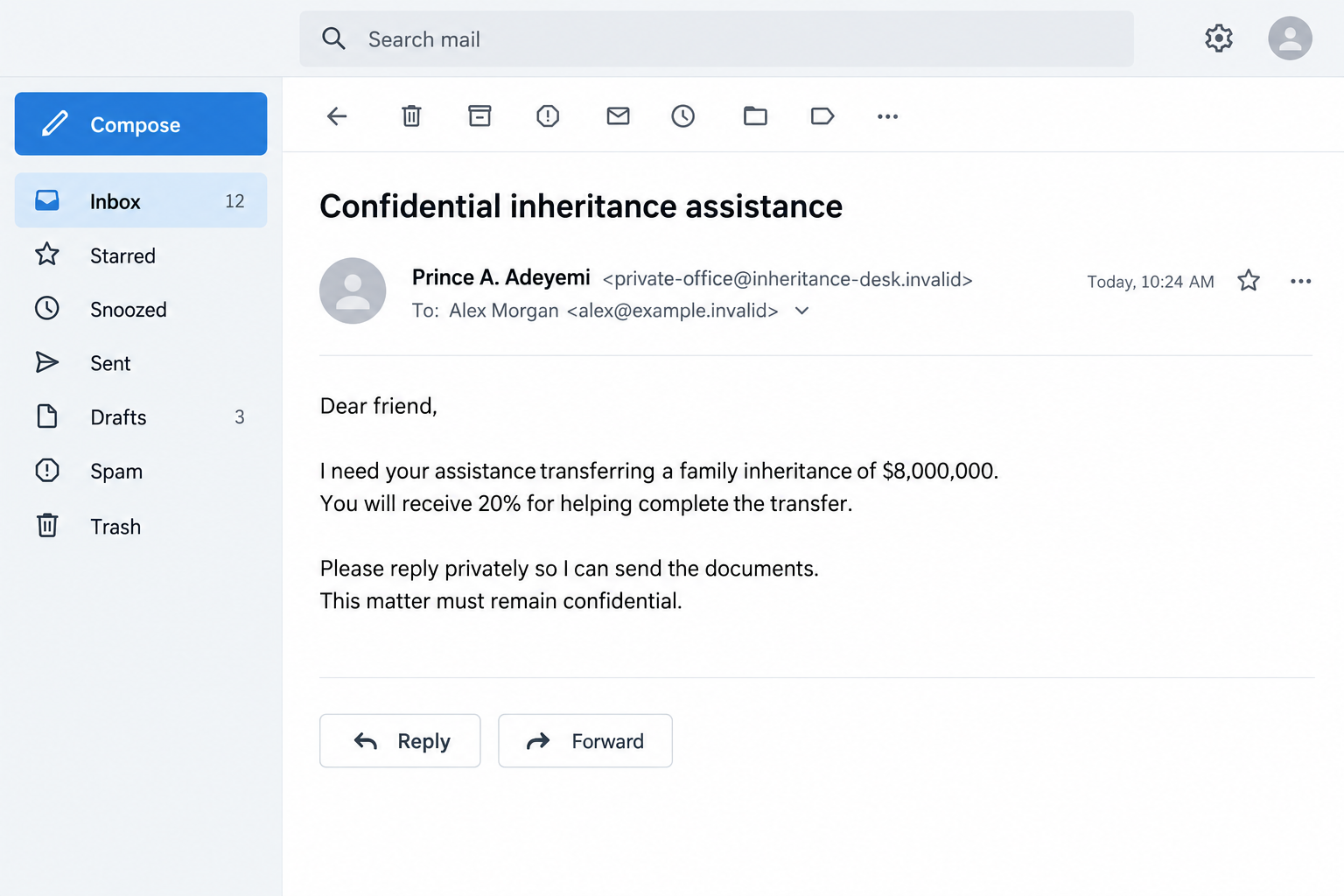
The fictional sums and messages illustrated here explain the pattern. They do not identify a real estate, beneficiary, sender, or transaction.
Recognize the arrangement before debating the paperwork
Different stories can share the same underlying request. Look at what you are expected to do, rather than judging only the language or claimed origin.
- A stranger selects you to receive or help transfer money without a credible existing relationship.
- The reward depends on advance clearance, legal, processing, insurance, or transfer payments.
- New costs appear after an earlier fee was described as the final requirement.
- Confidentiality is used to keep you from speaking with a bank, relative, or independent professional.
- Documents and introduced contacts can only be verified through channels supplied by the same sender.
When those features appear together, do not send a test payment. A smaller amount does not verify the larger promise and can lead to further demands.
What Makes the Offer Persuasive
The reward makes the cost look manageable
A request for $450 looks different when it is placed beside a promised $8,000,000 inheritance. The comparison encourages you to evaluate the fee against imagined future wealth.
Those are illustrative figures, not verified amounts from one campaign. The same distortion can work with much smaller promises and more modest processing charges.
The useful question is not whether the fee seems affordable. It is whether the money, your entitlement, and the party requesting payment have been independently established.
A private favor creates a sense of responsibility
The sender may describe a family crisis, blocked inheritance, or urgent need for a trusted overseas contact. You are invited to become helpful, not merely fortunate.
That framing can make skepticism feel unkind. In reality, declining an unverifiable financial request is not abandoning someone who has proved they need your assistance.
You do not have to solve the stranger’s story before refusing. A request involving your account or money requires reliable evidence, not an emotional obligation.
Time spent on the exchange can make leaving harder
After several conversations, the sender may feel familiar. After a payment, walking away also means accepting that the expected reward may never arrive.
A new fee can then sound like the easiest way to finish what you started. That is precisely when outside advice becomes especially valuable.
Previous effort does not improve the truth of the original claim. You can stop today even if you replied yesterday or paid last week.
How the Nigerian Prince Email Scam Works
Step 1: An unsolicited message offers access to hidden wealth
The opening introduces a fortune and a supposed problem moving it. The recipient is offered a commission, inheritance share, or other reward for assisting.
The explanation supplies a role for you without showing why a genuine owner would need an unknown person’s help. That missing connection is important.
A title, family history, or institutional name may make the proposal sound established. None of those claims confirms that the sender controls any funds.
Do not reply just to ask how the arrangement works. The sender can adapt their explanation around your questions while learning that your address is active.
Step 2: The conversation gathers cooperation and personal details
Someone who responds may be asked for a full name, address, identification, bank details, or an explanation of their ability to help.
The request can be framed as creating a beneficiary file or confirming eligibility. That administrative language makes the disclosure feel routine.
In this setting, the information goes to an unverified stranger. It could support later impersonation or other attempts, even if no payment is ultimately made.
Having a genuine account at a real bank does not make this proposed transfer legitimate. Your banking relationship cannot validate someone else’s invented estate.
Step 3: Documents and additional contacts support the story
The sender may introduce a supposed lawyer, banker, or clearance office. Their messages seem to confirm that the arrangement has moved into a formal process.
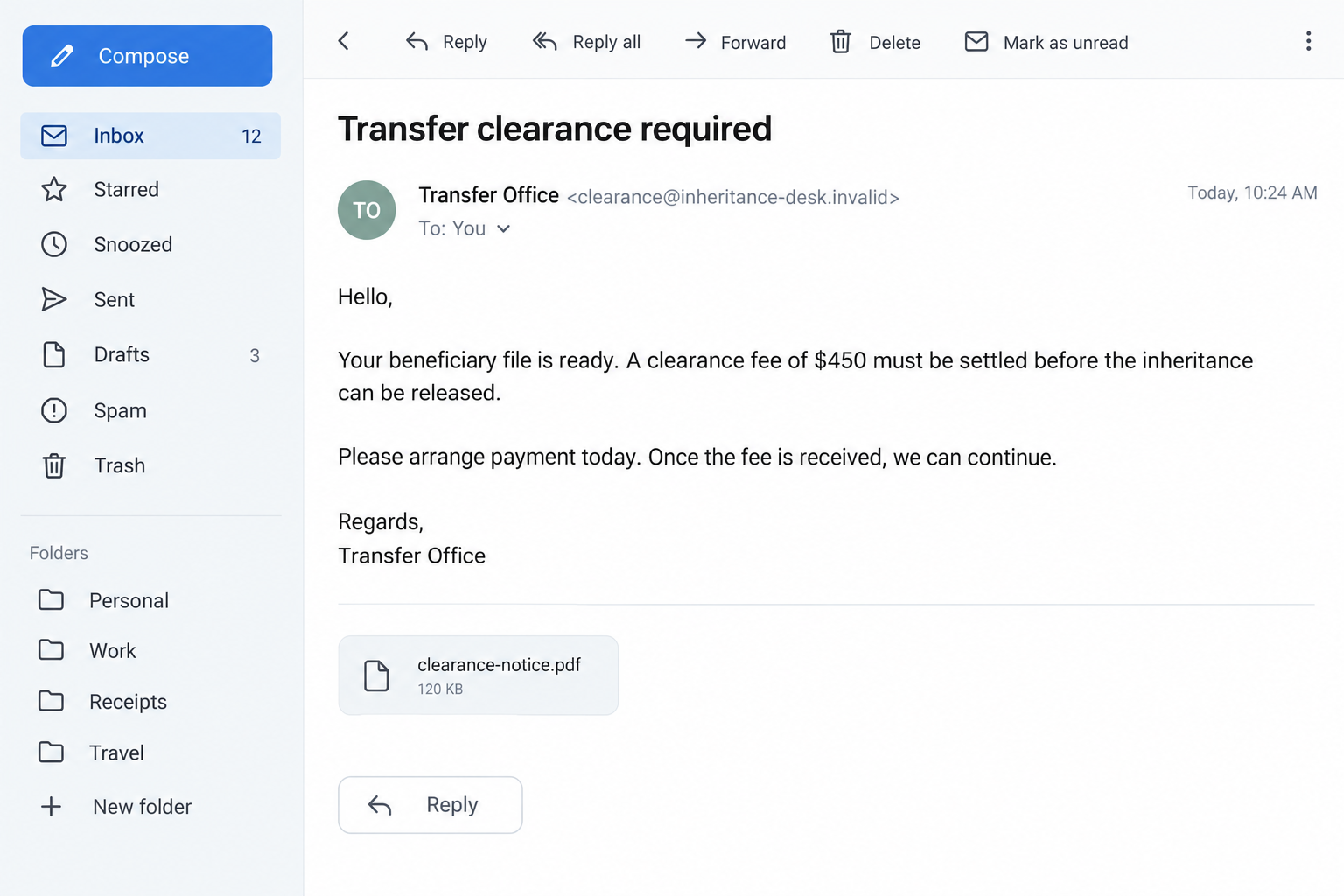
Official-looking files can contain reference numbers, signatures, or payment instructions. Their appearance is evidence of presentation, not proof that an institution issued them.
A contact supplied by the original sender is not an independent witness. If all roads lead back into the same conversation, verification has not happened.
Do not open unexpected document attachments to investigate an offer. A legitimate institution can be contacted through an address or number you find separately.
Step 4: The first fee becomes the condition for release
A processing, transfer, legal, or clearance expense supposedly blocks the payout. The sender asks you to settle it before funds can be released.
They may explain that the expense cannot be deducted from the promised fortune. That creates the central contradiction: extraordinary wealth still requires money from a stranger.
Real legal and banking processes can involve costs. The problem here is the unverified entitlement and identity, not the existence of professional fees generally.
The second illustration shows this decision point with a fictional clearance request. No listed amount should be taken as a standard fee or a safe threshold.
Step 5: Another obstacle replaces the promised completion
After payment, the explanation may change. A supposed authority now needs another document, a correction, an insurance charge, or a different release fee.
The reward remains just out of reach while the recipient’s real losses increase. The sender can describe each new obstacle as the last one.
This is why paying a small initial amount is not a useful experiment. The scam does not need to honor the promise to keep asking for money.
Stop evaluating new demands in isolation. Review the entire sequence, including how many times completion was promised after a payment.
Step 6: The sender disappears or offers another version of the deal
Eventually, the contact may become unreachable. Alternatively, new names can appear with explanations for the delay and another request to finish the transfer.
A later recovery approach can claim that someone found your money. That claim also needs verification, particularly if a refund depends on another advance fee.
Receiving a document marked approved does not mean a payout exists. Nor does a screenshot of a balance prove money is held for you.
The safest endpoint is outside the sender’s process: stop paying, preserve the record, and ask your own payment provider about available recovery options.
How to Verify an Inheritance or Transfer Claim
Establish why you would be entitled to anything
A real inheritance should have a traceable explanation connecting you to an estate. A random email offering wealth for secrecy is not that explanation.
If you genuinely expect an estate matter, contact your known representative independently. Ask whether the specific message and requested payment belong to that process.
Do not let the sender’s claimed lawyer perform the independent check. A second person introduced within the offer can be part of the same deception.
Confirm institutions through their own channels
Locate the bank or professional independently, using official contact information rather than a number printed in the suspicious file. Ask about the exact claimed involvement.
Registration information can help establish that a professional exists, but it does not prove the email came from that person. Identity must also be confirmed.
Search results and copied seals can be misleading. A website with encrypted HTTPS traffic still does not establish that its operator owns an inheritance.
Do not lend your account to an unexplained transfer
Some offers ask you to receive money and forward part elsewhere. Do not treat incoming funds as validation of an unverified arrangement.
A deposit can involve a separate fraud or later reversal. Your bank should review an unexpected transaction before you move any part of it.
If you have already received unexplained funds, tell the bank how the contact began. Do not independently return money to instructions supplied by the stranger.
Also reject requests to travel or meet unfamiliar contacts to complete the deal. A financial promise does not justify putting your personal safety under their control.
What to Do if You Have Fallen Victim to This Scam
- End all payments and negotiations.
Do not pay another fee to retrieve the first payment. Refuse any new clearance demand, even if the sender now offers a discount or a guarantee.
You can disengage without admitting fault to the sender. Preserve the evidence first, then block the relevant accounts and numbers.
- Ask the payment provider for immediate assistance.
Contact your own bank, card issuer, transfer service, or payment app through its official support channel. Explain the promised fortune and the advance-fee request.
Ask whether a transfer can be stopped, recalled, or investigated. Provide the date, amount, reference, and destination information shown on your receipt.
For cryptocurrency, notify the service you used and retain the transaction identifier. Reversing a completed blockchain transfer may not be possible, so avoid refund promises.
- Build a clear chronological record.
Keep the first offer, subsequent fees, introduced contacts, documents, and receipts. A timeline helps show how the story changed after you cooperated.
Record any threats or instructions to conceal the transaction. Share sensitive records privately with relevant institutions, not in public comment threads.
- Tell your bank about information or account access you shared.
Explain exactly what was exposed: account details, a login, a security code, identification, or permission to access a service. Those exposures need different responses.
Ask whether the account, payment credentials, or transfer permissions require protective changes. Do not assume one new password resolves every kind of banking risk.
- Recover compromised logins and assess document exposure.
Replace an exposed password on the legitimate service and any accounts where it was reused. Review sessions and recovery contacts for changes you did not make.
US readers who disclosed identity information can use IdentityTheft.gov for tailored guidance. Other readers should consult their country’s official identity-theft resources.
If your email was compromised, warn contacts about messages sent in your name. Save relevant evidence without forwarding harmful attachments to them.
- Check the device only when the interaction warrants it.
Receiving or reading a message does not by itself prove infection. Downloads, installed programs, browser changes, or suspicious attachments deserve a more targeted check.
Use Malwarebytes after opening a questionable file or installing software supplied by the sender. Avoid running the same attachment again as part of your investigation.
AdGuard can help filter some malicious pages and ads you encounter later. It cannot determine whether an inheritance exists or undo an advance-fee payment.
- Report the actual conduct through current channels.
Submit the details to ReportFraud.ftc.gov in the US, and consider an IC3 report for online financial crime. Use local official reporting services elsewhere.
Include what was promised, what you provided, and what happened afterward. The familiar scam label is less useful than an accurate description of the transaction.
- Watch for refund offers targeting your loss.
A stranger may claim to represent investigators or a recovery service. Do not share account access or pay them to unlock an allegedly recovered balance.
The FTC’s recovery-scam guidance explains this follow-on risk. Reporting a loss does not create a guarantee that anyone can return it.
Frequently Asked Questions
Does the scammer have to claim to be a prince?
No. The same advance-fee structure can involve a supposed estate, official, businessperson, or family member. Follow the payment conditions rather than the title.
Does the Nigerian Prince label identify where the sender lives?
No. It is a conventional name for a fraud pattern, not reliable evidence of a person’s nationality, residence, or real identity.
Are all unexpected inheritance messages fraudulent?
No. An authentic estate contact should be independently verifiable. Confirm the representative, entitlement, and process before disclosing information or arranging any payment.
Can an official-looking certificate make the transfer trustworthy?
Not on its own. A document can be fabricated or copied. The issuing institution must confirm its involvement through a channel outside the suspicious exchange.
What if I replied but did not send money?
Stop the conversation and assess any information you disclosed. Expect further approaches, but do not assume a reply automatically means your device or bank account was compromised.
Can I recover an advance fee after sending it?
Possibly, depending on the payment method and timing. Contact the provider promptly and describe the deception accurately. No stranger can guarantee a recovery.
The Bottom Line
The Nigerian Prince email scam turns a promised fortune into a reason to send real money first. The claimed title or country does not change that pattern.
Do not fund an unverified transfer or lend your account to it. If you already paid, stop further payments and contact your own provider immediately.








