

Nuora Vaginal Probiotic Gummies are positioned as a fast, easy fix for intimate odor, pH balance, and recurring BV or yeast issues. The pitch is polished, the testimonials are everywhere, and the review counts look massive.
But when a supplement is marketed like a cure, pushed with urgency tactics, and paired with “save more with automatic refills,” the smarter move is to slow down and evaluate the risks before you buy.
This is not medical advice. If you have symptoms like burning, itching, discharge changes, pelvic pain, or recurrent infections, a clinician visit is the safest starting point.
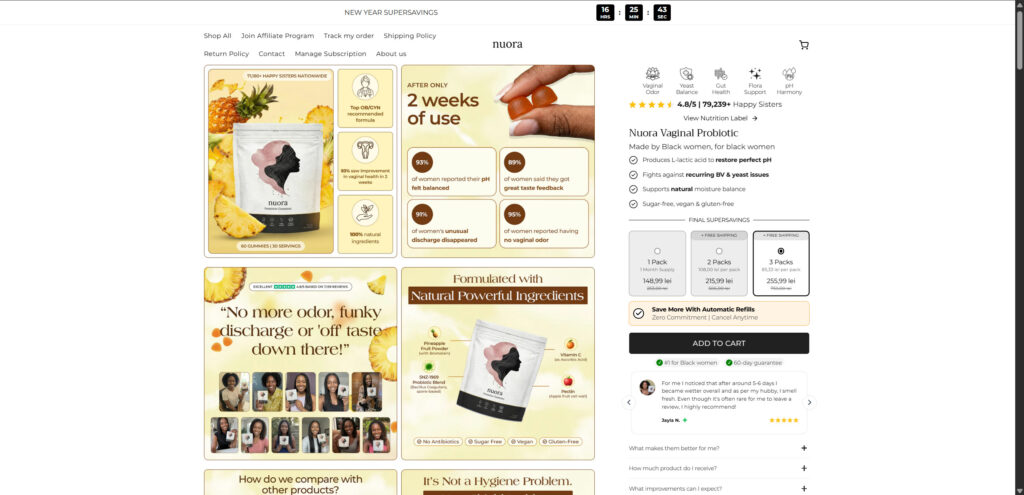
What Nuora claims to do
Based on the product page messaging in your screenshots, the gummies are promoted as:
- Supporting vaginal microbiome balance and “perfect pH”
- Reducing vaginal odor and “freshness” concerns
- Helping with recurring BV and yeast issues
- Improving comfort and confidence
- Producing noticeable results on a short timeline (sometimes framed in days or weeks)
- Being “featured” by major lifestyle publications, alongside very large customer counts and star ratings
Those are high-impact claims for a non-prescription supplement, especially when the messaging leans into infection-related outcomes.
Quick verdict: Buy or skip?
Skip, for most people.
Not because vaginal probiotics are always useless, but because this offer has multiple risk markers at the same time:
- Claims that sound like treatment promises (BV/yeast outcomes, guaranteed timelines)
- Hard-to-verify review volume and “community” numbers
- “As seen in” style media logos without clear sourcing
- Heavy reliance on auto-refill/subscription mechanics
- A return process that can become slow, conditional, and frustrating in the real world
If you still want to try a probiotic approach, there are safer ways to do it (covered below) without gambling on a direct-response funnel that may prioritize recurring billing over support.
Major red flags in the Nuora funnel
1) Massive social proof that is difficult to verify
Pages like this often show:
- Tens of thousands of “happy customers”
- Very high star ratings with huge review counts
- Photo-heavy testimonial grids
The problem is not that happy customers cannot exist. The problem is that you cannot easily validate how those reviews were collected, whether purchases were verified, whether negative reviews are filtered out, or whether the “review count” is aggregated across products and pages.
When you see a supplement marketed like a lifestyle brand with unusually large numbers, treat it as marketing, not evidence.
2) Media logo placement that implies endorsements
Your screenshots show “featured” logos like Forbes, Vogue, Elle, Marie Claire, and InStyle.
That style of logo strip is frequently used to imply credibility, even when the brand was never meaningfully reviewed or endorsed. Unless the page links to specific articles (with dates and author names) that actually discuss the product, treat “featured” as design, not proof.
3) Medical-style outcomes from a supplement
Language that suggests the product:
- “fights” BV and yeast issues
- “prevents infections”
- “restores perfect pH”
- changes odor and discharge reliably
…moves into territory that consumers interpret as treatment.
Real BV and yeast infections are diagnosable conditions with established treatments. Supplements may support general microbiome health, but they should not be framed as a replacement for diagnosis and treatment, especially for recurrent symptoms.
4) “Biofilm” and “reset protocol” framing
A common pattern in supplement marketing is to introduce a scary-sounding mechanism (biofilm, toxins, “shield,” hidden bacteria) and then position the product as the only “reset” that fixes what other probiotics cannot.
Biofilms are real in microbiology, but the way they are used in ads is often simplified into a universal explanation for every symptom. That kind of narrative is persuasive, but it is not the same as clinically proven outcomes for a specific gummy formula.
5) Countdown timers and urgency loops
Timers (New Year savings, limited-time deals, low stock claims) are conversion tools. They are not inherently fraudulent, but they are frequently used to push impulse purchases, especially in health categories where people feel anxious and want fast relief.
If the discount never seems to end, it is not a discount. It is the price.
6) Auto-refill subscriptions and recurring billing complaints
You specifically noted reports of:
- Monthly subscription charges people did not expect
- Difficulty canceling
- Multiple bottles being shipped and billed
That aligns with a familiar pattern: the purchase flow encourages “save more” bundles and refills, and customers later realize they agreed to recurring shipments or “program” terms.
Even when a site says “cancel anytime,” the practical experience can still be messy:
- account login required
- cancellation only via a specific portal
- email-only support with slow response times
- cancellation not confirmed before the next charge
- refund offers limited to store credit or partial refunds
When you combine a supplement offer with subscription mechanics, the risk is no longer “Does it work?” It becomes “Can I easily stop paying if it doesn’t?”
7) Refunds that sound simple but have conditions
Refund pages often include limitations like:
- shipping fees not refundable
- returns must be unopened or “original condition”
- strict timelines
- proof requirements
- “contact us first” steps that delay the clock
That structure can be used to reduce refund success rates, even with a “money-back guarantee” headline.
8) Corporate transparency that does not fully resolve trust
Your screenshots show contact details and a listed company/address in Sheridan.
Having contact info is better than none. But it does not automatically mean the product is clinically validated, the reviews are authentic, or the subscription process is customer-friendly.
In this category, trust comes from:
- clear ingredient panel with strain IDs
- realistic claims
- published testing or quality documentation
- straightforward billing and cancellations
- consistent, responsive support
What vaginal probiotics can realistically do
The basics: pH and lactobacilli
For many people, a healthy vaginal microbiome is dominated by Lactobacillus species that help maintain an acidic pH. When that balance shifts, BV risk can increase. Yeast issues are different, and can be triggered by antibiotics, hormones, diabetes, immune changes, and more.
What the evidence looks like
Probiotics are not fake across the board. Certain strains have research behind them, especially as an adjunct for recurrent BV in some contexts.
But three points matter:
- Strain matters. “Probiotic” is not one thing. Benefits are strain-specific.
- Delivery matters. Oral probiotics may or may not meaningfully affect vaginal flora for a given person.
- Results are not guaranteed. Especially not on a universal timeline like “days” for everyone.
So the issue is not “probiotics never help.” The issue is the marketing certainty: a gummy brand promising predictable infection-level outcomes.
Oral gummies vs targeted formulations
Gummies can be convenient, but they can also be a poor fit for serious claims because:
- dosing can be lower than capsule-based products
- heat and storage conditions may affect viability
- labels may omit strain IDs and clinically studied dosages
If a brand is making strong claims but not giving precise strain and CFU details (and how they are guaranteed through expiration), skepticism is warranted.
If you still want to try a probiotic approach
1) Choose strain transparency, not branding
Look for products that list:
- full strain identifiers (example format: Genus species + strain code)
- CFUs at expiration (not just “at manufacture”)
- third-party testing or quality standards
Avoid products that rely mainly on testimonials and vague “proprietary blend” language.
2) Buy from retailers with clean returns
If you want the lowest billing risk:
- avoid direct-to-consumer funnels with upsells
- avoid subscription defaults
- purchase from a reputable retailer with a clear return policy and support
3) Do not use supplements to delay diagnosis
If symptoms are persistent or recurrent:
- get tested for BV, yeast, and STIs if appropriate
- rule out dermatitis, allergic irritation, hormonal changes, or other causes
- treat confirmed infections properly first
Probiotics, if used, are usually more reasonable as a support strategy, not a primary cure.
What to do if you were charged, subscribed, or sent multiple bottles
- Screenshot everything
Capture the checkout page, order confirmation, any subscription language, and the policy pages. - Cancel through the account portal first
If the site offers “Manage Subscription,” use it immediately and save the cancellation confirmation. - Email support with a clear demand
Keep it simple: cancel subscription, stop shipments, refund unauthorized charges, confirm in writing. - Contact your card issuer
If you were enrolled without clear consent or billed after cancellation attempts, ask about disputing the charge. - Block future merchant charges if needed
Some banks can block a merchant or require a new card number if recurring charges persist. - Document delivery issues
If you received extra bottles or unwanted shipments, photograph the package label and contents.
FAQ
Are Nuora Vaginal Probiotic Gummies FDA approved?
Dietary supplements are not “FDA approved” the way prescription drugs are. They are regulated differently, and approval is not a standard pre-market requirement for most supplements.
Can these gummies cure BV or yeast infections?
A supplement should not be treated as a cure for BV or yeast infections. If you suspect an infection, testing and proper treatment are the reliable path.
Do probiotics actually help vaginal odor?
Sometimes odor is linked to BV or other infections, and sometimes it is related to sweat, hygiene products, hormonal shifts, or irritation. A probiotic might help some people in some contexts, but sudden or strong odor changes should be evaluated medically.
How fast should a probiotic work?
Be cautious with promises like “results in 3-5 days.” Microbiome changes vary widely. If a brand promises a predictable timeline for everyone, that is marketing, not clinical reality.
Is it safe to take with other supplements?
Often yes, but “natural” does not mean risk-free. If you are pregnant, immunocompromised, have chronic illness, or take prescription meds, check with a clinician.
What if I keep getting charged every month?
Cancel through the account portal (if available), email support with a written cancellation request, and contact your bank to dispute unauthorized charges or block future recurring transactions.
What if they refuse a refund?
Escalate with your payment provider. Provide screenshots showing unclear subscription terms, cancellation attempts, and any policy contradictions.
Are the reviews and “featured in” logos reliable?
Not automatically. Treat them as marketing until you can verify sources, purchase verification, and independent reviews.
Bottom line
Nuora Vaginal Probiotic Gummies are marketed with big promises and heavy social proof, but the overall funnel raises enough concerns that “skip” is the safer default, especially if you are trying to avoid subscription billing headaches.
If your goal is genuine vaginal health support, you will usually do better with: diagnosis first for symptoms, then a transparent strain-specific probiotic from a retailer with straightforward returns, and no auto-refill hooks.








