

Olavita Liquid Solution Serum shows up online with the kind of promises that stop you mid-scroll: smoother skin, fewer wrinkles, and visible results fast, all wrapped in “scientifically proven” language and dramatic before-and-after photos.
Before you spend $49.95 on a bottle, it’s worth taking a closer look at what this product really is, how it’s being sold, and what many buyers say happens after checkout.
Overview
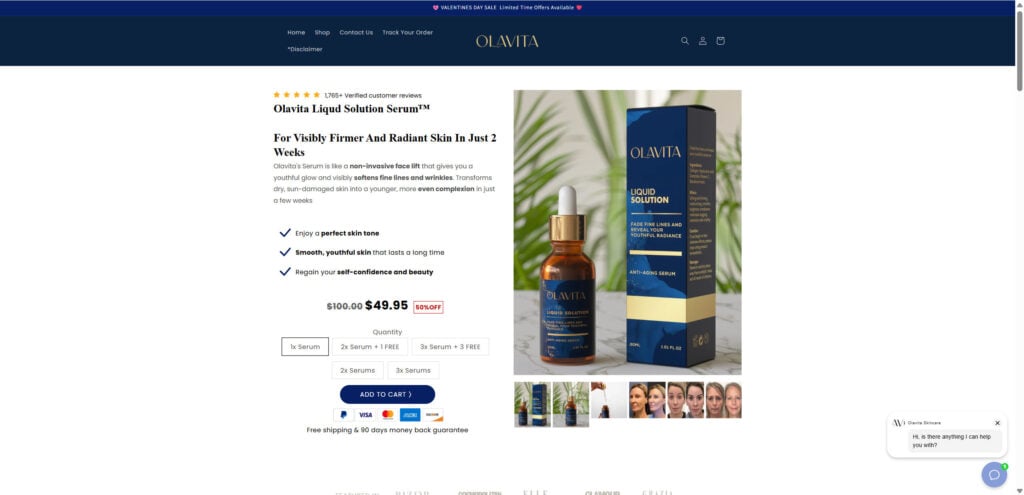
Olavita Liquid Solution Serum is positioned as a premium anti-aging product. The typical pitch goes something like this:
- Visible improvement in wrinkles and fine lines in a short timeframe
- A smoother, more even complexion
- A “tightening” effect that lifts sagging skin
- “Clinically proven” or “scientifically proven” results
- High satisfaction rates such as 98% seeing visible improvement
- Big, urgent discounts, for example a “$100” price crossed out and reduced to around $49.95, often with a “limited time” sale
- A “90 days money back” style guarantee to reduce buyer anxiety
On paper, it reads like a legitimate skincare brand.
But when you examine the supporting evidence, the credibility starts to collapse.
The first major red flag: the product appears as a generic China wholesale item
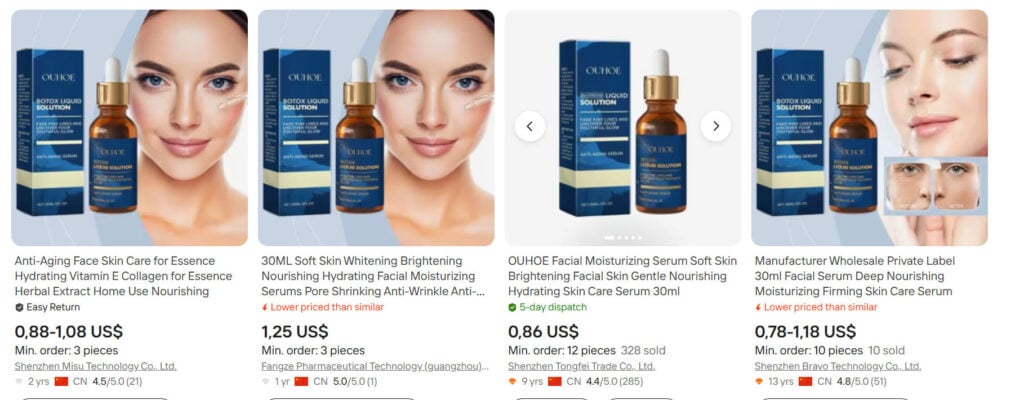
In the images you provided, a nearly identical bottle-and-box design appears in wholesale listings priced around $0.78 to $1.25 per unit, offered by multiple suppliers. The packaging style and marketing language are very close to what Olavita uses, including “liquid solution,” “anti-aging serum,” “fade fine lines,” “brightening,” and “moisturizing.”
That matters because it strongly suggests Olavita is not a unique formula developed and manufactured by a dedicated skincare company.
Instead, the pattern looks like private label dropshipping:
- Suppliers in China sell a generic serum in bulk.
- Resellers choose a label design or reuse an existing packaging template.
- A brand name like “Olavita” is placed on the same concept.
- The product is sold at a steep markup through aggressive ads.
When a product can be sourced for around $1 and sold for around $49.95, the profit margin funds heavy marketing and still leaves room for refunds. The catch is that many dropshipping operators reduce refunds through friction, not customer satisfaction.
The second major red flag: the claims are far bigger than typical skincare reality
Skincare can improve the appearance of skin. Some ingredients have real evidence behind them. But the style of claim matters.
Olavita pages commonly imply:
- Results that resemble a medical procedure
- A rapid reversal of aging signs
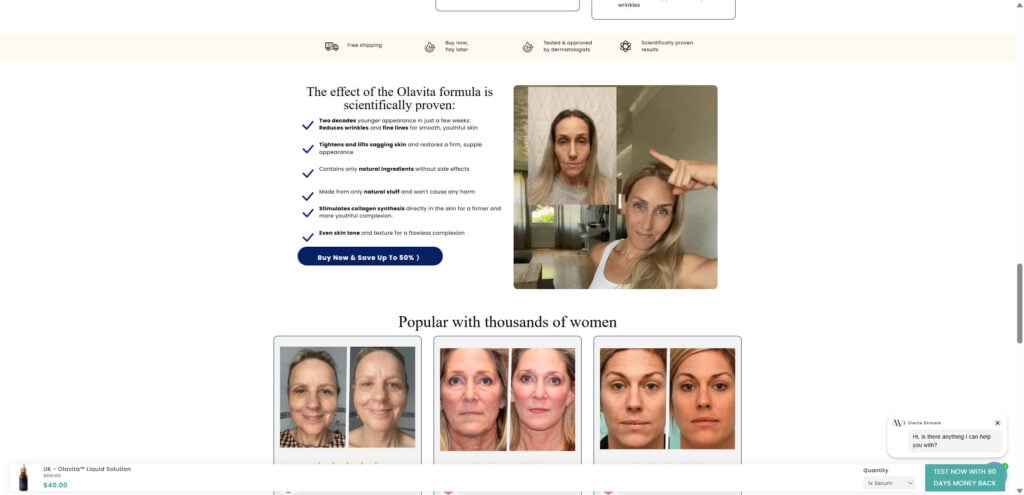
- Numbers like 60% improvement in the first month and 95% improvement after continued use
- “Scientifically proven” outcomes without providing verifiable clinical trials
Those are very strong claims.
In legitimate skincare, you usually see careful language such as:
- “Helps reduce the appearance of fine lines”
- “Supports hydration and skin barrier”
- “Can improve skin texture over time”
- “Results vary”
Dropshipping funnels often do the opposite. They speak in certainty and speed because certainty sells.
The third major red flag: the page is built to convert, not to inform
The structure of Olavita sales pages tends to follow a familiar template:
- A credibility headline
- Bulleted promises
- Big discount anchoring
- Before-and-after galleries
- A large “percentage” statistic like 98% to create trust
- A prominent “money-back guarantee” badge
- Persistent chat widgets that nudge you to buy
- Bundle options designed to increase the order size
This is direct response marketing, and it is optimized to trigger impulse purchases.
That is not automatically “illegal,” but it is often how questionable products are sold.
The fourth major red flag: it is sold across multiple sites
Many dropshipping products appear on multiple storefronts. Sometimes the same product is presented under different names. Other times the same brand name appears on multiple domains or “regional” storefronts.
This matters because real brands generally protect their distribution and maintain consistent official channels. Dropshipping operations often do the opposite:
- Create multiple domains
- Rotate storefront designs
- Reuse the same images
- Test different prices and claims
- Relaunch when complaint volume rises
If you can find the same “liquid solution serum” concept repeated across different sellers, it is a strong sign you are not looking at a proprietary, controlled product line.
The fifth major red flag: post-purchase issues are common
You highlighted several recurring buyer issues that align with this model:
- Returns are “possible” on paper but difficult in practice because they require shipping back to China
- Some buyers report unwanted subscriptions or recurring billing
- Some buyers report receiving multiple bottles even though they believed they ordered only 1
These issues tend to cluster around the same type of funnel.
The product does not need to be great. The business only needs enough buyers to convert, and enough friction to reduce successful refunds.
How the Olavita Liquid Solution Operation Works
This section is the most important part. Once you see the mechanics, you will recognize the same pattern across dozens of “viral” skincare products.
Step 1: A generic serum is sourced cheaply
The wholesale listings you provided show low unit pricing, commonly around $0.78 to $1.25.
That is normal for mass-produced skincare items in bulk, especially when sold as a generic formula that can be private labeled.
The seller does not need:
- A research team
- A unique formulation
- A long-term brand reputation
- Years of clinical trials
They need inventory and a marketing angle.
Step 2: The product is rebranded to look premium
Branding does heavy lifting here.
The Olavita packaging and page design are made to feel:
- Clean and premium
- “Dermatologist approved”
- Clinical and modern
- Trustworthy, like a boutique skincare line
This is why you see dark blue packaging, gold accents, and clinical language. It signals luxury and science.
The goal is to make the buyer feel that $49.95 is a normal price for something “advanced.”
Step 3: A high-converting landing page is created
Dropshipping pages are engineered for conversion psychology.
Common elements include:
Price anchoring
You see a higher “original” price (for example $100.00) crossed out, and a discounted price (for example $49.95) shown with a “50% off” badge.
This makes the buyer feel they are getting a deal.
Strong promise statements
Examples include “two decades younger appearance” or “tightens and lifts sagging skin.”
Even if the page uses slightly different wording across versions, the meaning is the same: dramatic change fast.
A big percentage statistic
A circular graphic like “98% saw a visible difference” is designed to shortcut doubt.
Before-and-after galleries
These create an emotional sense of proof, even when the images are not verifiable.
Guarantee badges
“90 days money back” reduces purchase hesitation. Many buyers assume a guarantee means refunds are easy. In dropshipping, the guarantee is often marketing-first and logistics-second.
Step 4: Ads target insecurity and urgency
Skincare ads often focus on:
- Wrinkles
- Sagging skin
- Uneven tone
- Sun damage
- “Looking tired”
- Feeling older than you are
There is nothing wrong with wanting to improve your skin. The issue is when the ad implies a medical-level result from a cheap serum.
The ad funnel is usually built to:
- Create emotional discomfort
- Offer a fast fix
- Push you to buy before you overthink it
Step 5: Checkout is optimized to increase the order size
This is where “I ordered 1 but got charged for more” complaints often begin.
Common tactics include:
- Bundle options that are presented as the default “best value”
- A quantity selector that is easy to misunderstand
- Upsells after clicking “buy”
- “Free bottle” offers that change the total
- Shipping protection add-ons
A buyer might think they selected “1x serum” but the checkout can nudge them into “2x” or “3x” with discounts and bonuses.
This is also where subscription-like billing can get introduced.
Step 6: Subscription traps and recurring billing can happen
You specifically mentioned unwanted subscriptions.
This can happen in a few ways:
- A “subscribe and save” option is preselected
- The terms include a continuity program in fine print
- A post-purchase upsell adds a recurring shipment
- The billing descriptor is unclear, so the buyer does not recognize the merchant name later
Not every shopper experiences this, but when it shows up repeatedly in complaints, it is a serious red flag.
If you suspect subscription billing, you should treat it as urgent. The sooner you act, the easier it is to block further charges.
Step 7: Fulfillment routes through overseas shipping
Many of these brands present themselves like local or “UK” or “US” skincare brands. But orders often ship from overseas, or the return address leads overseas.
That matters because:
- Delivery times can be longer than expected
- Tracking can be vague
- Customer service can stall with “please wait”
- Returns become expensive and slow
This is where the return policy becomes a practical barrier, not a customer service feature.
Step 8: Returns become difficult through friction
A common pattern is:
- The site claims “money back guarantee”
- The buyer tries to return
- The seller requires shipping back to China
- The buyer must pay for tracked international shipping
- The return shipping cost can be close to the original purchase price
- The seller may delay responses or request repeated documentation
On paper, refunds exist.
In practice, they are designed to be inconvenient.
Step 9: The storefront can rotate if complaints rise
Dropshipping sellers can create new domains quickly. They can also rename products, adjust claims, and rebuild the page.
This is why the same serum can appear across multiple sites.
It is not a stable brand ecosystem. It is a sales machine.
What buyers commonly report with products like Olavita Liquid Solution
Based on the complaint patterns you described and what is typical in this niche, the most common problems include:
1) The product does not match the expectations set by the ads
Many buyers expect dramatic tightening, lifting, and wrinkle reversal.
Most cheap serums, even decent ones, do not deliver anything close to that. At best, they can:
- Hydrate temporarily
- Create a short-term plumping effect
- Make skin feel smoother
- Improve appearance slightly with consistent use
Hydration can reduce the appearance of fine lines for a period of time. That is real.
But that is not the same as reversing aging or “looking two decades younger.”
2) The “clinical proof” is not verifiable
A page can say “scientifically proven,” but without real studies, it is just a claim.
When a company leans hard on scientific language and numbers like 98%, but does not provide:
- study names
- sample size
- methodology
- independent verification
you should treat it as marketing.
3) Shipping and fulfillment are slower than expected
If a product is coming from overseas, shipping can take longer.
Some buyers interpret the delay as a warning sign that the brand is not local or not established.
4) Refunds feel blocked by overseas return requirements
Requiring a buyer to ship a low-cost item back to China is one of the most effective refund-reduction tactics.
Even if the return is “allowed,” the buyer often gives up because:
- shipping is expensive
- the process is slow
- communication is inconsistent
5) Unwanted subscription or repeat charges
If a buyer sees new charges later, they often feel blindsided.
Sometimes it is a misunderstanding of terms. Sometimes it is a checkout design that makes recurring billing too easy to accept without noticing.
Either way, recurring billing is one of the most serious red flags in this space.
6) Multiple bottles delivered or unexpected quantities
You mentioned a key complaint: being sent multiple bottles even when ordering 1.
This can happen due to:
- bundle defaults
- confusing selection boxes
- “free bottle” promotions
- post-purchase upsells
- the seller substituting a different bundle for “availability” reasons
Regardless of the reason, it often correlates with buyers later feeling that the total charge did not match their intent.
Is Olavita Liquid Solution legit?
It depends on what you mean by “legit.”
If “legit” means “a bottle will arrive,” then many dropshipped products do arrive.
If “legit” means:
- the brand is a stable, accountable skincare company
- the claims are supported by verifiable clinical evidence
- refunds are straightforward
- billing is transparent
- the product is unique and not a generic private label item
then Olavita has multiple red flags that make it difficult to treat as trustworthy.
The strongest indicator is the wholesale evidence: the same product concept appears at extremely low cost through China suppliers, which strongly suggests Olavita is a private label dropshipping product sold with premium-level claims.
That is not a brand you should trust with recurring billing access to your card.
What to do if you already bought Olavita Liquid Solution
If you already placed an order, focus on controlling the situation. Your goals are:
- Protect your payment method.
- Stop unwanted billing.
- Maximize your chance of a refund if you want one.
- Avoid wasting time in endless back-and-forth.
1) Take screenshots of everything right now
Before the page changes, capture:
- The product page with key claims
- The price you paid
- The “money back guarantee” terms
- The refund and return policy
- Any subscription or continuity terms shown at checkout
- Your order confirmation page
Also save:
- Order emails
- Tracking emails
- Any chat logs with customer support
This documentation matters if you dispute charges.
2) Check your bank or card statement for the exact merchant name
Many dropshipping charges appear under a billing descriptor that does not say “Olavita.”
Look for:
- multiple charges
- separate “shipping protection” charges
- charges days later that you do not recognize
- repeat charges that suggest a subscription
If you see anything you did not authorize, act quickly.
3) If you suspect a subscription, contact your payment provider immediately
If you believe you were enrolled in a subscription or continuity program without clear consent:
- Call your card issuer or bank
- Ask about blocking future charges from that merchant
- Ask whether you should replace your card number
If the billing is repeating, do not wait. The longer it continues, the harder it is to unwind.
4) Email support once, clearly, and keep it short
If you want to cancel or refund, send one clean message that includes:
- Your order number
- A clear request: cancel order, refund, and confirm no subscription
- A request for written confirmation
Do not argue point-by-point with marketing claims. Keep it transactional.
5) If they stall or require costly returns, move to a dispute
If the seller refuses to help or demands expensive shipping back to China, consider filing a dispute through:
- your credit card chargeback process
- PayPal dispute, if you used PayPal
- your bank’s transaction dispute system
Disputes are often more effective than negotiating with a seller whose business model depends on refund friction.
6) Do not send your ID documents unless you are sure it is necessary
Some sellers request additional personal documents during refund processes. Be cautious.
A legitimate refund request usually does not require sensitive documents.
7) If you decide to try the product, patch test first
If you already have it and are considering using it:
- patch test on a small area for 24 hours
- stop if you have irritation
- avoid the eye area unless the product is clearly designed for it
This is general skincare safety, not a judgment on the product.
8) Set realistic expectations
A cheap serum might hydrate and make skin feel smoother.
It is unlikely to deliver:
- dramatic lifting
- medical-level wrinkle reversal
- “two decades younger” results
If you use it, treat it like a basic cosmetic serum, not a transformation formula.
How to spot similar skincare scams in the future
Olavita is not unique. This exact template is used across many “viral” skincare products.
Here is a practical checklist.
Look for these claim patterns
- “Clinically proven” with no studies linked
- A single number like 98% with no methodology
- “Dermatologist approved” without naming any dermatologist
- “Two weeks to dramatic results”
- “Non-invasive facelift”
- Overconfident guarantees of reversing aging
Look for these business model signs
- The product appears on wholesale sites for under $2
- The brand is sold across multiple storefronts
- The company address is unclear or missing
- Returns require shipping overseas at your expense
- Customer support is only a form or a generic email
- Refund policies include many conditions and delays
Look for these checkout risks
- Subscription language in small print
- Preselected options
- Upsells that appear after entering payment details
- Confusing quantity selectors
- “Free bottle” promos that change totals
If you see several of these at once, treat it as a high-risk purchase.
The Bottom Line
Olavita Liquid Solution Serum is marketed as a premium, clinically proven anti-aging breakthrough, with bold promises like visible transformation in 2 weeks and satisfaction numbers like 98%.
But the underlying signals point to a much more common story: a low-cost private label serum sourced from China, sold through aggressive marketing and strong claims, often distributed across multiple sites, and paired with a return process that can become impractical because it may require shipping back to China.
On top of that, recurring complaint themes like unwanted subscription billing and unexpected multiple bottles are serious trust issues. Even if a bottle arrives and even if it feels like a normal serum, the business practices and claim style are what make it high-risk.
If you are considering buying it, the safer move is to skip it and choose a reputable skincare brand with transparent ingredients, clear policies, and real third-party retail accountability.
If you already bought it, document everything, monitor your card closely, and act fast if you see subscription charges or refund stalling.









do not send any more of this product!!! it is useless and I did not order additional items after the 1st order!
I understand the frustration, but we cannot stop the shipments – MalwareTips is an independent review site with no connection to the seller, no access to their orders and no ability to cancel anything. Writing here will not reach them.
What does work goes around them entirely. Ring the number on the back of your card and ask for three things in one call: revoke that merchant’s recurring authorisation, block them from billing again, and issue you a new card number. Ask for the new number even if they offer only to block the merchant, because the card networks automatically pass updated card details to merchants holding a subscription. Then dispute every charge after the first as unauthorised – you did not order those items, and they cannot show that you did. You generally have up to 120 days per charge.
Anything that still arrives is legally yours to keep under the FTC’s unordered-merchandise rules, so do not pay a restocking fee or return postage. And it is worth five minutes at reportfraud.ftc.gov plus a complaint to your state Attorney General, because shipping unordered goods and billing for them is exactly what gets a merchant account closed.
Can web sites block advertisements on Olavita?
Hi Jaclyn, individual websites can usually block or remove ads through their ad platform controls, but it depends on where the ad is served from. Readers can also report misleading ads directly on platforms like Facebook, YouTube, Google, or TikTok.
Hi Jaclyn, yes, websites can often block specific ads or advertisers, depending on the ad platform they use.
Readers can also report misleading ads directly on Facebook, YouTube, Google, TikTok, or wherever the ad appears. The more reports these ads receive, the better the chance they get reviewed.
Thank you for this information. I now know to search here for other information of products I may be interested in to see if they are indeed scams & be able to save myself money & headaches! Be Blessed!
Thank you, Terry. Doing a quick search before buying saves a lot of money and stress.
Thanks for the information your in-depth research and information has saved me a fortune. I now know what to look for in these ads in the future
Thanks, Angela. Glad it helped. The more people learn the patterns, the less profitable these ad scams become.