

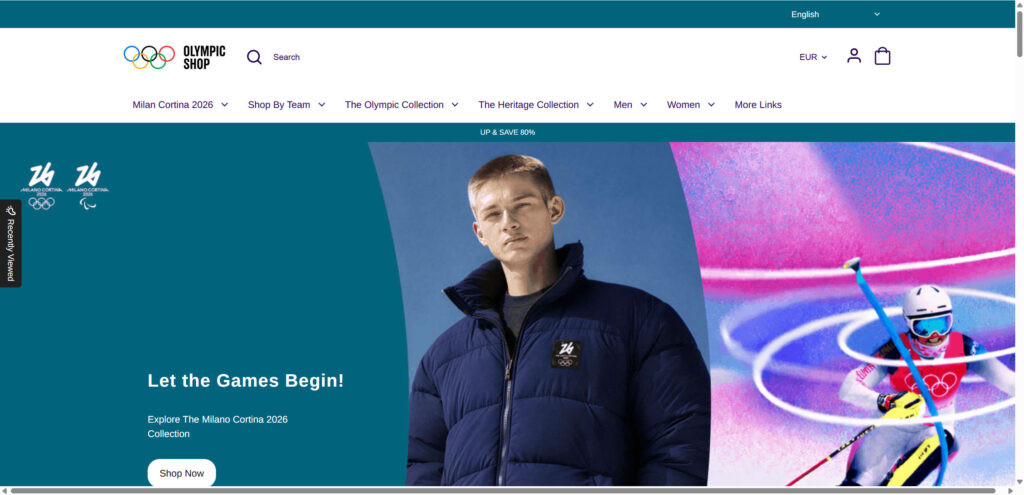
Olympics-sale.top presents itself as an official Olympics merchandise store, pushing “up to 80% off” Milano Cortina 2026 gear through polished ads and a near-identical shop layout.
It is not official.
It is a lookalike domain built to capture payment details and personal information at checkout, often leaving buyers with counterfeit items, fake tracking, or nothing at all.
Scam Overview
Olympics-sale.top is not an official Olympics merchandise store.
It is a lookalike domain created to mimic the branding, layout, and product catalog of a legitimate Olympic shop, particularly focused on Milano Cortina 2026 merchandise.
At a glance, the site appears credible because it replicates:
- Official-looking Olympic imagery
- Professional product photography
- Structured collections such as “Shop by Team,” “Men,” “Women,” and “Heritage Collection”
- Clean navigation and polished product pages
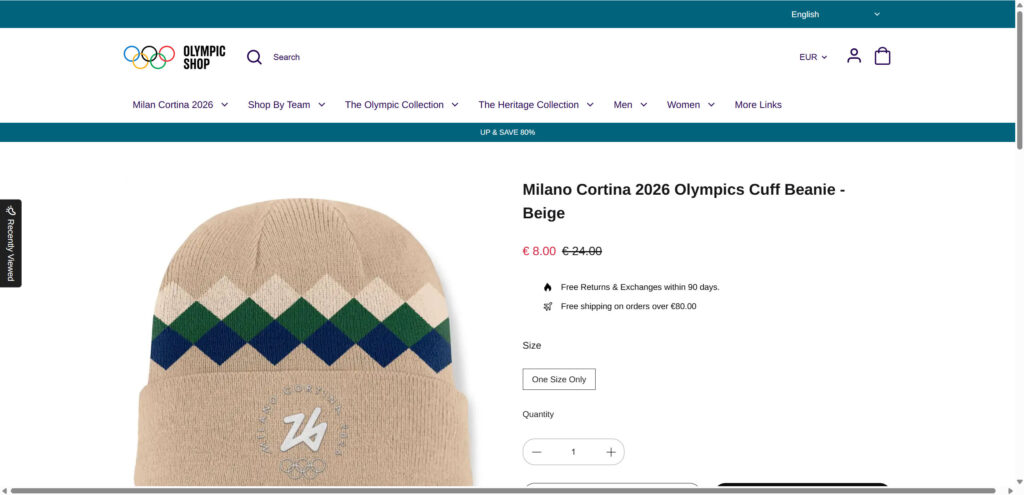
- Familiar return and shipping promises
This is not a low-effort scam page filled with broken images and spelling errors.
It is a near-clone.
The Core Hook: Extreme Discounts
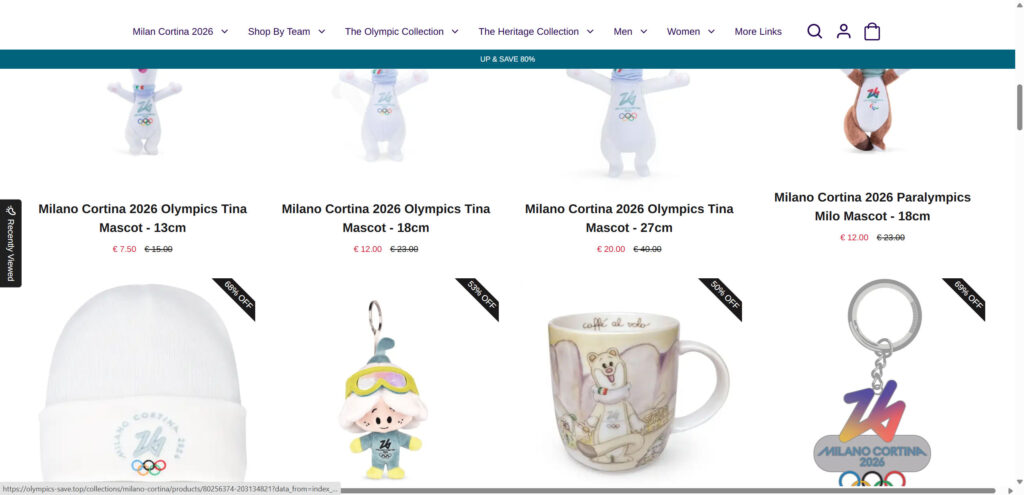
The central tactic used by Olympics-sale.top is aggressive discount framing, often advertising up to 80% off “official” merchandise.
Examples of items displayed at unrealistic prices may include:
- Beanies discounted from $24 to $8
- Mascots discounted from $23 to $12
- Keychains, mugs, and apparel slashed well below expected retail pricing
While seasonal sales happen, legitimate official event merchandise is rarely discounted at 70% to 80% across the entire store, especially for a major global event like the Olympics.
The discount is not a bonus.
It is the bait.
Why the Site Looks So Real
Scam operations like Olympics-sale.top understand something important: most users trust visuals more than URLs.
Instead of creating their own fake products, they copy:
- The same product photos used by official stores
- The same color scheme
- Similar banners and category names
- The same Milano Cortina 2026 branding
This triggers visual recognition. When shoppers see familiar Olympic logos and professional layouts, their skepticism drops.
The deception is subtle.
The domain is different.
That is the only detail that truly matters.
The Domain Pattern
Olympics-sale.top fits a broader pattern of recently registered domains using combinations of:
- olympics
- 2026
- sale
- save
- hot
- top
- shop
These domains are often registered within days of each other and are used interchangeably in ad campaigns.
That pattern indicates coordination, not coincidence.
When one domain is reported or taken down, another takes its place.
Where the Traffic Comes From
Most victims encounter Olympics-sale.top through paid ads on platforms like:
The ads are professionally designed and include phrases such as:
- “Exclusive Olympics Gear Up to 80% OFF”
- “30 Days Free Return”
- “Limited Stock”
- “Get Yours Before Out of Stock”
The ad preview may even resemble the official shop.
But after clicking, users are redirected to Olympics-sale.top.
This redirect step is critical because it allows scammers to hide the true destination behind polished ad previews.
The Real Risk: What Happens at Checkout
The most dangerous part of Olympics-sale.top is not the homepage.
It is the checkout page.
When users attempt to purchase, they are asked to provide:
- Full name
- Shipping address
- Email address
- Phone number
- Payment card details
At that moment, the scammers gain access to highly valuable data.
There are several possible outcomes:
- The card is immediately used for fraudulent transactions.
- The card data is sold on underground markets.
- The personal information is stored for phishing campaigns.
- The victim receives counterfeit goods.
- The victim receives nothing at all.
In many cases, the site later disappears entirely.
Why Victims Don’t Realize Immediately
Some scam stores send:
- Order confirmation emails
- Basic receipts
- Generic tracking numbers
These confirmations are designed to delay panic.
Victims may wait weeks before realizing the item is not coming or the tracking is fake.
By that time, the domain may already be offline.
How The Olympics-sale.top Scam Works
Understanding the full mechanism makes the deception easier to recognize.
Step 1: Register a Lookalike Domain
The scammers register a domain like Olympics-sale.top.
The goal is not perfection.
It only needs to look plausible when glanced at quickly.
Many users do not inspect URLs carefully, especially on mobile.
Step 2: Clone an Official Store Design
Next, they replicate:
- Product images
- Collections
- Brand logos
- Page layout
- Pricing display structure
They insert exaggerated discounts, such as “Up & Save 80%,” in place of more modest official offers.
The design feels trustworthy because it borrows credibility from the real brand.
Step 3: Launch Paid Advertising
The operation invests in ads because the discount converts well.
Urgency + event merchandise + high discount = impulse purchases.
Many Facebook pages running these ads are newly created, sometimes the same day as the domain registration.
That short timeline is a major red flag.
Legitimate global brands do not create brand-new pages and immediately launch 80% off campaigns.
Step 4: Redirect and Obfuscate
In some cases, ad previews show one domain while the click leads to another.
This tactic reduces moderation detection and keeps campaigns running longer.
It also confuses victims who later try to retrace their steps.
Step 5: Capture Payment and Personal Data
The checkout page collects everything needed for identity and payment fraud.
Even if a victim never sees unauthorized charges immediately, their information may still be compromised.
Small test charges of $1 to $5 may appear later.
Or fraudulent purchases may show up weeks afterward.
Step 6: Deliver Counterfeit Items or Nothing
Some victims receive low-quality knockoffs.
Others receive:
- Empty packages
- Completely unrelated items
- No package at all
The scammers may provide fake tracking numbers that never update.
Step 7: Rotate to a New Domain
Once reports accumulate, Olympics-sale.top can disappear.
Then a new domain appears.
The same design. The same photos. The same 80% banner.
Only the URL changes.
That is the lifecycle.
Red Flags Specific to Olympics-sale.top
If you encounter this site, look for these warning signs:
- Constant site-wide 80% discounts
- Recently created domain with no long-standing brand history
- Vague or generic contact information
- No verifiable corporate address
- Customer support that does not respond
- Redirect behavior from ads
- Checkout pages that lack strong, verifiable payment security details
Even if the design looks professional, the domain itself is the critical factor.
Always verify the URL independently through trusted sources.
What To Do If You Bought From Olympics-sale.top
If you entered your payment information or completed a purchase, act quickly.
- Contact your card issuer immediately and report suspected fraud.
- Request a new card number.
- Dispute the transaction and ask about chargeback options.
- Monitor your account for small test charges.
- Change the password of your email account if it was used at checkout.
- Enable 2-factor authentication on important accounts.
- Save screenshots of the site and transaction details.
- Report the domain to the platform where you saw the ad.
Speed matters. The earlier you notify your bank, the better your chances of preventing additional damage.
Why These Scams Are So Effective
The Olympics carry emotional weight.
People want souvenirs. They want memorabilia. They want limited-edition items.
Scammers understand that emotional context lowers caution.
When you combine:
- A trusted global event
- Familiar branding
- Professional visuals
- A massive discount
The psychological pressure is strong.
Most victims are not careless.
They are responding to a carefully engineered environment.
The Bottom Line
Olympics-sale.top is not an official Olympics merchandise store.
It is a lookalike scam site built to exploit trust in the Olympic brand and lure shoppers with unrealistic 80% discounts on Milano Cortina 2026 items.
The design is convincing.
The pricing is the bait.
The domain is the giveaway.
If you see extreme Olympics Shop discounts promoted through ads, pause and verify the URL independently before entering any personal or payment information.
And if you already did, act quickly.
The sooner you involve your bank and secure your accounts, the smaller the damage will be.
FAQs
1) What is Olympics-sale.top?
Olympics-sale.top is a lookalike online store that impersonates an official Olympics merchandise shop, commonly promoted through ads claiming up to 80% off Milano Cortina 2026 gear.
2) Is Olympics-sale.top an official Olympics Shop website?
No. The domain Olympics-sale.top is not an official Olympics Shop domain. Scam campaigns often use newly created, similar-sounding domains to trick shoppers.
3) Why does Olympics-sale.top look so legitimate?
Because it is designed as a near-clone. These sites often copy:
- Official-looking images and branding
- Product photos and descriptions
- Store layout, color scheme, and collections
The goal is to make you trust the page without checking the URL carefully.
4) What happens if I buy from Olympics-sale.top?
Common outcomes include:
- Your card details being captured and later used for unauthorized charges
- Your personal data being harvested (name, address, email, phone)
- Counterfeit merchandise arriving, or nothing arriving at all
- Fake tracking numbers or stalling emails meant to delay disputes
5) I entered my card details but did not finish checkout. Am I still at risk?
Potentially, yes. If you submitted payment details on the checkout page, assume the information may have been captured. Monitor your account and contact your issuer if you see any suspicious activity.
6) What should I do immediately if I already paid?
Do this quickly:
- Call your card issuer and report suspected fraud risk
- Lock the card and request a replacement card number
- Dispute the charge and ask about chargeback options
- Save screenshots of the site, checkout, and confirmation pages
- Change your email password and enable 2-factor authentication
7) Can I get my money back?
Often, yes, depending on how you paid:
- Credit card: chargeback is usually the best route
- Debit card: act fast; protection varies by bank
- PayPal: open a dispute quickly (item not received or counterfeit)
- Crypto/wire transfer: recovery is unlikely
8) Why are there so many “Olympics” domains like this?
These scams typically rotate through multiple lookalike domains. When one gets reported or taken down, the operation switches to a new domain and restarts the same ads.
9) Why do the ads sometimes look official but link to a scam domain?
Scammers may use redirects or cloaking. The ad preview can appear legitimate, but the click sends users to a different domain like Olympics-sale.top.
10) Should I trust the site’s “30-day returns” and “customer support” promises?
No. Scam sites often publish reassuring return and support text, but victims frequently report no responses, fake policies, and disappearing websites.
11) What are the strongest red flags to look for?
- Site-wide discounts of 70% to 90% on “official” merchandise
- A domain that is not clearly official or verified
- Newly created pages running aggressive ads
- Missing or vague company details and contact information
- Checkout that feels normal but is hosted on an unknown domain
12) What scams might happen after I buy?
After checkout, victims may receive follow-up scams like:
- Fake delivery texts asking for a “small fee”
- Fake refund emails requesting card verification
- “Order problem” emails pushing you to click another payment link

Join the discussion
0 commentsShare your experience or ask a question about this article.
Discussion
Start the conversation
Have a question or something useful to share? Add the first comment.