

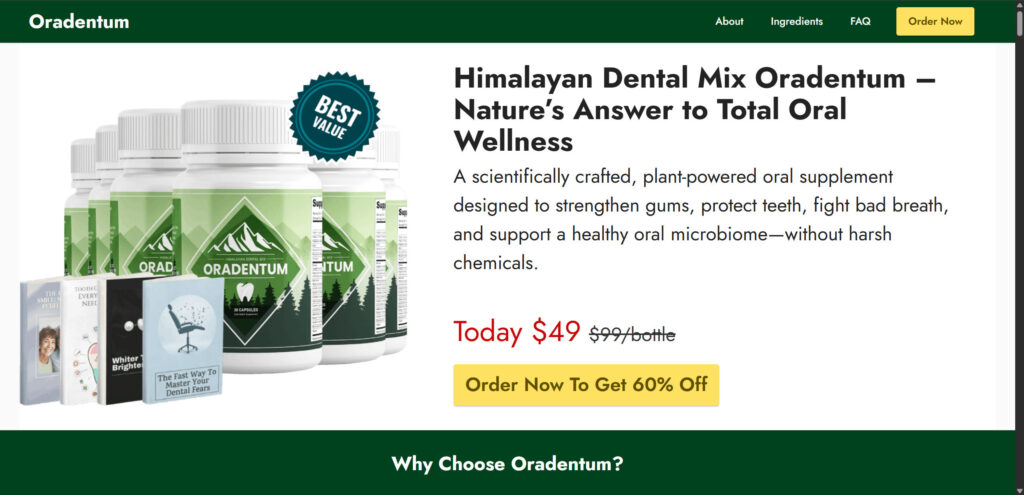
You’ve probably seen it advertised everywhere — a mysterious Himalayan dental formula promising whiter teeth, stronger gums, and fresh breath, all in a simple capsule. Oradentum, also marketed as “Himalayan Dental Mix,” claims to be rooted in ancient monastic traditions and backed by modern science.
It sounds compelling. Too compelling, perhaps.
So what’s the truth behind the hype? Is Oradentum the revolutionary oral care breakthrough it claims to be, or is it yet another overhyped product preying on our desire for perfect health? Let’s peel back the layers.
What Are the Concerns With Oradentum?
On the surface, Oradentum appears to be a dream product: natural ingredients, glowing testimonials, scientific backing, and a heritage rooted in ancient practices. But a closer look reveals several warning signs that should raise serious questions for consumers.
1. Too-Good-to-Be-True Marketing Claims
Many products make bold claims, but Oradentum steps into extreme territory:
- “21 nutrients backed by science”
- “Firmer gums in just a few weeks”
- “No more sensitivity or bleeding”
- “Zero side effects”
These claims are not supported by peer-reviewed scientific studies directly related to Oradentum. Although some individual ingredients have recognized health benefits, the supplement’s specific formulation has not been independently validated.
2. Lack of Transparency
Consumers have reported difficulty finding:
- Clinical trial results
- Clear ingredient sourcing information
- Real before-and-after results
- Legitimate contact details or business registration
Despite boasting FDA approval and GMP certification, Oradentum’s website does not display any verifiable certification documents. The absence of this evidence casts doubt on the authenticity of these claims.
3. Manufactured Urgency & Limited-Time Offers
A common hallmark of questionable marketing is artificial urgency. Phrases like:
- “Only today: $49 instead of $99!”
- “Act now to get 4 free bonuses worth $400”
- “Limited stock remaining”
These tactics pressure users into purchasing without conducting due diligence. Products that rely heavily on high-pressure sales methods often prioritize conversions over customer welfare.
4. Untraceable Company Origins
Despite referencing the Himalayas and ancient monk traditions, there is little to no public information about the creators of Oradentum. Attempts to identify the manufacturer, production facilities, or scientific advisory board lead nowhere.
Additionally, Oradentum is registered under various shell-like names on review sites, including different domains that all seem to lead back to the same checkout page — a classic sign of an evasive or hard-to-pin-down operation.
5. Paid and Scripted Testimonials
Scrolling through Oradentum’s testimonials, one can’t help but notice:
- Stock photo-style images
- Generic names like “Jessica M.”
- Repetitive phrasing across reviews
Independent review platforms such as Trustpilot and Reddit are filled with skepticism about the authenticity of these testimonials. There are also no verifiable links to any video testimonials or real customer profiles.
6. Customer Service Complaints
Several Reddit users and Trustpilot reviewers report:
- No response from customer service after purchase
- Delayed or missing deliveries
- Refunds not honored despite “60-day guarantee” promises
These are major red flags for any health product — especially one costing close to $50 per bottle.
7. Unverifiable Scientific Backing
While the individual ingredients like Vitamin C, Zinc, and Licorice Root are scientifically recognized for their roles in health, the proprietary formula of Oradentum has never been published in a peer-reviewed journal. The product presents its ingredient list as “scientifically formulated,” but without transparency, this claim remains hollow.
How the Oradentum “Himalayan Dental Mix” Operation Works
Let’s break it down step by step. Understanding the structure of operations like this can help you and others avoid similar pitfalls in the future.
Step 1: Hook You With Ancient Wisdom and Nature
The Oradentum narrative is crafted to evoke trust:
- “Ancient monk formula”
- “Himalayan secrets passed down generations”
- “Used for centuries with no side effects”
These phrases invoke emotional and psychological appeal. They’re not necessarily false — but they aren’t backed by traceable evidence either. The blend of folklore with pseudo-science primes the consumer to trust the product before even reading the ingredients.
Step 2: Science-y Language to Add Legitimacy
Next, the brand introduces terms like:
- “Synergistic formula”
- “Clinically validated”
- “Scientifically backed herbs and minerals”
This language gives the illusion of research-based credibility, even if no studies are cited. The presence of familiar vitamins and minerals also boosts confidence, even though these are commonly found in multivitamins available at a fraction of the cost.
Step 3: Use of Fake Reviews and Testimonials
Fake reviews are a powerful trust weapon. By showing dozens of glowing testimonials from apparent users with perfectly white teeth and flawless smiles, the brand simulates widespread satisfaction.
Closer inspection reveals:
- Generic review names
- No third-party verification
- Testimonials with duplicate structure and phrasing
It’s an echo chamber designed to influence your emotions.
Step 4: Time-Limited Offers and Psychological Triggers
Urgency is used as leverage:
- “Order today and get 4 free ebooks worth $400”
- “Only 5 bottles remaining at this price”
- “Time-sensitive bonuses”
These tactics prey on the FOMO (fear of missing out) effect. They push you to buy before you have time to critically assess the claims.
Step 5: Collect Payment — Then Ghost or Delay
Once a customer places an order:
- Immediate charge on your card
- Confirmation email (often vague and untraceable)
- Shipment delays or unresponsiveness to follow-ups
Many buyers report struggling to receive tracking info, struggling to initiate refunds, or receiving packages with no return address. In some cases, the product arrives with a different label altogether — possibly a white-label version of a low-grade supplement.
Step 6: Keep Selling More With Upsells and Subscription Models
Even more concerning is the presence of subscription traps:
- Buyers unknowingly enrolled in monthly auto-ship programs
- Unexpected charges appearing weeks later
- No clear way to cancel
These practices are increasingly common in health and wellness ecommerce scams and often hidden in fine print.
What To Do If You Have Fallen Victim to the Oradentum Scheme
If you’ve already purchased Oradentum and suspect foul play, follow these steps quickly:
1. Contact Your Bank or Credit Card Provider
- Request a chargeback for unauthorized or misleading charges
- Inform them of recurring billing attempts and ask to block the merchant
- Provide screenshots and email proof if available
2. Report the Transaction
- File a complaint with the Federal Trade Commission (FTC)
- Report to Better Business Bureau (BBB) under the product name and website URL
- Submit feedback to Trustpilot and SiteJabber to warn others
3. Stop Any Recurring Payments
- Check if you enrolled in auto-ship or subscription billing
- Cancel through your bank or payment gateway (e.g., PayPal or Stripe)
- Email the vendor to document your cancellation (even if they don’t reply)
4. Check for Data Exposure
- Run a dark web scan using services like HaveIBeenPwned or Credit Karma
- Monitor bank accounts for unusual charges
- Consider temporary freezes on your credit via Experian or TransUnion
5. Warn Others
- Post honest reviews on Reddit, Quora, and scam-tracking forums
- Comment on YouTube videos or blog posts that promote the product
- Share on social media using hashtags like #OradentumScam
6. Consult Your Dentist
- Avoid replacing proper dental care with supplements
- If you’ve experienced side effects, get checked for allergic reactions or complications
- Ask your dentist about safe alternatives for gum health or bad breath
The Bottom Line: Should You Trust Oradentum?
While Oradentum markets itself as a breakthrough in natural dental health, the red flags around transparency, customer complaints, questionable marketing practices, and unverifiable claims are too significant to ignore.
The reality is this: truly effective oral care solutions are backed by clinical trials, endorsed by real experts, and transparent in sourcing and manufacturing. Oradentum fails to meet those benchmarks.
If you’re serious about your oral health, stick with proven practices: regular brushing and flossing, dental visits, and reputable products recommended by professionals.
Always do your homework before buying into health trends online — especially when they sound just a little too miraculous.

Join the discussion
0 commentsShare your experience or ask a question about this article.
Discussion
Start the conversation
Have a question or something useful to share? Add the first comment.