

A text or email claims there is a suspicious PayPal transaction and urges you to call a “PayPal Customer Service” phone number to cancel or verify it. This is a common support impersonation scam.
The goal is to get you on a fake support call, where scammers pressure you to share login details, one-time security codes, or payment information. This article explains how the scam works, what red flags to watch for, and what to do if you interacted with it.

Scam Overview
The PayPal Customer Service scam is a support impersonation scheme. The scammer’s entire strategy is to make you believe you are speaking with PayPal so you will follow instructions you would normally reject.
The “support” angle shows up in multiple formats, but the core pattern stays the same:
- A message claims there is a problem involving your PayPal account or a transaction.
- The message creates urgency and fear, often using a specific dollar amount.
- The message gives you a phone number or link that routes to the scammer, not PayPal.
- The scammer uses the call or chat to steal access, money, or both.
One reason this scam keeps working is that it can look convincing even when the target does not use PayPal often. Many people have a PayPal account from years ago, or they have used PayPal once for an online purchase. Scammers exploit that familiarity.
What this scam typically looks like
Most victims see it in one of these “entry point” forms:
1) Smishing (scam texts) that claim suspicious activity
You may receive a text like:
- “PayPal: Your payment of $489.50 is pending. If this wasn’t you, call support now at (###) ###-####.”
- “PayPal Security Alert: New login detected. Call customer service to secure your account.”
PayPal’s own security guidance warns that scammers use urgent SMS messages with bogus numbers or URLs to push you into calling. (PayPal)
2) Phishing emails that include a fake support number
The email often looks like a receipt, a fraud alert, or an account limitation notice. The biggest giveaway is the “Call PayPal now” number inside the email.
Sometimes the sender address looks believable. Sometimes the email is formatted like a real PayPal message. But the phone number is not PayPal’s.
3) Fake invoices or money requests sent through PayPal
This is one of the most confusing variants because the invoice can be delivered through PayPal’s real invoicing system.
The scammer sends an invoice or money request with a scary note in the description, such as:
- “You have been charged $799.99 for a new iPhone. If you did not authorize, call PayPal immediately at (###) ###-####.”
PayPal explicitly warns that invoice and money request scams may include a phone number and try to get you to call so you will hand over personal or financial details. (PayPal)
4) Search results and ads that lead to fake PayPal support
Some scammers run ads or create lookalike pages designed to appear when you search “PayPal customer service number” or “PayPal support phone.”
This version is dangerous because it catches people who are already trying to do the right thing: get help. If you click the wrong result, you can end up calling a scam number you found online.
5) Robocalls that tell you to call back
You may get an automated voicemail that claims a PayPal charge was approved and asks you to call a number to cancel it.
PayPal warns people not to return automated calls that provide a callback number, and to contact PayPal only through official support channels.
Why scammers love the “customer service” approach
A fake support call is more profitable than a simple phishing link for a few reasons:
- A live call lets the scammer build trust and apply pressure in real time.
- The scammer can adapt the script based on your answers.
- They can talk you into actions that bypass security, like reading a one-time code.
- They can push you toward payment methods that are hard to reverse.
Support impersonation also exploits a normal habit: when people see fraud, they want to resolve it fast. Scammers weaponize that urgency.
The most common storylines scammers use
PayPal support scams rotate scripts constantly, but most fall into these buckets:
“Payment pending” or “payment authorization”
This is the classic hook. It claims you have a pending transaction, and you must call to stop it.
“You sent money”
The message claims you sent $ to an unknown person, sometimes with a name that sounds like a business.
“Account limitation”
It says your account is limited, suspended, or flagged for compliance. You must call to restore access.
“Unrecognized device”
It claims a new device logged in and your account is at risk.
“Subscription renewal”
It claims you are being charged for a high-priced subscription, often $299.00, $399.00, or $499.00.
“Refund in progress”
It claims PayPal is issuing a refund and you must verify details. This is often a setup for a refund scam.
What scammers are actually trying to steal
The scam may start with a fake “PayPal customer service” interaction, but the end goals are very consistent.
Scammers commonly want:
- Your PayPal login email and password
- Your one-time security code (2-step verification code)
- Your bank account or debit card details
- Your credit card details
- Your PayPal balance, if you keep funds in PayPal
- Access to your email account (because it is the key to password resets)
- Remote access to your phone or computer
- Direct payment through gift cards, wire, crypto, or peer-to-peer apps
Even if you never store money in PayPal, access to your account can still be valuable. A compromised PayPal account can be used for:
- Unauthorized payments from linked cards or banks
- Requests for money sent to your contacts
- New linked financial accounts added by the scammer
- Identity data collection for follow-up fraud
Why the scam often includes a specific dollar amount
A specific amount makes the alert feel “real.”
Scammers choose amounts that create fear but still feel plausible. $143.95, $289.47, or $499.99 are common because they sound like realistic purchases.
The exact number is not proof of anything. It is a psychological lever.
Why invoice scams confuse people so effectively
Invoice scams deserve special attention because they exploit a feature people misunderstand.
An invoice is not the same as a completed payment.
A scammer can send you a PayPal invoice that looks like a bill, but you are not automatically charged just because you received it. The scammer’s goal is to make you panic and call the phone number in the invoice notes.
PayPal warns users to be cautious with invoices and money requests that include alarmist messages and push you to call quickly. The right move is to log into PayPal directly and verify whether any action is needed.
Red flags that reliably identify a PayPal customer service scam
Use this checklist when you are unsure.
Message-level red flags
- The message is unexpected and urgent.
- It claims a payment is pending and you must act now.
- It contains a phone number to call “PayPal support.”
- It uses generic greetings like “Dear customer.”
- It threatens account suspension or legal action.
- It pushes you to reply, call, or click immediately.
Call-level red flags
- The “agent” asks for your password or one-time code.
- The “agent” asks you to install remote access software.
- The “agent” tells you to move money to “protect it.”
- The “agent” requests payment by gift card, crypto, wire, or unusual methods.
- The “agent” pressures you to stay on the phone while you log in.
Account-level red flags
- You see an invoice you do not recognize.
- You see a money request from a stranger.
- You see a new linked bank or card you did not add.
- You see new shipping addresses or profile changes.
What PayPal recommends instead of calling numbers in messages
PayPal’s security guidance emphasizes contacting them through official support paths, not numbers included in suspicious calls, texts, or emails.
PayPal also provides a dedicated approach for reporting fraud and unauthorized activity, including using the Resolution Center.
For suspicious messages, PayPal also encourages reporting phishing, including forwarding suspicious emails to PayPal’s phishing reporting address.
That theme matters because it exposes the scam’s biggest weakness: the scammer cannot control what happens if you go to PayPal directly.
Why smart people still fall for it
Most victims are not reckless. They are rushed.
The scam succeeds because it creates a tight emotional loop:
- Fear: “Someone is spending your money.”
- Urgency: “It’s pending right now.”
- Authority: “This is PayPal customer service.”
- Convenience: “Just call this number.”
When you are stressed, it is easy to choose the fastest option. Scammers know that. They build the entire experience around speed and pressure.
How The Scam Works
This section walks through the typical PayPal Customer Service scam from first contact to financial loss. Not every scam uses every step, but most follow a similar progression.
Step 1: The scammer creates the hook
The hook is the initial claim that triggers concern.
Common hooks include:
- A PayPal payment is pending.
- A large “purchase” was approved.
- Your account is limited or locked.
- A new device logged in.
- A refund is being processed.
Scammers often include a precise amount to make it feel like a real transaction. They also use language like “urgent,” “immediately,” “verify,” and “fraud prevention.”
Step 2: The message routes you to the scammer
This is the most important stage.
Instead of directing you to the PayPal app or telling you to log in, the message gives you:
- A phone number to call
- A link to a fake support site
- A QR code
- Instructions to reply “YES” or “NO”
If you follow that path, you have left PayPal’s environment and entered the scammer’s controlled environment.
In invoice scams, the phone number is often buried inside the invoice note. PayPal warns that scammers may use invoices or money requests to push you to call their phone number. (PayPal)
Step 3: The fake “agent” builds credibility fast
Once you call, the scammer focuses on sounding legitimate.
They may:
- Answer with a polished greeting like “PayPal Fraud Department”
- Use hold music
- Reference a “case number”
- Speak confidently and quickly
- Repeat your concern back to you to build rapport
They will also ask “verification” questions that feel normal:
- Your name
- Your email address
- Your phone number
- The last 4 digits of a card
This is not harmless small talk. They are collecting data and testing how compliant you are.
Step 4: They intensify urgency and isolate you
After you confirm it was not you, they escalate:
- “Your account has been compromised.”
- “The payment will process in the next 10 minutes.”
- “If we disconnect, the system may complete the transfer.”
They often try to keep you on the phone while you do everything else. That matters because isolation prevents you from pausing, checking PayPal directly, or asking someone for advice.
Step 5: They attempt account takeover
At this point, the scam goes in one of two directions:
Direction A: They try to log into your PayPal while you help them
They may say they need to “verify ownership,” then ask you for:
- Your password
- A one-time code sent to your phone
- An authentication prompt approval
If you share a one-time code, you may be giving them the key to your account.
Direction B: They pivot to your email
If they cannot break into PayPal directly, they may go after the email account tied to PayPal. Email control makes password resets easy.
They might ask you to “confirm” an email code, which is actually a code to reset your email password.
Step 6: They introduce remote access or screen sharing
If the victim seems uncertain, scammers often “offer help” by walking them through steps on their device.
On computers, this usually means remote access software.
On phones, this can mean:
- A screen-sharing app
- A “support” app
- A device management profile
- Instructions that keep you busy while they work
Remote access is dangerous because it can allow the scammer to:
- View your financial accounts
- Capture codes in real time
- Create transfers or purchases
- Change security settings
- Install additional tools
The FTC warns that scammers posing as tech support often ask for remote access, and that you should not grant it.
Step 7: The “refund” scam playbook appears
A very common PayPal customer service scam is the fake refund flow.
Here is how it typically works:
- The scammer claims the payment is confirmed and they will “reverse it.”
- They tell you a refund is being processed.
- They ask you to log into your bank while they “assist.”
- They create confusion about numbers on the screen.
Then they push you into sending money “back,” often using a method that is hard to reverse.
In many cases, there is no real refund. The scammer uses misdirection to make you believe you received extra funds or that you must transfer money to secure your account.
Step 8: They pressure you into an irreversible payment method
If the scammer can get you to send money, they want it sent in a way that is difficult to claw back.
Common payment demands include:
- Gift cards
- Wire transfer
- Crypto
- Peer-to-peer apps
- “Manual transfer” to a “secure account”
This is where many victims lose money quickly.
Gift cards are a classic end point because once you read the code to the scammer, the money is usually gone. The FTC has extensive consumer guidance on gift card scams and notes that scams often begin with a call, text, or email and can involve fake tech support scenarios. (Consumer Advice)
Step 9: They cover tracks and set up future access
If the scammer gains account access, they may:
- Add a new phone number to the PayPal profile
- Add a new email address
- Add a bank account
- Create or approve payments
- Change security settings
- Create billing agreements
- Send money requests to your contacts
Even if you stop them mid-scam, they may have enough personal data to attempt future account recovery attacks.
Step 10: Follow-up scams target you again
After an interaction, many victims are targeted with follow-ups like:
- “This is PayPal calling you back.”
- “Your refund has been approved, confirm your identity.”
- “A second transaction attempted, we must secure your account again.”
These follow-ups are designed to catch you while you are still anxious.
Why many victims do not see a real PayPal charge at first
This is important for understanding invoice-based and “pending payment” variants.
- An invoice is not an automatic charge.
- A money request is not a completed transfer.
- A scammer may show you a “transaction ID” that is made up.
That is why the safe verification step is always the same: log into PayPal directly, using the official app or typing the address yourself, and review your activity.
If something is real, it will be reflected inside your PayPal account activity and your bank or card records. If it is fake, it often exists only in the scam message.
Top 5 PayPal Customer Service Scam Variants
Below are the most common formats scammers use to impersonate PayPal support. These examples are representative templates. Scammers rotate wording, amounts, and phone numbers constantly.
1) “Payment Authorization Pending” Text Message (Smishing)
What it claims: A PayPal payment is awaiting verification, and you must call to stop it.
Typical red flags:
- Urgent language (“pending,” “verification,” “immediate action”)
- A phone number labeled as PayPal support
- You are told “no action is needed” if it was you, but to call if not
Example text:
- “PAYPAL ALERT: A payment of $246.88 is pending approval. If you did not authorize this, call PayPal Support at +1 (8##) ###-#### to cancel.”
Example text:
- “PayPal Security Notice: Attempted transaction at ‘PAYPAL *ONLINE’ for $389.40. Not you? Call Customer Service: (8##) ###-####.”
2) “Unrecognized Login or New Device” Email
What it claims: Your PayPal account was accessed from a new device or location, and you must call support to secure it.
Typical red flags:
- Threats about account limitation
- A “support center” phone number in the email body
- Generic greeting and vague device details
Example email snippet:
- Subject: “PayPal: New Sign-In Detected”
- Body: “We detected a new login to your PayPal account from an unknown device. If this was not you, contact PayPal Customer Support immediately at (8##) ###-#### to secure your account.”
Example email snippet:
- Subject: “Immediate Action Required: Account Access”
- Body: “Your PayPal account has been accessed from a new location. Please call (8##) ###-#### to prevent unauthorized activity.”
3) PayPal Invoice or Money Request Scam (Often Looks “Official”)
What it claims: You were billed for a high-value item or subscription. The invoice notes include a number to call for cancellation.
Why it works: The invoice may arrive through PayPal’s real invoice system, so it feels legitimate. But receiving an invoice is not the same as being charged.
Typical red flags:
- A scary item description and a “call to cancel” note
- Large amounts like $499.99, $699.99, $899.99
- A phone number inside the invoice memo
Example invoice note:
- “Invoice: Apple MacBook Pro Order Confirmation”
- Amount: $799.99
- Note: “If you did not authorize this charge, contact PayPal Support immediately at +1 (8##) ###-#### for cancellation.”
Example money request note:
- “Payment Request: Norton Renewal”
- Amount: $399.99
- Note: “To dispute or cancel, call PayPal Billing Department at (8##) ###-####.”
4) “Subscription Renewal / Auto-Renewal” Receipt Email
What it claims: You are being charged for a subscription renewal and must call to cancel.
Typical red flags:
- “Auto-renewal” language
- A fake receipt with a customer service number
- Pressure to call instead of managing it in your account
Example email snippet:
- Subject: “Receipt: Renewal Successful”
- Body: “Your subscription has been renewed for $489.99. If you did not authorize or wish to cancel, call PayPal Customer Service at (8##) ###-#### within 24 hours.”
Example email snippet:
- Subject: “Payment Completed: Annual Protection Plan”
- Body: “Total charged: $349.99. For cancellation, contact support at +1 (8##) ###-####.”
5) “Account Limited / Suspended” Text or Email (Threat-Based)
What it claims: Your PayPal account is limited due to suspicious activity and you must call to restore access.
Typical red flags:
- Threats and deadlines
- “Compliance” language meant to intimidate
- A phone number as the primary action step
Example text:
- “PayPal: Your account has been LIMITED due to suspicious activity. Call support at (8##) ###-#### to unlock now.”
Example email snippet:
- Subject: “PayPal Account Limitation Notice”
- Body: “Your account access is restricted. Verify identity by contacting PayPal Support at +1 (8##) ###-#### to avoid permanent suspension.”
Quick rule that catches most of them
If the message’s main instruction is “Call PayPal at this number,” treat it as suspect. Verify by opening the PayPal app directly or typing PayPal’s official website yourself, then check Activity and notifications there.
What To Do If You Have Fallen Victim to This Scam
If you clicked, called, installed something, or shared information, act quickly. You do not need to panic, but you do need to be methodical.
Follow the steps below in order. Not every step applies to every situation, so focus on what matches what you did.
1) Stop communicating with the scammer
- Hang up immediately.
- Do not call back.
- Do not reply to texts or emails.
- Do not click any new links they send.
If they keep calling, block the number. If they switch numbers, keep blocking. Your goal is to end the conversation loop.
2) Write down what you shared and what you installed
This determines your next steps.
Make a quick checklist:
- Did you share your PayPal password?
- Did you share a one-time code?
- Did you share your email password?
- Did you share card or bank details?
- Did you install remote access or screen sharing software?
- Did you send money, buy gift cards, or transfer crypto?
A clear summary helps you respond correctly and helps your bank or PayPal support if you need to report fraud.
3) Secure your PayPal account from a clean device
If you suspect your computer is compromised, do this from your phone using the PayPal app, or from a different trusted device.
Then:
- Change your PayPal password to a strong, unique password.
- Review your email address and phone number on the account.
- Check your linked banks and cards and remove anything you do not recognize.
- Review recent activity and look for payments, added addresses, or profile edits you did not make.
- Enable 2-step verification if it is not already enabled.
If you cannot access your account, go through PayPal’s official recovery process inside the official Help Center.
4) Secure the email account connected to PayPal
Email control is often the real prize.
- Change your email password.
- Turn on 2FA for your email.
- Review email forwarding rules and filters.
- Check the “recent logins” or “security activity” page for your email provider.
If a scammer can access your email, they can reset PayPal and many other accounts.
5) Check for unauthorized PayPal transactions and report them properly
If you see a payment you did not authorize:
- Report it inside PayPal through official reporting channels such as the Resolution Center. (PayPal)
- Document dates, amounts, and recipient details.
- Do not rely on a phone number from an email or invoice.
If the issue is an invoice or money request you did not create, do not pay it. Treat it as suspicious and review it inside PayPal directly.
6) If you shared card or bank details, contact your bank immediately
If you provided:
- Debit card number
- Credit card number
- Bank account information
- Bank login credentials
- Any bank one-time passcode
Call the number on the back of your card or use the official bank app.
Ask the bank to:
- Flag your account for fraud monitoring
- Replace your card
- Block suspicious merchants if needed
- Review pending transfers and new payees
The faster you do this, the more options the bank may have to stop or reverse activity.
7) If you gave a one-time code, treat it as an active takeover attempt
One-time codes are often the turning point.
If you shared a PayPal login code or email verification code:
- Change the password immediately.
- Sign out of other sessions if the platform offers that option.
- Review and reset any security settings that were changed.
Even if nothing looks wrong yet, assume the scammer tried to use it.
8) If you installed remote access or screen sharing tools, remove them and clean the device
If you installed any “support” software:
- Disconnect your device from the internet.
- Uninstall the software.
- Reboot the device.
- Run a reputable malware scan on the computer.
- Update your operating system and browser.
- Change passwords again after cleaning, especially for email, PayPal, and banking.
If you are not confident the device is clean, consider professional help or a full system reset. It is better to be cautious when financial accounts are involved.
9) If you paid with gift cards, act immediately
If you bought gift cards and shared the codes:
- Contact the gift card company right away.
- Keep the receipt and card details.
- Report it as fraud.
The FTC’s consumer guidance emphasizes that gift cards are a common payment method requested by scammers, and fast action matters.
Do not feel embarrassed. Gift card payments are a standard scam technique because they are fast and hard to reverse.
10) If you sent money through a bank transfer, wire, crypto, or peer-to-peer app
Time matters, especially for bank transfers.
- Call your bank immediately and ask whether the transfer can be recalled.
- If it was a wire, request a wire recall and fraud claim.
- If it was crypto, report it, but understand recovery is often difficult.
Even when recovery is unlikely, reporting helps create a record that may help with related fraud later.
11) Report the scam message the right way
Reporting helps reduce future victims and may help your own case.
Actions that are usually worth doing:
- Report the email as phishing in your email provider.
- Report the text as junk or spam in your Messages app.
- Forward suspicious emails to PayPal’s phishing reporting mailbox when applicable, then delete them.
- File a report with consumer fraud reporting agencies in your country.
If you are in the United States, reporting to the FTC is a common step for fraud tracking and documentation.
12) Watch for follow-up attacks for at least 30 days
After a scam call, many victims receive more attempts.
Be alert for:
- “Refund department” calls
- “Account recovery” emails
- “Chargeback reversal” messages
- Messages that reference the earlier incident
Follow a simple rule: never use contact info provided in an unexpected message. Navigate to PayPal support through the official app or by typing the official address yourself.
13) Lock down your phone habits to reduce repeat targeting
You cannot stop all scam attempts, but you can reduce exposure.
Consider:
- Silencing unknown callers
- Filtering unknown senders in Messages
- Using carrier spam filtering tools
- Avoiding searching for support numbers via random web results
A small change in how you contact support prevents a large percentage of support impersonation scams.
14) If you feel overwhelmed, pause and switch to verification mode
Scammers win when you act fast.
If you ever feel pressure, do this instead:
- Stop the call.
- Open the PayPal app.
- Check Activity and Resolution Center.
- Check your bank app for pending charges.
If there is a real problem, you will be able to verify it calmly through official tools.
How to Remove Unwanted Apps and Malware
If a pop-up scam tricked you into downloading an unwanted program — or you suspect your device is infected — follow the free, step-by-step removal guide below to clean it completely.
Please follow the steps in order. If you get stuck or have doubts at any point, stop and ask for help in our free support forum — our team will guide you personally.
 Remove Unwanted Apps and Malware from Windows
-
 Remove Unwanted Apps and Malware from Mac
  Remove Unwanted Apps and Malware from Android
- Remove Unwanted Apps and Malware from iPhone and iPad
Remove Unwanted Apps and Malware from Windows
- STEP 1: Uninstall malicious programs from Windows
- STEP 2: Reset browsers back to default settings
- STEP 3: Use Malwarebytes Anti-Malware to remove malware and unwanted programs
- STEP 4: Use HitmanPro to scan your computer for badware
- STEP 5: Use AdwCleaner to remove adware and malicious browser policies
STEP 1: Uninstall malicious programs from Windows
In this first step, we will manually check if any unknown or malicious programs are installed on the computer. Sometimes adware and browser hijackers can have a usable Uninstall entry that can be used to remove them.
-
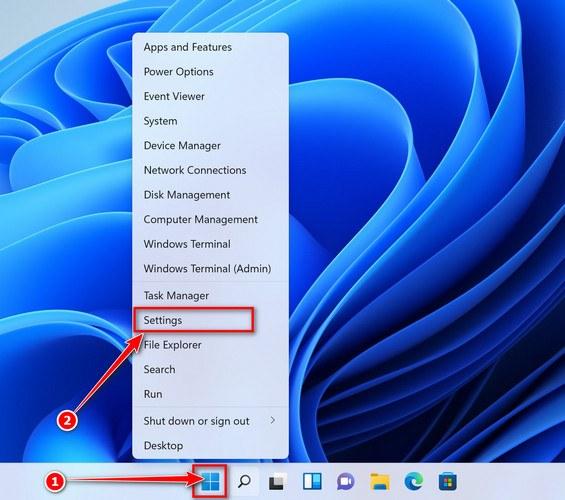
Open the Settings app
Press Windows + I on your keyboard to open Settings. Alternatively, right-click the Start button and select “Settings” from the menu.
-
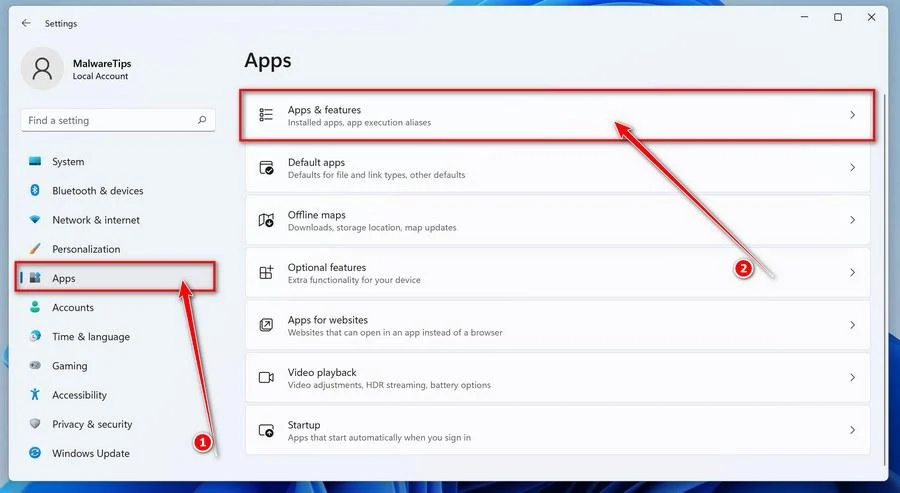
Go to “Apps & Features”
In the Settings window, click “Apps” in the sidebar, then select “Apps & Features“.
-
Find and uninstall the malicious program
Scroll through the list of installed apps and look for anything suspicious — a program you don’t remember installing, or one with a strange or generic name.
Quick tip: click “Sort by” and choose “Install date“. Malware is usually one of the most recently installed programs, so it will appear near the top.
When you find the malicious program, click the three dots next to it and select “Uninstall“.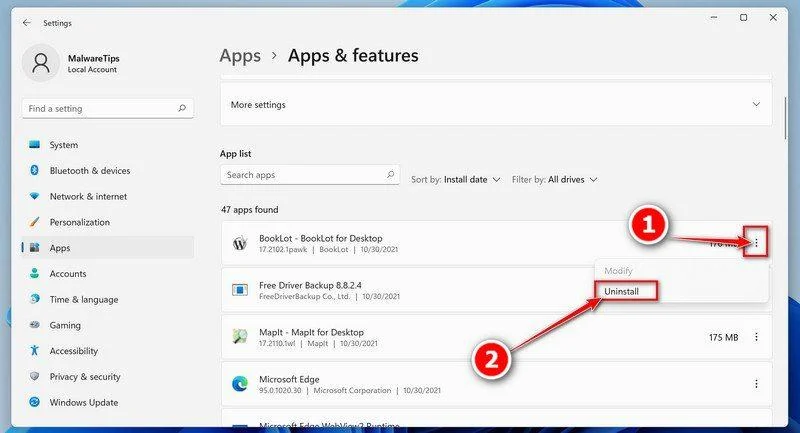 Didn’t find any suspicious programs? That’s fine — not all infections install visible apps. Just continue with the next step in this guide.
 -
Complete the uninstall
Confirm by clicking Uninstall in the message box, then follow the remaining prompts.
Read each prompt carefully — some malicious programs use confusing wording or pre-ticked boxes hoping you’ll click through without looking.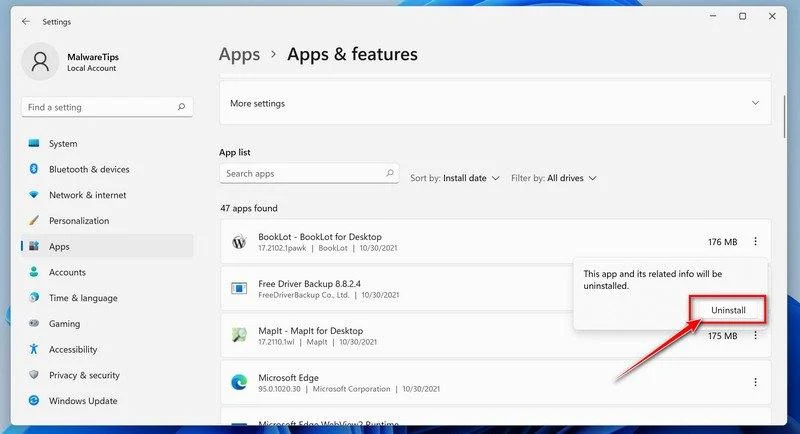
-
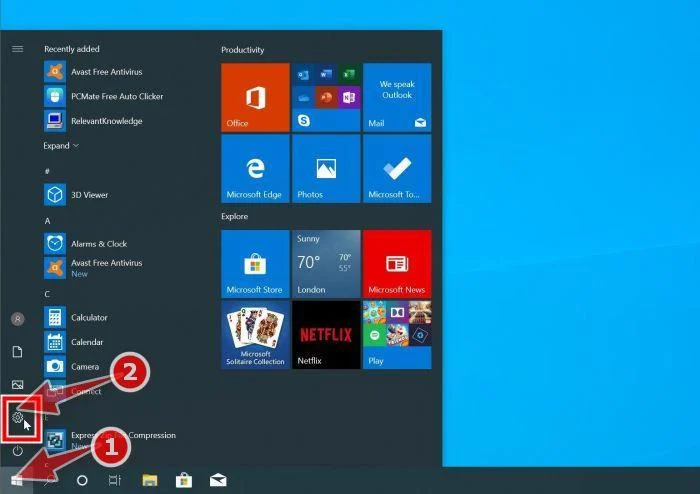
Open the Settings app
Press Windows + I on your keyboard to open Settings. Alternatively, click the Start button on the taskbar and select “Settings” (the gear icon).
-
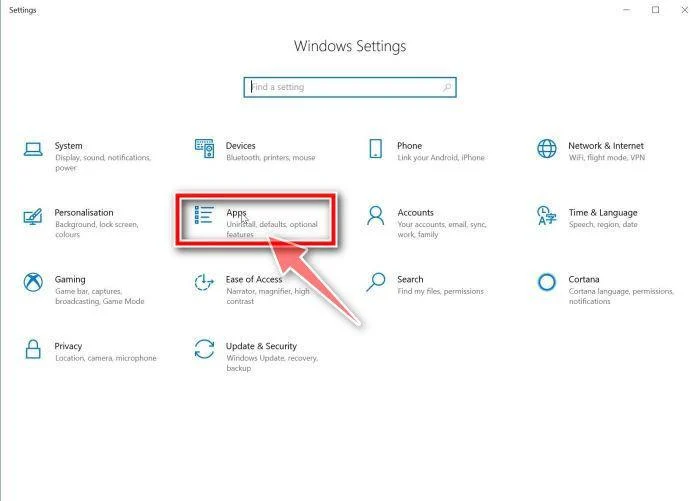
Click on “Apps”
In the “Windows Settings” window, click “Apps“. The “Apps & Features” section should open by default — if it doesn’t, select it from the list on the left.
-
Find and uninstall the malicious program
Scroll through the list of installed apps and look for anything suspicious — a program you don’t remember installing, or one with a strange or generic name.
Quick tip: click “Sort by” and choose “Install date“. Malware is usually one of the most recently installed programs, so it will appear near the top.
When you find the malicious program, click on it and select “Uninstall“.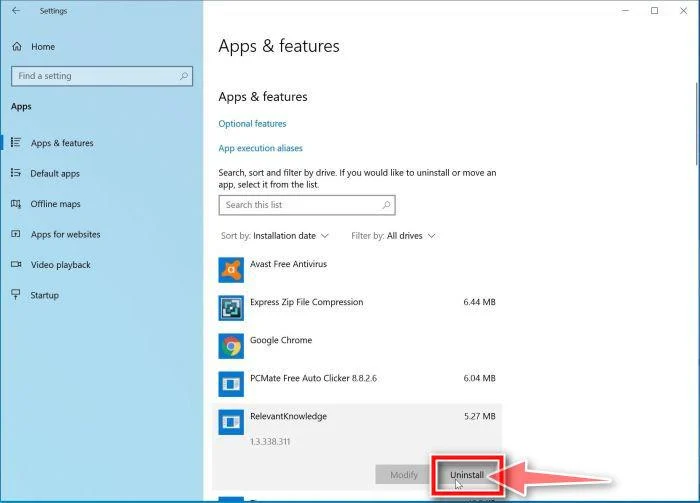 Didn’t find any suspicious programs? That’s fine — not all infections install visible apps. Just continue with the next step in this guide.
 -
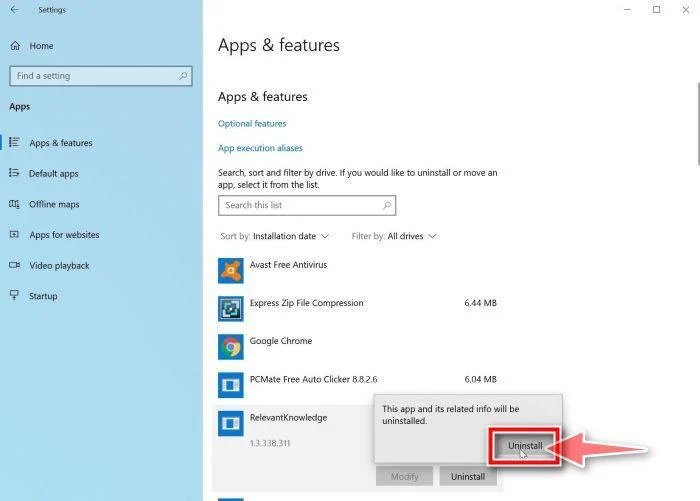
Complete the uninstall
Confirm by clicking Uninstall in the message box, then follow the remaining prompts.
Read each prompt carefully — some malicious programs use confusing wording or pre-ticked boxes hoping you’ll click through without looking.
-
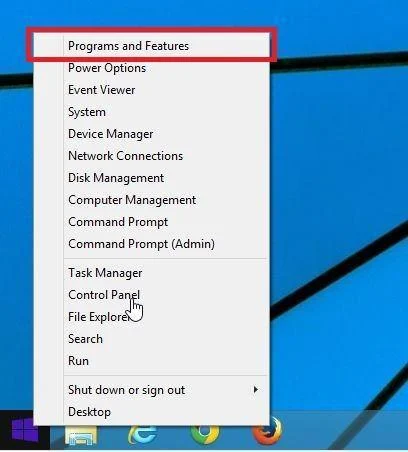
Open “Programs and Features”
Right-click the Start button in the taskbar, then select “Programs and Features“. This takes you straight to the list of installed programs.
-
Find and uninstall the malicious program
Scroll through the list of installed programs and look for anything suspicious — a program you don’t remember installing, or one with a strange or generic name. Click to highlight it, then click the “Uninstall” button.
Didn’t find any suspicious programs? That’s fine — not all infections install visible apps. Just continue with the next step in this guide.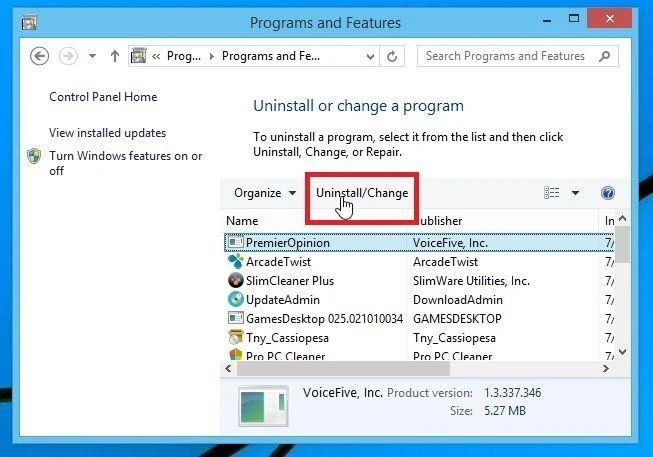
-
Complete the uninstall
Confirm by clicking Yes in the message box, then follow the remaining prompts. Read each prompt carefully — some malicious programs use confusing wording or pre-ticked boxes hoping you’ll click through without looking.
-
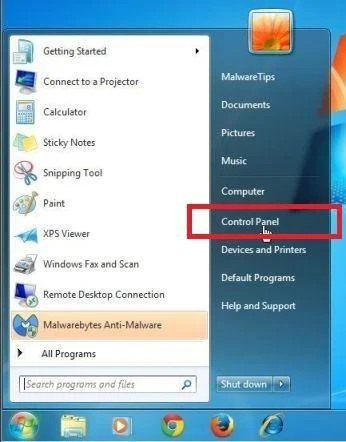
Open the Control Panel
Click the “Start” button, then click “Control Panel“.
-
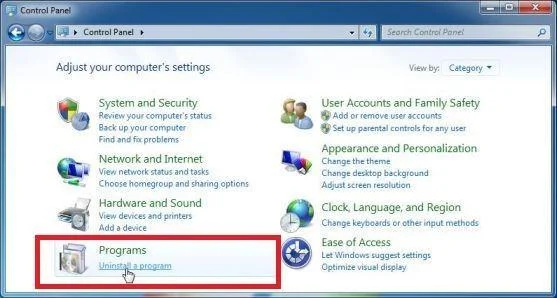
Click on “Uninstall a Program”
In the Control Panel, click “Uninstall a Program” under the Programs category.
-
Find and uninstall the malicious program
Scroll through the list of installed programs and look for anything suspicious — a program you don’t remember installing, or one with a strange or generic name. Click to highlight it, then click the “Uninstall” button.
Didn’t find any suspicious programs? That’s fine — not all infections install visible apps. Just continue with the next step in this guide.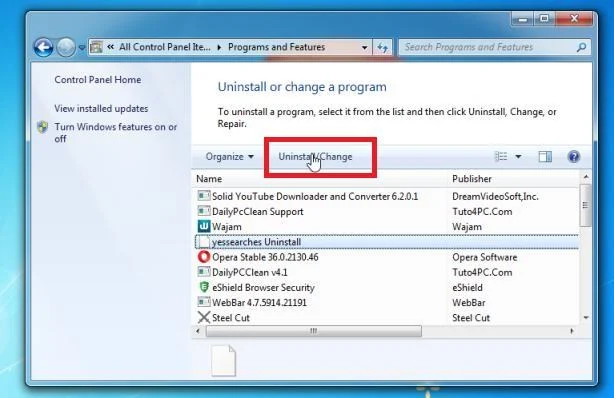
-
Complete the uninstall
Confirm by clicking Yes in the message box, then follow the remaining prompts. Read each prompt carefully — some malicious programs use confusing wording or pre-ticked boxes hoping you’ll click through without looking.
With the malicious programs removed, you’re ready for the next step in this guide.
STEP 2: Reset browsers back to default settings
In this step, we will remove spam notifications, malicious extensions, and change to default any settings that might have been changed by malware.
Please note that this method will remove all extensions, toolbars, and other customizations but will leave your bookmarks and favorites intact. For each browser that you have installed on your computer, please click on the browsers tab below and follow the displayed steps to reset that browser.
Reset Chrome for Windows to default settings
We will now reset your Chrome browser settings to their original defaults. This will reset your startup page, new tab page, search engine, and pinned tabs. It will also disable all extensions and clear temporary data like cookies. Your favorites, history, and saved passwords will not be cleared.
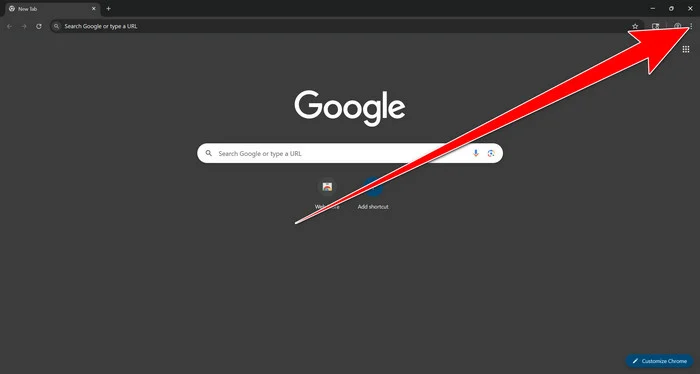
Open the Chrome menu
Open Google Chrome and click the three-dot (⋮) icon in the top-right corner.
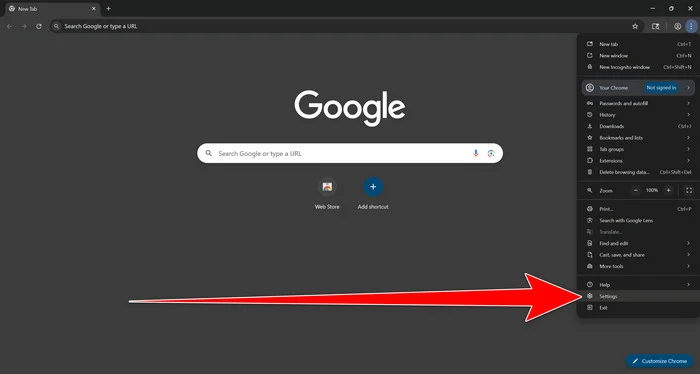
Open Chrome Settings
Select Settings from the Chrome menu.
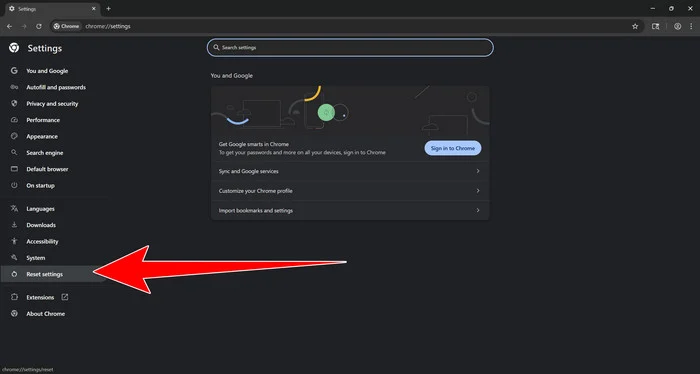
Select “Reset settings”
Look at the menu on the left side of the Settings page. Scroll down and click Reset settings.
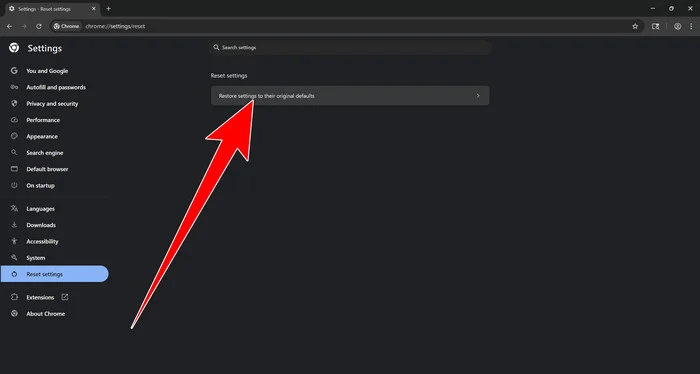
Restore Chrome’s original settings
Click Restore settings to their original defaults.
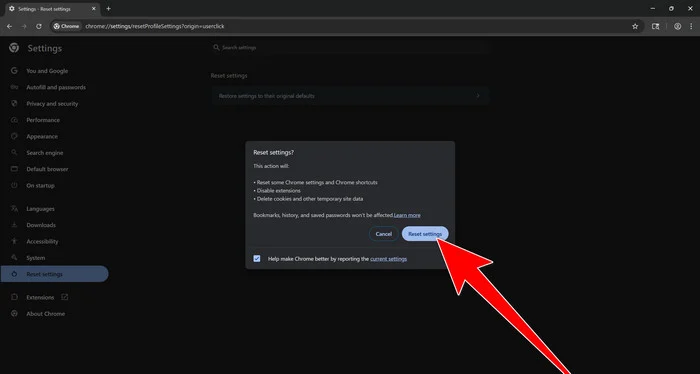
Confirm the Chrome reset
A confirmation window will appear. Click Reset settings.
This will:
- Restore the default search engine, homepage, and new tab page
- Reset startup pages and pinned tabs
- Disable installed extensions
- Clear temporary cookies and website data
Don’t worry: Chrome will not delete your bookmarks, browsing history, or saved passwords.
Restart Chrome and perform a test search. If your searches now open normally in Google, you can stop here.
If searches are still redirected through shady domains complete the additional step below.
Remove persistent search hijacker data
Only complete this step if the redirect continues after resetting Chrome.
Some browser hijackers hide inside Chrome’s local search-engine database. A standard Chrome reset may not remove this database, which is why searches can continue to pass through shady sites.
The following procedure creates a backup of the affected database and allows Chrome to build a new, clean version. This is safer and less disruptive than deleting the entire Chrome profile.
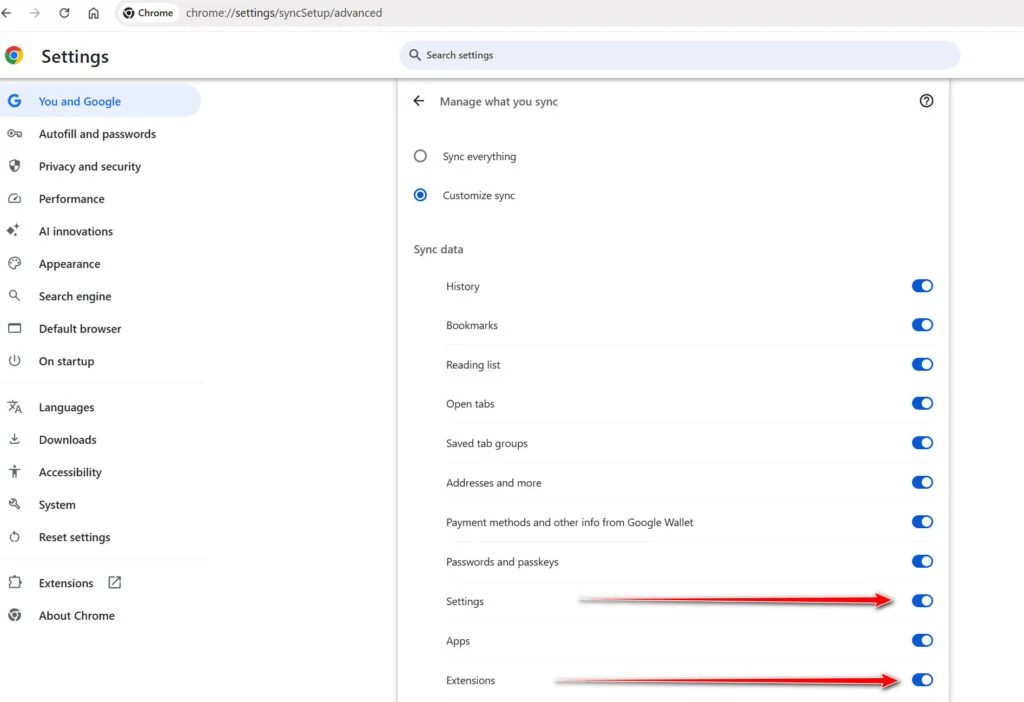
First, prevent Chrome Sync from restoring the hijacked settings:
- Open a new Chrome tab.
- Copy the following address, paste it into Chrome’s address bar, and press Enter:
chrome://settings/syncSetup/advanced - Under Manage what you sync, select Customize sync.
- Turn off Settings and Extensions.
- You can leave Bookmarks and Passwords enabled so your important data remains synchronized.
Note: Some newer Chrome versions may automatically redirect this address to the Google Account settings page. If that happens, locate the list of synchronized Chrome data and turn off Settings and Extensions there.
Now save anything you are working on and close every Chrome window.
Run the cleanup command:
- Press the Windows key on your keyboard.
- Type PowerShell.
- Open Windows PowerShell. Administrator access is not required.
- Copy the entire command shown below.
- Right-click inside the PowerShell window to paste the command, then press Enter.
- If Windows warns you about pasting multiple lines, select the option to continue.
$stamp = Get-Date -Format "yyyyMMdd-HHmmss"

Get-Process chrome -ErrorAction SilentlyContinue |
 Stop-Process -Force

$root = "$env:LOCALAPPDATA\Google\Chrome\User Data"

if (Test-Path $root) {
 $profiles = Get-ChildItem $root -Directory |
 Where-Object {
 $_.Name -eq "Default" -or
 $_.Name -match "^Profile \d+$"
 }

 foreach ($profile in $profiles) {
 foreach ($name in @(
 "Web Data",
 "Web Data-journal",
 "Web Data-wal",
 "Web Data-shm"
 )) {
 $file = Join-Path $profile.FullName $name

 if (Test-Path $file) {
 $backup = "$file.search-hijacker-backup-$stamp"
 Move-Item -LiteralPath $file -Destination $backup
 Write-Host "Backup created: $backup"
 }
 }
 }
}

Write-Host ""
Write-Host "Chrome search data has been cleaned."
Write-Host "You can now reopen Chrome."
Wait until PowerShell displays the following message:
Chrome search data has been cleaned.
You can now reopen Chrome.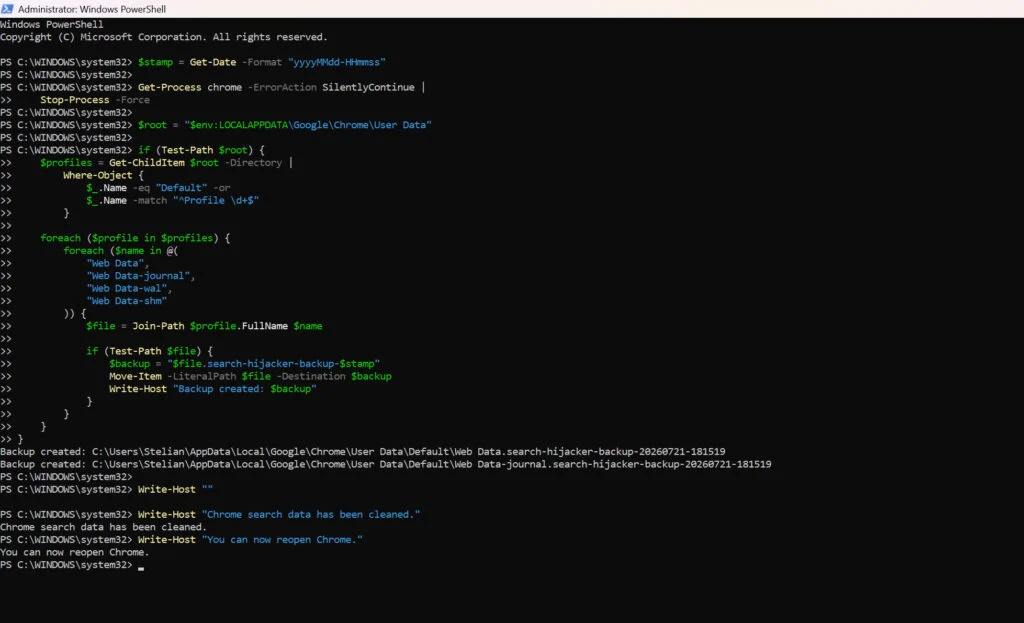
Close PowerShell and reopen Google Chrome. Chrome will automatically create a clean search database for every local profile.
Next, copy the following address, paste it into Chrome’s address bar, and press Enter:
chrome://settings/searchEnginesMake sure Google is selected as the default search engine. Test several searches from the address bar and confirm that they no longer pass through shady search engines.
Your important Chrome data is protected: the PowerShell cleanup does not remove bookmarks, saved passwords, browsing history, cookies, or installed extensions. However, it may reset locally stored Autofill addresses and form suggestions.
The original search database is not deleted. PowerShell renames it and adds
search-hijacker-backupto its filename so it can be recovered if necessary.Keep Settings and Extensions synchronization disabled while testing Chrome. Do not enable every extension at once. Enable only the extensions you recognize, one at a time, and test Chrome after each one.
If the redirect returns after enabling a particular extension, remove that extension immediately.
Reset Firefox for Windows to default settings
We will now reset your Firefox browser settings to their default. The reset feature fixes many issues by restoring Firefox to its factory default state while saving your essential information like bookmarks, passwords, web form auto-fill information, browsing history, and open tabs.
-
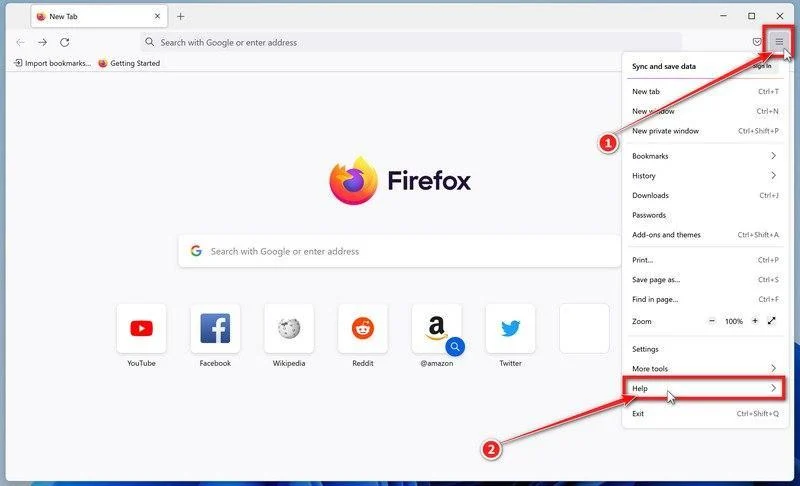
Open the Firefox menu and click “Help”
Click the three horizontal lines in the top-right corner of Firefox to open the main menu, then select “Help“.
-
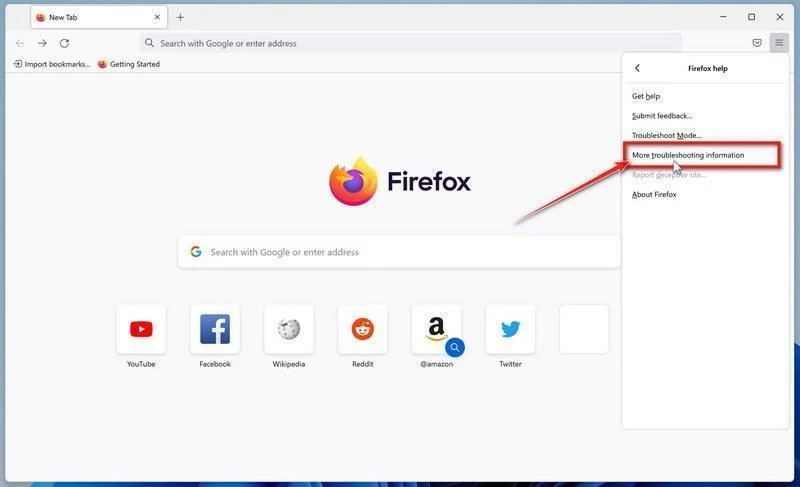
Click “More troubleshooting information”
In the Help menu, click “More troubleshooting information“.
-
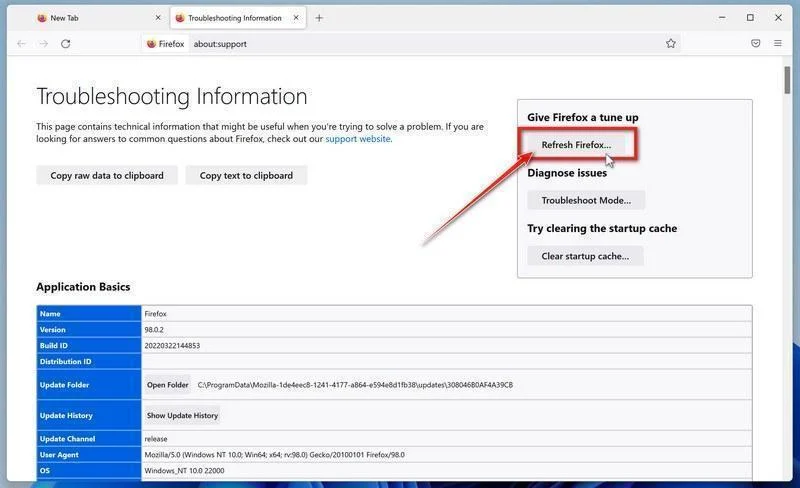
Click “Refresh Firefox”
On the “Troubleshooting Information” page, click the “Refresh Firefox” button in the top-right area of the page.
-
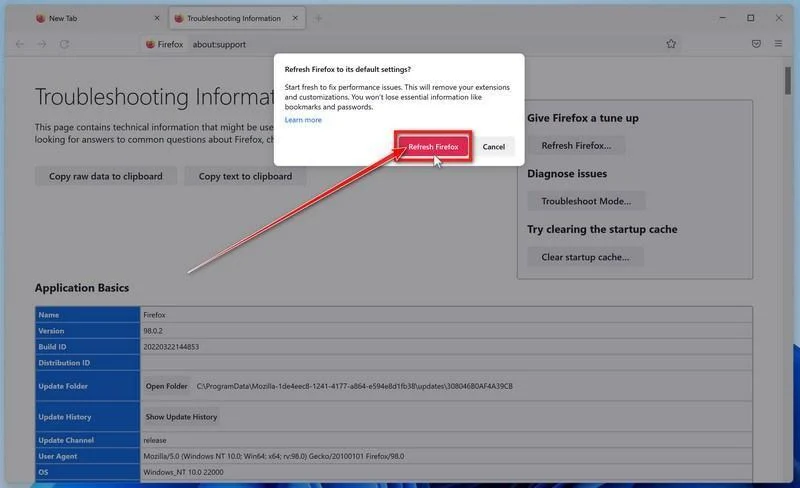
Confirm the refresh
In the confirmation window, click “Refresh Firefox” again. This removes extensions, themes, and customized settings — the usual hiding places for browser hijackers — while keeping your bookmarks, history, and saved passwords safe.
-
Click “Finish”
Firefox will close, reset itself to default settings, and reopen with a window listing the information that was restored. Click “Finish” — your Firefox is now clean.
About the “Old Firefox Data” folder: Firefox saves a copy of your old profile on your desktop. If something you need is missing after the reset, you can recover it from this folder. Otherwise, delete the folder — it contains sensitive data like passwords and cookies, and may also still hold the malicious files you just removed.
Reset Microsoft Edge to default settings
We will now reset your Microsoft Edge browser settings to their default. This will reset your startup page, new tab page, search engine, and pinned tabs. It will also disable all extensions and clear temporary data like cookies. Your favorites, history, and saved passwords will not be cleared.
Updated for Microsoft Edge on Windows 10 and Windows 11 — July 2026.
-
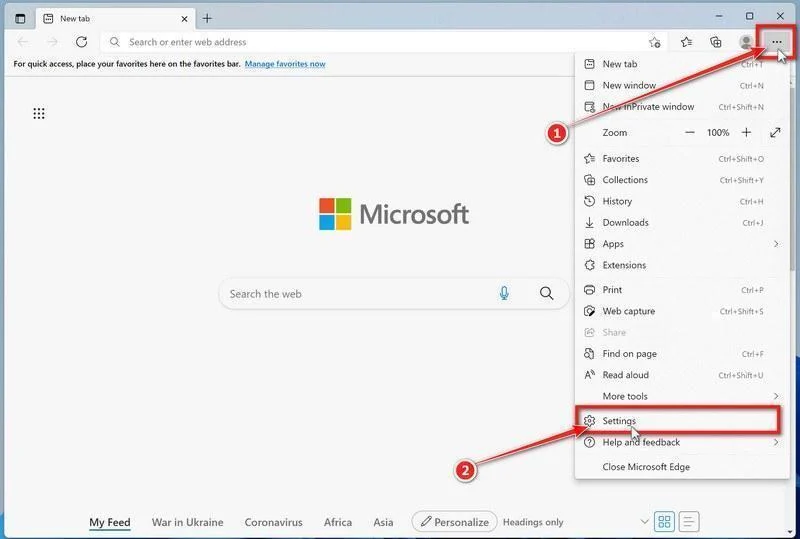
Open the Edge menu and click “Settings”
Open Microsoft Edge. In the top-right corner, click the three-dot (…) icon, then click Settings.
-
Prevent the unwanted settings from returning through Edge Sync
If you are signed in to Microsoft Edge, a bad setting or extension may be stored in your Microsoft account and return after the reset.
Copy the following address, paste it into the Edge address bar, and press Enter:
edge://settings/profiles/syncOn the Sync page, turn off these two options:
- Settings
- Extensions
You can leave Favorites and Passwords turned on.
If Edge says that sync is already off, simply continue to the next step.
Important: Edge Sync settings are separate for each profile. If you use more than one Edge profile, switch to each affected profile and repeat this step.
You do not need to sign out of your Microsoft account or delete the Edge profile.
-
Open “Reset settings”
In the left sidebar, click Reset settings.
You can also open the reset page directly. Copy the following address, paste it into the Edge address bar, and press Enter:
edge://settings/reset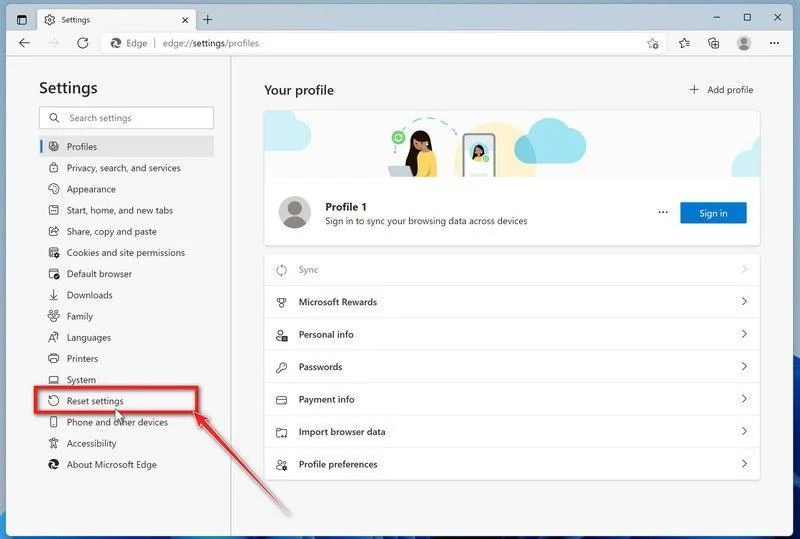
-
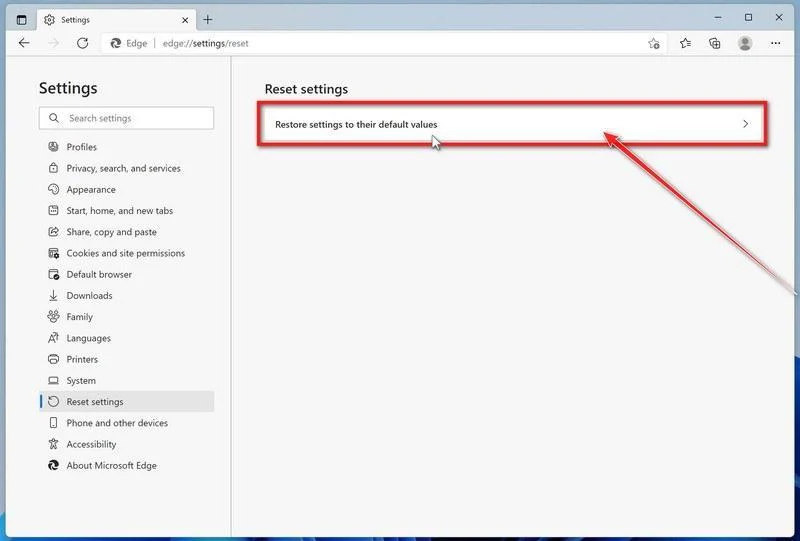
Click “Restore settings to their default values”
Click Restore settings to their default values.
-
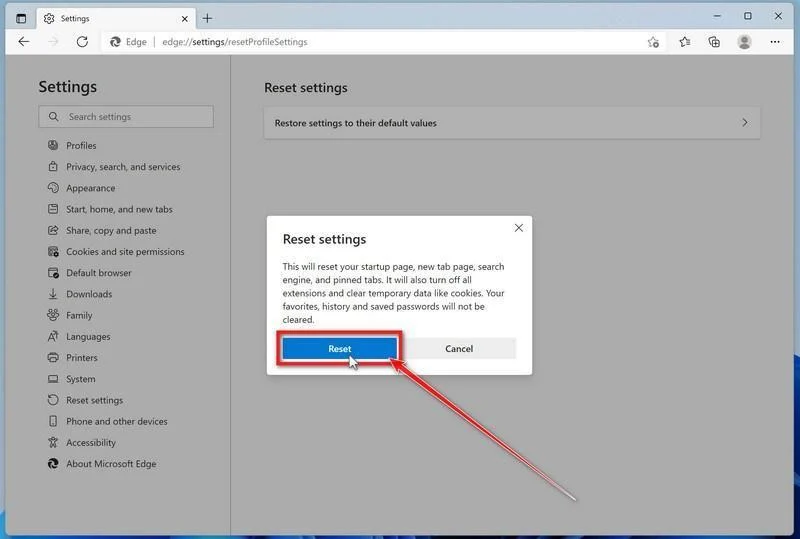
Confirm the reset
In the confirmation dialog, click Reset.
This resets the startup page, new tab page, search engine, and pinned tabs. It also disables all extensions and clears temporary site data, such as cookies.
Don’t worry: your favorites, browsing history, and saved passwords will not be deleted.
-
Check your extensions before turning them back on
Copy the following address, paste it into the Edge address bar, and press Enter:
edge://extensionsRemove any extension you do not recognize or no longer use. Pay particular attention to extensions related to search, coupons, shopping, PDF conversion, browser protection, new tabs, or video downloading.
Do not turn all extensions back on at the same time. Enable only the extensions you recognize and trust.
-
Select a trusted search engine
Copy the following address, paste it into the Edge address bar, and press Enter:
edge://settings/searchEnginesSelect Bing, Google, DuckDuckGo, or another search provider you trust and make it the default.
Remove any unknown search engines, especially providers with strange names or addresses that you did not add yourself.
Restart Edge and perform a search from the address bar. If searches are no longer redirected, you can stop here.
-
If the redirect remains, clean the corrupted search data without deleting the Edge profile
Use this additional step only if Edge continues to redirect searches after the normal reset.
This command cleans the search-engine database from every local Edge profile while keeping your favorites, saved passwords, browsing history, cookies, and profiles.
Before continuing: save anything you are working on because the command will close Microsoft Edge.
- Open the Windows Start menu.
- Type PowerShell.
- Open Windows PowerShell. Administrator access is not required.
- Copy the entire command below.
- Paste it into PowerShell and press Enter.
$stamp = Get-Date -Format "yyyyMMdd-HHmmss"
$root = Join-Path $env:LOCALAPPDATA "Microsoft\Edge\User Data"

Get-Process -Name msedge -ErrorAction SilentlyContinue |
    Stop-Process -Force -ErrorAction SilentlyContinue

Start-Sleep -Seconds 2

if (-not (Test-Path -LiteralPath $root)) {
    Write-Host "The Microsoft Edge profile folder was not found:"
    Write-Host $root
    return
}

$profiles = Get-ChildItem -LiteralPath $root -Directory |
    Where-Object {
        $_.Name -eq "Default" -or
        $_.Name -match "^Profile \d+$"
    }

$movedFiles = 0

foreach ($profile in $profiles) {
    foreach ($name in @(
        "Web Data",
        "Web Data-journal",
        "Web Data-wal",
        "Web Data-shm"
    )) {
        $file = Join-Path $profile.FullName $name

        if (Test-Path -LiteralPath $file) {
            $backup = "$file.search-reset-backup-$stamp"

            try {
                Move-Item -LiteralPath $file -Destination $backup -ErrorAction Stop
                Write-Host "Cleaned: $($profile.Name)\$name"
                $movedFiles++
            }
            catch {
                Write-Warning "Could not clean: $file"
            }
        }
    }
}

Write-Host ""

if ($movedFiles -gt 0) {
    Write-Host "Microsoft Edge search data has been cleaned." -ForegroundColor Green
    Write-Host "You can now reopen Microsoft Edge."
}
else {
    Write-Host "No Edge search database files were found." -ForegroundColor Yellow
}
The command does not permanently delete the original files. It renames them as backup files, and Edge creates a clean search database when it starts again.
Note: this additional cleanup may also reset saved form-fill suggestions, saved addresses, and manually added search engines. It does not delete favorites, passwords, or browsing history.
-
Reopen Edge and test the browser
Open Microsoft Edge again, visit edge://settings/searchEngines, and select your preferred search engine.
Perform several searches from the address bar to confirm that the redirect is gone.
Keep synchronization for Settings and Extensions turned off until you are certain that the computer and extensions are clean. If you enable them again, turn them on one at a time and test Edge after each change.
-
If Edge still redirects your searches
Open edge://policy. If this is your personal computer and Edge displays unknown policies such as ExtensionInstallForcelist or DefaultSearchProvider, the hijacker may be installed outside the browser profile.
In that situation, continue with the next malware-removal steps and run a complete antivirus scan. If the computer belongs to a company or school, contact its IT administrator before changing any policies.
Reset Internet Explorer to default settings
We will now reset your Internet Explorer browser settings to their default. You can reset Internet Explorer settings to return them to the state they were in when Internet Explorer was first installed on your computer.
-
Go to “Internet Options”.
Open Internet Explorer, click on the gear icon in the upper-right part of your browser, then select “Internet Options“.
-
Select the “Advanced” tab, then click “Reset”
In the “Internet Options” dialog box, select the “Advanced” tab, then click on the “Reset” button.
-
Click on “Reset”.
In the “Reset Internet Explorer settings” section, select the “Delete personal settings” checkbox, then click on the “Reset” button.
-
Click on “Close”.
When Internet Explorer has completed its task, click on the “Close” button in the confirmation dialogue box.
Close your browser and then you can open Internet Explorer again.
STEP 3: Use Malwarebytes Anti-Malware to remove malware and unwanted programs
In this third step, we will install Malwarebytes to scan and remove any infections, adware, or potentially unwanted programs that may be present on your computer.
Malwarebytes is one of the most popular and trusted anti-malware tools for Windows — and it’s completely free for removing infections. It catches threats that many antivirus programs miss, including adware, browser hijackers, and trojans. Follow the steps below to scan and clean your PC in just a few minutes.
Download Malwarebytes
Click the button below to download the latest version of Malwarebytes for Windows from the official source. The free version is all you need — it will scan your computer and remove adware, browser hijackers, and other malicious software at no cost.
Download MalwarebytesOfficial installer for Windows 11 and 10. Your download starts right away.Want real-time protection? See Malwarebytes Premium Malwarebytes Free for WindowsScans and removes malware at no cost
-
Install Malwarebytes
When the download finishes, open your Downloads folder and double-click the MBSetup file. If Windows shows a User Account Control pop-up, click “Yes” to allow the installation.
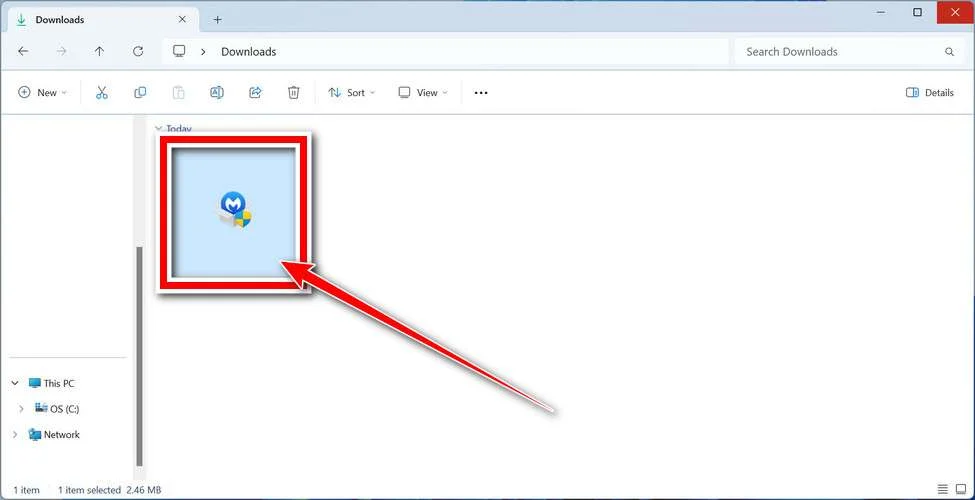
Follow the On-Screen Prompts to Install Malwarebytes
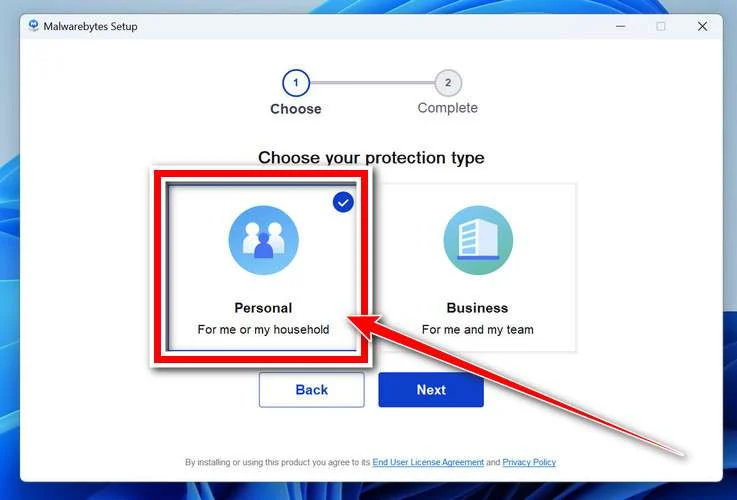
The setup wizard will walk you through a few quick screens:
-
Choose where you’re installing the program — “Personal Computer” or “Work Computer” — then click Next.
-
Malwarebytes will now install on your device. This usually takes under a minute.

-
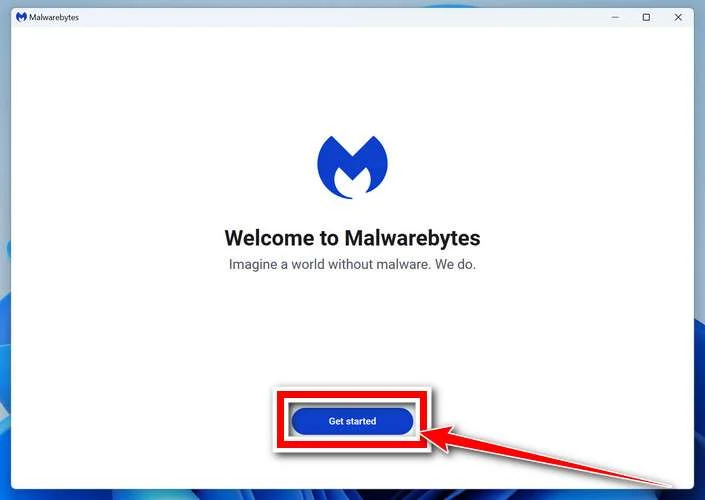
When installation is complete, the “Welcome to Malwarebytes” screen will open automatically.
-
On the final screen, click Open Malwarebytes to launch the program.

-
Enable “Scan for Rootkits”
Before scanning, turn on rootkit detection so Malwarebytes can find even the most hidden threats. Click the Settings gear icon on the left side of the screen.
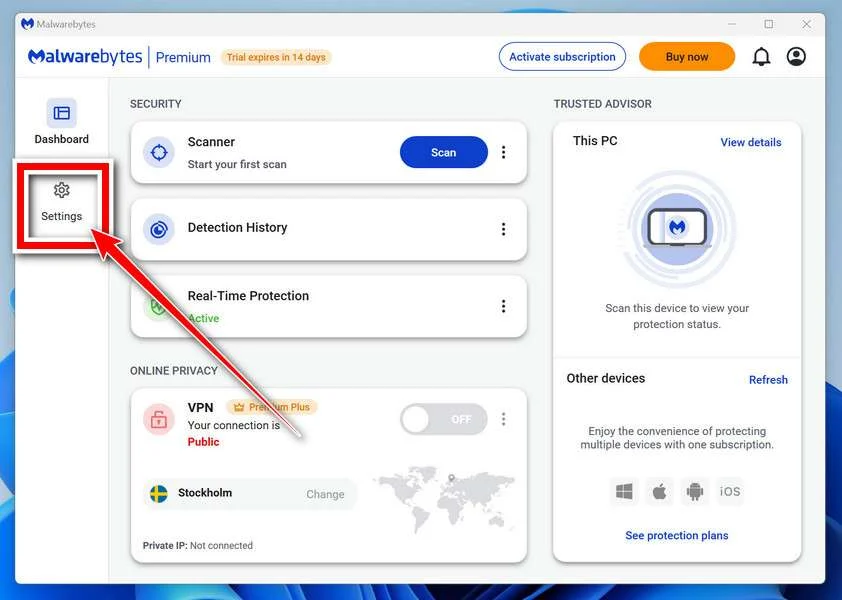
In the settings menu, find “Scan for rootkits” and click the toggle so it turns blue.

Done? Click “Dashboard” in the left pane to return to the main screen.
Start the Scan
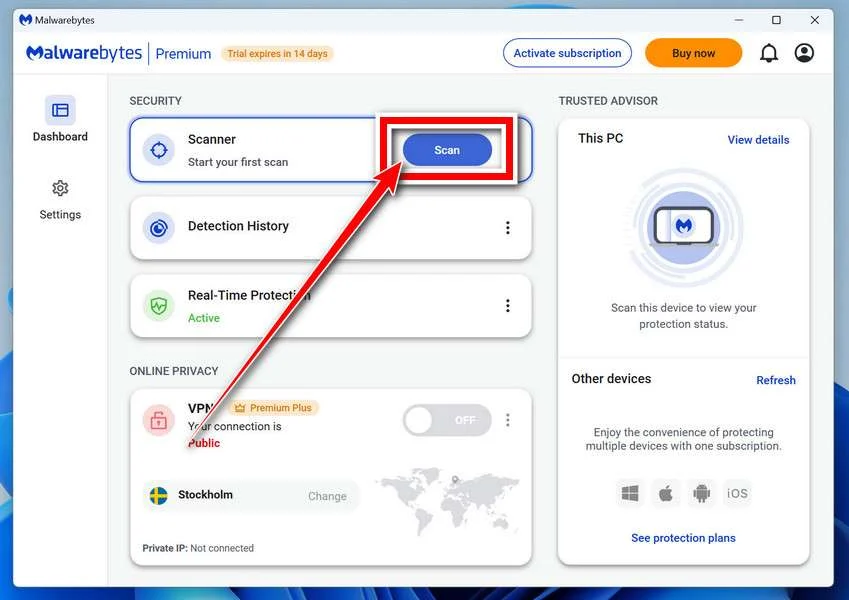
Click the blue Scan button. Malwarebytes will automatically update its virus database and start checking your computer for malware.
-
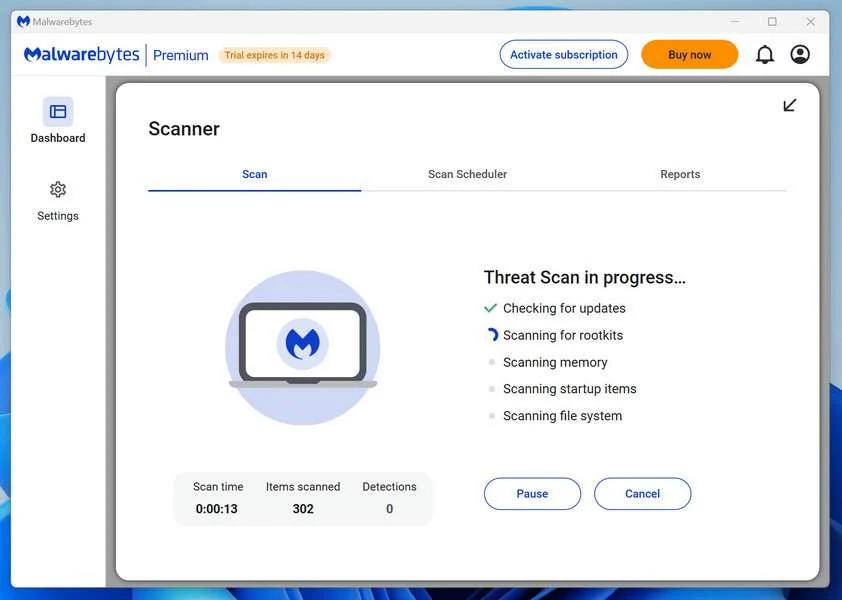
Wait for the Scan to Finish
The scan checks your entire system for browser hijackers and other malicious programs, so it can take 5 to 20 minutes depending on your computer. Feel free to do something else — just check back occasionally to see the progress.
-
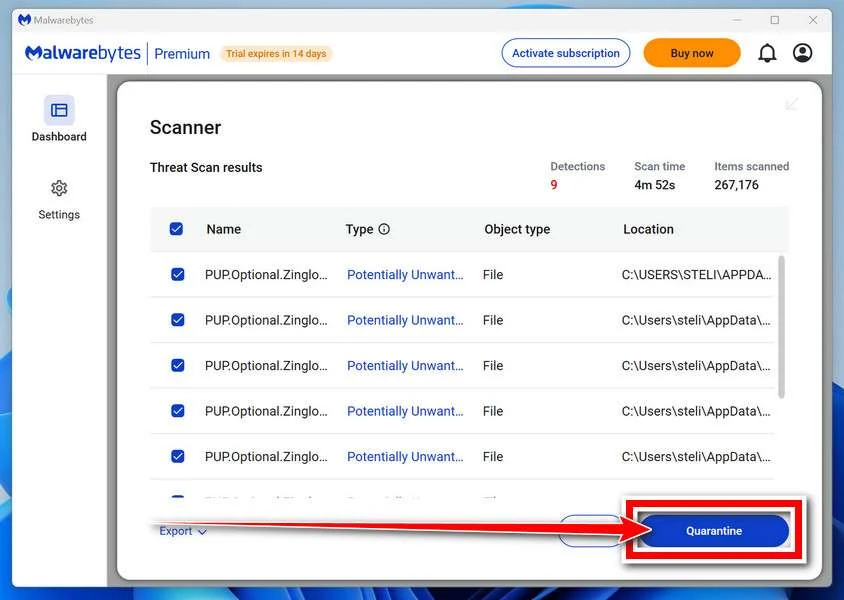
Quarantine the Detected Threats
When the scan is done, you’ll see a list of everything Malwarebytes found — malware, adware, and potentially unwanted programs. Click the “Quarantine” button to remove all of them at once.
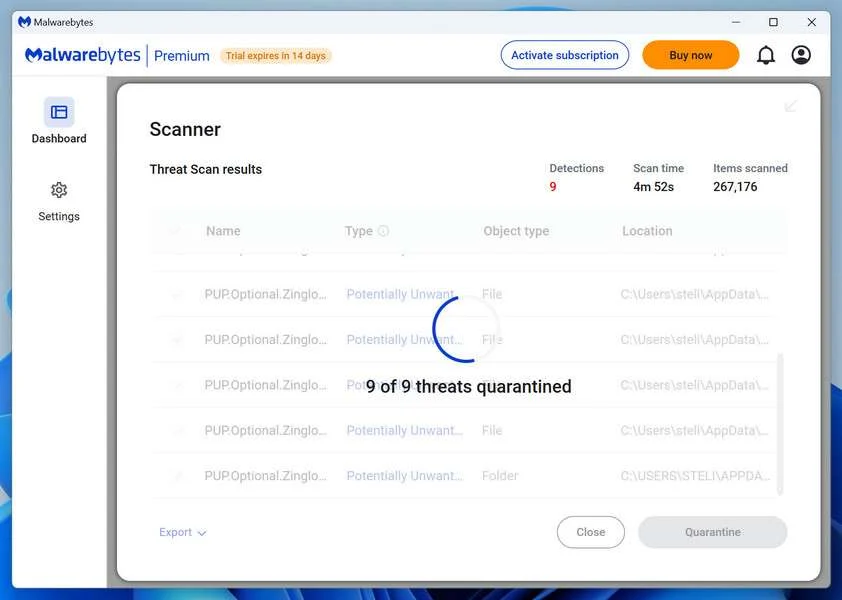
Malwarebytes will now remove the malicious files and registry entries and move them safely into quarantine.
-
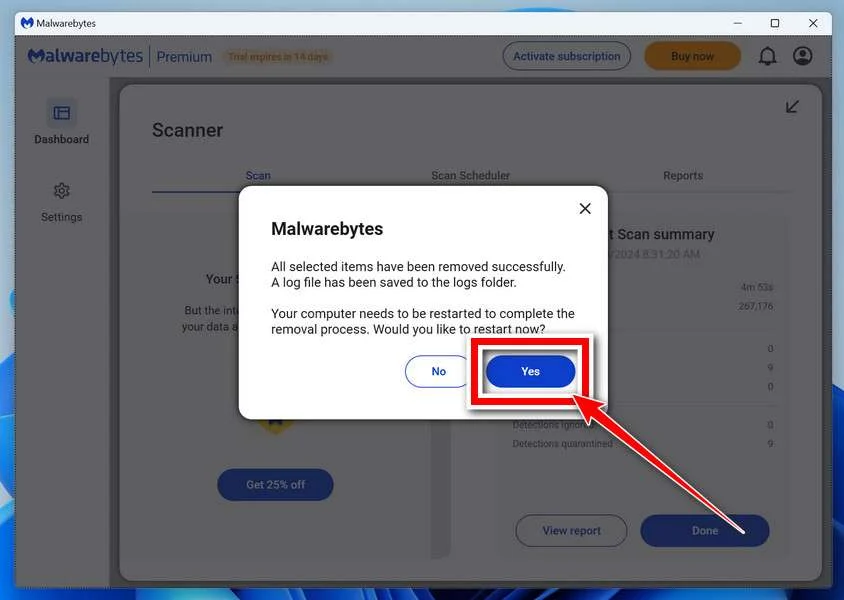
Restart Your Computer
Some threats can only be fully removed after a reboot. If Malwarebytes asks you to restart, click Yes. Once you’re logged back in, Malwarebytes has finished removing the threats it found.
STEP 4: Use HitmanPro to scan your computer for badware
In this next step, we will scan the computer with HitmanPro to ensure that no other malicious programs are installed on your device.
HitmanPro is a second-opinion scanner — it’s designed to catch what your main antivirus might have missed. Instead of relying on a single detection engine, it checks the behavior of files in the locations where malware usually hides. Anything suspicious gets sent to the cloud, where it’s analyzed by two of the best antivirus engines available: Bitdefender and Kaspersky.
Good news: scanning is completely free, with no limits. You only need a license when it’s time to remove what was found — and even then, you can activate a free one-time 30-day trial to clean your PC at no cost. (A full license is $24.95 per year for 1 PC.)
-
Download HitmanPro
Click the button below to download HitmanPro. Remember — the scan is free, so you have nothing to lose by checking your PC.
Download HitmanProFree scan. Removing threats needs the free 30-day trial. Opens the official HitmanPro page in a new tab. HitmanProSecond-opinion malware scanner from Sophos
 -
Install HitmanPro
When the download finishes, open your Downloads folder and double-click the file: “hitmanpro.exe” on 32-bit Windows, or “hitmanpro_x64.exe” on 64-bit Windows.
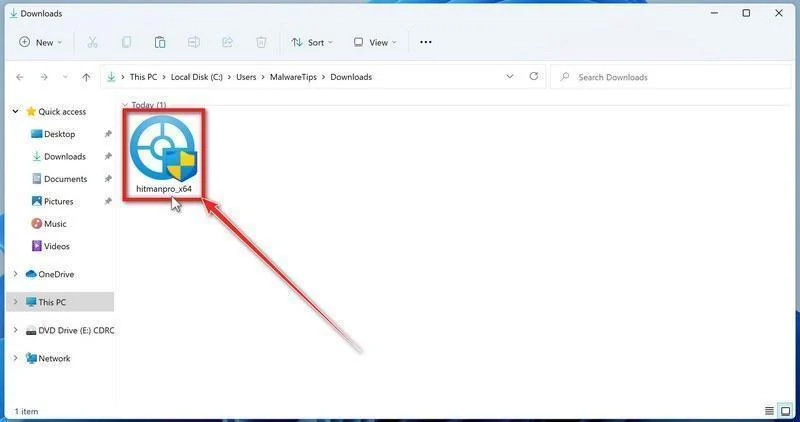
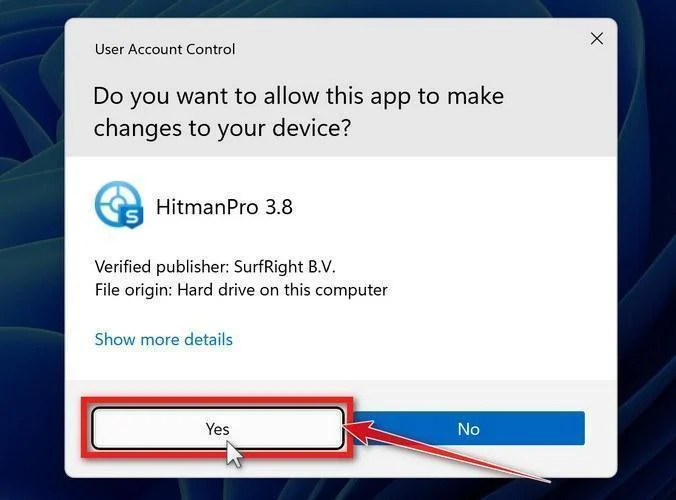
If a User Account Control pop-up asks whether HitmanPro can make changes to your device, click “Yes” to continue.
-
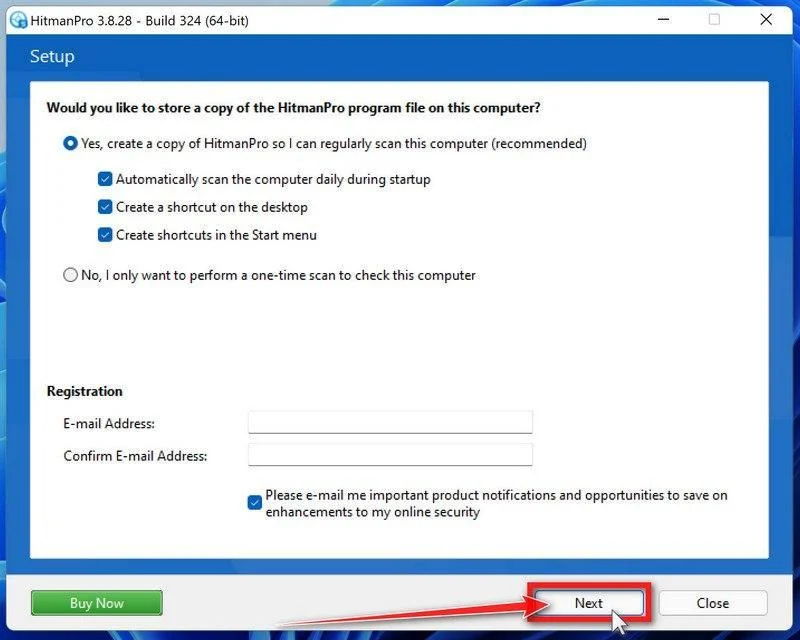
Follow the On-Screen Prompts
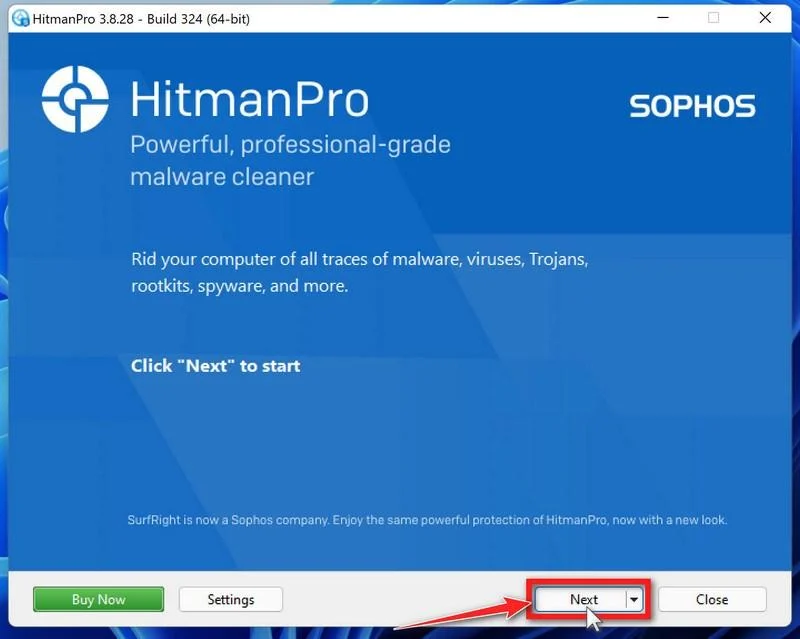
On the HitmanPro start screen, click “Next” to begin the system scan. No lengthy setup required — it goes straight to work.
-
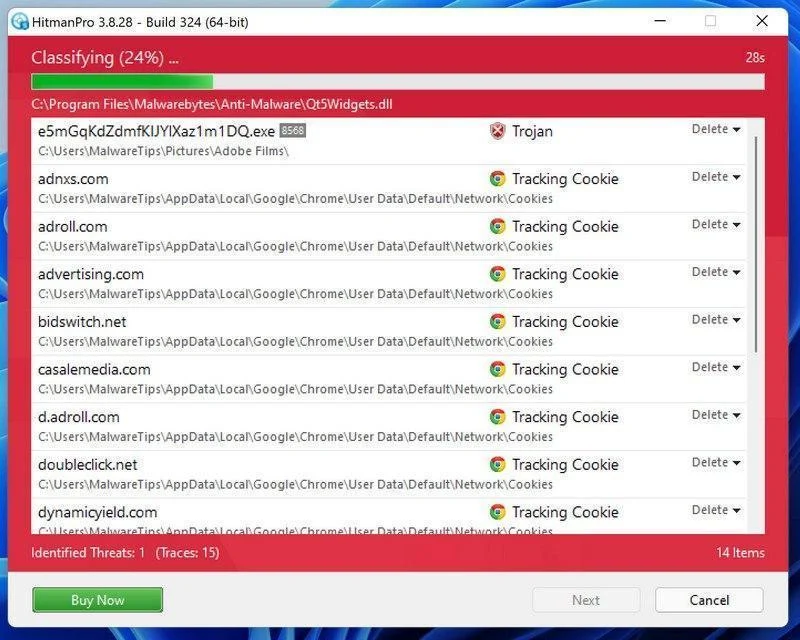
Wait for the Scan to Finish
HitmanPro will now check your computer for malicious programs. This usually takes just a few minutes thanks to its cloud-based scanning.
-
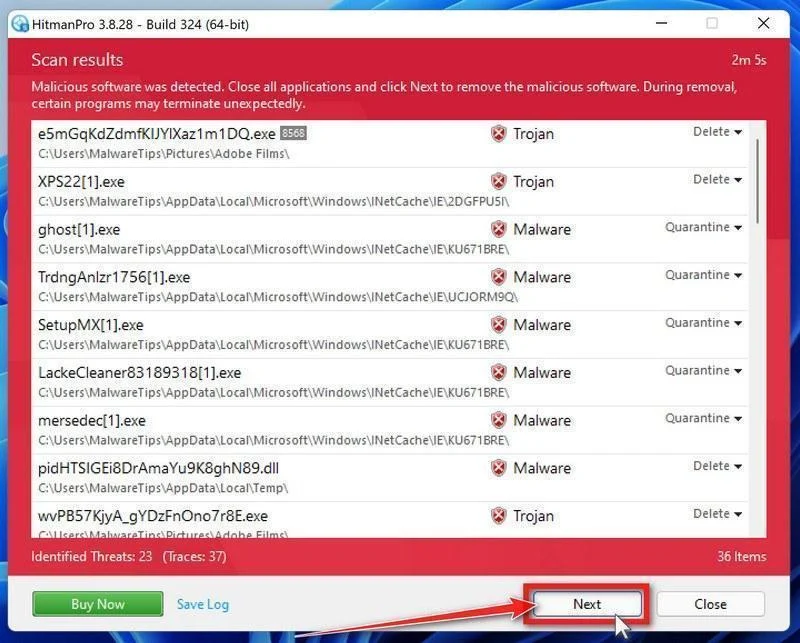
Review the Results and Click “Next”
When the scan is done, HitmanPro will show you everything it found. Click “Next” to remove the detected threats.
-
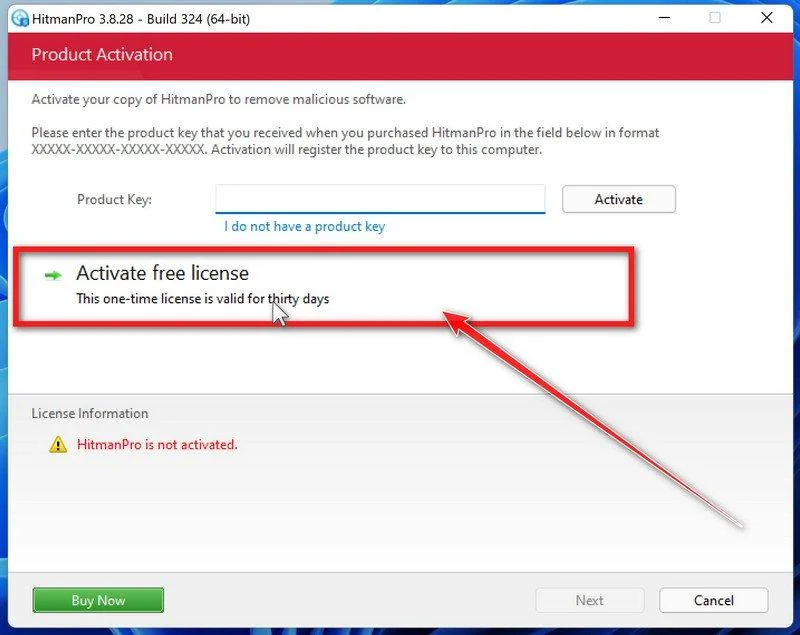
Click “Activate Free License”
To remove the malicious files, click the “Activate free license” button. This starts your free 30-day trial — no payment details needed — and unlocks the full cleanup.
When the removal is complete, HitmanPro will show a summary of everything it cleaned. Click Next, then click Reboot if prompted. If there’s no reboot prompt, just click Close — your PC is clean.
STEP 5: Use AdwCleaner to remove adware and malicious browser policies
In this final step, we will use AdwCleaner to remove the malicious browser policies that were set by browser hijackers on your computer and delete malicious browser extensions.
AdwCleaner is a free on-demand scanner that specializes in adware, browser hijackers, and unwanted toolbars — the exact threats that mainstream antivirus programs often miss. It also includes tools that repair the damage malware leaves behind, like hijacked browser settings and malicious policies. It’s a quick scan that’s well worth running.
-
Download AdwCleaner
Click the button below to download AdwCleaner — it’s free, portable, and requires no installation.
Download AdwCleanerOpens the official download page in a new tab. Malwarebytes AdwCleanerRemoves adware and unwanted programs at no cost
 -
Run AdwCleaner
Open your Downloads folder and double-click the file named “adwcleaner.exe“. There’s no installation — the program starts right away.
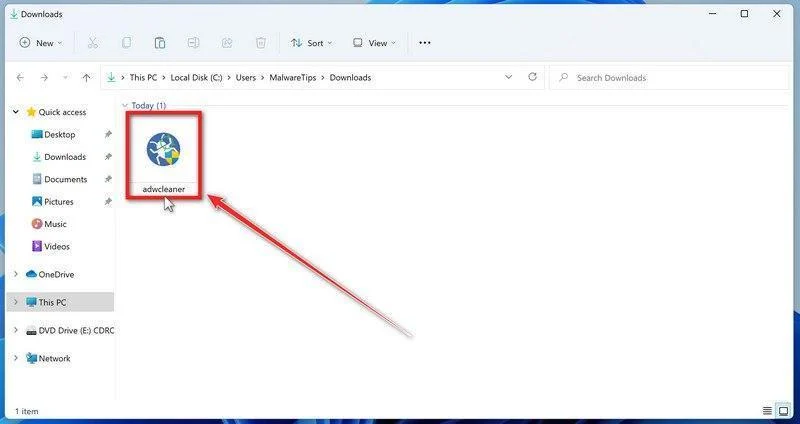
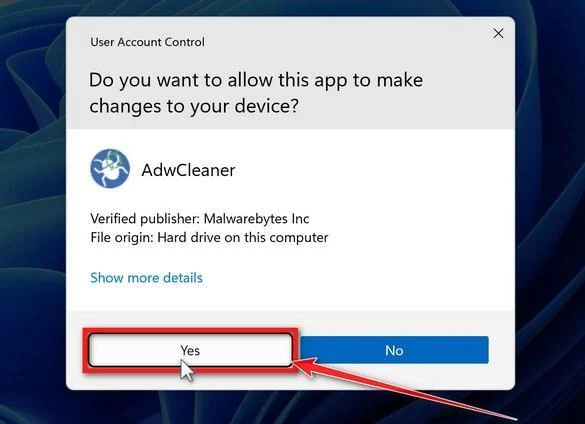
If Windows asks whether you want to allow AdwCleaner to run, click “Yes“. When the license agreement appears, click I agree to continue.
-
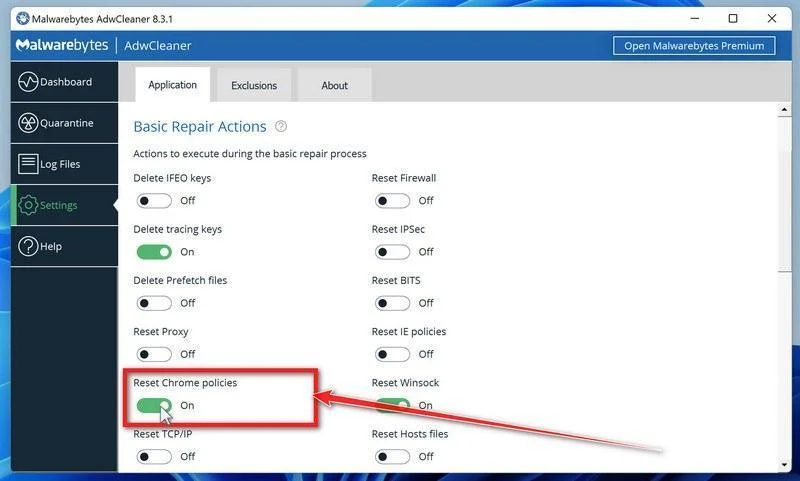
Enable “Reset Chrome policies”
This setting removes malicious browser policies — a trick malware uses to lock your browser settings so you can’t change them back. Click “Settings” on the left side of the window, then turn on “Reset Chrome policies“.
-
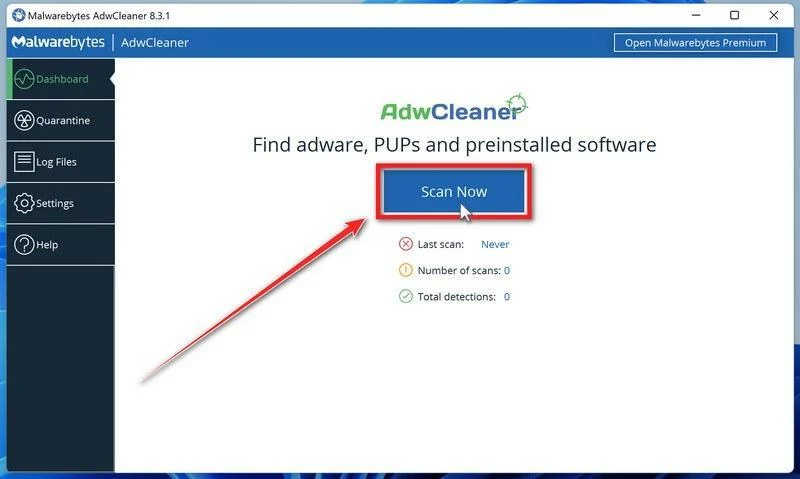
Start the Scan
Click “Dashboard” on the left side of the window, then click the “Scan” button.
-
Wait for the Scan to Finish
AdwCleaner will now check your computer for adware and other malware. This usually takes only a few minutes — it’s one of the fastest scanners around.
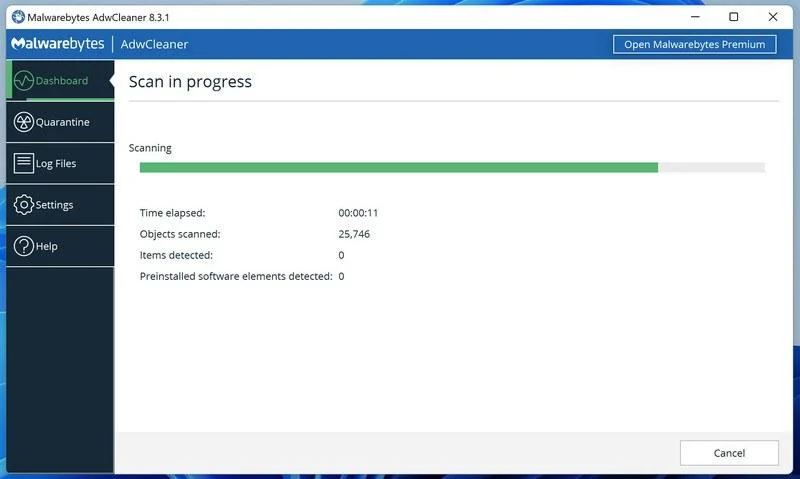
-
Quarantine the Detected Threats
When the scan finishes, AdwCleaner will list everything it found. Click the “Quarantine” button to remove all the malicious items at once.
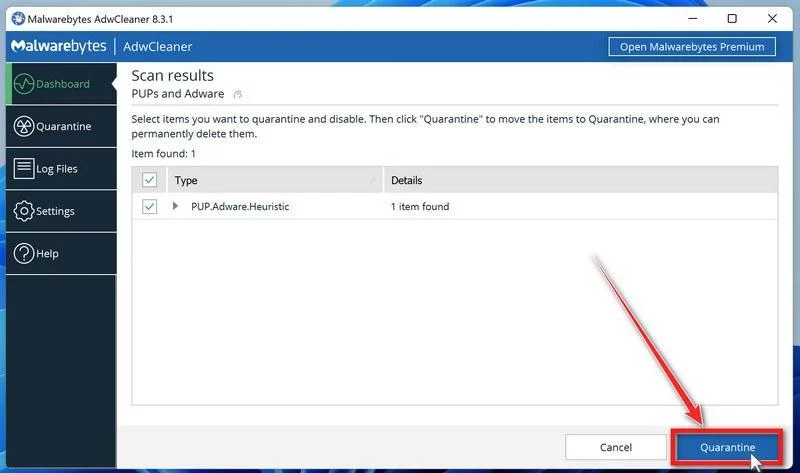
-
Click “Continue” to Finish the Cleanup
Save any open work first — AdwCleaner needs to close your open programs before it can clean. When you’re ready, click the “Continue” button.
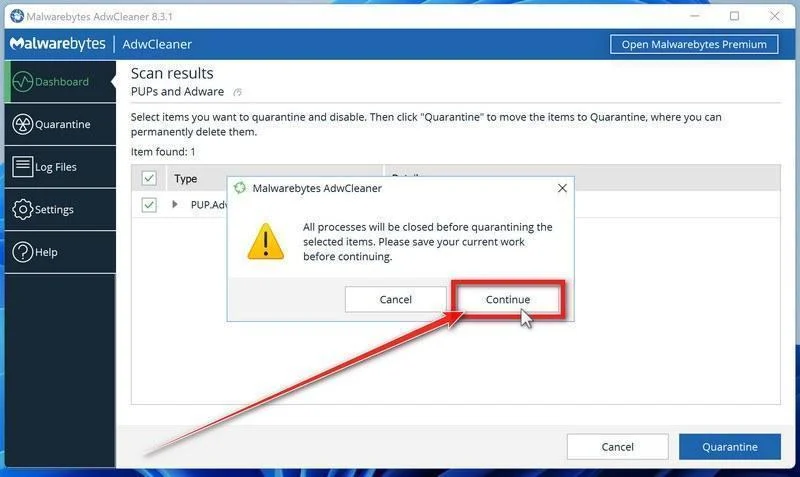
AdwCleaner will now delete all detected malware from your computer. If it asks you to restart your PC, allow it — your computer will be clean when you log back in.
That’s it — your Windows computer is now clean. The unwanted apps, adware, and any other malware have been removed.
If you are still having problems with your computer after completing these instructions, then please follow one of the steps:
- Run a computer scan with ESET Online Scanner
- Ask for help in our Windows Malware Removal Help & Support forum.
Remove Unwanted Apps and Malware from Mac
- STEP 1: Remove malicious profiles
- STEP 2: Delete malicious apps
- STEP 3: Reset browsers back to default settings
- STEP 4: Run a scan with Malwarebytes for Mac to remove malware
STEP 1: Remove malicious profiles
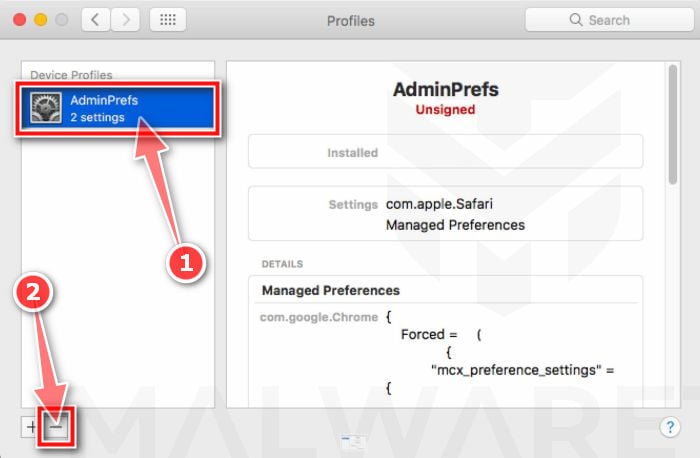
Profiles are used by IT admins in businesses to control the behavior of their Macs. These profiles can configure a Mac to do many different things, some of which are not otherwise possible.
When it comes to home users, adware and browser hijackers are using the configuration profile to prevent users from removing malicious programs from the computer. This also prevents the user from changing that behavior in the browser’s settings.
In this first step, we will check your computer to see if any configuration profiles are installed. To do this, follow the below steps:
-
Open “System Settings”
From the Apple menu () in the top-left corner of the screen, select System Settings. (On macOS Monterey and earlier, this is called System Preferences.)
-
Look for “Profiles”
In the System Settings window, search for Profiles — on newer macOS versions you’ll find it under Privacy & Security, or you can type “Profiles” in the search box.
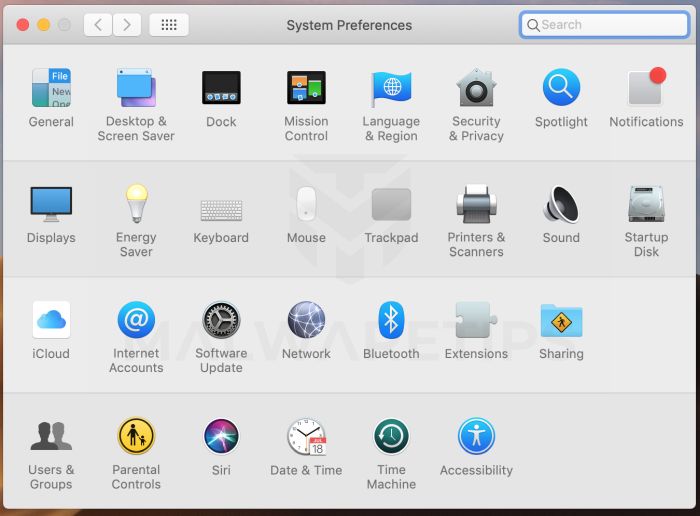 No Profiles section? Good news — that means no profiles are installed on your Mac, which is completely normal. Skip ahead to the next step of this guide.
 -
Remove the malicious profiles
Malware uses configuration profiles to lock your browser settings — forcing a fake search engine or homepage on you and preventing you from changing it back. If you see a profile you don’t recognize (and your Mac isn’t managed by your workplace or school), select it, press the − (minus) button, and click Remove to confirm.
STEP 2: Delete malicious apps
In this second step, we will try to identify and remove any malicious apps and files that might be installed on your computer. Sometimes redirects or adware programs can have usable Uninstall entries that can be used to remove these programs.
-
Quit the malicious programs
Check the Apple menu bar in the top-right corner of your screen. If you see an icon you don’t recognize, click it and select Quit. This stops the malware from running so it can’t interfere while we remove it.
-
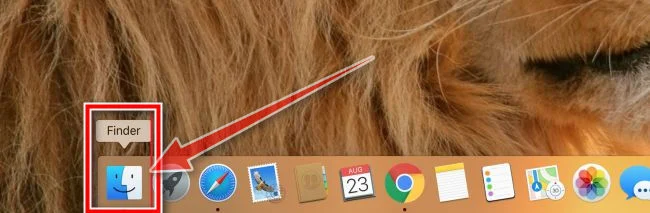
Open “Finder”
Click the Finder icon in your dock.
-
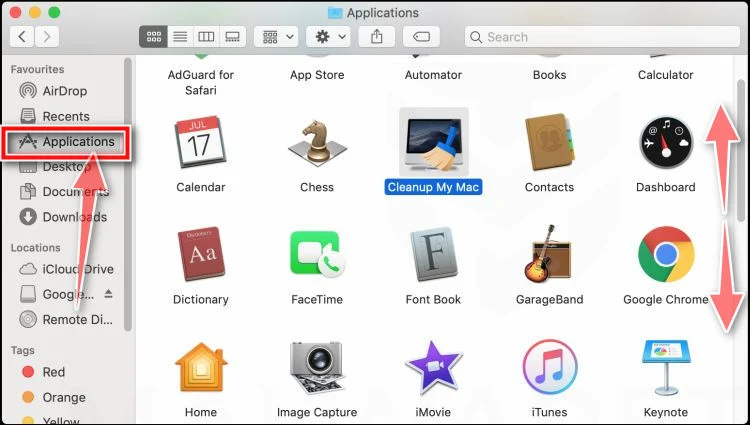
Click on “Applications”
In the Finder sidebar, click “Applications“.
-
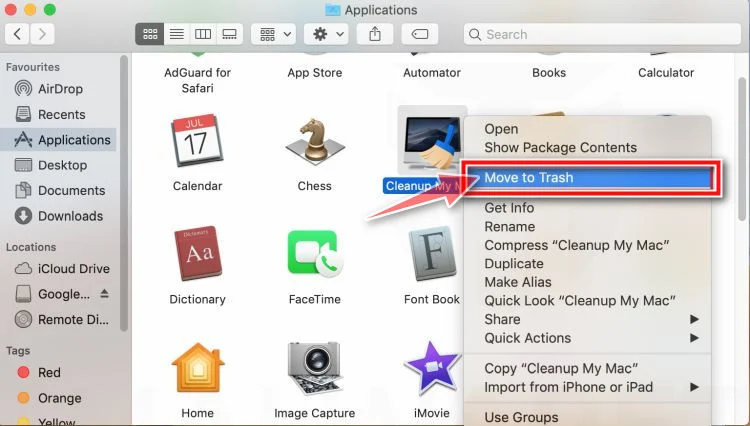
Find and remove the malicious app
Scroll through the list of installed apps and look for anything suspicious — an app you don’t remember installing, or one with a strange or generic name. When you find it, right-click it and select “Move to Trash“.
Some known malicious programs to look for: SearchMine, TakeFresh, TopResults, FeedBack, ApplicationEvents, GeneralOpen, PowerLog, MessengerNow, ImagePrime, GeneralNetSearch, Reading Cursors, GlobalTechSearch, PDFOnline-express, See Scenic Elf, MatchKnowledge, Easy Speedtest, and WebDiscover. The names change constantly, though — so treat any app you can’t account for as suspect.
-
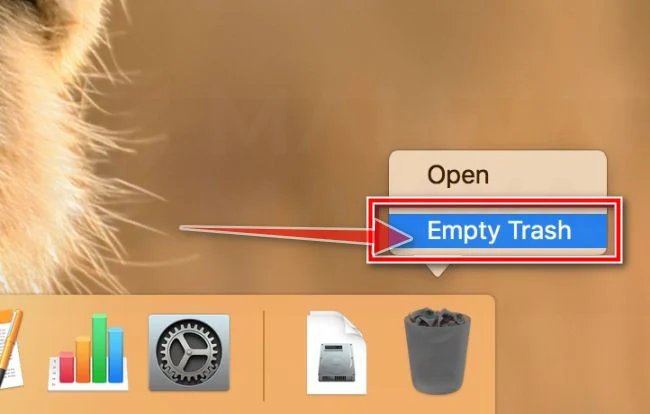
Empty the Trash
Right-click the Trash icon in your dock and select “Empty Trash“. This permanently deletes the malicious app you just removed — until you do this, the malware is still on your Mac.
Find and remove the malicious files
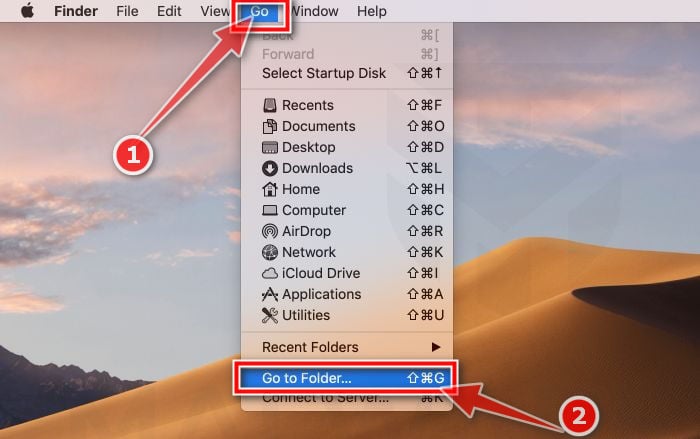
Malware on Mac uses launch agents and launch daemons — small files that automatically restart the malware every time you boot your Mac. We’ll check the four folders where they hide:
- Click the desktop to make sure you’re in Finder, then open the “Go” menu and click “Go to Folder“.
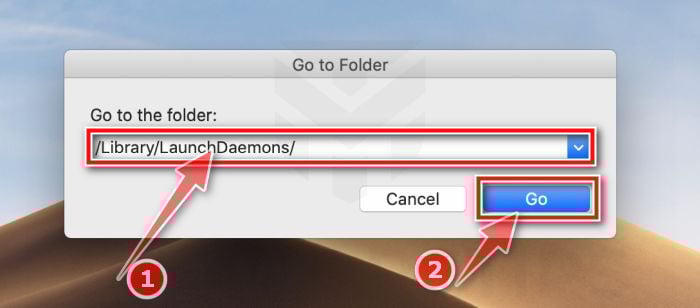
- Copy and paste each of the paths below into the window, one at a time, and click Go after each:
- /Library/LaunchAgents
- ~/Library/LaunchAgents
- /Library/Application Support
- /Library/LaunchDaemons
- In each folder, look for suspicious .plist files — typically named after the malware or with odd, random-looking names. Some known examples: “com.adobe.fpsaud.plist”, “installmac.AppRemoval.plist”, “myppes.download.plist”, “mykotlerino.ltvbit.plist”, and “com.myppes.net-preferences.plist”. When you find a malicious file, move it to the Trash — then empty the Trash again when you’re done.
Be careful: these folders also contain files belonging to legitimate apps — especially /Library/Application Support, where programs like Adobe, Google, and Microsoft store their data. Only delete files you’re confident are malicious. If you’re unsure about a file, search its exact name online first — or skip it; the Malwarebytes scan in the next step will catch what you miss.
- Click the desktop to make sure you’re in Finder, then open the “Go” menu and click “Go to Folder“.
STEP 3: Reset browsers back to default settings
In this third step, we will remove spam push notifications and malicious extensions, and change to default any settings that might have been changed by malware.
For each browser that you have installed on your computer, please click on the tab below and follow the displayed steps to reset that browser.
Remove malicious extensions and settings from Safari
To remove malware from Safari we will check if there are any malicious extensions installed on your browser and what settings have been changed by this malicious program.
-
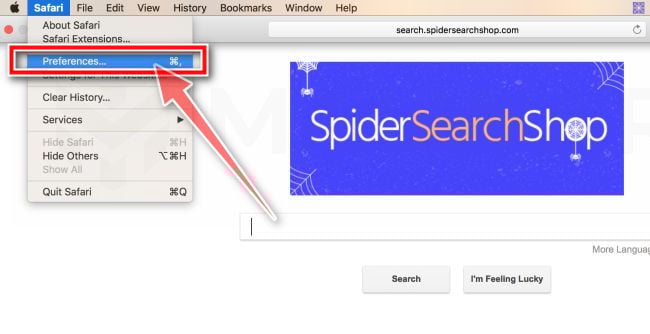
Go to Safari’s “Preferences”.
On the menu bar, click the “Safari” menu and select “Preferences”.
-
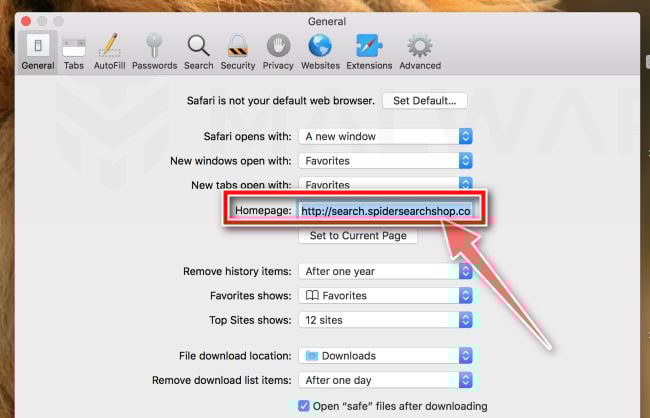
Check Homepage.
This will open a new window with your Safari preferences, opened to the “General” tab. Some browser hijackers may change your default homepage, so in the Homepage field make sure it’s a web page you want to use as your start-up page.
-
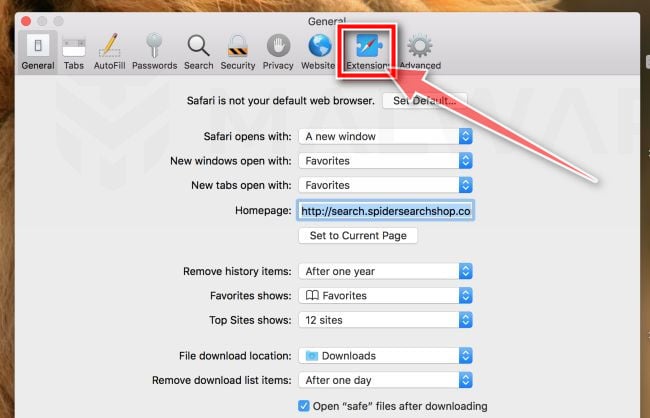
Click “Extensions”
Next, click on the “Extensions” tab.
-
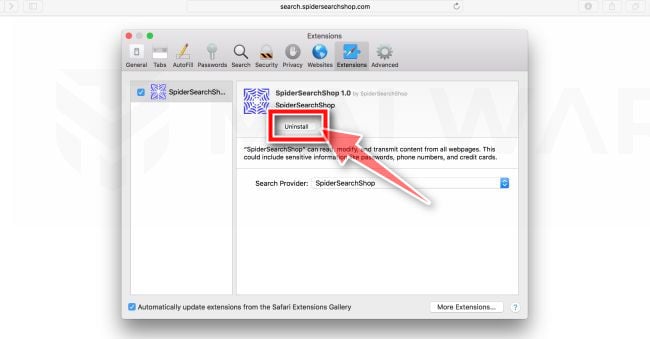
Find and uninstall malicious extensions.
The “Extensions” screen will be displayed with a list of all the extensions installed on Safari. Look out for any suspicious browser extension that could be behind all the drama – anything you don’t remember downloading or that doesn’t sound like a genuine extension. By default, there are no extensions installed on Safari so it’s safe to remove an extension
-
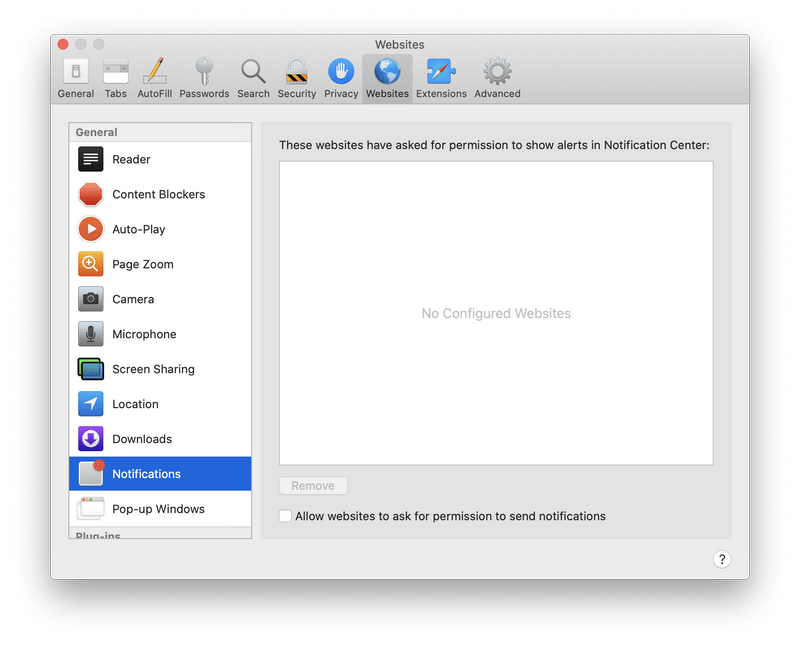
Remove spam notifications ads
Click Preferences, click Websites, then click Notifications. Deselect “Allow websites to ask for permission to send push notifications”.
-
Remove all data stored by websites on your computer.
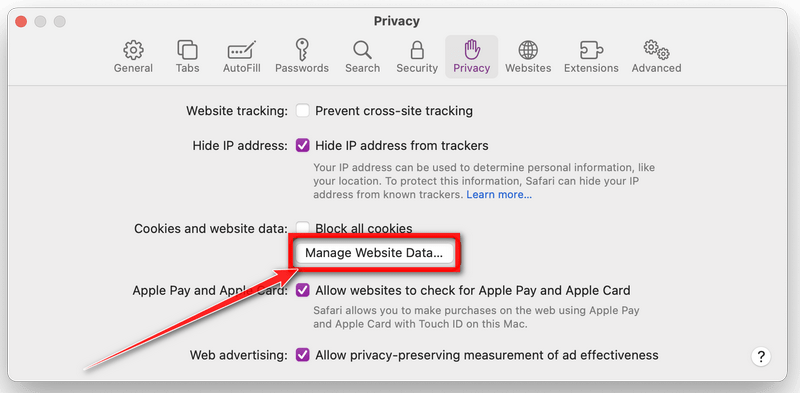
In the Safari menu, choose “Preferences…”, select “Privacy” at the top of the new window that appears, and then click the “Manage Website Data” button.
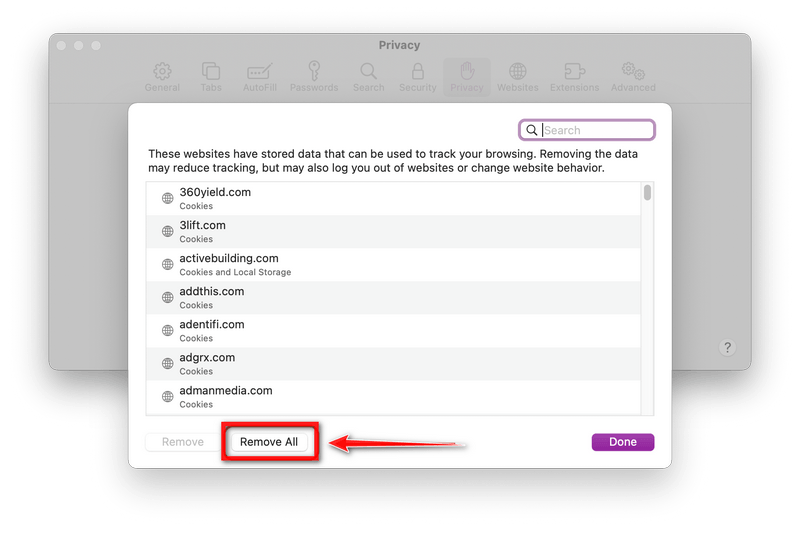
In the next dialog box, click “Remove All“. It will ask you if you are sure you want to remove all data stored by websites on your computer. Select “Remove Now” to clear data that could be used to track your browsing.
-
Empty Safari Caches.
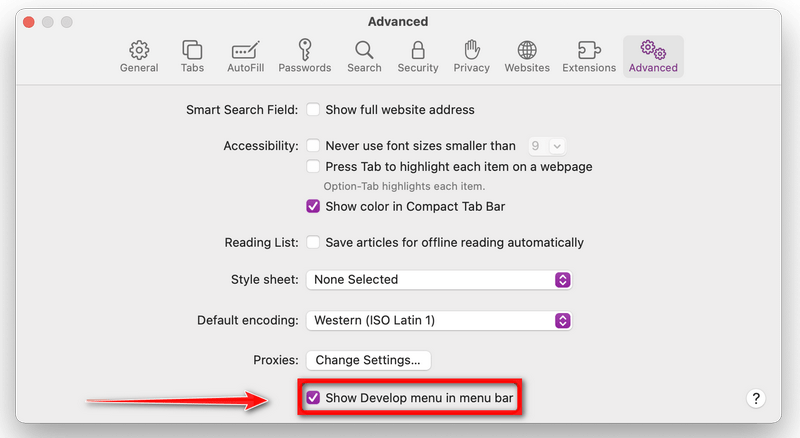
From your Safari menu bar, click Safari and select Preferences, then select the Advanced tab. Enable the checkbox to “Show Develop menu in menu bar“.
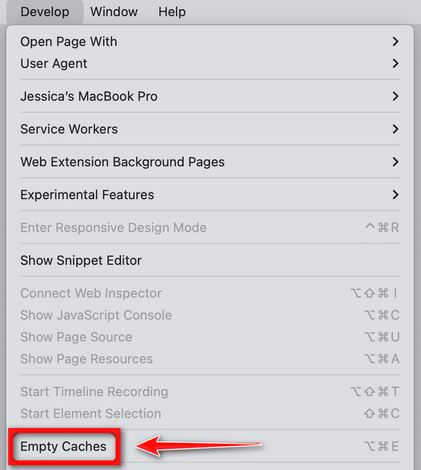
From the menu bar select Develop, then click on Empty Caches as seen in the image below.
Remove malware from Chrome for Mac
To remove malware from Chrome for Mac we will reset the browser settings to their default. Doing these steps will erase all configuration information from Chrome such as your home page, tab settings, saved form information, browsing history, and cookies. This process will also disable any installed extensions. All of your bookmarks, though, will be preserved.
-
Click on the three dots at the top right and go to Settings.
Click on Chrome’s main menu button, represented by three dots at the top right corner. Now click on the menu option labeled Settings as shown by the arrow in the picture below, which will open the basic settings screen.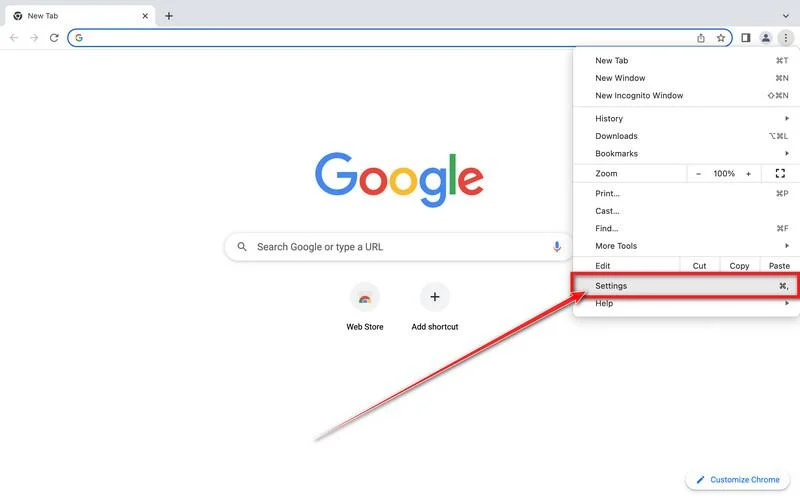
-
In the left sidebar, click on the “Reset and Cleanup” option.
In the left sidebar, click on “Reset and clean up“.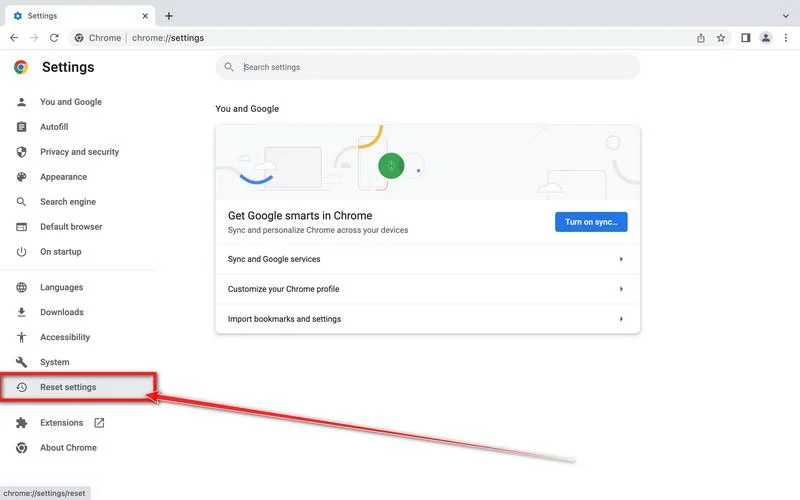
-
Click “Reset settings to their original defaults”.
Now click on the “Reset settings to their original defaults”. link as shown in the image below.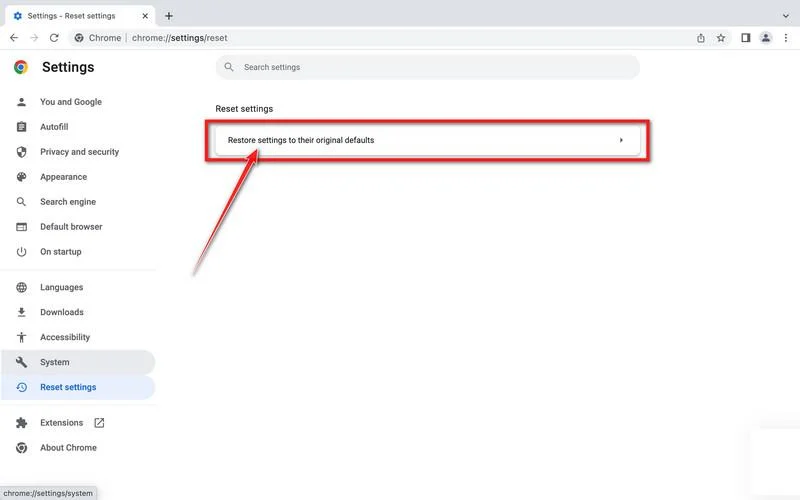
-
Click “Reset Settings” button.
A confirmation dialog should now be displayed, detailing the components that will be restored to their default state should you continue with the reset process. To complete the restoration process, click on the “Reset Settings” button.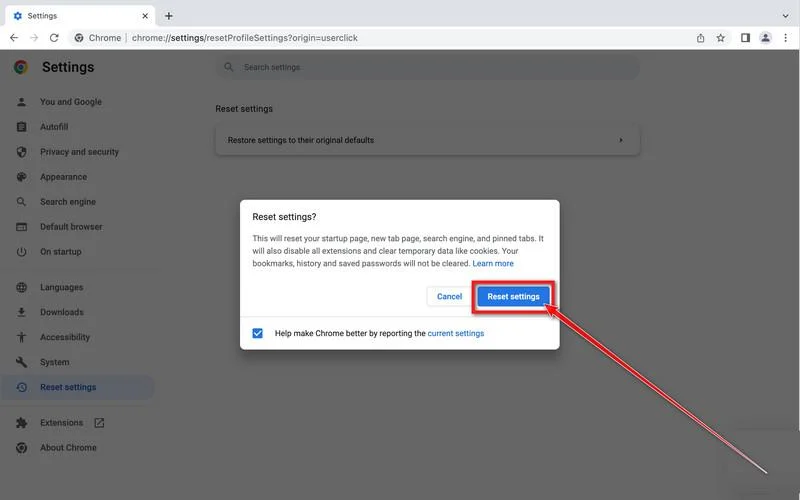
-
(Optional) Reset Chrome Data Sync.
In case a malicious extension reinstalls itself even after performing a browser reset, you have an additional option to reset the data sync for your browser. To do this, navigate to chrome.google.com/sync and click on the Clear Data button.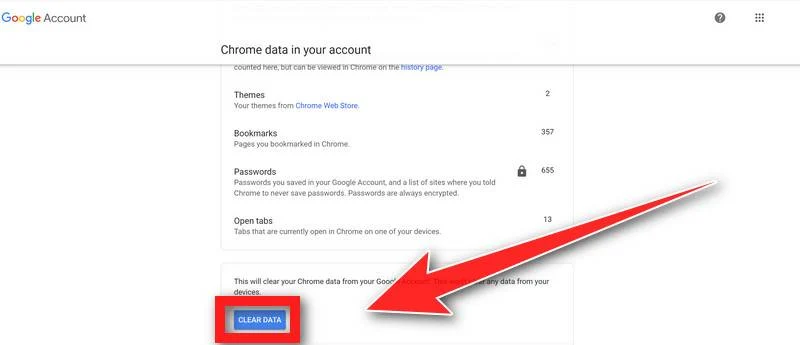
Remove malware from Firefox for Mac
To remove malware from Firefox for Mac we will reset the browser settings to its default. The reset feature fixes many issues by restoring Firefox to its factory default state while saving your essential information like bookmarks, passwords, web form auto-fill information, browsing history, and open tabs.
-
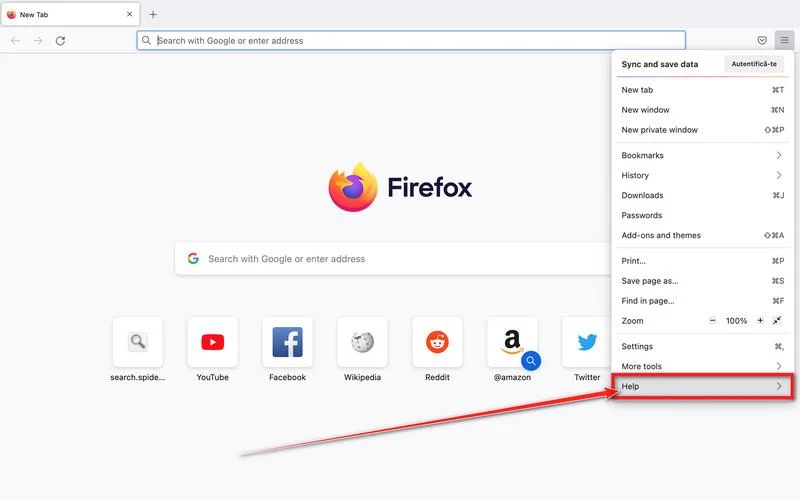
Go to the “Help” menu.
Click on Firefox’s main menu button, represented by three horizontal lines. When the drop-down menu appears, select the option labeled “Help“.
-
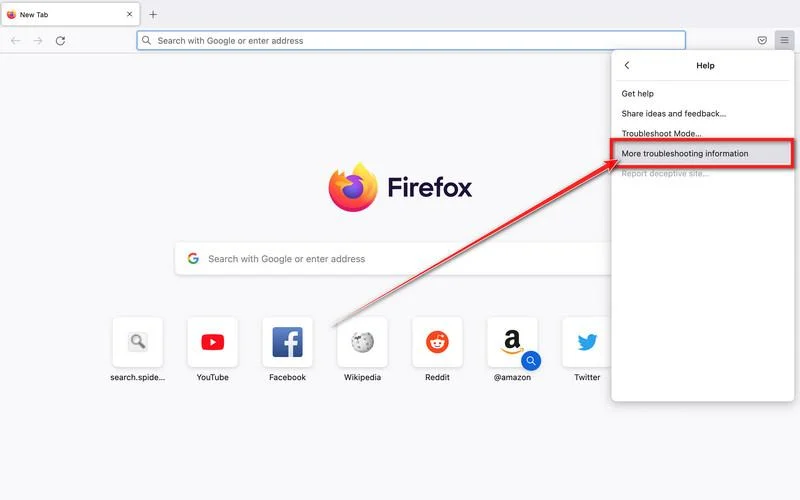
Click “Troubleshooting Information”.
Next click on the “Troubleshooting Information” option as indicated by the arrow in the image below. This will bring you to a Troubleshooting page.
-
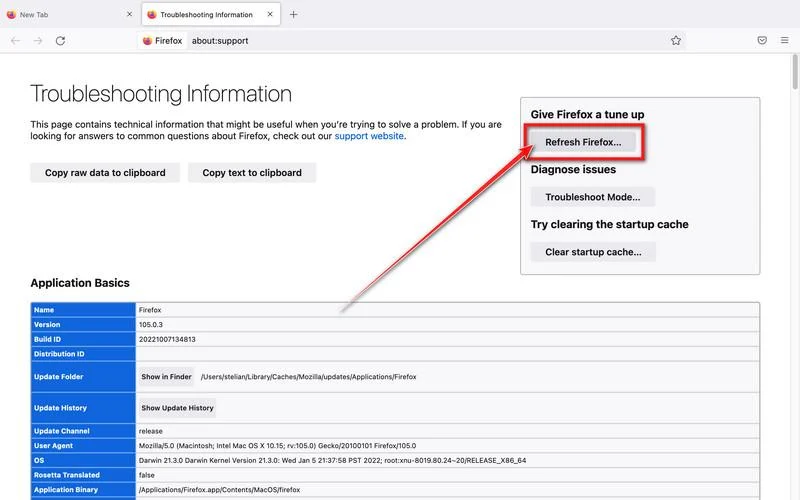
Click on “Refresh Firefox”
Click the “Refresh Firefox” button in the upper-right corner of the “Troubleshooting Information” page.
-
Confirm.
To continue, click on the “Refresh Firefox” button in the new confirmation window that opens.
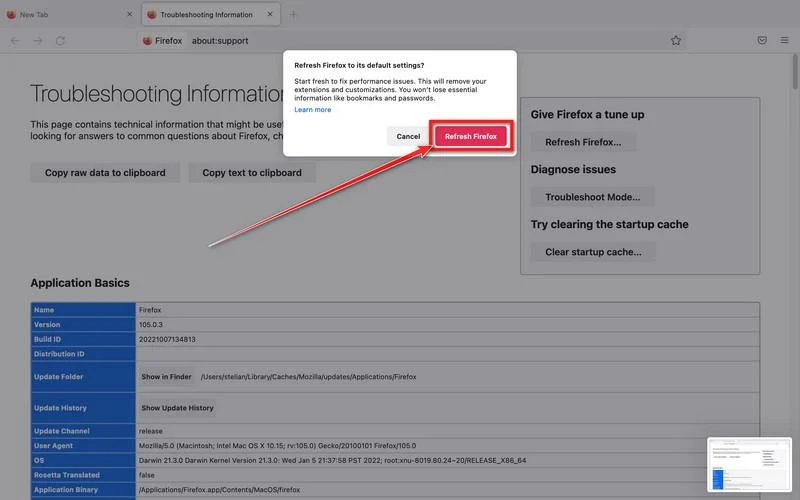
-
Click on “Finish”.
Firefox will close itself and will revert to its default settings. When it’s done, a window will list the information that was imported. Click on the “Finish“.
STEP 4: Run a scan with Malwarebytes for Mac to remove malware
In this final step, we will scan the computer with Malwarebytes for Mac to find and remove any malicious programs that might be installed on your Mac.
Malwarebytes for Mac is a free on-demand scanner that removes the malware other security software tends to miss — adware, browser hijackers, and unwanted programs included. Cleaning an infected Mac with Malwarebytes has always been completely free, and it’s our go-to recommendation. Follow the steps below to scan and clean your Mac in just a few minutes.
-
Download Malwarebytes for Mac
Click the button below to download the latest version of Malwarebytes for Mac.
Download MalwarebytesOfficial installer for macOS. Your download starts right away.Want real-time protection? See Malwarebytes PremiumMalwarebytes Free for MacScans and removes malware at no cost -
Open the Malwarebytes setup file
When the download finishes, open your Downloads folder and double-click the setup file to begin the installation.
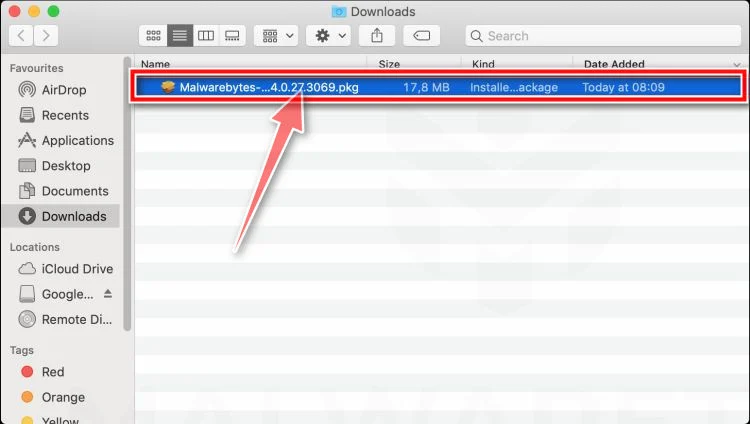
-
Follow the On-Screen Prompts to Install Malwarebytes
The Malwarebytes for Mac Installer will guide you through a few quick screens. Click “Continue” and keep following the prompts until the installation completes.
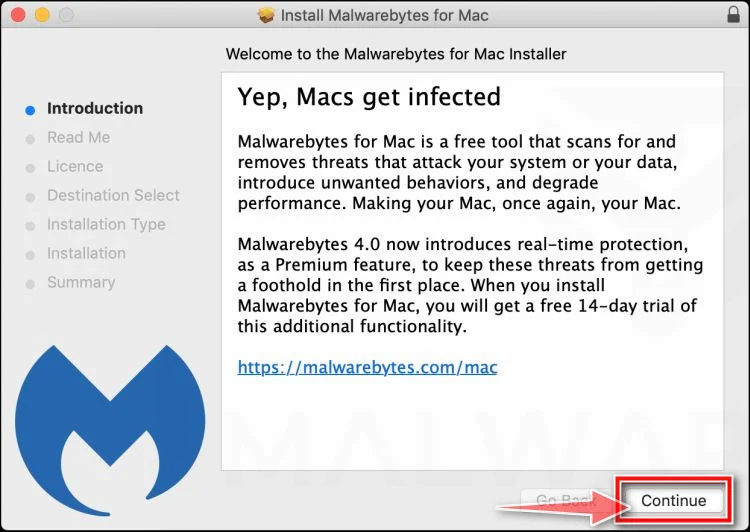
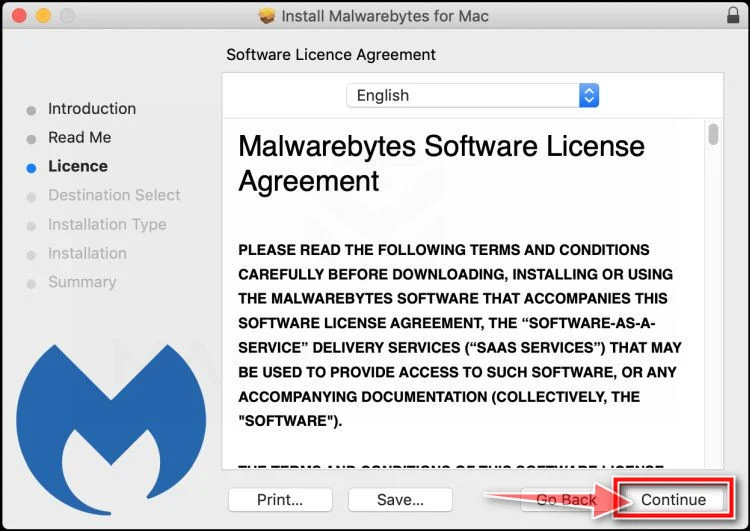
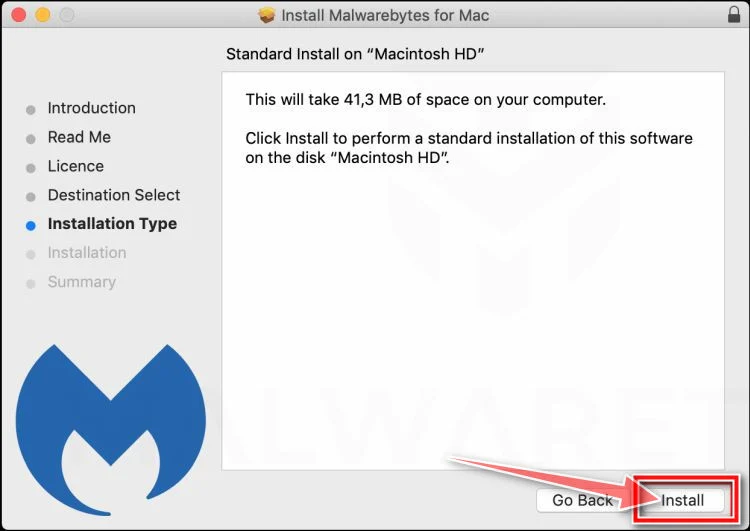
When the installation is complete, Malwarebytes opens to the Welcome to Malwarebytes screen. Click “Get started“.
-
Select “Personal Computer” or “Work Computer”
Malwarebytes will ask what type of computer you’re installing it on. Click either Personal Computer or Work Computer, whichever applies.
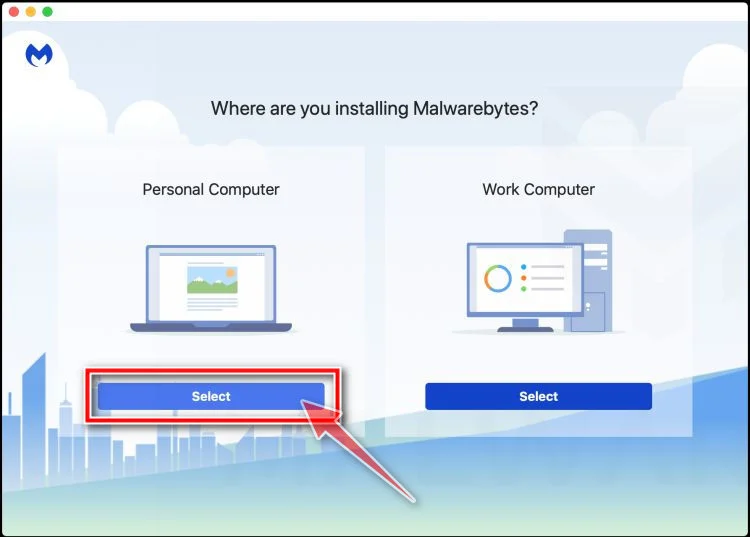
-
Start the Scan
Click the “Scan” button. Malwarebytes will automatically update its detection database and begin checking your Mac for malware.
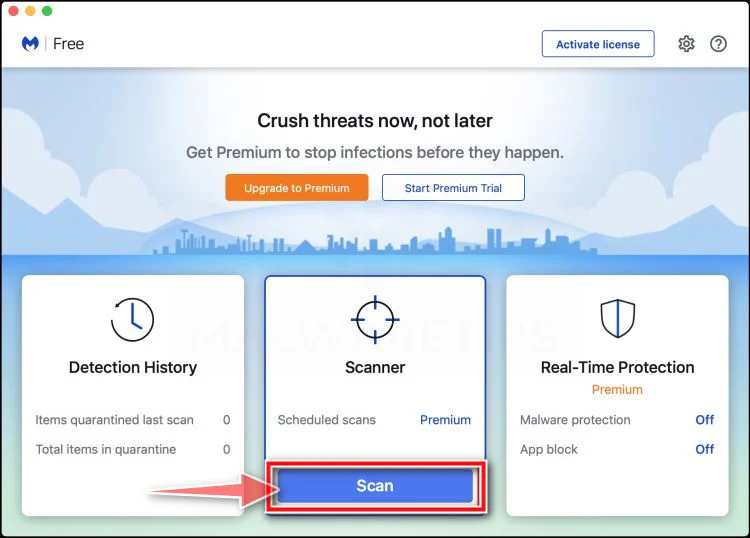
-
Wait for the Scan to Finish
Malwarebytes will scan your Mac for adware, browser hijackers, and other malicious programs. This can take a few minutes, so feel free to do something else — just check back occasionally to see the progress.
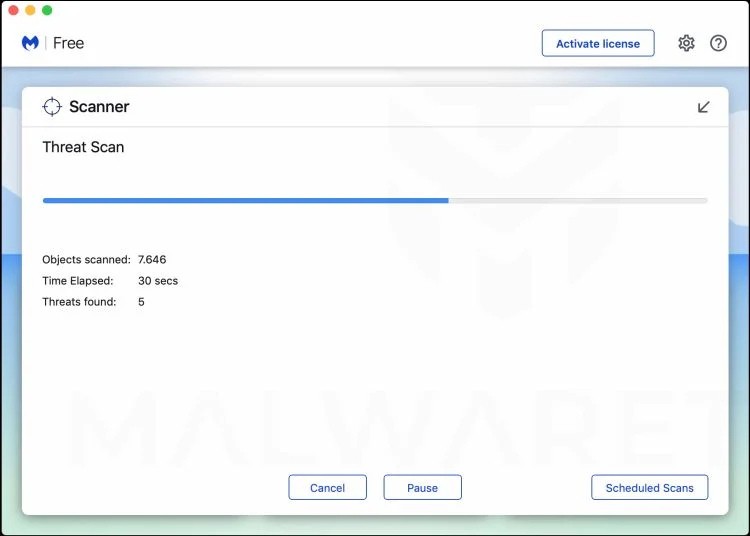
-
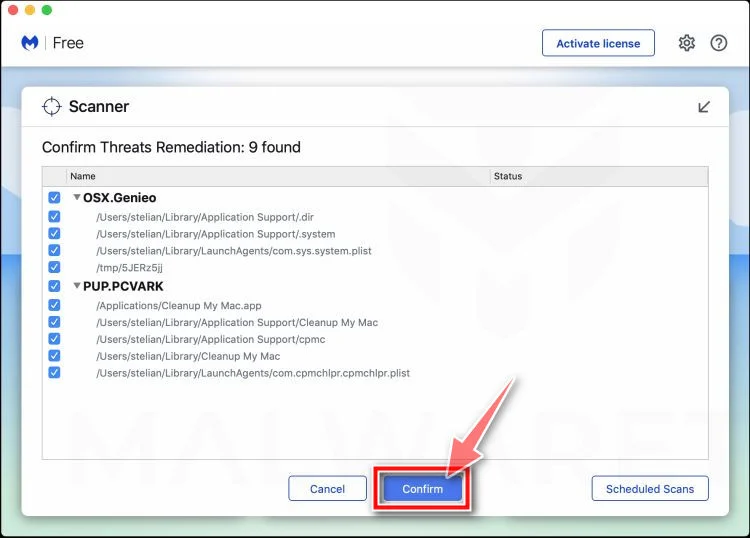
Quarantine the Detected Threats
When the scan is done, you’ll see a list of everything Malwarebytes found. Click the “Quarantine” button to remove all the threats at once.
-
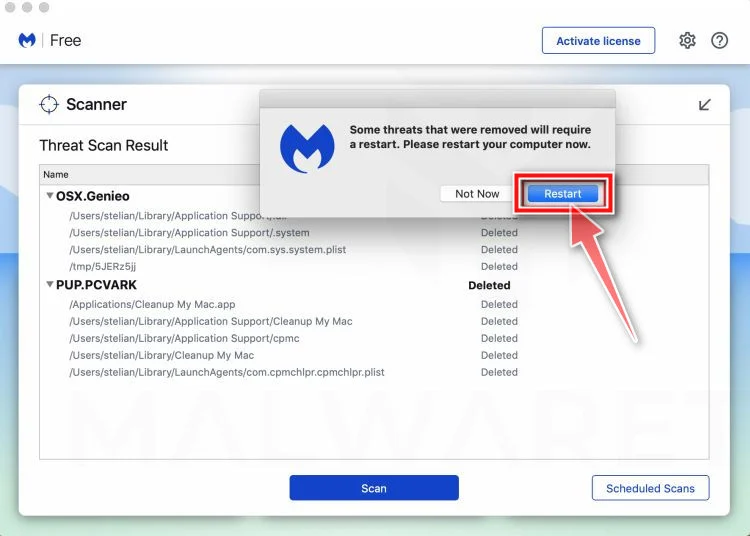
Restart Your Mac
Malwarebytes will now remove all the malicious files it found. Some threats can only be fully removed after a reboot — if Malwarebytes asks you to restart, allow it. Once you’re logged back in, your Mac is clean.
That’s it — your Mac is now clean. The unwanted apps, adware, and any other malware have been removed.
If you are still experiencing problems while trying to remove a malicious program from your computer, please ask for help in our Mac Malware Removal Help & Support forum.
Remove Unwanted Apps and Malware from Android
- STEP 1: Uninstall malicious apps
- STEP 2: Reset browsers back to default settings
- STEP 3: Use Malwarebytes for Android to remove malicious apps
STEP 1: Uninstall malicious apps
In this first step, we will check if any malicious apps are installed on your phone. Sometimes browser hijackers or adware apps can have usable Uninstall entries that can be used to remove these apps.
-
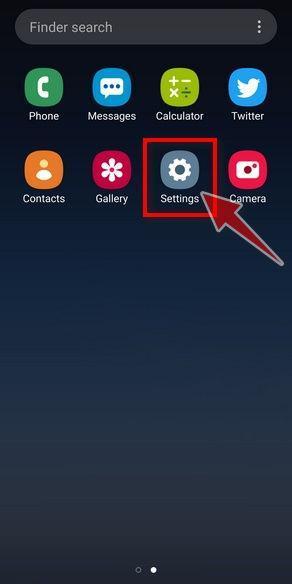
Open the “Settings” menu.
Tap on the “Settings” app from your phone menu or home screen.
-
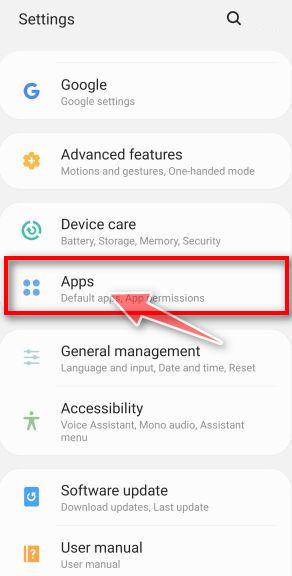
Tap on “Apps”.
When the “Settings” menu opens, tap on “Apps” (or “App Manager”) to see all the installed applications on your phone.
-
Find the malicious app.
The “Apps” screen will be displayed with a list of all the applications that are installed on your phone. Scroll through the list and look out for any suspicious app that could be behind all the drama – anything you don’t remember downloading or that doesn’t sound like a genuine program.
Most often, cyber criminals hide malware inside video or photo editing apps, weather apps, and camera apps.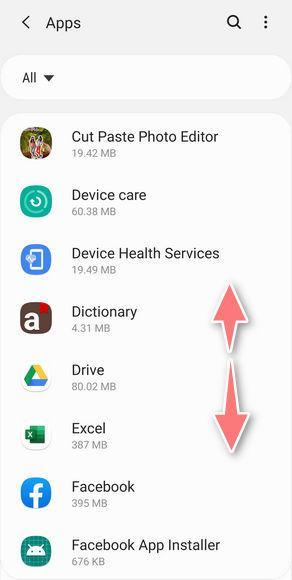
-
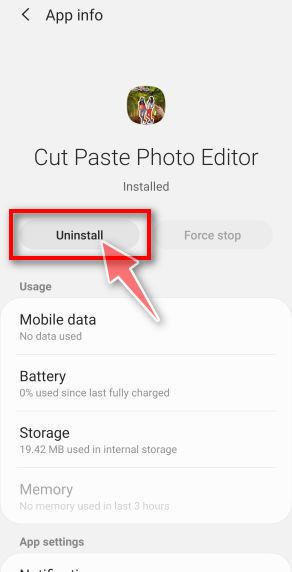
Uninstall the malicious app
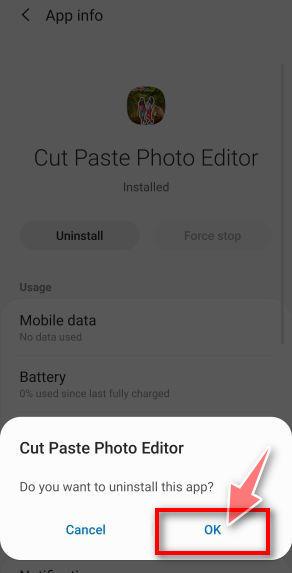
When you find a suspicious or malicious app, tap on it to uninstall it. This won’t start the app but will open up the app details screen. If the app is currently running press the “Force stop” button, then tap on “Uninstall”.
A confirmation dialog should be displayed to confirm you want to uninstall the app, tap on “OK” to remove the malicious app from your phone.
STEP 2: Reset browsers back to default settings
In this second step, we will reset your browser to its default settings to remove spam notifications, unwated search redirects, and restore its factory settings
Resetting the browser settings to their default it’s an easy task on Windows or Mac computers; however, when it comes to Android, this can’t be done directly because it’s not an option built-in into the browser settings. Restoring the browser settings on Android can be done by clearing the application data. This will remove all the cookies, cache, and other site settings that may have been saved. So let’s see how we can restore your browser to its factory settings.
Remove malware from Chrome for Android
To reset Chrome for Android to its default settings, follow the below steps:
-
Open the “Settings” menu.
Tap on the “Settings” app from your phone menu or home screen.
-
Tap on “Apps”.
When the “Settings” menu opens, tap on “Apps” (or “App Manager”) to see all the installed applications on your phone.
-
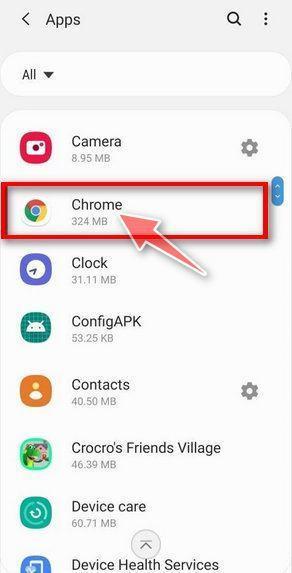
Find and tap on Chrome.
The “Apps” screen will be displayed with a list of all the apps installed on your phone. Scroll through the list until you find the Chrome app, then tap on it to open the app’s details.
-
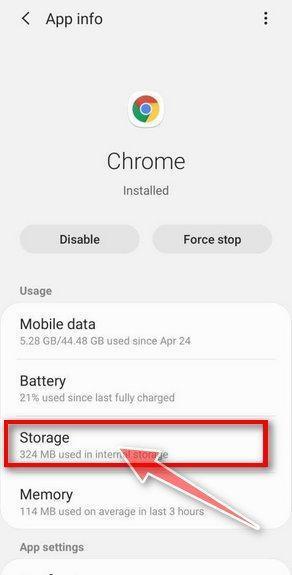
Tap “Storage”.
When Chrome’s app info menu is displayed, tap on “Storage“.
-
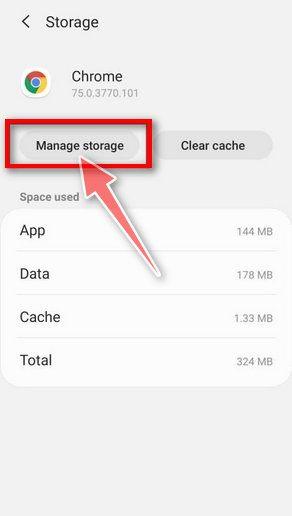
Tap “Manage Space”.
Under the storage settings, you will get two options — Manage Space and Clear Cache. Tap on “Manage Space“.
-
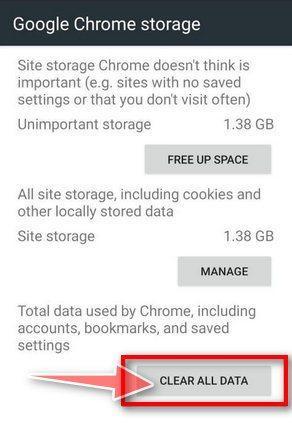
Tap “Clear all data”.
Tap “Clear all data” to delete all Chrome’s data including accounts, bookmarks, and your settings to reset the default settings.
-
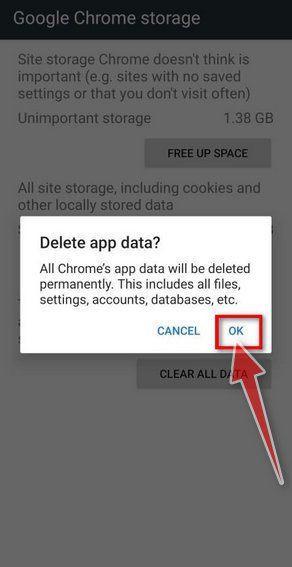
Confirm by tapping “Ok”.
A confirmation dialog should now be displayed, detailing the components that will be restored to their default state should you continue with the reset process. To complete the restoration process, tap “Ok“.
Remove malware from Firefox for Android
To reset Firefox for Android to its default settings, follow the below steps:
-
Open the “Settings” menu.
Tap on the “Settings” app from your phone menu or home screen.
-
Tap on “Apps”.
When the “Settings” menu opens, tap on “Apps” (or “App Manager”) to see all the installed applications on your phone.
-
Find and tap on Firefox.
The “Apps” screen will be displayed with a list of all the apps installed on your phone. Scroll through the list until you find the Firefox app, then tap on it to open the app’s details.
-
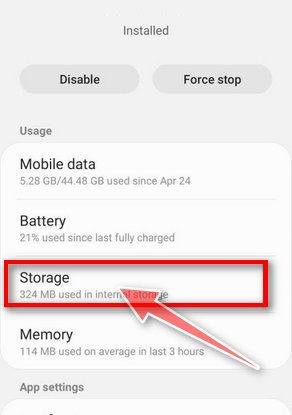
Tap “Storage”.
When Firefox’s app info menu is displayed, tap on “Storage“.
-
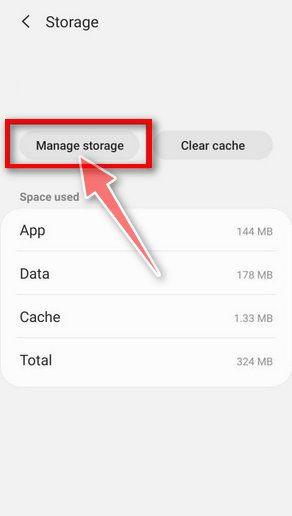
Tap “Manage Space”.
Under the storage settings, you will get two options — Manage Space and Clear Cache. Tap on “Manage Space“.
-
Tap “Clear all data”.
Tap “Clear all data” to delete all Firefox data including accounts, bookmarks, and your settings to reset the default settings.

-
Confirm by tapping “Ok”.
A confirmation dialog should now be displayed, detailing the components that will be restored to their default state should you continue with the reset process. To complete the restoration process, tap “Ok“.
Remove malware from the Opera browser
To reset the Opera browser to its default settings, follow the below steps:
-
Open the “Settings” menu.
Tap on the “Settings” app from your phone menu or home screen.
-
Tap on “Apps”.
When the “Settings” menu opens, tap on “Apps” (or “App Manager”) to see all the installed applications on your phone.
-
Find and tap on Opera.
The “Apps” screen will be displayed with a list of all the apps installed on your phone. Scroll through the list until you find the Opera app, then tap on it to open the app’s details.
-
Tap “Storage”.
When Opera’s app info menu is displayed, tap on “Storage“.
-
Tap “Manage Space”.
Under the storage settings, you will get two options — Manage Space and Clear Cache. Tap on “Manage Space“.
-
Tap “Clear all data”.
Tap “Clear all data” to delete all Opera’s data including accounts, bookmarks, and your settings to reset the default settings.
-
Confirm by tapping “Ok”.
A confirmation dialog should now be displayed, detailing the components that will be restored to their default state should you continue with the reset process. To complete the restoration process, tap “Ok“.
Remove malware from Samsung Internet Browser
To reset the Samsung Internet Browser to its default settings, follow the below steps:
-
Open the “Settings” menu.
Tap on the “Settings” app from your phone menu or home screen.
-
Tap on “Apps”.
When the “Settings” menu opens, tap on “Apps” (or “App Manager”) to see all the installed applications on your phone.
-
Find and tap on Samsung Internet Browser.
The “Apps” screen will be displayed with a list of all the apps installed on your phone. Scroll through the list until you find the Samsung Internet Browser app, then tap on it to open the app’s details.
-
Tap “Storage”.
When the Samsung Internet Browser’s app info menu is displayed, tap on “Storage“.
-
Tap “Manage Space”.
Under the storage settings, you will get two options — Manage Space and Clear Cache. Tap on “Manage Space“.
-
Tap “Clear all data”.
Tap “Clear all data” to delete all Samsung Internet Browser’s data including accounts, bookmarks, and your settings to reset the default settings.
-
Confirm by tapping “Ok”.
A confirmation dialog should now be displayed, detailing the components that will be restored to their default state should you continue with the reset process. To complete the restoration process, tap “Ok“.
Remove malware from Microsoft Edge for Android
To reset the Microsoft Edge for Android to its default settings, follow the below steps:
-
Open the “Settings” menu.
Tap on the “Settings” app from your phone menu or home screen.
-
Tap on “Apps”.
When the “Settings” menu opens, tap on “Apps” (or “App Manager”) to see all the installed applications on your phone.
-
Find and tap on Microsoft Edge.
The “Apps” screen will be displayed with a list of all the apps installed on your phone. Scroll through the list until you find the Microsoft Edge app, then tap on it to open the app’s details.
-
Tap “Storage”.
When the Microsoft Edge’s app info menu is displayed, tap on “Storage“.
-
Tap “Manage Space”.
Under the storage settings, you will get two options — Manage Space and Clear Cache. Tap on “Manage Space“.
-
Tap “Clear all data”.
Tap “Clear all data” to delete all Microsoft Edge’s data including accounts, bookmarks, and your settings to reset the default settings.
-
Confirm by tapping “Ok”.
A confirmation dialog should now be displayed, detailing the components that will be restored to their default state should you continue with the reset process. To complete the restoration process, tap “Ok“.
STEP 3: Use Malwarebytes for Android to remove malicious apps
In this final step, we will install Malwarebytes for Android to scan and remove malicious apps from your phone or tablet.
Malwarebytes for Android automatically detects and removes dangerous threats like malware and ransomware so you don’t have to worry about your most-used device being compromised. Aggressive detection of adware and potentially unwanted programs keeps your Android phone or tablet running smooth.
-
Download Malwarebytes for Android.
You can download Malwarebytes for Android by clicking the link below.
Get Malwarebytes for AndroidOpens Google Play in a new tab.Want real-time protection? See Malwarebytes Premium for AndroidMalwarebytes for AndroidScans your phone and removes malware at no cost -
Install Malwarebytes for Android on your phone.
In the Google Play Store, tap “Install” to install Malwarebytes for Android on your device.

When the installation process has finished, tap “Open” to begin using Malwarebytes for Android. You can also open Malwarebytes by tapping on its icon in your phone menu or home screen.

-
Follow the on-screen prompts to complete the setup process
When Malwarebytes will open, you will see the Malwarebytes Setup Wizard which will guide you through a series of permissions and other setup options.
This is the first of two screens that explain the difference between the Premium and Free versions. Swipe this screen to continue.
Tap on “Got it” to proceed to the next step.
Malwarebytes for Android will now ask for a set of permissions that are required to scan your device and protect it from malware. Tap on “Give permission” to continue.
Tap on “Allow” to permit Malwarebytes to access the files on your phone.
-
Update database and run a scan with Malwarebytes for Android
You will now be prompted to update the Malwarebytes database and run a full system scan.

Click on “Update database” to update the Malwarebytes for Android definitions to the latest version, then click on “Run full scan” to perform a system scan.

-
Wait for the Malwarebytes scan to complete.
Malwarebytes will now start scanning your phone for adware and other malicious apps. This process can take a few minutes, so we suggest you do something else and periodically check on the status of the scan to see when it is finished.

-
Click on “Remove Selected”.
When the scan has been completed, you will be presented with a screen showing the malware infections that Malwarebytes for Android has detected. To remove the malicious apps that Malwarebytes has found, tap on the “Remove Selected” button.

-
Restart your phone.
Malwarebytes for Android will now remove all the malicious apps that it has found. To complete the malware removal process, Malwarebytes may ask you to restart your device.
That’s it — your Android device is now clean. The malicious apps, adware, and browser redirects have been removed.
If you are still having problems with your phone after completing these instructions, then please follow one of the steps:
- Restore your phone to factory settings by going to Settings > General management > Reset > Factory data reset.
- Ask for help in our Mobile Malware Removal Help & Support forum.
Remove Unwanted Apps and Malware from iPhone and iPad
STEP 1: Clean your browser
First, we’ll clean Safari using the built-in “Clear History and Website Data” feature. This removes your browsing history, cookies, and cached data — including the stored data that scam sites use to keep showing you pop-ups and redirects. Don’t worry: this won’t delete your photos, apps, or saved passwords.
- Don’t tap anything inside the scam page or pop-up — the buttons are designed to trick you. Instead, tap the tabs icon in the lower-right corner of Safari, as shown below.
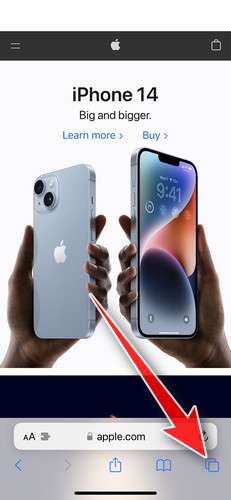
- Tap the X on the malicious tab (or swipe it up) to close it safely.
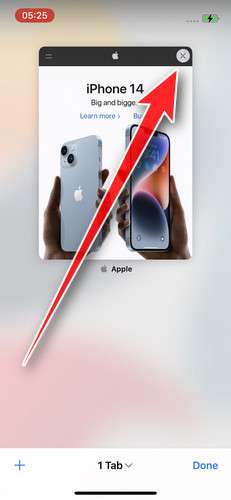
- Open the Settings app.
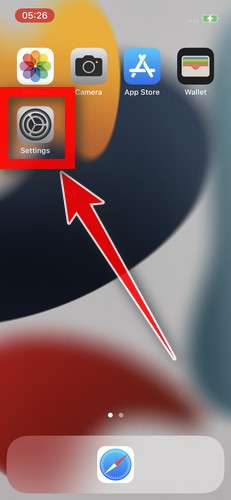
- Turn on Airplane Mode. This temporarily disconnects your iPhone from the internet, so the scam site can’t load anything while we clean up. We’ll turn it back off at the end.
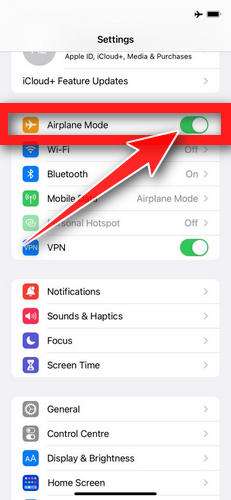
- Scroll down and tap Safari.
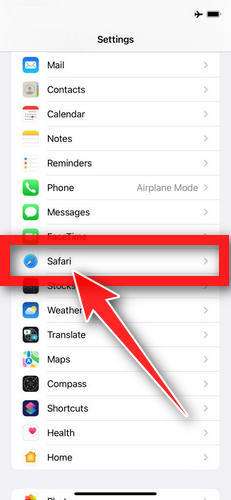
- Tap Clear History and Website Data.
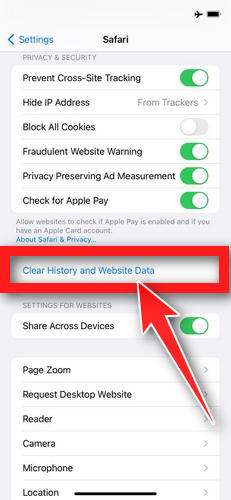
- Confirm by tapping “Clear History and Data” in the pop-up.
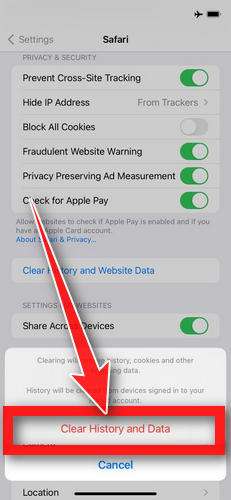
- While you’re still in Safari settings, turn on Block Pop-ups and Fraudulent Website Warning. These two switches stop most scam pages before they can even load.
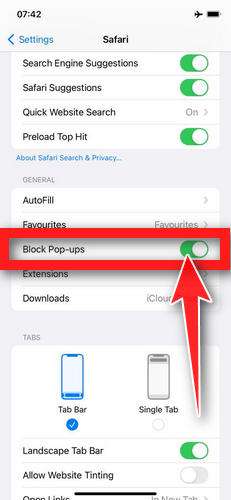
- Tap Settings in the upper-left corner to return to the main Settings menu.
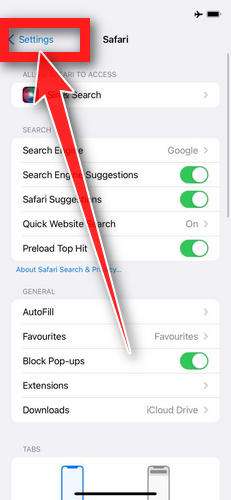
- Turn Airplane Mode back off to reconnect your iPhone to the internet.
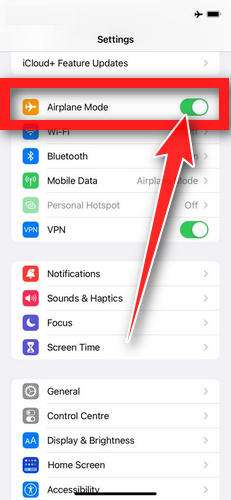
STEP 2: Delete unwanted apps
Next, we’ll remove any suspicious apps from your iPhone. If a shady website redirected you to the App Store and you installed an app — or you spot an app you don’t remember downloading — delete it now:
-
On the home screen, tap and hold the unwanted app’s icon until the icons start to wiggle.
-
Tap the minus (–) badge in the corner of the app icon, then tap Delete App. (On older iOS versions, this badge appears as an “X”.)
-
Confirm by tapping “Delete“.
That’s it — your iPhone is now clean and safe to use.
To stop these scam pages from coming back, we recommend installing an ad blocker like AdGuard. It blocks the malicious ads and redirects that cause these pop-ups in the first place.
Still having issues after completing these steps? Try one of the following:
- Run a scan with Malwarebytes for iOS
- Ask for help in our free Mobile Malware Removal Help & Support forum — our team will assist you personally.
That’s it — your iPhone or iPad is now clean.
The Bottom Line
The PayPal Customer Service scam is not about PayPal itself. It is about getting you to panic and contact a fake support line.
Sometimes it arrives as a text. Sometimes it is an email. Sometimes it is a PayPal invoice designed to scare you with a large dollar amount and a phone number in the notes. PayPal warns that invoice and money request scams may try to push you into calling a number so you will share sensitive information.
If you remember only one rule, make it this: never call a phone number provided in an unexpected message about fraud. Open the PayPal app, log in directly, and use official support channels.
That single habit breaks the scam’s most important mechanism and keeps your account, your money, and your peace of mind intact.
FAQ
Is a “PayPal Customer Service” text or email about a suspicious charge always a scam?
Not always, but many are. The clearest warning sign is when the message tells you to call a phone number provided in the text or email. Treat that as suspicious and verify by logging into PayPal directly through the official app or website.
If I receive a PayPal invoice I do not recognize, does that mean I was charged?
No. A PayPal invoice or money request is not an automatic charge. Scammers send invoices to scare you into calling the number written in the note. Do not call it. Log into PayPal directly and review your Activity to confirm whether any payment actually occurred.
Why do these scams include a specific amount like $399.99 or $489.50?
A precise dollar amount makes the alert feel real and triggers urgency. It is a psychological tactic, not proof of legitimacy.
What happens if I call the phone number in the message?
You reach scammers impersonating PayPal. They may claim they are the fraud department, create a fake case number, and pressure you to “verify” your identity. Their goal is to get your PayPal login, a one-time code, your card or bank details, or to convince you to send money.
Will PayPal ever ask for my password or one-time security code?
No. You should never share your PayPal password or a one-time security code with anyone. If a caller asks for either, it is a scam.
How can I safely check if a PayPal charge is real?
Use trusted sources:
- Open the PayPal app or type PayPal’s website address yourself and check Activity
- Check your linked bank or card app for pending or posted charges
- Review emails only after you confirm the same activity inside your PayPal account
If you need help, contact PayPal using official in-app support, not a number from the message.
I clicked a link in a PayPal “security alert” email. What should I do?
Assume your login could be at risk. Immediately change your PayPal password from the official app or website, enable 2-step verification, and review recent logins and transactions. If you reused that password anywhere else, change those accounts too.
I entered my PayPal login on a page that might be fake. What now?
Change your PayPal password right away and enable 2-step verification. Then review:
- Recent login activity
- Linked cards and bank accounts
- Any new shipping addresses, emails, or phone numbers
Report unauthorized activity inside PayPal using official reporting options.
I gave the scammer a one-time code. Can they access my account?
Yes, potentially. One-time codes are often used to complete a login or account change. Change your password immediately, sign out of other sessions if available, and review all security settings and linked payment methods.
The scammer asked me to install software or enable screen sharing. Is that normal?
No. That is a major red flag. If you installed anything, uninstall it immediately, run a security scan if it was a computer, and consider resetting the device if you are unsure what was installed. Then change your passwords from a different trusted device.
The caller told me I need to “move money” to a safe account to protect it. Is that real?
No. That is a classic fraud technique. Any instruction to transfer money, buy gift cards, or send crypto to “secure” your account is a scam.
If I did not lose money, should I still report it?
Yes. Report the message as spam or phishing in your email or messaging app. If you interacted and shared information, also monitor your PayPal and bank accounts closely for the next 30 days.
How do I stop these PayPal scam messages?
You cannot stop them completely, but you can reduce exposure:
- Block the sending number and mark messages as spam
- Filter unknown senders in Messages
- Silence unknown callers
- Avoid searching for support numbers in ads or random search results
Most importantly, never use contact details provided in unexpected alerts.
What is the single best rule to avoid PayPal customer service scams?
Never call a phone number or click a link from an unexpected message about fraud. Open the PayPal app directly and verify the claim there.

Join the discussion
0 commentsShare your experience or ask a question about this article.
Discussion
Start the conversation
Have a question or something useful to share? Add the first comment.