

Imagine receiving an alarming email that says your PayPal account has been charged hundreds of dollars for a suspicious transaction. A phone number is provided, urging you to act fast. You panic, pick up the phone, and unknowingly step into a trap laid by professional scammers.
This is the reality for thousands of people who fall victim to PayPal scam emails and fake customer support numbers. These scams are sophisticated, convincing, and devastating. In this article, we will break down exactly how these scams operate, how to recognize them, and what steps to take if you’ve been targeted.
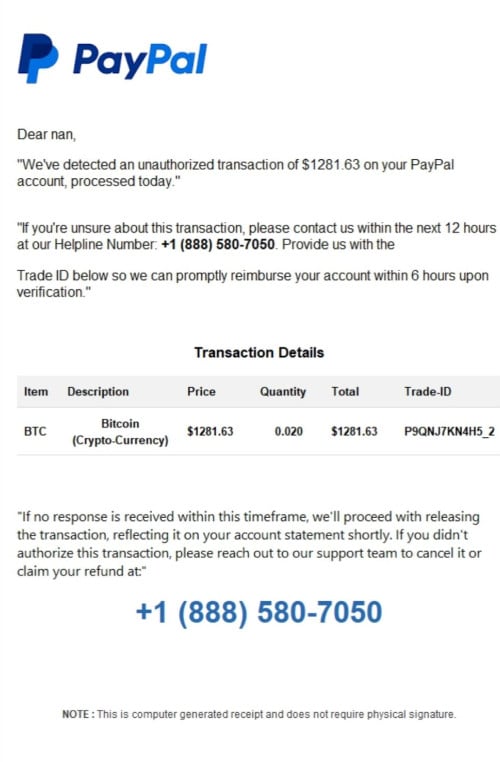
Scam Overview
Scammers are increasingly targeting PayPal users with cleverly disguised emails that mimic official PayPal communications. These scam emails are designed to create a sense of urgency by claiming unauthorized transactions have been made on your account. They often involve large sums of money and mention items like Bitcoin purchases or high-value electronics. The intent is to prompt the recipient to call a fake customer service number listed in the email.
What Makes These Emails So Convincing?
- Professional Appearance: The scam emails closely replicate legitimate PayPal formatting, including logos, headers, and disclaimers. They look official at a glance.
- Urgent Language: These emails use alarming phrases such as “unauthorized transaction,” “limited time to act,” and “finalized charges” to induce panic.
- Detailed Transaction Info: Fake invoices include specific product names, amounts, order numbers, and trade IDs, making the message appear legitimate.
- Customer Service Numbers: Each scam email lists a different toll-free support number, which connects the victim to fake support agents who sound knowledgeable and empathetic.
- Spoofed Email Addresses: Scammers use email addresses that mimic PayPal domains to bypass spam filters and gain user trust.
Common Themes in These Scams
- Unauthorized Bitcoin Purchases: Emails claim that hundreds of dollars were used to buy Bitcoin without your consent.
- Weapon or High-Risk Item Invoices: Some emails falsely indicate purchases of firearms or suspicious items to spark immediate concern.
- Refund Offers: Victims are promised a refund if they call within a certain timeframe, creating a false sense of urgency.
- Remote Access Requests: Once the call is made, scammers ask to access your computer to “verify” the transaction or “secure” your device.
Real-Life Examples
Three email samples illustrate the scam:
- Email 1: Claims a $279.29 unauthorized transaction for Bitcoin with a refund available within 12 hours upon calling.
- Email 2: States a $1100 charge for a handgun, urging the recipient to call immediately to cancel if it wasn’t authorized.
- Email 3: Lists a $678.99 Bitcoin purchase with a helpline number and a friendly tone thanking the victim for their “devotion.”
All these examples point to the same tactic: panic-inducing communication paired with a call-to-action that leads to further exploitation.
How the Scam Works
Step 1: The Initial Email
Scammers begin by sending a phishing email to a potential victim. The email appears to be from PayPal and includes convincing branding and details. It alerts the user to a suspicious transaction, typically for a large amount.
Step 2: Induced Panic
The email uses psychological manipulation. Terms like “unauthorized,” “finalized,” and “urgent action required” push the victim into a state of panic. The fear of financial loss overrides logical thinking.
Step 3: The Phone Number Trap
The email includes a toll-free number that supposedly connects you to PayPal support. In reality, this is a fake call center operated by scammers.
Step 4: The Fake Support Call
Once you call, you’re greeted by someone posing as a PayPal support agent. They may use your name and refer to the transaction listed in the email to appear legitimate. The scammer then “verifies” your account and pretends to process a refund.
Step 5: Remote Access Request
The scammer claims they need to secure your device or confirm the refund by remotely accessing your computer. They ask you to install remote access tools like AnyDesk or TeamViewer.
Step 6: Data Extraction
With access to your computer, scammers scour your files for personal data, banking credentials, saved passwords, and more. They may even install keyloggers or other malicious software.
Step 7: Direct Theft
Scammers may initiate transfers from your bank accounts or PayPal, make unauthorized purchases, or use the data to open new accounts in your name.
Step 8: Gift Card Scams
In some cases, the fake support agent claims the refund failed and asks you to buy gift cards (like Amazon or Apple) and send them the codes. This is a common method for laundering stolen money.
Step 9: Continued Exploitation
Once hooked, victims may be contacted multiple times for further “verification” or follow-ups. Scammers aim to extract as much value as possible before the victim catches on.
How to Spot Fake PayPal Emails and Phone Numbers
Recognizing a scam before engaging is the most effective way to protect yourself. Fake PayPal emails and fraudulent customer support numbers often follow predictable patterns. Knowing what to look for can help you avoid falling victim.
Signs of a Fake PayPal Email
- Generic Greetings
Real PayPal emails will address you by your full name or business name. Scams often begin with vague greetings like “Dear Customer” or “Dear User.” - Urgent or Alarming Language
Messages that pressure you to act immediately, using phrases like “limited time,” “unauthorized transaction,” or “final notice,” are red flags. - Unusual Transaction Details
Emails often claim you’ve made a high-value purchase (e.g., Bitcoin or firearms) you don’t recognize. Scammers use this tactic to spark panic. - Suspicious Email Addresses
Check the sender’s email carefully. Scammers often use addresses that look similar to PayPal’s but contain subtle errors or extra characters (e.g., paypal@secure-pay.com). - Request for Phone Contact
Legitimate PayPal emails rarely ask you to call a phone number. If a number is included and the email urges you to call immediately, be cautious. - Links That Don’t Go to PayPal
Hover over any links without clicking. If the URL doesn’t point to “paypal.com,” it’s likely a phishing attempt. - Poor Grammar and Formatting
Many scam emails contain grammar mistakes, awkward phrasing, or inconsistent formatting. Official PayPal messages are professionally written and formatted. - Unfamiliar Attachments
Some scam emails include attachments or ask you to download invoices. PayPal does not send unsolicited attachments.
How to Identify Fake PayPal Phone Numbers
- Numbers Not Listed on PayPal’s Website
Always verify any customer service number by visiting the official PayPal site. If the number doesn’t match, don’t call it. - Prominently Displayed in the Email
Scammers often bold or highlight the number and place it in buttons or banners to grab your attention and push you to call. - High-Pressure Tactics When You Call
Fake agents may demand quick action, ask for private information, or insist that your account is compromised and must be “secured” immediately. - Requests for Remote Access
Real PayPal representatives will never ask to connect to your computer. If someone tells you to install software like AnyDesk or TeamViewer, hang up. - Requests for Gift Cards or Wire Transfers
Scammers may claim they need you to verify a refund by purchasing gift cards and reading the codes. This is a common fraud tactic PayPal never uses. - No Case or Email Follow-Up
Legitimate PayPal support follows up via your official PayPal account and email inbox. Scammers rarely provide consistent, trackable communication. - Unprofessional or Fake-Sounding Agents
Be alert to overly casual or scripted responses, strange background noise, or poor audio quality. These are often signs of fake support call centers.
What to Do if You’re Unsure
- Do not click any links or call any numbers in the suspicious email.
- Log in to your PayPal account directly by typing www.paypal.com into your browser.
- Check your account activity for any real transactions.
- Forward the suspicious email to spoof@paypal.com for verification.
Spotting a scam email or phone number early can prevent serious financial and data loss. Always pause, verify, and act with caution.
What to Do if You Have Fallen Victim to This Scam
If you have already called the number or allowed remote access to your device, take these steps immediately:
1. Disconnect Internet and Power Off Device
Shut down your device to prevent further data access or file extraction by scammers.
2. Change Your Passwords
On a secure, clean device, change the passwords for all important accounts: email, PayPal, bank, social media, etc.
3. Contact Your Bank and PayPal
Notify your financial institutions of the fraud:
- PayPal Support: Visit paypal.com/contact
- Bank/Credit Card Provider: Inform them of potential unauthorized activity and ask to freeze your account if needed.
4. Remove Remote Access Software
Uninstall any remote access programs like AnyDesk, TeamViewer, or LogMeIn that scammers asked you to install.
5. Run a Security Scan
Use reputable antivirus and anti-malware tools to scan for malicious software. Reformat your device if you’re unsure it’s clean.
6. Report the Scam
Submit reports to the following agencies:
- FTC: reportfraud.ftc.gov
- IC3 (FBI Internet Crime Complaint Center): ic3.gov
- PayPal Phishing Email: Forward the scam email to spoof@paypal.com
7. Monitor Your Accounts Closely
Keep a close eye on your credit report, bank accounts, and PayPal for unusual activity.
8. Consider Identity Theft Protection
Sign up for a reputable identity theft monitoring service to track any fraudulent activity using your information.
Is Your Device Infected? Run a Free Malware Scan
Slow performance, constant pop-ups, or strange behavior? These are classic signs of a malware infection. The fastest way to find out is to scan your device with Malwarebytes Free — one of the most trusted malware removal tools available.
The free version detects and removes the most common threats, including:
- Adware — the cause of those annoying pop-ups
- Browser hijackers — unwanted redirects and changed homepages
- Trojans and spyware — hidden programs stealing your data
- Potentially unwanted programs (PUPs) — software you never asked for
👉 Select your device below — Windows, Mac, or Android — then follow the simple steps to download Malwarebytes, scan your system, and remove any threats it finds. The scan usually takes 5 to 20 minutes.
Run a Malware Scan with Malwarebytes for Windows
Malwarebytes is one of the most popular and trusted anti-malware tools for Windows — and it’s completely free for removing infections. It catches threats that many antivirus programs miss, including adware, browser hijackers, and trojans. Follow the steps below to scan and clean your PC in just a few minutes.
Download Malwarebytes
Click the button below to download the latest version of Malwarebytes for Windows from the official source. The free version is all you need — it will scan your computer and remove adware, browser hijackers, and other malicious software at no cost.
Download MalwarebytesOfficial installer for Windows 11 and 10. Your download starts right away.Want real-time protection? See Malwarebytes Premium Malwarebytes Free for WindowsScans and removes malware at no cost
-
Install Malwarebytes
When the download finishes, open your Downloads folder and double-click the MBSetup file. If Windows shows a User Account Control pop-up, click “Yes” to allow the installation.

Follow the On-Screen Prompts to Install Malwarebytes
The setup wizard will walk you through a few quick screens:
-
Choose where you’re installing the program — “Personal Computer” or “Work Computer” — then click Next.

-
Malwarebytes will now install on your device. This usually takes under a minute.

-
When installation is complete, the “Welcome to Malwarebytes” screen will open automatically.

-
On the final screen, click Open Malwarebytes to launch the program.

-
Enable “Scan for Rootkits”
Before scanning, turn on rootkit detection so Malwarebytes can find even the most hidden threats. Click the Settings gear icon on the left side of the screen.

In the settings menu, find “Scan for rootkits” and click the toggle so it turns blue.

Done? Click “Dashboard” in the left pane to return to the main screen.
Start the Scan
Click the blue Scan button. Malwarebytes will automatically update its virus database and start checking your computer for malware.

-
Wait for the Scan to Finish
The scan checks your entire system for browser hijackers and other malicious programs, so it can take 5 to 20 minutes depending on your computer. Feel free to do something else — just check back occasionally to see the progress.

-
Quarantine the Detected Threats
When the scan is done, you’ll see a list of everything Malwarebytes found — malware, adware, and potentially unwanted programs. Click the “Quarantine” button to remove all of them at once.

Malwarebytes will now remove the malicious files and registry entries and move them safely into quarantine.

-
Restart Your Computer
Some threats can only be fully removed after a reboot. If Malwarebytes asks you to restart, click Yes. Once you’re logged back in, Malwarebytes has finished removing the threats it found.

That’s it — your Windows PC is now clean of trojans, adware, and other malware, and should be back to running smoothly.
If you are still having problems with your computer after completing these instructions, then please follow one of the steps:
- Run a computer scan with ESET Online Scanner
- Ask for help in our Windows Malware Removal Help & Support forum.
Run a Malware Scan with Malwarebytes for Mac
Malwarebytes for Mac is a free on-demand scanner that removes the malware other security software tends to miss — adware, browser hijackers, and unwanted programs included. Cleaning an infected Mac with Malwarebytes has always been completely free, and it’s our go-to recommendation. Follow the steps below to scan and clean your Mac in just a few minutes.
-
Download Malwarebytes for Mac
Click the button below to download the latest version of Malwarebytes for Mac.
Download MalwarebytesOfficial installer for macOS. Your download starts right away.Want real-time protection? See Malwarebytes PremiumMalwarebytes Free for MacScans and removes malware at no cost -
Open the Malwarebytes setup file
When the download finishes, open your Downloads folder and double-click the setup file to begin the installation.

-
Follow the On-Screen Prompts to Install Malwarebytes
The Malwarebytes for Mac Installer will guide you through a few quick screens. Click “Continue” and keep following the prompts until the installation completes.



When the installation is complete, Malwarebytes opens to the Welcome to Malwarebytes screen. Click “Get started“.
-
Select “Personal Computer” or “Work Computer”
Malwarebytes will ask what type of computer you’re installing it on. Click either Personal Computer or Work Computer, whichever applies.

-
Start the Scan
Click the “Scan” button. Malwarebytes will automatically update its detection database and begin checking your Mac for malware.

-
Wait for the Scan to Finish
Malwarebytes will scan your Mac for adware, browser hijackers, and other malicious programs. This can take a few minutes, so feel free to do something else — just check back occasionally to see the progress.

-
Quarantine the Detected Threats
When the scan is done, you’ll see a list of everything Malwarebytes found. Click the “Quarantine” button to remove all the threats at once.

-
Restart Your Mac
Malwarebytes will now remove all the malicious files it found. Some threats can only be fully removed after a reboot — if Malwarebytes asks you to restart, allow it. Once you’re logged back in, your Mac is clean.

That’s it — your Mac is now free of adware, rogue browser extensions, and other potentially harmful software.
If you are still experiencing problems while trying to remove a malicious program from your computer, please ask for help in our Mac Malware Removal Help & Support forum.
Run a Malware Scan with Malwarebytes for Android
Malwarebytes for Android automatically detects and removes dangerous threats like malware and ransomware so you don’t have to worry about your most-used device being compromised. Aggressive detection of adware and potentially unwanted programs keeps your Android phone or tablet running smooth.
-
Download Malwarebytes for Android.
You can download Malwarebytes for Android by clicking the link below.
Get Malwarebytes for AndroidOpens Google Play in a new tab.Want real-time protection? See Malwarebytes Premium for AndroidMalwarebytes for AndroidScans your phone and removes malware at no cost -
Install Malwarebytes for Android on your phone.
In the Google Play Store, tap “Install” to install Malwarebytes for Android on your device.

When the installation process has finished, tap “Open” to begin using Malwarebytes for Android. You can also open Malwarebytes by tapping on its icon in your phone menu or home screen.

-
Follow the on-screen prompts to complete the setup process
When Malwarebytes will open, you will see the Malwarebytes Setup Wizard which will guide you through a series of permissions and other setup options.
This is the first of two screens that explain the difference between the Premium and Free versions. Swipe this screen to continue.
Tap on “Got it” to proceed to the next step.
Malwarebytes for Android will now ask for a set of permissions that are required to scan your device and protect it from malware. Tap on “Give permission” to continue.
Tap on “Allow” to permit Malwarebytes to access the files on your phone.
-
Update database and run a scan with Malwarebytes for Android
You will now be prompted to update the Malwarebytes database and run a full system scan.

Click on “Update database” to update the Malwarebytes for Android definitions to the latest version, then click on “Run full scan” to perform a system scan.

-
Wait for the Malwarebytes scan to complete.
Malwarebytes will now start scanning your phone for adware and other malicious apps. This process can take a few minutes, so we suggest you do something else and periodically check on the status of the scan to see when it is finished.

-
Click on “Remove Selected”.
When the scan has been completed, you will be presented with a screen showing the malware infections that Malwarebytes for Android has detected. To remove the malicious apps that Malwarebytes has found, tap on the “Remove Selected” button.

-
Restart your phone.
Malwarebytes for Android will now remove all the malicious apps that it has found. To complete the malware removal process, Malwarebytes may ask you to restart your device.
That’s it — your Android phone is now clean — no more malicious apps, adware, or browser redirects.
If you are still having problems with your phone after completing these instructions, then please follow one of the steps:
- Restore your phone to factory settings by going to Settings > General management > Reset > Factory data reset.
- Ask for help in our Mobile Malware Removal Help & Support forum.
Stay Protected: Block Ads and Malicious Sites
Now that your device is clean, keep it that way. Most infections start with a malicious ad or a fake download button — so blocking them at the source is your best defense.
We recommend AdGuard, which blocks malicious ads, phishing pages, and dangerous redirects before they can reach you.
👉 Download AdGuard and browse safely
FAQ: PayPal Scam Emails and Fake Customer Service Numbers
What is the PayPal scam involving fake customer service numbers?
This scam involves phishing emails that appear to come from PayPal, warning of unauthorized transactions. The emails include a phone number that connects to a fake support center. Once contacted, scammers attempt to gain access to your device, steal personal information, and defraud you financially.
How can I identify a fake PayPal email?
Look for the following red flags:
- Generic greetings like “Dear customer” instead of your name
- Alarming or urgent language pushing immediate action
- Email addresses that do not end with @paypal.com
- Spelling or grammatical errors
- Requests to call unfamiliar phone numbers or install software
What happens if I call the number in the scam email?
You will be connected to a fake support agent who pretends to be from PayPal. They may ask for remote access to your device, request personal or financial information, or tell you to purchase gift cards as part of a fake refund or security process.
Is PayPal involved in these emails or calls?
No. PayPal is not associated with these scams. The emails and phone numbers are fabricated by criminals. PayPal will never ask you to call random phone numbers or install remote access software.
What should I do if I already called and gave access to my computer?
- Immediately disconnect your device from the internet and power it off
- Change all important account passwords from a clean device
- Contact your bank and PayPal to report the incident
- Uninstall any remote access software the scammer had you install
- Scan your device with a trusted antivirus or reset it completely
- Report the scam to the FTC, FBI, and PayPal
Why do scammers ask for gift cards?
Gift cards are untraceable and can be quickly converted to cash or used anonymously. Scammers often claim it’s part of the refund process or a verification step to pressure victims into buying and sending codes.
Can scammers really steal my money through remote access?
Yes. Once they access your computer, they can log into bank accounts, transfer funds, steal saved passwords, and even monitor your activities for further exploitation.
How can I verify a real PayPal email?
Real PayPal emails:
- Always address you by your full name or business name
- Come from official @paypal.com addresses
- Never ask for remote access
- Can be verified by logging into your PayPal account directly and checking for any notifications
Where can I report a PayPal scam email?
Forward the suspicious email to: spoof@paypal.com
You can also report the scam to:
- FTC: reportfraud.ftc.gov
- FBI’s IC3: ic3.gov
How can I protect myself from similar scams in the future?
- Never click links or call numbers in unsolicited emails
- Always log in to PayPal directly through your browser
- Use multi-factor authentication for added security
- Keep your device’s security software up to date
- Stay informed about the latest scam tactics
The Bottom Line
These PayPal scam emails and fake customer service numbers are part of a highly orchestrated tech support scam designed to exploit panic and steal your money and data. They have nothing to do with PayPal.
If you ever receive a suspicious email, do not call the number. Always log in directly to your PayPal account via the official website to verify transactions. Stay informed, stay calm, and share this information to protect others.
Understanding how these scams work is your best defense against falling for them. Take the time to double-check, verify, and when in doubt—don’t engage.
Awareness is the most powerful tool against cybercrime. Don’t let urgency cloud your judgment.








