

Power Grid Pro shows up like a whistleblower story.
A “licensed electrician.” A shocking claim about your meter. A simple plug-in device that supposedly stops power companies from charging you for electricity you never used.
It sounds urgent, almost personal, like you have been getting played for years.
But when we started digging, the storyline began to crack fast. The names, the faces, the credentials, even the “proof” in the ads did not behave like anything real.
Before you spend money or plug anything into your wall, there’s one detail you need to see, because it changes how you look at the entire pitch.
Scam Overview
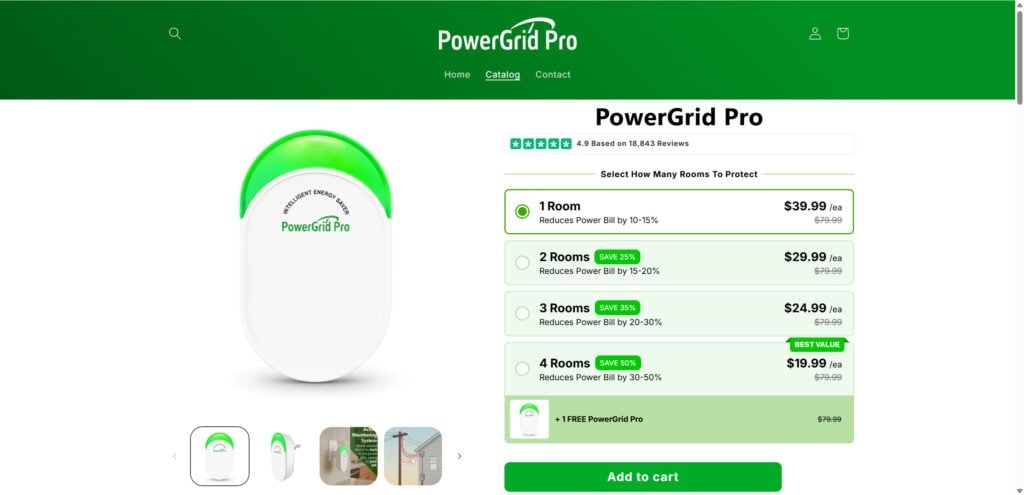
Power Grid Pro is marketed as an electricity-saving device that allegedly reduces your bill by exploiting a “surplus electricity loophole” and fixing hidden waste in your home’s electrical system. The ads lean hard on outrage and authority, using fake characters, fabricated credentials, and buzzwords to make a cheap plug-in box feel like a breakthrough.
In reality, this campaign shows the classic fingerprints of a dropshipping operation pushing a generic product that has been sold for years under many different names.
The device looks identical to the generic “electricity saving box” sold in bulk
A key giveaway is the product design itself.
Power Grid Pro matches the same common “electricity saving box” style device sold on wholesale and marketplace listings for around $1 to $2 per unit when purchased in bulk. The casing, the green top section, and the “electricity saving box” branding style are all part of a mass-produced template.
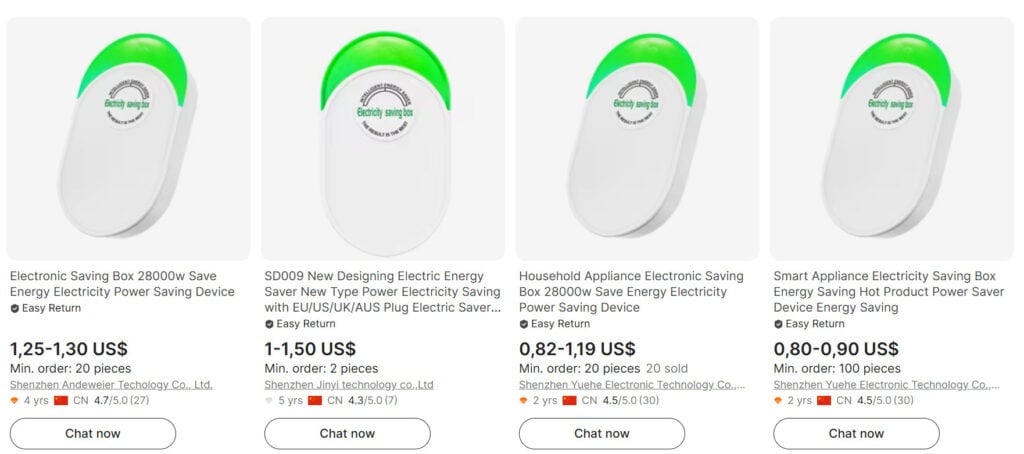
This matters because it explains the business model:
- A generic gadget is bought cheaply in bulk
- A new brand name is slapped on it
- A polished website is created with aggressive claims
- Social media ads drive traffic
- The product is marked up dramatically, often to $30 to $60 per unit
That is not innovation. That is repackaging.
This is a dropshipping funnel, not a normal consumer electronics brand
Power Grid Pro does not behave like a real electronics company with a consistent identity, established distribution, and verifiable support.
Instead, it follows the dropshipping pattern:
- Ads are the main “sales engine,” not brand reputation
- The site is built like a conversion funnel with heavy pressure tactics
- The product is framed as scarce or time-limited
- Bundle pricing is pushed hard to increase the average order value
- The story and testimonials matter more than real technical specifications
- Customer service often becomes difficult once refunds are requested
Dropshipping is not automatically a scam by itself, but when it is paired with fabricated experts, fake media logos, and impossible performance claims, it becomes a major warning sign.
The marketing relies on fake people and fabricated authority
Power Grid Pro ads have been linked to AI-generated people and made-up characters, including a nonexistent “licensed electrician” named Mark. Other ads introduce different fake personas such as “engineers” and everyday dads, all reading the same script.
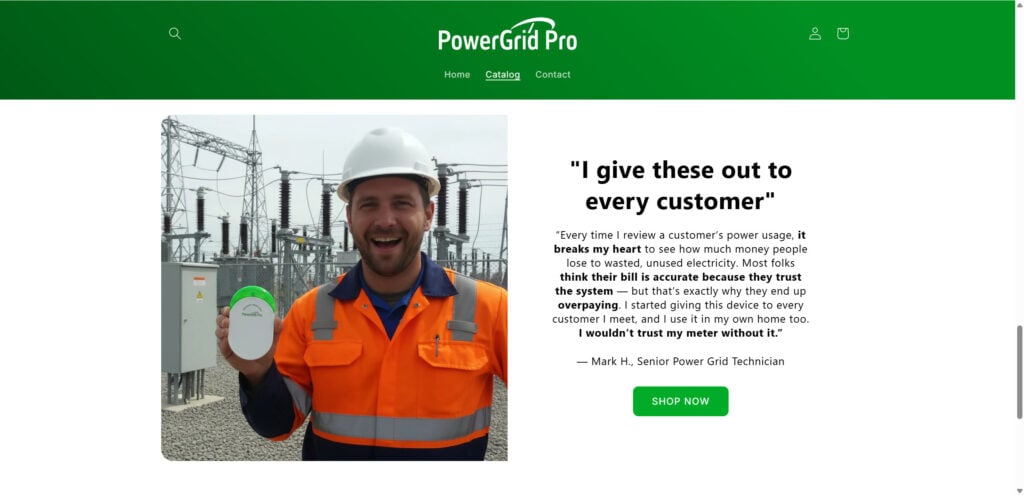
This is an intentional tactic.
If a marketer can borrow credibility from an “expert,” many viewers will accept the claim without asking for proof. When that expert is not real, it tells you exactly how the seller thinks about honesty.
“FDA approved safety” is an immediate credibility collapse
Some versions of these ads include statements like “FDA approved safety.”
That claim makes no sense for an electricity-saving device. The Food and Drug Administration does not approve home power-saving gadgets.
When a page uses “FDA approved” as a trust badge for an unrelated product category, it is typically a sign the funnel is throwing random authority labels at you to make you feel safe.
The “unused electricity” narrative is a story, not evidence
A major claim in Power Grid Pro ads is that power companies secretly route unused electricity through your meter to charge you for energy you never used.
The ads often present this as an established fact, sometimes even with dramatic dollar figures showing how much you have been “overbilled.”
But no legitimate proof is provided. No real meter data. No utility documentation. No independent testing.
It is a storyline designed to trigger anger and urgency.
The breaker box “test” is used as fake proof
Some Power Grid Pro ads tell viewers to shut off the home’s main breaker and claim the meter will keep spinning, supposedly proving fraud.
That is not how these systems work in the way the ads imply, and the campaign does not provide legitimate evidence to support the claim.
The purpose is persuasion. The ad wants you to picture a dramatic moment of “proof” so you stop thinking critically and start believing emotionally.
The “rooms to protect” pricing is a conversion trick
Power Grid Pro pushes bundles by framing the purchase as “rooms to protect,” with promises like 10% to 15% savings for 1 room and up to 30% to 50% for 4 rooms.
That framing is not how electric bills work.
Your meter measures total energy usage. It does not grant bigger discounts because you placed more boxes around the house. The “rooms” model is designed to increase your order size, not improve results.
Sold under different names: why the same gadget keeps reappearing
This is one of the most important points to make clearly.
Power Grid Pro fits a pattern where the same generic device is repeatedly rebranded and sold under new names. The product design stays nearly identical, while the branding, domain, and story change.
Why?
Because the funnel is disposable.
When one version gets too many complaints, chargebacks, bad reviews, or ad takedowns, the seller can:
- Launch a new website
- Choose a fresh brand name
- Swap in a new fake “expert”
- Reuse the same product photos and scripts
- Restart the ads
That is why these “electricity saving box” gadgets seem to pop up endlessly.
What is likely inside the device?
Teardowns of this product category typically reveal simple, cheap parts such as:
- A basic circuit board
- A capacitor
- An LED light
- A plug and minimal wiring
The LED turning on is not evidence of energy savings. It is often just a visual cue meant to create the feeling of function.
There is also a real safety concern
A cheap, unknown plug-in device is not only a financial risk.
It can be a safety risk.
Poor-quality components, weak soldering, inadequate insulation, and cheap capacitors can lead to overheating or electrical failure. That does not mean every unit will cause a fire, but it does mean the risk is real enough that you should not plug one in casually, especially when the seller is using fabricated credentials and misleading claims.
If you already received one and it feels hot, smells odd, buzzes, or discolors, unplug it immediately.
This scam has been also investigated by Jordan Liles on his YouTube channel, where he offers a detailed video on the subject. We recommend watching his content for a comprehensive understanding of the scam.
Next, let’s break down exactly how scammers carry out this scam from start to finish.
How The Scam Works
Step 1: Social media ads trigger anger and curiosity
The ads often open with a claim that makes you feel cheated:
- Power companies are stealing from you
- Your meter is billing “unused electricity”
- There is a hidden loophole
That emotional hook matters. Anger reduces skepticism.
Step 2: A fake expert appears to “confirm” it
Next, you see a supposed professional, often an invented electrician or engineer, stating the claim confidently.
The face may be AI-generated. The credentials may be fabricated. The script is usually the same across multiple versions.
Step 3: Buzzwords replace real explanations
You hear phrases like “surplus electricity,” “efficiency optimization,” and “unused electricity through your meter,” but you do not get testable details.
No lab report. No standards. No independent verification.
Just confidence and repetition.
Step 4: A dramatic “test” is suggested
The breaker box story is presented as something you can do at home to “prove” the fraud.
This is theatrical. It is not evidence.
It is designed to make the claim feel tangible so you stop asking hard questions.
Step 5: You are pushed to the sales site
The ads send you to getpowergridpro.com, where the page immediately hits you with:
- High review scores and huge review counts
- “As featured in” logos
- A big discount
- A money-back guarantee
- A strong call to action
Step 6: The site pushes bundles and “room coverage”
Instead of encouraging you to try one device first, the funnel pushes multiple units.
This is common in dropshipping because profit increases sharply with larger orders.
Step 7: The product arrives, and reality is underwhelming
Many buyers of this gadget category report:
- Cheap construction
- Minimal instructions
- The device does little besides light up
- No measurable changes in electricity usage
Step 8: Refund friction begins
If you request a refund, you may see the usual pattern:
- Slow responses
- Vague instructions
- Tight “windows”
- Return shipping complexity
- Stalling tactics
The longer it takes, the more likely the buyer gives up.
Step 9: The brand rotates and disappears
If complaints build up, the operation can simply relaunch under a new name with a new story, using the same generic device.
What You Will Actually Receive If You Order Power Grid Pro
If you order Power Grid Pro, you are not receiving a revolutionary “grid optimization” device or a verified electricity-saving system.
In most cases, what arrives is a generic, mass-produced “electricity saving box” that has been sold for years under many different names and designs, then rebranded for a new ad campaign.
Here’s what buyers typically receive.
A small plug-in plastic device with a glowing LED
The unit is usually a lightweight plastic box that plugs into a standard wall outlet.
It often looks like the exact same “electricity saving box” sold on overseas marketplaces for around $1 to $2 in bulk. The casing and styling are nearly identical across multiple listings, with only the branding changed.
When you plug it in, an LED light turns on.
That light is meant to create the impression that the device is actively doing something, but in many cases it is simply a power indicator.
Minimal packaging and little to no real documentation
Many customers report receiving:
- A plain box or generic packaging
- No meaningful manual or real technical documentation
- No verifiable certifications or lab test results
- No clear company information beyond a support email
If paperwork is included, it is often generic and does not explain a real, testable mechanism for lowering electricity bills.
Basic, low-cost electronics inside
Teardowns of this product category commonly show the same basic setup:
- A simple circuit board
- A capacitor
- An LED light
- Basic plug wiring
This is not advanced technology. It is a low-cost electronic assembly that can be produced cheaply and resold at a high markup.
A device that does not match the “whole-home” promises
Even if the website claims one unit can “cover” your home or reduce your bill by 10% to 50%, the product itself is usually just a small plug-in gadget.
It does not connect to your breaker panel.
It does not communicate with your meter.
It does not magically control or reduce how much energy your appliances actually use.
A real chance of frustration when you try to return it
This part matters.
Many people who buy products from dropshipping funnels run into predictable refund issues, such as:
- Slow support replies
- Vague return instructions
- Return addresses that change or feel unreliable
- Tight deadlines and stalling tactics
- Partial refunds or “keep it” offers instead of a full return
Even when a “money-back guarantee” is advertised, getting the refund can be far harder than the checkout process.
A safety concern you should take seriously
Because these devices are often cheap and mass-produced with unclear quality control, there is always a risk with unknown plug-in electronics.
If the unit:
- Gets warm or hot
- Smells like burning plastic
- Buzzes or crackles
- Shows discoloration around the plug
Unplug it immediately and do not keep testing it.
Even a small plug-in device can fail in ways that create an overheating or fire hazard if components are low-quality or poorly assembled.
What To Do If You Have Fallen Victim to This Scam
- Screenshot the ad, product page, and claims
Capture the “unused electricity” claim, any “FDA approved” text, review counts, and the bundle pricing. - Save your order confirmation and receipts
Keep emails, order numbers, and tracking information. - Check your card statement for the merchant name
Write down the exact descriptor and amount. - Watch for extra charges
Look for add-ons, multiple charges, or repeat billing later. - Email the seller once with a clear refund request
Include your order number and request return instructions in writing. - If they stall or ignore you, contact your payment provider
Ask about a dispute or chargeback based on misleading advertising and refusal to honor refunds. - Consider replacing your card if the checkout felt sketchy
Enable transaction alerts and monitor for unexpected charges. - Be cautious plugging it in
If it heats up, smells odd, buzzes, or discolors, unplug it. - Report the ad
Report it on the platform where you saw it to reduce spread.
FAQ
Is Power Grid Pro a scam or legit?
Power Grid Pro shows many scam-style red flags: fake stories, fabricated “experts,” unrealistic bill-saving claims, and aggressive ad funnels designed to push quick purchases.
Are the people in Power Grid Pro ads real?
Often, no. Multiple versions use AI-generated faces or actor-style personas presented as “licensed electricians,” engineers, or everyday customers, all repeating the same script.
Why do scammers keep changing the name and website domain?
Because it helps them outrun complaints, bad reviews, and ad takedowns. When one brand gets flagged, they relaunch the same product under a new name, new domain, and new “characters.”
Is the “unused electricity loophole” real?
No credible evidence is provided, and the claim does not match how residential meters and billing work. It is a buzzword story meant to create anger and urgency.
What is Power Grid Pro really?
In many cases, it appears to be a cheap, generic “electricity saving box” sourced from China and resold at a huge markup through dropshipping-style fulfillment.
Does it actually lower your electricity bill?
For most homes, dramatic savings from a plug-in box are not realistic. These devices often do nothing meaningful beyond lighting up an LED.
Is there a fire risk?
Any low-quality plug-in electrical gadget can be a safety risk if components or insulation are poor. If it gets hot, smells, buzzes, or discolors, unplug it immediately and stop using it.
The Bottom Line
Power Grid Pro is not selling a verified energy breakthrough. It is selling a story.
The campaign relies on fake experts, AI-generated people, fabricated claims like “FDA approved safety,” and an invented narrative about “unused electricity” that power companies supposedly route through your meter.
On top of that, the product itself appears to be the same generic “electricity saving box” sold cheaply in bulk, then rebranded and dropshipped at a huge markup. When one version gets too much heat, it can be relaunched under a new name.
If you want to protect your wallet, skip miracle plug-in devices and stick to energy-saving steps you can actually measure. If you already purchased, document everything and use your payment protections quickly.

Join the discussion
0 commentsShare your experience or ask a question about this article.
Discussion
Start the conversation
Have a question or something useful to share? Add the first comment.