


Prosperity4x offered a familiar online route into leveraged trading: follow a trader, open an account, and fund it with cryptocurrency.
The regulatory records now explain what sat behind that brand. They show why a working platform and a popular promoter cannot replace proper registration.
Overview
The brokerage behind the Prosperity4x name
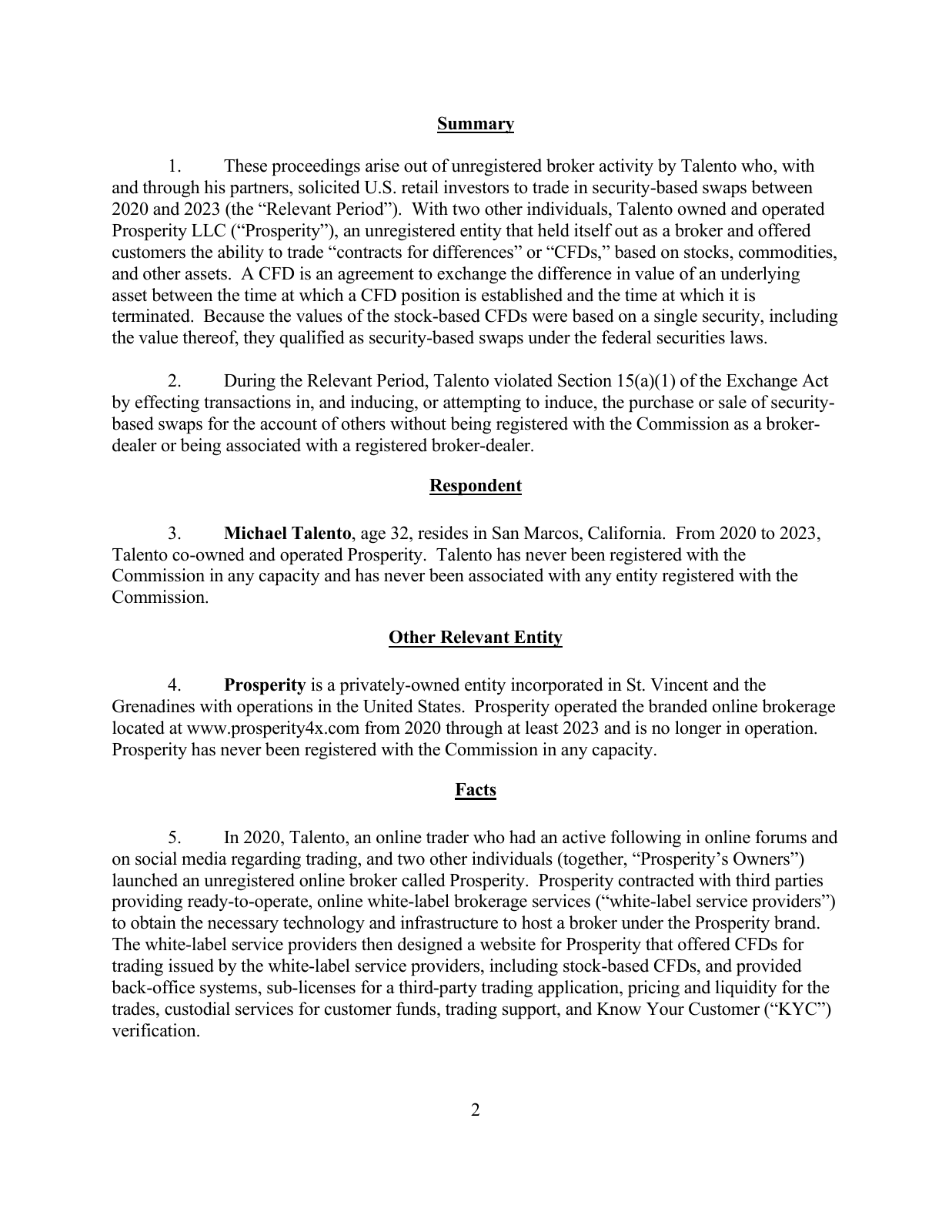
Prosperity LLC operated the online brokerage at prosperity4x.com. The SEC’s September 2026 order describes its operations from 2020 through 2023 and says the business subsequently closed.
Customers used cryptocurrency to fund accounts offering contracts for difference, or CFDs. These contracts involved price movements rather than ownership of the underlying shares or other assets.
What the regulators actually found
The SEC found unregistered broker activity by co-owner Michael Talento. A separate November 2026 CFTC announcement includes him among eight people sanctioned for unregistered solicitation.
- The SEC describes approximately $35 million deposited into Prosperity accounts, not $35 million proven stolen or lost.
- The brokerage used outside technology, custody, and trading services rather than operating every component behind its own branding.
- Promoters and owners received compensation tied to trading activity, creating an incentive distinct from a customer’s investment outcome.
- The enforcement records establish registration violations; they should not be rewritten as a finding that every trade or withdrawal was fictitious.
The practical conclusion for customers
Do not send money to a supposed continuation of this closed brokerage without independently verifying the actual entity, authorization, and destination of the funds.
Former customers should preserve account and transaction records. A regulatory penalty is not an automatic repayment notice or permission for an unsolicited recovery agent to collect fees.
A Familiar Trading Brand Was Only the Front End
The SEC’s Talento order describes Prosperity as a branded brokerage built using ready-to-operate services supplied by outside businesses.
That arrangement matters because the name visible on a trading website may not identify every organization pricing trades, keeping records, or holding customer funds.
White-label services let a business present technology under its own logo. Using such services is not inherently fraudulent, but it does not supply the operator’s missing license.
A polished interface can therefore answer whether somebody built a convincing website while leaving the more important question unanswered: who is legally responsible for the account?
Customers need to distinguish the promoter, branded broker, contractual counterparty, software provider, and custodian. One attractive homepage does not establish that those roles are interchangeable.
The SEC describes real operational activity, including customer support and certain withdrawals. The case should not be flattened into an unsupported claim that nothing existed behind the screen.
The documented problem was offering and inducing transactions without the required registration. A functioning trading app is not a defense against that finding.
This also explains why downloading familiar trading software cannot complete a broker check. Software availability and permission to serve a particular customer are separate matters.
The Broader White-Label Network Was Documented, Not Guessed
The CFTC’s November 9 announcement connects its group of individual cases to earlier action involving Netrios LP Ltd. and Red Acre Ltd.
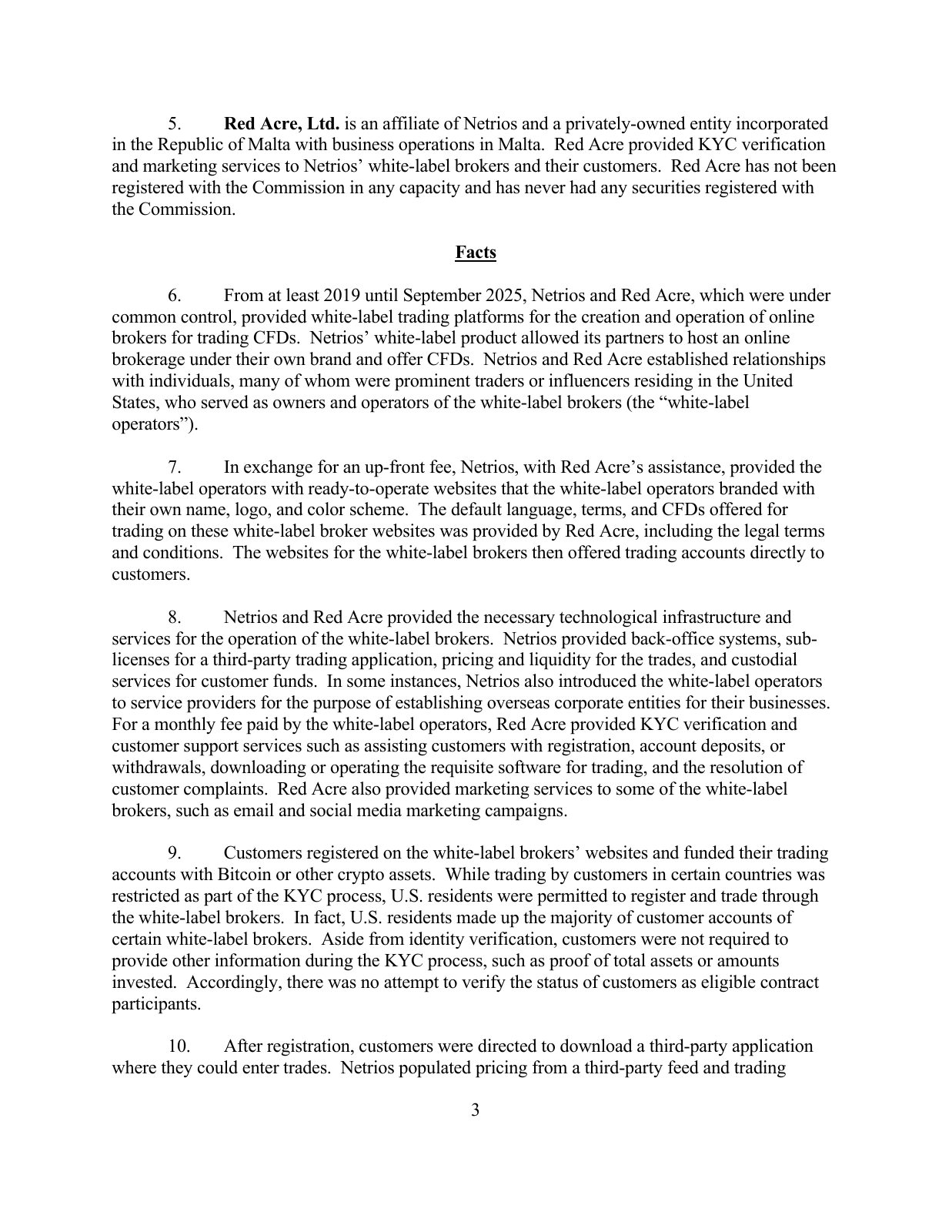
The related SEC order concerning those providers describes a network of at least fifteen brokers primarily owned or operated within the United States.
It identifies shared platform services, legal wording, customer verification, and fee arrangements. That is materially stronger evidence of a network than websites merely sharing a color scheme.
The providers’ common control is stated in that order. It does not mean every separate branded broker had the same owners or identical customer circumstances.
Talento’s SEC order refers to Prosperity’s service providers without naming them. The broader enforcement connection should not become an invented contract naming every supplier of his brokerage.
For customers, the useful lesson is the separation of branding from infrastructure. A fresh broker name may still rely on outside systems for important account functions.
That does not make all brokers using shared technology part of this case. Match the legal entities and documented relationships before attaching a regulatory finding to another platform.
Crypto Funding Was Not the Same as Buying Shares
Prosperity customers funded trading accounts with Bitcoin or other crypto assets. The SEC describes those assets being held in a margin account by the service providers.
The cryptocurrency was a funding method, not proof that customers owned every stock or commodity shown in the trading menu.
A CFD is a contract linked to the change in an underlying asset’s value. Buying that contract is different from acquiring the underlying shares.
That distinction affects what an account statement means. A position described using a company’s name need not represent shares held for you at a stock custodian.
Similarly, a displayed account balance is not a complete record of where deposited crypto is held. Preserve both the brokerage statement and the originating transfer details.
The SEC treated Prosperity’s stock-based CFDs as security-based swaps under federal securities law. A platform’s forex-focused marketing did not eliminate the requirements applicable to those products.
Different products can trigger different regulatory requirements. A permission relating to one activity is not a universal authorization to offer every investment on a menu.
Customers outside the United States also need their own jurisdiction’s rules. These US findings should not be presented as an identical legal determination for every country.
Why Trading-Based Compensation Deserves Attention
Prosperity’s owners recruited affiliates receiving transaction-based compensation. Talento also received part of the commissions and spreads generated by trading activity, according to the SEC.
That incentive differs from simply receiving a fixed payment to explain software. More activity can generate more compensation even when the customer does not earn a profit.
An endorsement therefore deserves two separate questions: what is being recommended, and how does the person recommending it benefit when you act?
A promoter may discuss successful trades without explaining the customer’s complete costs. Commissions, spreads, and overnight charges need to be understood together.
The word swap also requires care here. An overnight holding charge called a swap is not the same concept as the security-based swap being regulated.
Confusing those terms makes the legal finding harder to follow. One concerns a trading cost; the other concerns the type of financial contract offered.
The compensation findings do not prove that every affiliate statement was false. They explain why a promoter’s enthusiasm should not substitute for independent account and registration checks.
How the Prosperity Trading Arrangement Operated
Step 1: Online promotion brought customers to the brand
The SEC describes promotion through the brokerage website and social platforms, including YouTube, Telegram, and Instagram. Existing audiences gave the branded broker a ready route to customers.
For a prospective customer, familiarity with a trader can make checking the business feel unnecessary. The trader’s identity and the brokerage’s authorization still require separate verification.
Step 2: Registration and crypto deposits created an account
Customers registered through the site and transferred crypto assets to fund trading. Identity checks occurred within that arrangement, rather than independently confirming permission to offer every product.
Completing a verification form does not mean a regulator approved your account. It also does not explain which legal entity has custody of the transferred assets.
Step 3: Outside infrastructure supported the trading experience
The branded website displayed balances and history while trading used a third-party application. Behind that interface, service providers supplied substantial account and trading functions.
A clear written agreement should identify those responsibilities before funding. Customers should not need an enforcement proceeding to understand which organization handles their assets.
Step 4: Trading activity generated shared fees
Commissions and other activity-related charges supported the business model. When reviewing an old account, separate deposits, withdrawals, trading results, and charges rather than treating them as one number.
Doing so helps distinguish an unpaid balance, an unexplained deduction, and a market loss. Those are different questions requiring different evidence.
Step 5: Closure left records more important than branding
The SEC says Prosperity wound down after ending its service-provider relationship in late 2023. The 2026 orders are later enforcement developments, not evidence of a newly operating broker.
A website using a similar name today should not inherit the old firm’s identity automatically. Independently identify whoever now requests a deposit or offers to recover an account.
Who Was Responsible for the Brokerage and Its Services?
Prosperity was the customer-facing business
The order identifies Prosperity LLC as incorporated in St. Vincent and the Grenadines, with US operations. Incorporation did not provide the securities registration missing from the arrangement.
Do not confuse this case with an unrelated business using Prosperity in its name. The domain and named respondent provide more precise identifiers.
The technology providers had separate roles
The related Netrios proceeding describes services covering website creation, pricing, execution, and custody. Red Acre’s identified work included verification, marketing, and customer assistance.
Those roles help explain the documented network, but responsibility for an individual account still depends on its agreements and transaction records.
Offshore registration did not settle US authorization
A foreign company record answers where an entity was formed. It does not establish permission to solicit US retail customers for the transactions described in these orders.
The important check concerns the actual person, entity, product, and customer jurisdiction. A general business certificate cannot replace the relevant financial authorization.
The settlement orders have defined limits
The SEC proceedings were settled without admitting their findings, subject to the orders’ specified exceptions. They contain regulatory findings, not criminal convictions or universal loss calculations.
Talento’s SEC sanction includes an association bar with a right to apply for reentry after two years. That is not an automatic permission to resume brokerage work.
Penalties Are Not an Automatic Customer Refund
Talento’s SEC order imposes a $65,000 civil penalty payable to the government. It does not announce a customer claim portal distributing that amount.
The provider order separately imposes $1.75 million on Netrios and $750,000 on Red Acre. Related regulatory actions must not be added together as a promised customer-recovery fund.
The SEC’s approximately $35 million deposit figure measures money entering accounts during the relevant period. It does not, by itself, calculate outstanding balances or individual losses.
A customer’s actual position requires their own deposit history, withdrawals, charges, and trading records. A headline number cannot replace that reconciliation.
Be particularly careful with unsolicited messages using these enforcement details to promise repayment. Knowing a public case number does not make the sender an appointed claims administrator.
What to Do If You Had a Prosperity4x Account
-
Retain account agreements, statements, emails, and promotional messages. Keep original files as well as screenshots so dates and complete wording remain available.
-
List each deposit and withdrawal separately, including crypto transaction identifiers and destination addresses. Distinguish the amount transferred from any profit later displayed on the platform.
-
Preserve communications identifying the broker, representative, or service provider handling your account. An old social-media nickname alone may not identify the correct legal party.
-
For an unresolved securities-account issue, use the SEC’s independently located investor complaint information. Describe the actual transaction rather than assuming every loss has the same cause.
-
Relevant commodities information can be reported through the CFTC’s complaint and tip channels. Read the options because enforcement tips and private recovery proceedings serve different purposes.
-
Ask a qualified professional about any private claim and its deadline if money remains unresolved. A complaint or published penalty does not guarantee compensation.
-
Reject requests for new crypto deposits to unlock an old balance. Verify any purported administrator through official records before sharing documents or sending money.
Before considering another broker, use the CFTC’s registration-check guidance and the SEC’s investment-professional search guidance to select the appropriate record.
Match names, identifiers, and contact details, rather than accepting somebody else’s screenshot of a listing. Registration is not a guarantee against losses, but missing authorization matters.
Frequently Asked Questions
Is Prosperity4x still the operating brokerage described here?
The SEC says that brokerage wound down after its 2023 provider relationship ended. These later enforcement records do not authenticate any supposed reopening.
Did the SEC find that all customer deposits were stolen?
No such conclusion appears in the inspected orders. The deposit total is not a finding that every customer lost that amount or every trade was imaginary.
Did customers buy the underlying stocks?
The described products were CFDs rather than ownership of the underlying assets. A stock name in the trading interface did not itself create share ownership.
Does shared technology prove all branded brokers had one owner?
The provider order documents shared infrastructure and common control of the providers. It does not assign the same ownership to every separately branded operator.
Does the SEC penalty mean I can claim an immediate refund?
The cited penalty is not an announced automatic repayment program. Verify any claimed distribution independently and keep your individual transaction records.
Is a familiar trading app enough to trust another broker?
No software interface replaces checking the responsible entity and applicable registration. Understand the product, custody arrangement, fees, and withdrawal terms before providing funds.
The Bottom Line
Do not treat the old Prosperity4x brand, a functioning trading interface, or a promoter’s following as authorization to accept your money. The cited orders document specific registration violations.
If you held an account, preserve its complete history and use official complaint channels for unresolved issues. Do not fund an unverified reopening or pay an unsolicited recovery demand.

Join the discussion
0 commentsShare your experience or ask a question about this article.
Community experiences
Did this happen to you?
Your experience could help someone recognize the same scam. Submit a private report for our team to review.
I experienced this tooReports are reviewed before publication. Sharing publicly is always your choice.
Discussion
Start the conversation
Have a question or something useful to share? Add the first comment.