


The invitation sounds wonderfully simple: open a page, follow a short presentation, and let a button change your finances. That is why Push Button System keeps attracting attention.
Before handing over your card, pause at the point where the sales story becomes a purchase. The details there deserve more attention than the button.
Overview
The AI income promise is much bigger than the product description
The Push Button System pitch at Pushmysystem.net says its AI “will generate you anywhere between $500 to $5,000 a day.” It also describes the process as fully automated.
That is not an ordinary claim about software helping with a task. It presents daily income as something the buyer can expect the system to produce.
Meanwhile, Pushbuttonsystem.net describes a course covering online marketing, pages, email lists, and website traffic. Learning those activities is very different from receiving automatic daily profit.
The price at the first button is not the whole offer
The presentation advertises $67. Additional products appear on the website and on linked payment pages, with different descriptions and prices across those routes.
An optional purchase is still another expense. A beginner hoping to earn money can instead start spending on access, training, support, and further upgrades.
Do not buy this offer for its guaranteed-income story. The gap between that story and the documented course descriptions is the central problem.
Follow the transaction, not just the familiar name
Several pages use Push Button System branding. For an existing payment, the receipt and exact checkout matter more than a search result with a similar title.
- The AI presentation links to a $67 Explodely checkout.
- Pushbuttonsystem.net publishes marketing-course descriptions and separate upgrade prices.
- Buttonpushed.com uses the same product name and names Fort Cove LLC in its refund policy.
- The published legal pages reject any guarantee of earnings.
- A genuine payment platform does not validate the seller’s income promises.
This investigation concerns the public sales claims, policies, and checkout offers. It does not assume that a paid course contains nothing or that every similarly named promotion has one operator.
The Promise Falls Apart When You Ask Who Pays You
Automation is not a source of customers
A website builder can publish a page. An email tool can schedule messages. Neither operation creates a buyer who wants the product and is willing to pay.
If the suggested business involves affiliate sales, someone still needs to choose a suitable offer, reach interested people, and persuade them to purchase.
Refunds, advertising charges, platform costs, and unsuccessful attempts also affect the result. A revenue figure is not the same as money left after those expenses.
That is why a serious explanation starts with the customer and the sale, not with a daily withdrawal number. Ask what transaction produces the claimed income.
A profit calculator does not calculate your prospects
The AI presentation includes a calculator with a daily amount and a number of days. It displays a corresponding potential-profit total.
Entering a desired income does not make that income likely. Multiplying a daily target by time supplies arithmetic, not evidence of customers, conversions, or net profit.
Use the same distinction with an earnings feed. Names and amounts displayed beside a sales button are promotional statements, not access to independently verified bank records.
The disclaimer describes a different risk
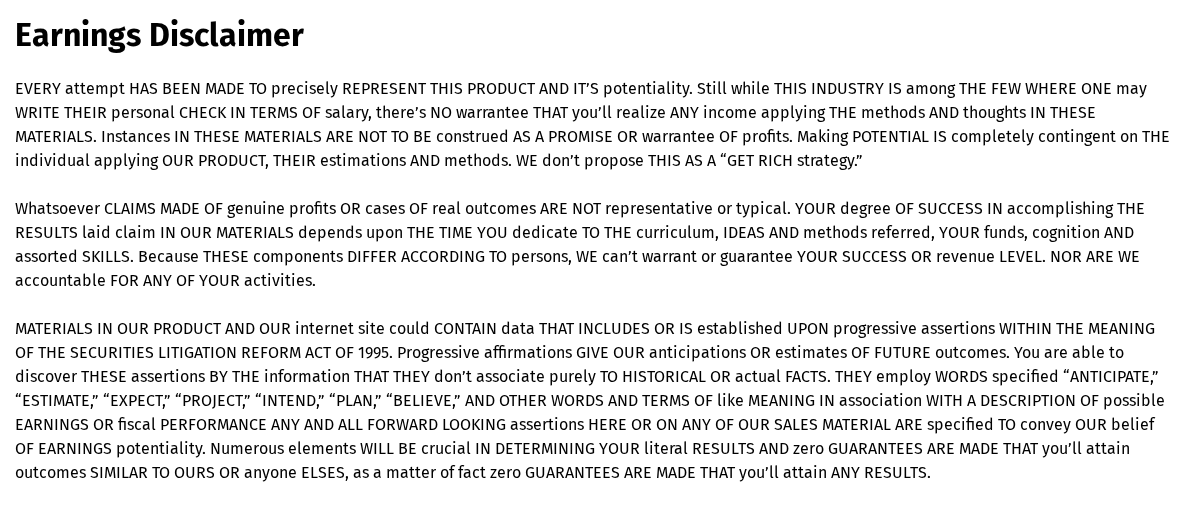
Pushbuttonsystem.net’s earnings disclaimer says results depend on the individual’s time, funds, knowledge, and skills. It does not promise that the purchaser will earn anything.
Those are substantial qualifications, not a small adjustment to an automatic-income claim. They put work and financial uncertainty back into a story that sells their absence.
A refund promise does not resolve that contradiction. Getting the purchase price back later is different from receiving the advertised daily earnings.
How the Push Button System Scam Works
Step 1: Make the income seem already within reach
The presentation places large earnings expectations beside a simple action. It encourages the visitor to imagine the result before understanding how the underlying business would operate.
This is an effective sales shortcut because the proposed reward dwarfs the entry price. Against thousands in imagined earnings, a $67 decision can feel almost trivial.
Reverse that comparison. Evaluate what the payment actually buys today, not the lifestyle the video encourages you to picture.
Step 2: Add pressure around the purchase button
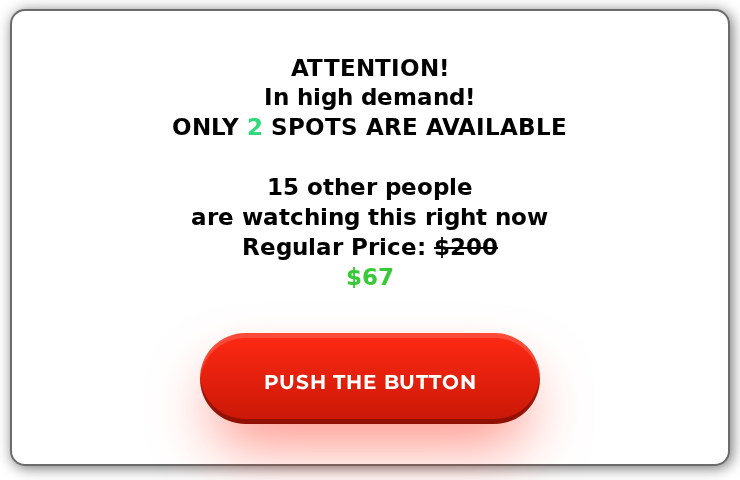
The sales card shows two available places and fifteen other viewers. The checkout also presents a short expiry timer and limited-enrollment wording.
These devices focus attention on missing out. They do not explain why access to a digital course requires such a small enrollment limit.
A price should withstand a calm comparison. Do not let an on-screen countdown decide whether you understand the offer, the seller, or the refund conditions.
Step 3: Sell access while the buyer expects an earning mechanism
The product page describes instruction in building funnels, web pages, mailing lists, and online marketing. Course access is described as a digital delivery after purchase.
That creates the crucial mismatch. Someone expecting software to deposit profits may be purchasing lessons about activities they must learn, perform, and fund themselves.
Training can have value when it is described honestly. Selling it through a promise of effortless daily income is a different proposition.
Step 4: Offer additional ways to spend
Pushbuttonsystem.net lists optional website-speed training at $39, VIP support at $24, and an interview at $95. Its catalog also advertises Gold and Platinum packages.
The current AI presentation’s linked Explodely offer shows $67 plus an optional $55 interview. Buttonpushed.com’s linked offer instead shows a $39 Turbo Charged Profits add-on.
These are separate checkout configurations, not evidence that every buyer is charged every amount. Read the selected order summary before authorizing anything.
A useful stopping rule is to reject another purchase offered as the missing piece of the first promise. More spending does not turn an unsupported income claim into evidence.
Step 5: Leave the refund argument until after payment
The disappointed buyer must then identify the order, explain the mismatch, and use the correct refund route. That takes time the initial sales story barely acknowledges.
Keep the original presentation as well as the course description. A complaint is stronger when it shows exactly how automatic income was presented before payment.
The FTC’s business-coaching warning identifies guaranteed income and substantial returns for little work as signs of a scam. A course label does not excuse those claims.
What the Extra Products Actually Describe
The public Gold Package description centers on WordPress website training and support. The broader catalog lists Gold tiers at $297, $197, and $97.
Platinum tiers are listed at $299, $199, and $99. A listed tier is not proof that someone bought it or that all buyers follow the same sequence.
The relevant point is the expanding purchase menu. A visitor arriving for a simple income button encounters products about learning and running an online business.
Before considering any course, require an outline that identifies the work, required platforms, expected expenses, and what happens if your website attracts no paying customers.
The FTC’s detailed guidance on business offers recommends asking how the business earns money, what you sell, and what your costs would be.
Those questions are not a technicality for unusually cautious buyers. They are the basic difference between planning a business and purchasing a hopeful feeling.
Company, Contact, and Payment Checks
The pages do name a company
Pushbuttonsystem.net’s legal pages name Fort Cove LLC and list 1314 E Las Olas Blvd #80, Fort Lauderdale, FL 33301. Buttonpushed.com’s refund policy names the same company and address.
A Florida corporate record for Fort Cove LLC identifies document L24000176602 and an April 15, 2024 filing. The listed principal address matches the website’s address.
It would therefore be wrong to describe these pages as supplying no company identity. Evaluate the earnings claims rather than relying on an anonymity accusation.
An address does not verify a money-making method
A corporate filing concerns a business entity. It is not an audit of customer results, a license for an automatic-profit product, or approval of a sales presentation.
The address is useful for identifying correspondence and a complaint. It is not a reason to ignore the contradiction between the income pitch and the course disclaimer.
Keep the support contact tied to your order
Pushbuttonsystem.net lists support@pushbuttonsystem.net and 786-841-4826. Buttonpushed.com lists support@pbsmember.com with that same phone number.
The shared company details and phone are concrete connections between these pages. They are more useful than guessing a relationship from similar product names alone.
Use the receipt to confirm which contact applies. Do not send card security codes, banking passwords, or remote-access permission as part of an ordinary refund request.
Explodely processes an offer, not an earnings guarantee
The linked checkout identifies Explodely as the sales platform. Its disclaimer states that the vendor is responsible for product claims and that platform review is not endorsement.
The payment page’s presence should help you locate an order, not reassure you that the income promise has been independently tested.
If your receipt names a different provider, use that provider’s order-support route instead. Do not assume an older reference to Digistore24 identifies every current transaction.
The Refund Promises Need a Saved Copy
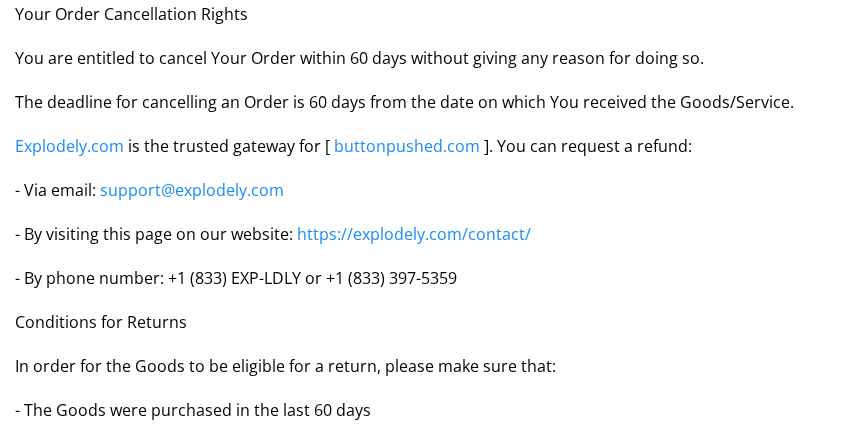
Pushbuttonsystem.net publishes a 60-day refund policy and says refunds should reach the payment account within 5–10 business days after the request is accepted.
Buttonpushed.com’s policy describes cancellation within 60 days of receiving the service and gives Explodely support as a request route.
Save the policy applicable to your order before it changes. Include each separately purchased add-on in the request, with its amount and order reference.
Do not let a support exchange run down a payment-provider deadline. You can ask the provider about your options while waiting for the merchant’s answer.
What to Do If You Paid for the Push Button System
-
Pause the spending immediately. Decline further upgrades, coaching, or traffic purchases while you review the original order. A disappointing purchase is not a reason to authorize another.
Write down the product names and amounts from actual receipts. Separate a completed payment from an upgrade page that merely appeared.
-
Document the expectation that led to payment. Save the income promise, product page, order summary, terms, and access email. Record what was delivered and what remained missing.
Describe the difference accurately. Receiving course access does not erase an earlier automatic-income promise, but do not claim non-delivery if access arrived.
-
Request the advertised refund in writing. Give your order reference, purchase email, date, amount, and the remedy requested. Include each add-on you want refunded.
For an Explodely order, its official support ticket form provides an additional documented contact route. Keep the ticket number and response.
-
Ask your payment provider about unresolved charges. Explain whether the problem is misdescription, an unprocessed promised refund, or a transaction you did not authorize.
Submit receipts and correspondence promptly. Rules and deadlines differ, so obtain the provider’s instructions rather than waiting for a universal refund period.
-
Check for separate billing arrangements. Review statements and the purchase confirmation for actual renewals or additional products. Cancel an unwanted recurring agreement through its named provider.
A one-time course payment does not automatically establish a subscription. Identify the charge before asking for cancellation or reporting it as unauthorized.
-
Protect only the information actually exposed. Replace a reused password, revoke access you granted to another account, and ask your bank about compromised payment details when applicable.
You do not need to reset a device merely because you watched the presentation. Avoid recovery agents who promise a refund in exchange for another upfront fee.
Report the specific advertisement and transaction to the platform and your consumer authority. In the US, the FTC’s payment-recovery guidance explains steps by payment method.
For related background, see our One Button Money App report, Push Button System marketing investigation, and earlier trading-app pitch report.
Frequently Asked Questions
Is the Push Button System a legitimate way to earn automatic income?
Do not buy it on that basis. The guaranteed-income pitch conflicts with the course descriptions and the seller’s own explanation that earnings depend on individual effort and circumstances.
Does the AI Push Button System create income without work?
AI can assist with defined marketing tasks. It cannot establish that your offers will attract paying customers or that revenue will exceed the costs of running the business.
Is the advertised $67 the total cost?
It is an entry price on the sales routes described here. Optional checkout extras and separately listed packages can increase the amount, depending on what you authorize.
Is Click Money System another name for this exact offer?
Do not equate them from the name. A 2018 CFTC complaint names a historical Click Money System binary-options campaign, not this current course checkout.
If a page asks for a trading deposit instead, assess that different transaction. Neither a similar name nor an old allegation establishes the same current operator.
Can a buyer request a refund after receiving course access?
The published policies describe a 60-day refund or cancellation opportunity. Keep the applicable terms and request the refund through the seller and provider named on your receipt.
Does a company address or secure checkout make the earnings claim true?
No. Those details help identify the transaction. They do not demonstrate typical customer profit, and the payment platform specifically separates its service from endorsement of the vendor’s claims.
The Bottom Line
The Push Button System’s automatic-income story is a reason to walk away, not a substitute for a business plan. Do not pay for guaranteed AI profits.
If you already bought access, stop the upgrades, preserve the promise that persuaded you, and pursue the applicable refund promptly. Work from your actual receipts, not another hopeful sales presentation.

Join the discussion
0 commentsShare your experience or ask a question about this article.
Discussion
Start the conversation
Have a question or something useful to share? Add the first comment.