


A court notice lands in your inbox, referring to an old bill and warning that the matter is about to get much worse.
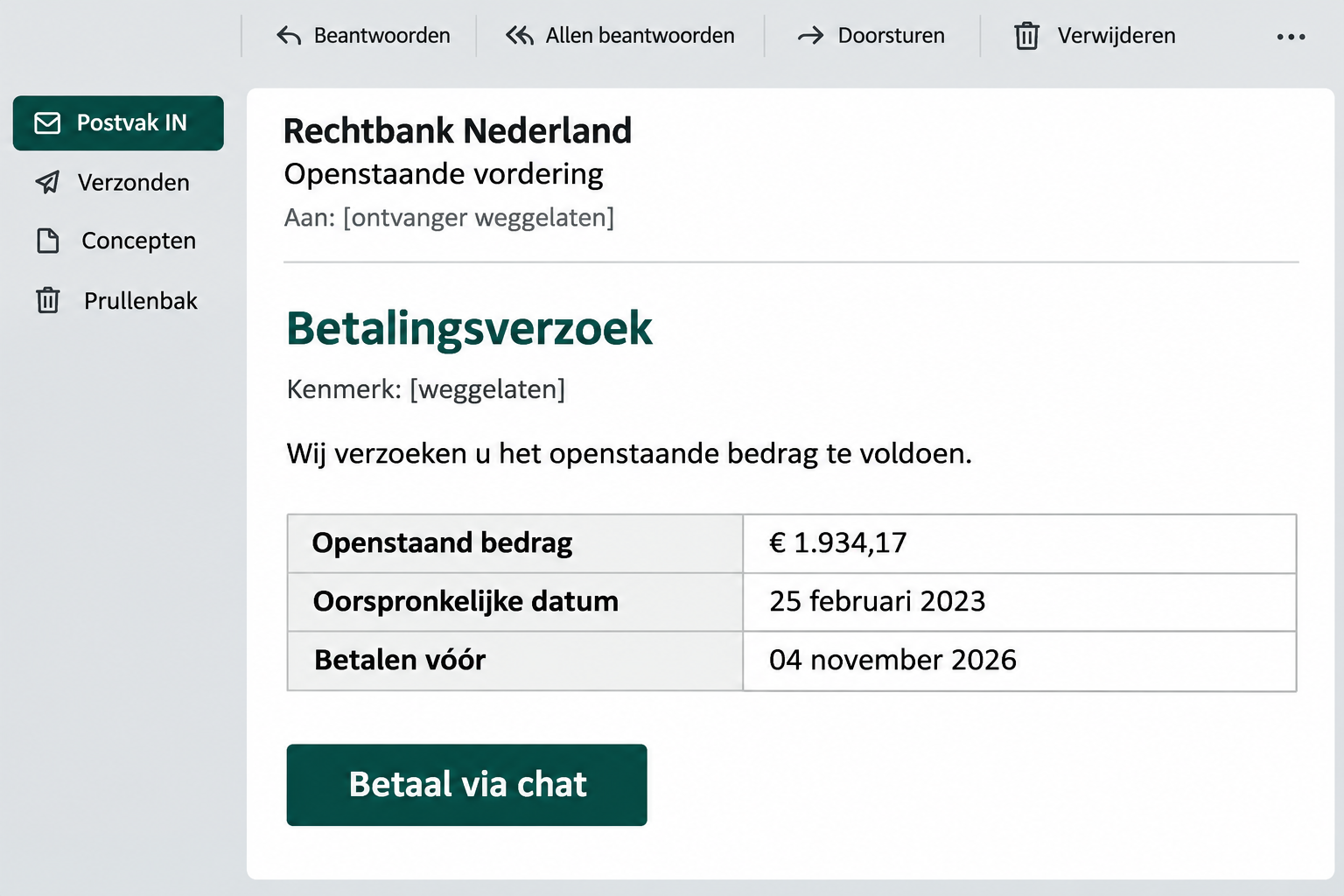
The illustrated notice shows how formal wording can make checking your records feel like a dangerous delay. Before answering, look at the action being requested.
Overview
The demand borrows the authority of a court
The Rechtbank Nederland email scam presents an alleged civil debt as an official matter requiring immediate payment. Court-style language makes an ordinary inbox message feel compulsory.
Fraudehelpdesk published the false-email example on November 5, 2026. The message itself is dated November 4 and claims an unpaid obligation from February 25, 2023.
It demands €1,934.17 and threatens collection involving police, a bailiff, bank funds, or property. Its payment instruction points readers toward a supposedly secure chat.
A precise amount does not establish a real debt
The reference number, official-looking layout, and older date give the demand a history. They do not independently establish that a court recognizes the claim.
A displayed balance is an allegation inside the message, not confirmation from your bank or a court. Establish the obligation before considering how to pay.
- The sender display name is not proof of who sent the email.
- A case reference needs confirmation outside the message that supplied it.
- A payment deadline does not authenticate the person setting it.
- A chat labeled secure is still an unverified contact route.
- Any genuine case should be checked through independently obtained official contacts.
The judiciary has warned about false payment emails
The Dutch judiciary issued its own warning on November 5 about false emails demanding payment of an unpaid bill.
It says those messages do not come from the judiciary and advises recipients not to click. Doubts can be checked with its financial service center.
The published example shows the email, not a verified chat conversation or payment. Don’t assume its button leads to any particular bank or payment service.
Why an Old Claim Can Feel Harder to Challenge
A message about yesterday’s purchase is relatively easy to check. A demand reaching back several years can make you question your own memory.
You might wonder whether you missed a letter, moved house, or forgot an account. That uncertainty gives a stranger’s explanation room to sound plausible.
The email then reverses the burden. Instead of proving the claim through a trustworthy channel, it pressures you to disprove it before the threatened consequences arrive.
Don’t accept that timetable as your only option. You can refuse the message’s payment route while promptly checking whether a genuine matter exists.
Those are separate decisions. Avoiding a suspicious chat is sensible protection; ignoring independently verified court correspondence would be something entirely different.
Nor does an old date settle whether an actual obligation could be enforceable. That depends on the real facts and applicable law, not this email’s presentation.
How the Rechtbank Nederland Email Scam Works
Step 1: An inbox message takes on the appearance of an official notice
The first task is to make the recipient treat the email as an instruction rather than a claim needing verification.
A prominent institution name, formal heading, and administrative reference can do much of that work before the reader reaches the demand.
Recognizable formatting is easy to mistake for a recognized sender. Yet the appearance of a document cannot establish who controls the address or button behind it.
Start by identifying the request in plain language. Someone you have not independently verified wants you to act on a financial obligation.
That remains the situation even when the message looks more polished than ordinary spam. Good spelling and restrained design do not replace an outside check.
Step 2: An alleged history makes immediate payment sound overdue
The notice presents the matter as something that should already have been resolved. This can make a recipient feel responsible before they establish what happened.
A supposed record of earlier reminders also supplies an explanation for escalation. The sender doesn’t need you to remember those reminders if you start doubting yourself.
Check your own correspondence instead of asking the suspicious contact to reconstruct the history. Their answer would still come from the same unverified source.
If you find a real account, compare the actual creditor and reference through a separate channel. A vaguely similar amount or date is not enough.
Keep the distinction clear: a familiar financial situation can make a fake approach more convincing without making that approach genuine.
Step 3: The threat makes verification feel like noncooperation
Collection and seizure language changes the emotional stakes. The reader may stop asking whether the sender is authentic and concentrate on preventing a frightening visit.
That is precisely when an independent check becomes most valuable. Someone demanding money should not control both the claim and the method for confirming it.
The message puts several authorities into one demand. Multiple official-sounding roles are not independent confirmation when the same email supplies them all.
Describe the actual message and requested action. That is more useful than asking a vague question about whether courts sometimes send emails.
Step 4: The button asks you to pay through a chat
The message steers you toward a conversation through its link. The label’s reassurance does not authenticate that destination or the person who might answer.
A person answering professionally would not solve the identity problem. Nor would another case number, a second signature, or an assurance that the channel is encrypted.
Avoid sending a small test payment or asking the chat operator to prove the debt. Both keep you inside the route whose legitimacy is disputed.
Instead, locate the institution yourself. A useful answer must survive that change of channel rather than depend on continued trust in the original button.
There is no need to open the destination to make this decision. The documented fraudulent request already supplies a reason not to use it.
How to Check the Claim Without Using the Email
Use the judiciary’s financial contact route
For a questionable court invoice, start with the official costs and payments page. It lists Rechtspraak Servicecentrum Financieel and explains the questions it handles.
The published financial number is 088 361 10 01. The listed email is rsc.financieel@rechtspraak.nl. Obtain these details from the official page yourself before using them.
Explain that you received a suspicious payment demand. Ask how to verify the invoice or identify the appropriate department without following the message’s link.
Keep your question specific: which institution supposedly issued it, what reference appears, and what payment is requested? Don’t begin by sending unnecessary identity documents.
Direct case questions to the responsible court
The judiciary’s contact directory distinguishes general questions from questions about a case or dossier. Case-specific inquiries belong with the institution handling the matter.
If you already have genuine correspondence, use it alongside the independently reached directory. Compare the reference with the real record, not just the email’s wording.
A service center can help route a question without deciding a legal dispute. Don’t treat administrative confirmation as a substitute for legal advice when advice is needed.
Likewise, don’t assume failure to locate an email immediately resolves every possible obligation. Keep a record of the verification and follow any separately confirmed instructions.
Recognize that genuine chat support has boundaries
The judiciary does have an official WhatsApp service for certain general and digital-service questions. That does not authenticate a chat linked from an unsolicited demand.
Its guidance says not to send sensitive information through WhatsApp, including a BSN, passport or ID photograph, or bank-account details.
It also warns against answering a message claiming to be the service if you never initiated contact. Begin from the published official route, not the incoming conversation.
For a substantive case question, use the responsible court instead. The existence of helpful messaging support does not turn every chat into a payment or verification service.
What to Do if You Have Fallen Victim to This Scam
Start with what happened: receiving an email, sharing information, and sending money call for different responses. Take the actions that match your situation.
-
Stop using the message and its chat link. Don’t reply, negotiate, pay a cancellation charge, or follow a replacement link supplied by the same contact.
If you only received or read the email, that alone does not establish a financial loss or compromised account. Preserve what you need, then report and block it.
If a conversation is already open, stop responding. Don’t stay involved because the other person claims leaving will automatically trigger enforcement.
-
Preserve a usable record without revisiting the destination. Save the email, its date, the displayed sender, and any existing conversation or payment confirmation.
Keep the original email where practical, not just a cropped image of the balance. It may contain information that helps a fraud team examine the approach.
Store private references and personal details securely. A public warning should not expose another person’s name, address, identification, or a personalized link.
-
If you paid or supplied banking information, contact your bank independently. Use its app, your card, or an established official contact route.
Fraudehelpdesk advises immediate bank contact when banking credentials were entered or payment followed. Explain the actual transaction and the court-impersonation request.
Ask what can still be stopped, recalled, disputed, or secured for that payment method. Provide the transaction reference and follow the bank’s instructions promptly.
Recovery is not guaranteed. Do not delay reporting while trying to extract an admission or refund from the person who sent the demand.
-
Secure any account whose credentials you actually shared. Reach that service independently and change the exposed password, including other accounts where you reused it.
Review the account’s available session and security controls. If the account is financial, follow the bank’s fraud process rather than relying only on a password change.
This is conditional advice. The published email does not establish a password-collection form, and merely seeing the message does not mean every account is exposed.
-
Describe other information you supplied precisely. Tell the relevant institution or Fraudehelpdesk whether you shared contact details, an identity document, a code, or financial information.
Specific details help distinguish an unwanted follow-up risk from an account action that needs immediate attention. Don’t send further documents to the suspicious contact to clarify.
Be particularly careful with a subsequent caller claiming to be your bank. End the incoming call and reach the bank yourself before following instructions.
-
Verify any genuine court matter separately. Use the judiciary’s published financial or court-specific contacts, keeping the suspicious email separate from authentic correspondence.
Ask whether the reference and requested payment correspond to a real record. Do not pay through the email while waiting for that confirmation.
If an actual deadline or proceeding is confirmed, obtain timely independent legal advice where appropriate. A fake email does not erase a separate genuine obligation.
-
Report the impersonation through established channels. The judiciary’s spoofing guidance explains how to report an attempted impersonation and directs victims to the police.
You can also use Fraudehelpdesk’s reporting routes reached from its own website. Supply the existing evidence without reopening the suspicious chat or making another payment.
Keep any report or bank reference you receive. It helps connect later correspondence to the same incident without repeatedly sending sensitive material to new contacts.
-
Reject follow-up recovery and enforcement pressure. A new person may claim to fix the original problem, cancel the case, or release money already paid.
Don’t accept their authority just because they know details of the earlier message. Verify each claimed institution through a route that person did not supply.
Continue any genuine dispute through the bank, court, or adviser you independently contacted. No stranger should charge another fee simply to stop an invented emergency.
Frequently Asked Questions
Is this Rechtbank Nederland email an official court demand?
The documented example is published as a false email by Fraudehelpdesk. The judiciary also warned about impersonating emails requesting unpaid-bill transfers.
Do not use its payment button. Check any real invoice or case through the institution’s independently reached contact details.
Does a correct-looking case number make the demand genuine?
No. A reference printed in an email needs confirmation outside that email. It does not independently prove that a court recognizes the alleged obligation.
Does the older debt date mean I can ignore every related bill?
No. An old date in a fake message does not determine the status of a real obligation. Verify genuine correspondence separately and seek advice where needed.
Do Dutch courts ever offer chat support?
The judiciary lists an official WhatsApp service with a limited purpose and privacy rules. Its existence does not validate this email’s unknown chat destination.
Start from the published official contact page rather than accepting a link because it says the conversation is secure.
Will opening the email automatically compromise my bank account?
Receiving or reading it does not establish that result. The urgent questions are whether you supplied information, authorized an account action, or actually paid.
Can someone guarantee recovery if I already sent money?
No guaranteed recovery follows from this warning. Contact your bank promptly about the actual payment and reject unsolicited demands for another fee to retrieve it.
The Bottom Line
Do not pay this court-debt demand through its chat link. A formal layout, threatening deadline, and historical reference do not turn an impersonation into a genuine case.
If you already acted, contact your bank about any payment or banking exposure, then verify the alleged obligation through the judiciary’s independently published channels.

Join the discussion
0 commentsShare your experience or ask a question about this article.
Discussion
Start the conversation
Have a question or something useful to share? Add the first comment.