


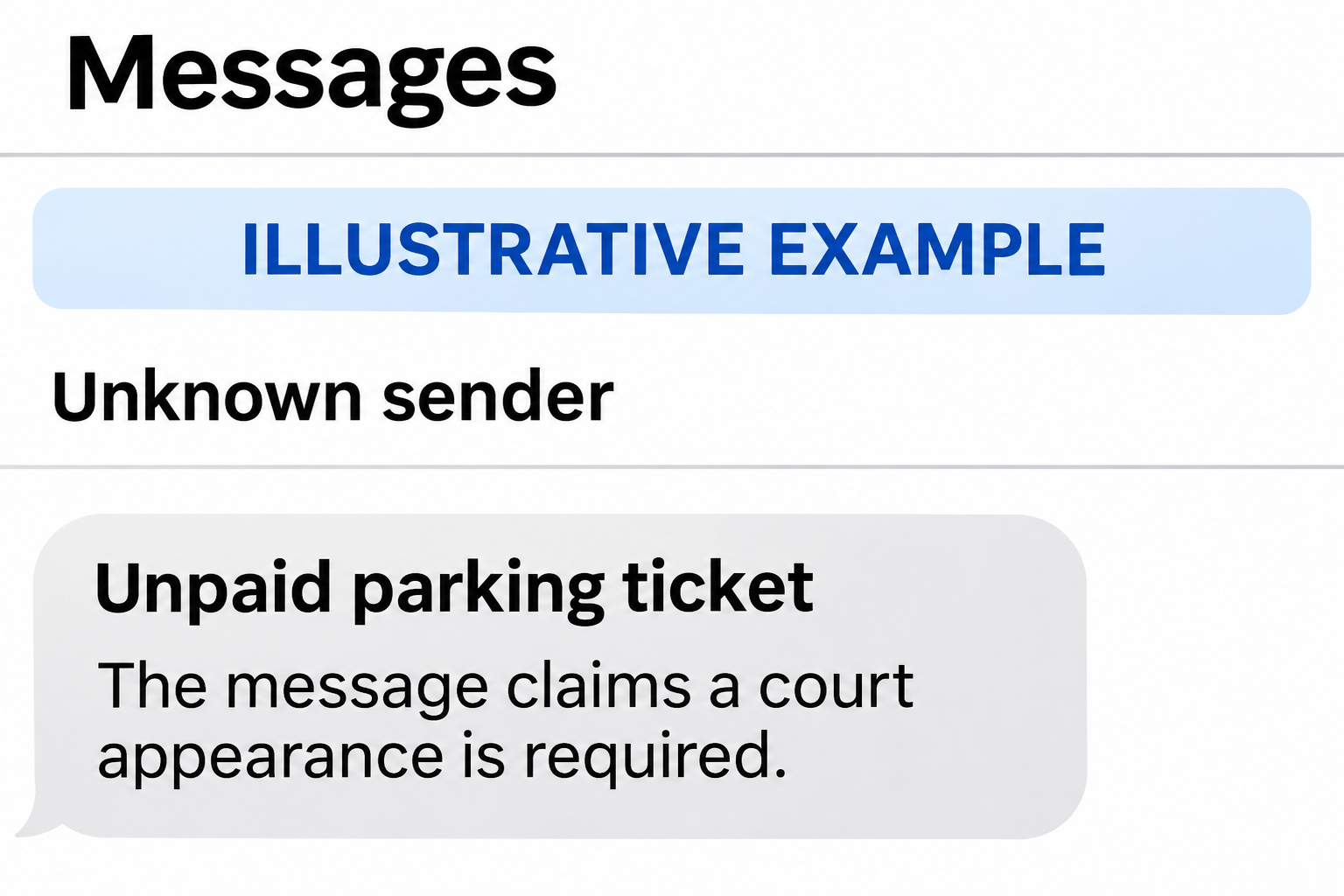
A text says you forgot to pay a parking ticket. Then it gives you a date to appear in court.
If it names Franklin County Municipal Court in Columbus, Ohio, there’s a way to check the claim without touching the message.
Overview
The court has confirmed the payment texts are fake
The Franklin County Municipal Court text scam tells Ohio residents that a fine is overdue and that paying promptly can keep the matter out of court.
In a joint warning from the court and clerk, both offices say they don’t use text messages to notify people of fines. Initial court appearances are sent by mail.
The warning describes messages claiming an unpaid parking ticket and giving the recipient a choice: pay through the message or show up for a hearing.
Some messages even gave a date and time that week. The court told recipients not to come in unless they actually had a scheduled hearing.
A seal, judge’s name, or hearing date doesn’t make it a court record
The court’s scam advisory describes a fake Ohio seal and a notice naming someone who wasn’t a sitting judge there. It also says the court doesn’t request QR-code payments.
Those are useful clues, but you don’t have to memorize officials’ names or compare graphics. Even a perfectly copied seal wouldn’t put a hearing on the calendar.
What counts is the record kept by the clerk, and a contact route you found without using the number, button, or code in the text.
There are two questions, and the text can’t answer either one
First, did the message come from the court? Second, do you separately have a real ticket or a real hearing? The answers don’t have to match.
- A fake payment text doesn’t create a fine or a court date.
- A real ticket from an earlier incident doesn’t make an unrelated text trustworthy.
- A name, case number, or court date can look plausible without matching an official record.
- If a genuine obligation exists, handle it through the clerk or the agency responsible for it.
That distinction matters most if you’ve actually parked downtown recently, or you’re already waiting to hear about a citation. Verify the real matter without following the false notice.
How the Franklin County Municipal Court Text Scam Works
Step 1: A familiar parking problem becomes a court threat
Parking tickets are mundane. A hearing isn’t. Putting both in the same message makes a routine nuisance feel like something that could disrupt your week.
The wording may change from parking to a traffic citation, toll, or missed appearance. The court’s advisory covers more than one type of fake fine message.
Someone who recently drove through Columbus has a ready explanation for the message. Someone who didn’t might wonder whether another person used their plate or their information.
Either reaction can keep you reading. Neither makes the sender the right person to ask about your car, your license, or any case filed in your name.
Step 2: The notice uses the language and appearance of authority
Terms like final notice or enforcement can make a text feel as if it arrived at the end of a process you somehow missed.
Adding a court name, an official-looking seal, or a hearing time gives you more details to react to. None of them is hard to put in a document.
The court points to obvious errors in some versions. You may not see those errors in yours. A message can look neat and still be made up.
Don’t use a spelling mistake as your only test. The important mismatch is the instruction to settle a court fine from an unsolicited text.
Step 3: A short deadline makes the payment feel like a shortcut
The court’s warning mentions messages with a hearing date that week. If you’re at work or caring for family, the chance to avoid that appointment can feel appealing.
The message offers an apparently simple choice: pay now or face the inconvenience and fear of showing up. It doesn’t invite you to verify whether the hearing exists.
That missing option is the one you should take. Use the court’s records or ask the clerk about the notice before making any decision about the claimed date.
Step 4: The link or QR code takes the decision away from the clerk
A QR code is another way to open a link. It can hide the destination from view until your phone reads it, which makes a notice harder to judge.
You don’t have to scan it to see where it goes. The court already says a QR-code payment request isn’t how it collects a fine.
A fake payment page may ask for enough personal information to look like it is matching a record. Entering it gives the page that information, not the court.
If a card form appears, the amount displayed doesn’t limit what someone can try with the card details later. That’s why a small claimed fine can still matter.
Step 5: A payment screen can leave you believing the problem is over
A screen that says your payment was accepted doesn’t prove a court received it. A failure message doesn’t tell you whether the page captured the data you entered.
Don’t try a second card or look for help through the same website. Check activity with your bank and verify any real citation with the clerk.
Keep those jobs separate. Your bank can help with a card transaction; it cannot tell you whether a hearing is actually on the court’s schedule.
How to Check a Franklin County Ticket or Hearing Safely
Start with the clerk’s actual record search
Open the Franklin County Municipal Court Clerk’s record search independently. The court’s website can also direct you to it if you aren’t sure where to start.
Use information you already know, such as the number on a citation you were actually given. If you use a number from the text, don’t assume it belongs to you.
Match the identity, case type, and hearing details before drawing a conclusion. A similar name or a number that produces a result isn’t the whole story.
If you find a case you recognize, check the next action through the official record or ask the clerk. Don’t let the text tell you how to pay it.
Know what an empty search can and can’t tell you
An empty result doesn’t necessarily settle every ticket question. You may have the wrong number, the record may not be available online, or another office may handle the citation.
If you have a paper citation, check its instructions against the issuing authority’s website. Don’t discard a real notice because an unrelated text was fake.
For a genuine hearing you already know about, keep following your court paperwork or advice from your lawyer. A separate scam doesn’t cancel a real date.
If the notice is the only thing telling you to appear, call the clerk through its published contact route before making a trip or changing your schedule.
Don’t mistake a paid card charge for a paid court balance
If you authorized a transaction through the text, a pending card entry may only show that somebody attempted to charge you. It doesn’t identify an official court payment.
Look at the clerk’s record for any legitimate balance, and work with the card issuer on the suspected fraud. The two records can tell very different stories.
Even if you owe a real fine, don’t assume the money you sent through the scam will count toward it. Ask the clerk what remains due.
Which Columbus Office Handles the Ticket?
A city parking citation and a court traffic citation aren’t interchangeable
For an actual Columbus parking ticket, the city’s parking citation page explains the city’s own ways to pay or contest it. Start there if Columbus issued the citation.
The court clerk’s Traffic Violations Bureau has separate instructions for traffic citations it handles. The fact that both offices serve Columbus doesn’t make their records interchangeable.
If the message calls something a toll, a parking fine, and a court case in the same breath, don’t try to make the three descriptions fit.
Look at the citation you actually received. If you don’t have one, ask the office named in the message through its independently published contact information.
Be clear about what you want the clerk to verify
Tell the clerk whether you’re asking about an existing case, a hearing time, or a payment demand you didn’t expect. Those questions may use different records.
If you need to reach a specific division, start from the clerk’s contact directory. Don’t call a number that appears only in the notice.
You don’t need to send payment details to ask whether the office recognizes the kind of notice you got. A screenshot with sensitive details hidden can explain it.
Write down the office that helped you and what it verified. If the same text arrives again, you can go back to a known contact.
Help someone verify the notice without passing the link around
If a family member asks for help, don’t have them forward a working link to everyone. Ask what the message claimed and whether they already took action.
Bring up the clerk’s page together. Let them compare it with any genuine paperwork privately, especially if the record involves personal details they don’t want to share.
For someone who already paid, help them reach the issuer first. You can still check the court’s records while the issuer deals with the exposed card.
What to Do if You Have Fallen Victim to This Scam
-
If you only read the text, don’t scan or reply. Save a screenshot if you want to report it, then use your phone’s spam controls.
For the next message in the same thread, use the same rule. A reply calling itself a correction or an extension still hasn’t come through a verified channel.
-
If you opened the page without entering anything, close it. Check whether it downloaded a file or asked to send notifications, and remove permissions you granted.
Opening a link alone isn’t proof of infection. If you downloaded or installed something, don’t open it again to see what it does.
-
If you entered card information, contact your issuer promptly. Tell them it was a fake court payment page, whether or not the screen showed a completed payment.
Ask whether they recommend locking or replacing the card and disputing a charge. Keep the merchant name on the statement and any reference the bank gives you.
-
If you gave a password, change it on the real service. Check recent sign-ins and make the same change anywhere you reused that password.
If you shared identity information, use the FTC’s IdentityTheft.gov recovery guide to choose actions based on what was disclosed.
-
If you installed an app or gave someone remote access, address that separately. Disconnect the device if the access is still running and get trusted help.
Use another device for banking until the first is checked. Don’t download a supposed fix from the sender or give them an additional access code.
-
Report the notice and preserve the payment evidence. The court asks recipients to contact local law enforcement. Keep the sender, time, screenshot, and any transaction details.
The FTC phishing guide also explains how to report a text through your carrier. Don’t post an unredacted notice or card statement publicly.
-
Verify the underlying court matter if you still have a reason to expect one. Tell the clerk that a text gave you a date or claimed a fine.
Ask which record or office can confirm it. If a legitimate case is already underway, continue to follow its verified instructions while the bank investigates the fraud.
Frequently Asked Questions
Does Franklin County Municipal Court text people to collect a fine?
No. The court and clerk say they don’t use text messages to notify people of fines. The warning specifically covers the pay-or-appear parking ticket message.
Is the Columbus Municipal Court name a sign that the message is real?
No. People may use that name when talking about Franklin County Municipal Court, but neither a familiar local name nor a courthouse address authenticates a text.
Should I go to court on the date in the text?
Don’t go solely because the text says to. Confirm through the clerk first. If you already have a verified hearing, keep following its official instructions.
What if the notice includes a case number that looks right?
Check it with the clerk and verify that it matches you and the case described. A real-looking number isn’t permission to pay the sender.
Is scanning the QR code the same as paying?
No. Scanning may open a page, but it isn’t itself a card payment. Close the page and act according to what you entered, downloaded, or authorized.
What if my bank confirms that the money actually left my account?
Report it as a suspected fraud transaction through the bank’s official channel. Separately ask the clerk about any real balance you might owe.
The Bottom Line
The Franklin County Municipal Court text scam uses a fake fine to send you to a payment page. Don’t pay or scan a code from the message.
Verify any real ticket or hearing through the clerk. If you entered card details, call your issuer now rather than waiting to see whether the sender writes back.

Join the discussion
0 commentsShare your experience or ask a question about this article.
Discussion
Start the conversation
Have a question or something useful to share? Add the first comment.