

In late 2025, a website called RimaTech began flooding Facebook and Instagram with flashy ads for all kinds of futuristic gadgets — from “AI-powered drones” and “portable 4K displays” to the now-infamous Rima SoloJet, a compact jet boat supposedly on sale for $159. The site, listed as rimatech-us.co, promises up to 40% off site-wide, lifetime warranties, and free surprise gifts with every order.
To the average shopper, it looks like a sleek new tech brand offering high-performance outdoor and digital gear at incredible prices. But after a closer look, experts and victims alike have discovered a very different story. RimaTech’s entire operation fits the pattern of a large-scale online shopping scam designed to take money, vanish, and relaunch under new names.
This in-depth investigation breaks down exactly how the RimaTech scam works, what red flags to look for, and what steps to take if you’ve already placed an order.
Scam Overview: How RimaTech Tricks Shoppers
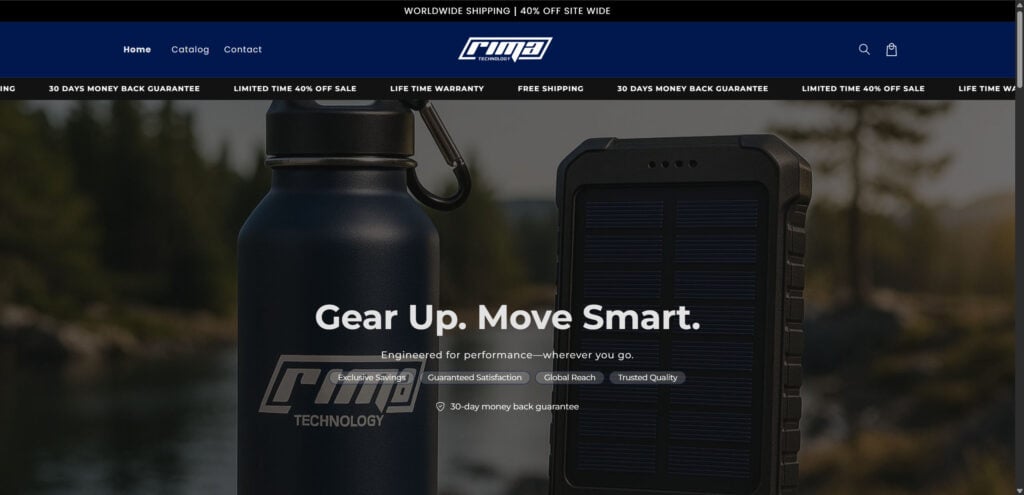
At first glance, the RimaTech website looks professional. It uses dark blue branding, modern fonts, and high-resolution product photos that make it appear legitimate. The home page displays messages like “Worldwide Shipping | 40% Off Site-Wide” and “30-Day Money Back Guarantee”, creating a strong sense of trust and urgency.
But beneath the polished design lies a web of deception — fake product lines, falsified reviews, and cloned imagery from real brands. Let’s dissect the main signs of fraud that define RimaTech’s operation.
1. The “Too-Good-To-Be-True” Pricing
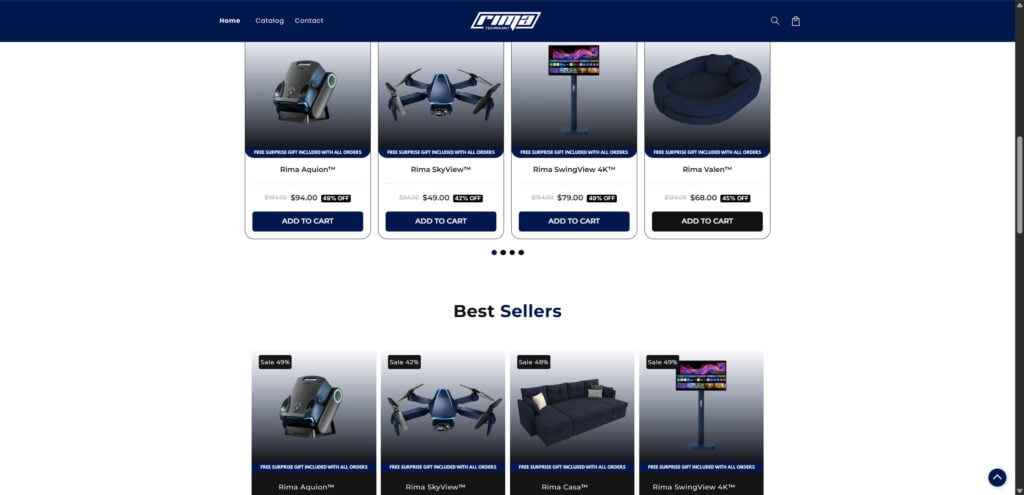
Nearly every item on rimatech-us.co is advertised with massive markdowns of 40–50% off. For example:
- Rima SoloJet – $159 (allegedly discounted from $314)
- Rima SkyView drone – $49 (claimed 42% off)
- Rima SwingView 4K display – $79 (claimed 49% off)
- Rima Valen inflatable chair – $68 (claimed 45% off)
These prices are completely unrealistic for what the images show. A real personal jet boat costs $4,000–$10,000, drones with 4K cameras retail for hundreds, and foldable monitors cost well over $300.
The extreme discounts are designed to override skepticism and make shoppers act quickly. Scammers know that the greater the perceived deal, the less likely buyers are to double-check legitimacy.
2. A Fake Catalog of Random Products
The product catalog is another telltale sign. RimaTech claims to sell over 100 products ranging from drones, solar generators, e-bikes, and smart projectors to couches, water bottles, and inflatable sofas.
No real company can produce such a wide range of unrelated goods under one brand. The catalog appears copied from multiple legitimate websites, rebranded with “Rima” names like Rima Casa, Rima ChefCut, Rima CargoTrike, or Rima Aquion.
This “everything store” model is a typical pattern among scam sites — they combine random product images to appear busy and credible, while none of the items are actually manufactured or stocked.
3. Fake Reviews and Ratings
Each product page displays a 4.8-star rating with “4,000+ reviews.” The Rima SoloJet listing, for instance, claims over 4,164 reviews and “1,000 orders in the last 24 hours.”
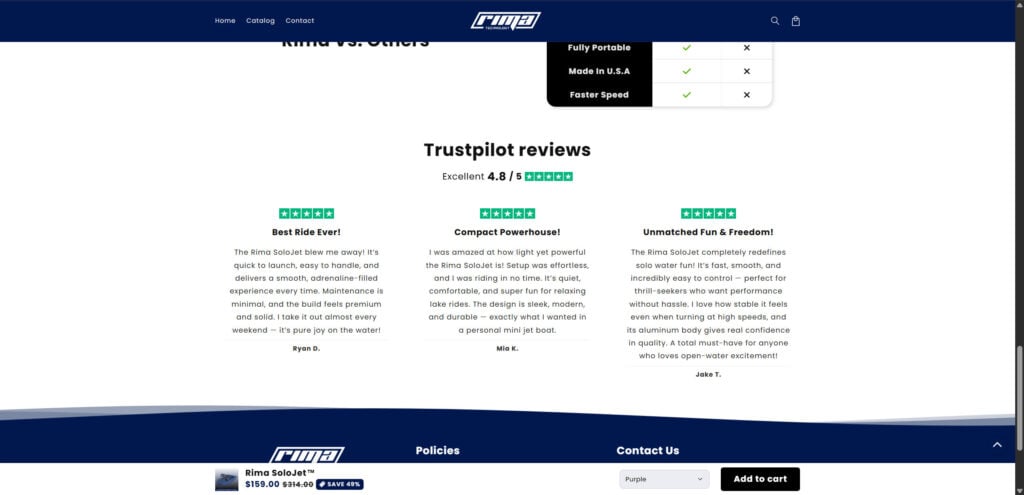
Independent verification proves these numbers are fabricated. There are no legitimate reviews on Trustpilot, Reddit, or any recognized marketplace. The 4.8 rating shown is part of a static graphic built into the website’s code — it never changes, regardless of the item.
This trick gives the illusion of popularity while hiding the absence of real buyers.
4. Recently Created Website with Hidden Ownership
A WHOIS lookup reveals that rimatech-us.co was registered in October 2025 — just weeks before its ads went live. The registrant’s name, address, and contact details are hidden behind a privacy shield, a method often used by scam operators to avoid identification.
There is no verifiable business registration, no physical office, and no legitimate corporate email address. The only contact option is a generic support form that either goes unanswered or sends automated replies.
5. Stolen Images and Product Designs
Many RimaTech product photos are stolen from genuine manufacturers. For example:
- The “Rima SoloJet” uses images from Havospark, a legitimate watercraft company.
- The “Rima SkyView” drone matches photos from DJI models.
- The “Rima SwingView 4K” monitor appears identical to a portable display sold on AliExpress.
The stolen visuals lend a false sense of authenticity and help bypass social-media ad filters that flag generic stock images.
6. False Promises and Psychological Triggers
The homepage banner lists attractive but meaningless guarantees:
- “Lifetime Warranty”
- “Free Surprise Gift with Every Order”
- “30 Days Money-Back Guarantee”
These statements exploit buyer psychology. The “lifetime warranty” sounds reassuring but has no legal or logistical basis. The “free gift” acts as a dopamine trigger, nudging shoppers to purchase immediately.
In practice, victims report that once payment is made, no product arrives or a random low-value trinket is delivered instead.
7. Copy-Protected Pages and Obfuscated Text
Visitors cannot copy or highlight text on rimatech-us.co. Scammers implement this restriction to prevent users from Googling suspicious phrases or discovering that entire paragraphs were plagiarized from legitimate stores.
8. Misleading Company Branding
The website presents itself as “Rima Technology”, with slogans like “Gear Up. Move Smart.” and “Engineered for performance — wherever you go.” These branding lines are professional but entirely generic, appearing nowhere else on the internet prior to the site’s creation.
The logo “RIMA” is stylized in a bold blue font reminiscent of real tech companies, giving an illusion of corporate legitimacy.
9. Fake Trust Badges and Logos
On multiple pages, RimaTech displays logos of well-known retailers and TV shows — Target, Dick’s Sporting Goods, Shark Tank, Vogue — implying partnerships or endorsements. None of these affiliations are real.
Scam sites frequently use this tactic to reassure potential buyers who are scrolling quickly and won’t verify details.
10. The Illusion of Activity
To simulate live customer engagement, RimaTech shows pop-up notifications like “John from Florida just purchased a Rima SkyView Drone” or “Sophia from Texas bought a SoloJet 5 minutes ago.” These are auto-generated scripts. There are no real customers.
How the RimaTech Scam Works
Understanding RimaTech’s mechanism reveals how modern online scams operate seamlessly across platforms and domains.
Step 1: Launching the Fake Brand
Scammers begin by registering a fresh domain like rimatech-us.co through a registrar that allows hidden WHOIS data. They set up a professional-looking Shopify or WooCommerce template with clean fonts, responsive layouts, and pre-built checkout forms.
They upload hundreds of stolen product images and write AI-generated descriptions using marketing buzzwords such as “durable,” “next-gen,” “adventure-ready,” and “smart performance.” The goal is to create a convincing tech brand identity within days.
Step 2: Setting Up Facebook and Instagram Ads
Next, the scammers launch a flood of paid ads featuring stolen videos of drones, boats, and smart gadgets. They often use captions like:
- “Limited Stock Available – Order Today Only!”
- “40% Off Site-Wide – Sale Ends at Midnight!”
- “Thousands Sold in the Last 24 Hours!”
The ads target audiences who’ve recently interacted with technology or outdoor-gear content, maximizing conversion potential.
Because these ads use real product videos and neutral language, they easily pass automated review systems on Facebook and Instagram.
Step 3: Building False Credibility
Once users click the ad, they’re greeted with a well-designed landing page displaying trust badges, countdown timers, and fake review widgets. A small cart icon in the top corner suggests an established e-commerce site.
Buyers are also promised free worldwide shipping and surprise gifts, which further reduce hesitation. The entire design is optimized to create an illusion of legitimacy during the few minutes between curiosity and checkout.
Step 4: Collecting Payments
When customers place an order, their payments are processed through third-party merchant accounts that use vague billing descriptors. This makes tracing the transaction difficult.
Victims usually receive an automated confirmation email with phrases like “Your order is being prepared for shipment.” After that, communication stops or becomes generic. Some users later receive fake tracking numbers linked to dummy logistics sites.
Step 5: Delivering Nothing or Junk Items
Weeks later, buyers either receive nothing or a small unrelated product such as a USB light, plastic keychain, or toy. This tactic creates “proof of delivery,” complicating chargeback requests.
In reality, no RimaTech warehouse exists, and no legitimate product inventory is maintained. The shipping labels, when present, are usually from low-cost fulfillment centers in China or anonymous reshippers.
Step 6: Disappearing and Rebranding
As soon as refund demands grow, scammers abandon the site, deactivate ads, and reappear under new names like RimaStore, RimaGear, or RimaProTech. The template, logo, and text remain nearly identical.
This rotation strategy allows them to evade blacklists and restart with a clean digital footprint every few months.
Step 7: Exploiting Payment Gaps and Platform Loopholes
Because platforms like Meta rely heavily on automated moderation, scam ads can remain active for days before removal. During this time, thousands of impressions generate hundreds of purchases.
Payment processors often take weeks to investigate complaints, allowing scammers to withdraw funds before accounts are frozen.
By the time a customer realizes they’ve been scammed, the website is either offline or replaced with a new URL.
Step 8: Recycling Stolen Content
Scammers recycle the same media across domains. The video of the Rima SoloJet, for example, also appears in unrelated ads for “Temu Jet Boat” or “Havospark Mini.” The same drone images appear under different fake brand names.
This reuse strategy keeps costs low while maintaining visual believability.
What to Do If You’ve Fallen Victim to the RimaTech Scam
If you placed an order on RimaTech or a similar site, act immediately. Swift action can significantly improve your chances of recovering funds and protecting personal data.
1. Contact Your Bank or Credit-Card Issuer
Report the charge as fraudulent and explain that you were misled by a fake online store.
Request a chargeback — credit-card networks typically allow disputes within 60–120 days.
Provide screenshots of the website, ads, and any correspondence as evidence.
2. Monitor Your Accounts
Keep an eye on your bank and email accounts for suspicious activity. Scammers sometimes attempt repeat or secondary charges after an initial transaction.
3. Do Not Provide Further Information
If “RimaTech support” contacts you asking for ID, payment confirmation, or photos of your card, do not reply. Legitimate companies never request such data through unsecured emails.
4. Collect and Save All Evidence
Save:
- Order confirmations and payment receipts
- Screenshots of the RimaTech website
- Any delivery tracking numbers
- Emails or messages exchanged
This documentation strengthens your case when filing complaints.
5. File Official Complaints
In the United States:
- Federal Trade Commission (FTC): reportfraud.ftc.gov
- Internet Crime Complaint Center (IC3): ic3.gov
In other regions, contact your national consumer-protection or cyber-fraud authority.
6. Report the Ads on Social Media
If you saw RimaTech ads on Facebook, Instagram, or TikTok, use the Report Ad feature under “Misleading or Scam.” Include a short explanation that you purchased and received nothing or a fake product. Platform reviews often lead to faster takedowns.
7. Change Your Passwords
If you created an account on RimaTech or reused credentials from other sites, change those passwords immediately. Use strong, unique passwords and enable two-factor authentication.
8. Warn Others
Post your experience on trusted forums like MalwareTips.com, Reddit’s r/Scams, or Trustpilot. Sharing detailed information — including URLs and screenshots — helps others avoid falling into the same trap.
9. Learn from the Red Flags
Understanding the warning signs is crucial for future safety:
- Unverified brand names with no history
- Unrealistic prices and permanent “40% off” claims
- Hidden WHOIS details and recent domain registrations
- Copy-protected product pages
- Generic marketing promises without technical details
Recognizing these traits early can save you from future loss.
The Bottom Line
RimaTech presents itself as a cutting-edge technology brand selling affordable drones, jet boats, and adventure gadgets. In reality, it’s a sophisticated e-commerce scam built on deception, false credibility, and psychological manipulation.
The evidence is overwhelming:
- The domain rimatech-us.co is newly registered and anonymous.
- Product images are stolen from legitimate manufacturers.
- Reviews and Trustpilot scores are fabricated.
- Pricing and sales claims are mathematically impossible.
- Victims consistently report non-delivery or unrelated junk items.
RimaTech is not a legitimate company — it’s a facade built to exploit impulsive shoppers through viral advertising. The operation thrives on social-media visibility, high discounts, and buyer trust in professional-looking websites.
The safest course of action is simple:
Never buy from unfamiliar sites that combine heavy discounts, no verifiable company data, and unrealistic product claims.
If you’ve been affected, follow the recovery steps above and report the website immediately. Collective awareness and timely reporting are the most effective tools against scams like RimaTech.
Stay skeptical, research every brand before purchase, and remember: if it looks too good to be true, it probably is.
Frequently Asked Questions (FAQ) About the RimaTech Scam
What is RimaTech?
RimaTech is a website that presents itself as a modern technology company selling innovative gadgets, drones, smart displays, and outdoor gear at steep discounts. The site, found at rimatech-us.co, showcases sleek products like the Rima SoloJet mini jet boat, Rima SkyView drone, and Rima SwingView 4K display. However, investigations show that these products are not real RimaTech inventions but stolen images and designs from other brands. The company provides no verifiable contact information, no real customer service, and no public business registration, making it a highly suspicious online operation.
Is RimaTech a legitimate company?
No, RimaTech is not a legitimate company. Everything about the brand — from its newly registered domain and hidden ownership data to fake customer reviews and unrealistic discounts — indicates a scam. The website was created recently, with all registrant information masked. There is no corporate address, no support phone number, and no evidence that the business exists offline. Numerous red flags, including fake ratings and fabricated Trustpilot badges, confirm that RimaTech is not a genuine retailer but a fraudulent online store designed to deceive shoppers.
What products does RimaTech claim to sell?
RimaTech lists a wide variety of products under categories like gadgets and outdoor gear. These include drones, projectors, portable monitors, smart furniture, inflatable chairs, e-bikes, solar panels, and even a personal jet boat called the Rima SoloJet. This product diversity is a clear sign of a scam because no legitimate company produces such unrelated items under a single brand. Most of the product images are stolen from legitimate manufacturers or online marketplaces and simply rebranded with the RimaTech logo.
How does the RimaTech scam work?
The RimaTech scam follows a classic pattern used by fraudulent e-commerce websites:
- Creation of a fake brand: Scammers register a new domain and build a professional-looking site using stolen product photos.
- Aggressive social-media ads: They launch viral Facebook and Instagram campaigns featuring fake videos and massive discounts.
- False trust signals: The site displays fabricated reviews, fake ratings, and logos of reputable companies to appear credible.
- Payment collection: Customers are urged to buy quickly through limited-time offers and checkout pages that accept major credit cards or Apple Pay.
- Non-delivery or fake items: After payment, buyers either receive nothing or a random, low-cost trinket sent to create a false tracking record.
- Disappearance and rebranding: When complaints grow, the scammers shut down the site and relaunch under a new name with the same layout and products.
This method allows scammers to repeatedly target unsuspecting consumers before authorities or payment processors can intervene.
Why do so many people fall for RimaTech’s ads?
RimaTech’s marketing is highly manipulative. It uses visual persuasion (real videos of high-end gadgets), psychological triggers (countdown timers, “limited stock” notices, and “40% off” discounts), and social proof (fake 5-star ratings and reviews) to build instant credibility. These tactics create a sense of urgency and trust, leading buyers to act impulsively before verifying the site’s legitimacy. Because the website design appears professional, many victims assume it’s a new tech startup rather than a fraudulent front.
Are the RimaTech customer reviews real?
No. The reviews displayed on the RimaTech website are completely fake. Each product lists thousands of positive reviews, often with the same rating (4.8/5) and repetitive wording. Independent searches on Trustpilot and other platforms show no genuine feedback for RimaTech. In fact, when a few real users post one-star warnings, they confirm that the company is unresponsive and that the “verified purchase” testimonials are fabricated to mislead potential buyers.
What are the biggest red flags of the RimaTech scam?
Several warning signs expose RimaTech as a fraudulent online store:
- The website rimatech-us.co was registered very recently.
- Ownership details are hidden behind domain privacy protection.
- The product catalog includes hundreds of unrelated items.
- Product images and videos are stolen from legitimate brands.
- There is no working phone number or verified business address.
- All listings display fake 4.8-star reviews and exaggerated sales numbers.
- Prices are unrealistically low, often claiming “40% off site-wide.”
- Support emails go unanswered, and refund requests are ignored.
Each of these signs alone is concerning, but together they confirm that RimaTech is not a trustworthy company.
What happens if you buy from RimaTech?
Customers who place orders on RimaTech typically experience one of three outcomes:
- No delivery at all: The most common result — the buyer pays but receives nothing.
- Fake or cheap item: Some buyers receive unrelated products worth only a few dollars, used to create a false delivery record.
- Credit-card issues: A few victims report unauthorized charges appearing on their accounts after purchase, suggesting that payment data may be misused or sold.
Once payment is complete, communication stops. The company does not provide real tracking, customer service, or refunds.
Can you get a refund from RimaTech?
In most cases, RimaTech does not honor its advertised “30-day money-back guarantee.” Victims who contact the listed support address either get automated replies or no response at all. The only reliable way to recover funds is through a chargeback with your credit-card company or bank. If you act quickly and provide documentation — order confirmations, website screenshots, and communication attempts — you have a strong chance of reversing the payment.
How can you report the RimaTech scam?
If you’ve been scammed by RimaTech, you should:
- Contact your bank or credit-card provider immediately to report fraud and request a chargeback.
- File a complaint with the Federal Trade Commission (FTC) via reportfraud.ftc.gov.
- Report the incident to the Internet Crime Complaint Center (IC3) at ic3.gov.
- Notify the social platform (e.g., Facebook, Instagram) where you saw the ad by clicking “Report Ad → Misleading or Scam.”
- Share your experience on public forums like MalwareTips.com or Reddit’s r/Scams to warn others.
Reporting scams helps authorities identify recurring patterns and shut down fraudulent domains faster.
Why is RimaTech still advertising on Facebook and Instagram?
Scammers exploit weaknesses in social-media ad review systems. Platforms like Meta rely on automated algorithms to approve ads, and since RimaTech’s ads use real-looking footage and non-violent language, they slip through filters. Even when users report them, it takes days or weeks for removal. By then, the scammers have often collected enough money to close the site and move on to a new one. This cycle makes detection and enforcement difficult, especially when domains and payment accounts are registered offshore.
Is the Rima SoloJet jet boat real?
No, the Rima SoloJet featured on rimatech-us.co is not a real product. The images used are from Havospark, a legitimate company that manufactures high-end watercraft. RimaTech has no connection to Havospark or any authentic jet-boat manufacturer. The SoloJet’s advertised price — around $159 — is impossible for a functional motorized watercraft. Selling such a product at that price is a clear indicator of fraud.
Why does RimaTech sell so many different types of products?
The wide product range is a deliberate scam strategy. By listing dozens of random gadgets, drones, and furniture items, RimaTech increases the likelihood of attracting different buyer interests. These fake stores often copy-paste product photos and descriptions from multiple real websites, rebranding them under one name. When buyers from different niches find what they’re looking for, the scammer’s reach — and profit — grows exponentially before the site is eventually taken down.

Join the discussion
0 commentsShare your experience or ask a question about this article.
Discussion
Start the conversation
Have a question or something useful to share? Add the first comment.