


A server-maintenance email says the work is finished, but there’s one task left for you. Sign in within 48 hours or risk losing access.
When email keeps your work and personal life moving, that sounds worth a quick click. Take a closer look at what the notice actually asks.
Overview
The maintenance announcement becomes an account-expiration threat
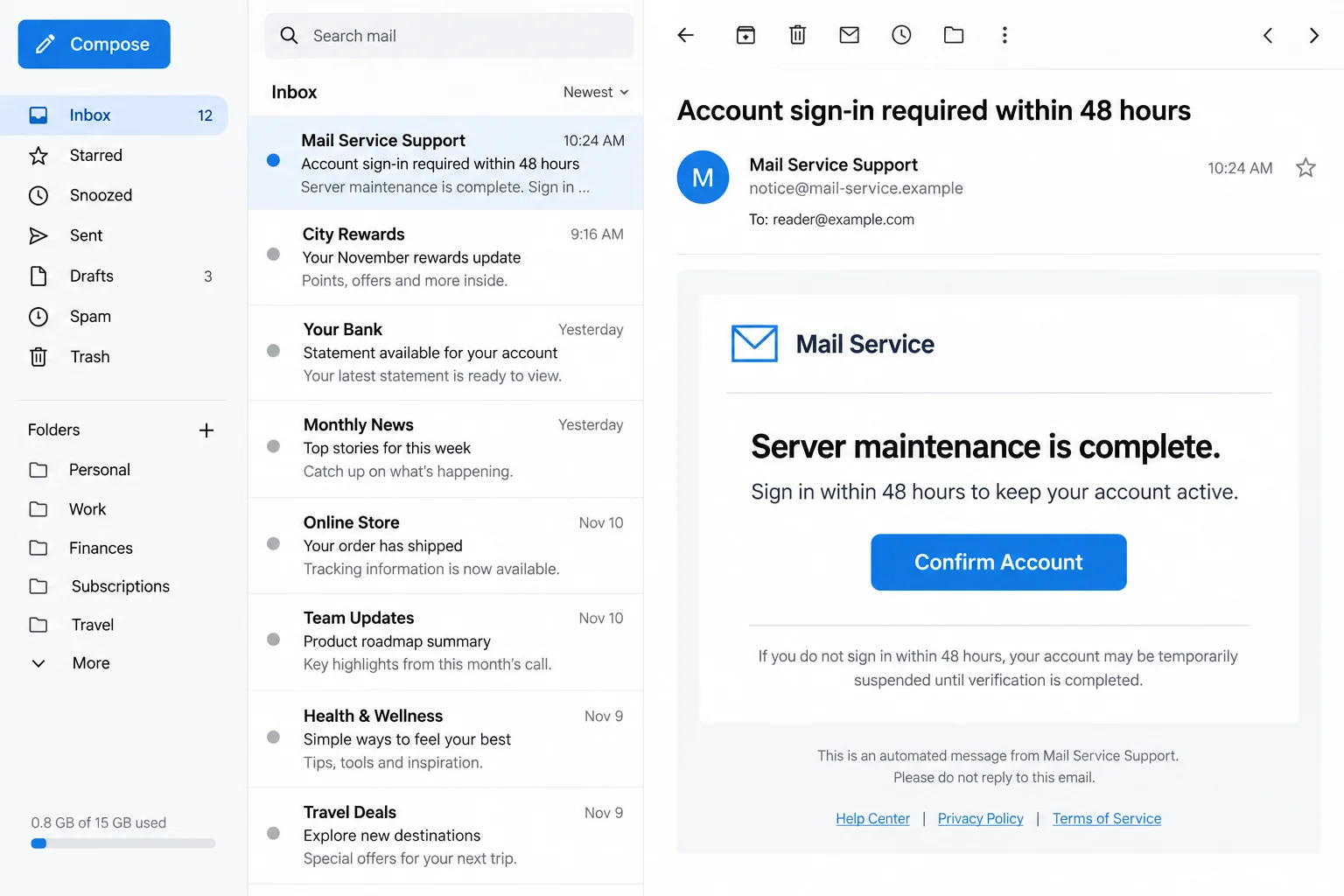
The Server Maintenance and Security Updates email scam claims a provider has completed work on its mail servers. It then makes continued access depend on signing in.
The recognizable detail is the 48-hour deadline. The message says a password may expire, or server access may be interrupted, unless the recipient confirms the account.
That is the sender’s claim, not a verified expiration notice. The email doesn’t establish that your actual provider changed your password policy.
The button is the risky handoff
A Confirm Account button moves the reader away from the notice. The reported destination is inactive, so its exact form and behavior cannot be confirmed now.
The lure fits credential phishing: an alleged service requirement pushes you toward an unverified sign-in route. Don’t supply a password through that route.
The missing page should not become a guessing game. If another copy asks for a login, check its destination independently rather than trusting familiar branding.
A real maintenance window needs a separate check
- Use the mailbox or customer portal you already trust.
- Ask your organization’s administrator whether the requirement is genuine.
- Check a password-expiration notice through the established account settings.
- Keep any recovery action separate from the email’s confirmation button.
The lead image illustrates the deadline and button using fictional addresses. It is not a captured alert from your provider or proof your account is affected.
Why This Email Can Arrive at a Convincing Moment
Maintenance notices are easy to skim. They often describe work happening behind the scenes, with language most customers have little reason to investigate.
This message starts there, then changes the task. What sounds like a completed technical improvement becomes something the customer must urgently fix.
That change matters. The person responsible for server maintenance and the person reading a mailbox are not necessarily responsible for the same systems.
A customer cannot authenticate a provider’s infrastructure work by submitting an existing password to an unfamiliar website. The requested action needs its own justification.
The 48-hour window also creates a convenient excuse to act now. You may think you’ll forget later, especially before a weekend or a busy shift.
A scammer doesn’t need to know your schedule for that pressure to work. A generic deadline can catch anyone already worried about missing an important email.
Likewise, receiving the notice shortly after a genuine outage doesn’t prove a connection. Unrelated events can make a mass-distributed story feel unusually personal.
Check the specific instruction, not merely whether maintenance is plausible. Real organizations do maintain servers, but that fact doesn’t authenticate this sender.
Some workplaces also have genuine password-expiration policies. You should follow verified requirements through your employer’s normal process, not through a copied maintenance message.
The right alternative is therefore not to ignore every security notice. It is to take the question to the provider or administrator whose authority you can establish.
How the Server Maintenance and Security Updates Email Scam Works
Step 1: A generic support message claims routine work has finished
The opening presents maintenance and security improvements as an accomplished fact. That gives the sender a service-provider role before you have checked its identity.
A broad greeting and generic support signature allow the wording to fit many mailboxes. Neither identifies the company actually responsible for hosting your account.
The message doesn’t need a dramatic virus warning. An administrative requirement can be persuasive precisely because it sounds less sensational than a typical fraud alert.
Before accepting the premise, ask which provider is speaking. A work address may use several vendors, but an unnamed support team should not become trusted by default.
Step 2: Continued access is tied to a 48-hour sign-in
The notice connects the alleged maintenance to a password deadline. It suggests that failing to act could cause expiration or temporary loss of server access.
That creates a small but uncomfortable choice: click now or risk disruption later. The scam benefits if avoiding inconvenience feels easier than checking the request.
Notice what is missing from that reasoning. A countdown tells you when the sender wants action, not whether the sender controls your account.
If a genuine password change is due, an established administrator can confirm it. Don’t let the artificial clock replace that independent check.
Step 3: The confirmation button supplies the sender’s preferred route
The button makes responding seem straightforward. Instead of finding your own login page, you are invited to use the destination chosen by the email’s author.
This is where a routine-looking task becomes a risky detour. The notice’s appearance does not tell you who operates the website behind its button.
Inspecting an address can reveal an obvious mismatch, but you don’t have to open the site to settle the question. Use your normal access route instead.
For this reported sample, the destination is no longer available. Treat a later copy according to its actual request rather than expecting one fixed screen.
Step 4: A supposed account check can become credential exposure
In this phishing pattern, the visitor is encouraged to enter mailbox credentials on a page that does not belong to the real account provider.
A copied logo, prefilled address, or familiar layout can make that request seem continuous with the email. None proves who receives the submitted information.
If you supplied a password, act on the exposure even if no error appeared. A page can accept information without delivering the account change it advertised.
If you stopped before entering anything, don’t return to test the form. Your response should match what happened, not a worst-case story invented afterward.
Check the Request Without Using Its Button
Start with the service you actually use
Open your established webmail bookmark or installed mail application. Check whether you can use the account normally and whether a relevant notice appears there.
Successful access doesn’t prove the email harmless. It simply gives you a safer place to investigate without following the sender’s route.
If an account setting genuinely needs attention, complete it through that trusted interface. You don’t need the suspicious email as a shortcut.
Ask the administrator a specific question
For work or school, ask whether a post-maintenance sign-in requirement was issued and where it should be completed. Include the subject and received time.
Use an existing directory entry, support portal, or known telephone number. A contact address supplied only by the questionable message doesn’t provide independent confirmation.
Don’t send your password with the question. Support staff can investigate the notice without receiving the secret you use to sign in.
Keep useful evidence without spreading the lure
The original message preserves sender details and link information better than a cropped screenshot. Use your organization’s reporting process when available.
If sharing an image with others, hide personal addresses and unrelated inbox contents. Explain the warning instead of encouraging colleagues to try the confirmation link.
A sender address alone is not a complete investigation. Display names can be copied, and a compromised account can send messages from an otherwise genuine address.
If You Entered a Password, Think Beyond the Next Login
Email often connects other parts of your life. A mailbox may contain account-recovery messages, private attachments, purchases, appointments, or ongoing business conversations.
That makes mailbox access useful even without an immediate financial demand. An intruder may look for opportunities already present in existing correspondence.
Start by restoring control of the affected account. Then consider what that account could reach, rather than changing every unrelated service in a panic.
Review account-recovery information and active sessions where the provider supports those controls. Check for forwarding rules or filters you did not create.
A filter that hides security messages can be as important as an unfamiliar login. Document suspicious changes before removing them if your support team needs evidence.
If the password was reused, change it on those other accounts too. Choose different replacements so one future disclosure doesn’t unlock several services.
For a company mailbox, let the organization assess the wider exposure. Shared files and customer conversations may require a coordinated response.
You don’t need to prove that every message was read before reporting a disclosure. Describe exactly what you entered and let the appropriate team investigate.
What to Do if You Have Fallen Victim to This Scam
Stop the confirmation process. Close the linked page and refuse any further request to verify through the same email.
If you only received the notice, report it as phishing. Receiving this message alone is not evidence that your computer has malware.
Record what you actually did. Note whether you clicked, typed a password, approved an authentication prompt, downloaded something, or ran software.
Keep the original email and approximate times. Don’t put the exposed password into a report or send it to someone offering assistance.
Replace disclosed credentials through the genuine provider. Use a trusted device if the original device may have run unfamiliar software.
For a managed account, contact the real help desk immediately. Its recovery process may include session termination and additional checks you cannot perform yourself.
Review the ways back into the account. Check recovery contacts, authorized applications, login history, and session controls available in the real account settings.
Turn on supported multifactor protection after regaining control. Don’t approve an unexpected prompt simply because the fraudulent page says approval completes maintenance.
Inspect mailbox behavior. Look for unknown forwarding destinations, filters, sent messages, or deleted security alerts.
If messages were sent in your name, coordinate a warning through a channel you control. Tell contacts not to act on suspicious requests from that period.
Check the device if software was involved. An unexpected installer, downloaded attachment, or persistent browser change calls for a separate security assessment.
Use Malwarebytes and the appropriate device instructions below. A scan does not recover a stolen mailbox password or cancel a session on another service.
Handle any real financial exposure promptly. Contact the bank, card issuer, or service involved using independently obtained contact details.
Give accurate dates and transaction references. The email’s expiration threat is not a reason to pay for emergency recovery offered by its sender.
Reduce repeat exposure. Keep browser protections active, update software, and consider AdGuard to limit some malicious advertisements and redirects.
These measures complement careful verification. They do not turn an unfamiliar confirmation form into a trustworthy place to enter your password.
Is Your Device Infected? Run a Free Malware Scan
Slow performance, constant pop-ups, or strange behavior? These are classic signs of a malware infection. A quick way to check is to scan your device with Malwarebytes Free, one of the most trusted malware removal tools available. If you only visited a scam page and didn’t download or install anything, this scan is optional.
The free version detects and removes the most common threats, including:
- Adware — the cause of those annoying pop-ups
- Browser hijackers — unwanted redirects and changed homepages
- Trojans and spyware — hidden programs stealing your data
- Potentially unwanted programs (PUPs) — software you never asked for
👉 Select your device below — Windows, Mac, or Android — then follow the simple steps to download Malwarebytes, scan your system, and remove any threats it finds. The scan usually takes 5 to 20 minutes.
Run a Malware Scan with Malwarebytes for Windows
Malwarebytes is one of the most popular and trusted anti-malware tools for Windows — and it’s completely free for removing infections. It catches threats that many antivirus programs miss, including adware, browser hijackers, and trojans. Follow the steps below to scan your PC and remove what Malwarebytes finds.
Download Malwarebytes
Click the button below to download the latest version of Malwarebytes for Windows from the official source. The free version is all you need — it will scan your computer and remove adware, browser hijackers, and other malicious software at no cost.
Download MalwarebytesOfficial installer for Windows 11 and 10. Your download starts right away.Want real-time protection? See Malwarebytes Premium Malwarebytes Free for WindowsScans and removes malware at no cost
-
Install Malwarebytes
When the download finishes, open your Downloads folder and double-click the MBSetup file. If Windows shows a User Account Control pop-up, click “Yes” to allow the installation.

Follow the On-Screen Prompts to Install Malwarebytes
The setup wizard will walk you through a few quick screens:
-
Choose where you’re installing the program — “Personal Computer” or “Work Computer” — then click Next.

-
Malwarebytes will now install on your device. This usually takes under a minute.

-
When installation is complete, the “Welcome to Malwarebytes” screen will open automatically.

-
On the final screen, click Open Malwarebytes to launch the program.

-
Optional: Check for rootkits with a Custom Scan
You don’t need to change any settings for a normal scan. The standard Threat Scan in the next step is enough for most problems, so you can go straight to it.
If you also want to check for rootkits, use a Custom Scan. In current versions of Malwarebytes, rootkit scanning is only available there:
- On the Scanner tile, click the three-dot menu and select Advanced Scan.
- Choose Custom Scan. In its options, check Scan for rootkits.
- Select your system drive (usually C:\) as the location to scan, then start the scan. It takes longer than a Threat Scan.
- When it finishes, review and quarantine the results as described in the steps below.
Rootkit scanning isn’t available on Windows devices with ARM processors.
Start the Scan
Click the blue Scan button. Malwarebytes will automatically update its virus database and start checking your computer for malware.

-
Wait for the Scan to Finish
The scan checks your entire system for browser hijackers and other malicious programs, so it can take 5 to 20 minutes depending on your computer. Feel free to do something else — just check back occasionally to see the progress.

-
Quarantine the Detected Threats
When the scan is done, you’ll see a list of everything Malwarebytes found — malware, adware, and potentially unwanted programs. Click the “Quarantine” button to remove all of them at once.

Malwarebytes will now remove the malicious files and registry entries and move them safely into quarantine.

-
Restart Your Computer
Some threats can only be fully removed after a reboot. If Malwarebytes asks you to restart, click Yes. Once you’re logged back in, Malwarebytes has finished removing the threats it found.

When the scan is done, check whether the problems you noticed have stopped. If they continue, see the options below.
If you are still having problems with your computer after completing these instructions, then please follow one of the steps:
- Run a computer scan with ESET Online Scanner
- Ask for help in our Windows Malware Removal Help & Support forum.
Run a Malware Scan with Malwarebytes for Mac
Malwarebytes for Mac is a free on-demand scanner that removes the malware other security software tends to miss — adware, browser hijackers, and unwanted programs included. Cleaning an infected Mac with Malwarebytes has always been completely free, and it’s our go-to recommendation. Follow the steps below to scan your Mac and remove what Malwarebytes finds.
-
Download Malwarebytes for Mac
Click the button below to download the latest version of Malwarebytes for Mac.
Download MalwarebytesOfficial installer for macOS. Your download starts right away.Want real-time protection? See Malwarebytes PremiumMalwarebytes Free for MacScans and removes malware at no cost -
Open the Malwarebytes setup file
When the download finishes, open your Downloads folder and double-click the setup file to begin the installation.

-
Follow the On-Screen Prompts to Install Malwarebytes
The Malwarebytes for Mac Installer will guide you through a few quick screens. Click “Continue” and keep following the prompts until the installation completes.



When the installation is complete, Malwarebytes opens to the Welcome to Malwarebytes screen. Click “Get started“.
Malwarebytes needs Full Disk Access to check your whole Mac. When it asks, open System Settings > Privacy & Security > Full Disk Access, turn on Malwarebytes (it may be listed as Malwarebytes Protection), and confirm with your password or Touch ID. Then return to Malwarebytes. On macOS Monterey and earlier, this setting is in System Preferences > Security & Privacy > Privacy.
-
Select “Personal Computer” or “Work Computer”
Malwarebytes will ask what type of computer you’re installing it on. Click either Personal Computer or Work Computer, whichever applies.

-
Start the Scan
Click the “Scan” button. Malwarebytes will automatically update its detection database and begin checking your Mac for malware.

-
Wait for the Scan to Finish
Malwarebytes will scan your Mac for adware, browser hijackers, and other malicious programs. This can take a few minutes, so feel free to do something else — just check back occasionally to see the progress.

-
Quarantine the Detected Threats
When the scan is done, you’ll see a list of everything Malwarebytes found. Click the “Quarantine” button to remove all the threats at once.

-
Restart Your Mac
Malwarebytes will now remove all the malicious files it found. Some threats can only be fully removed after a reboot — if Malwarebytes asks you to restart, allow it. Once you’re logged back in, check whether the problems you noticed have stopped. If they come back, save the scan report and ask for help in our forum.

If the problems you noticed continue after the scan, see the options below.
If you are still experiencing problems while trying to remove a malicious program from your computer, please ask for help in our Mac Malware Removal Help & Support forum.
Run a Malware Scan with Malwarebytes for Android
Malwarebytes for Android scans your phone or tablet for malware, adware, and potentially unwanted apps. The free version scans only when you start a scan. Real-time protection, which checks apps automatically, is part of the paid Premium version.
-
Download Malwarebytes for Android.
You can download Malwarebytes for Android by clicking the link below.
Get Malwarebytes for AndroidOpens Google Play in a new tab.Want real-time protection? See Malwarebytes Premium for AndroidMalwarebytes for AndroidScans your phone and removes malware at no cost -
Install Malwarebytes for Android on your phone.
In the Google Play Store, tap “Install” to install Malwarebytes for Android on your device.

When the installation process has finished, tap “Open” to begin using Malwarebytes for Android. You can also open Malwarebytes by tapping on its icon in your phone menu or home screen.

-
Follow the on-screen prompts to complete the setup process
When Malwarebytes opens, it walks you through a short setup. Tap Get started and follow the prompts. If you see an offer for a trial or a paid plan, read it before you accept. You can skip it and keep using the free scanner.
Malwarebytes will ask for permission to access the files on your phone so it can scan them. Tap Allow, or turn on the permission in the Android screen that opens, then return to Malwarebytes.
-
Run a scan with Malwarebytes for Android
On the main screen, tap Scan now. In some versions, you open the menu, tap Scanner, and then tap Run a scan.
-
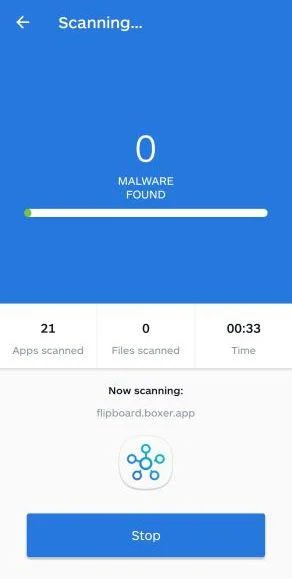
Wait for the Malwarebytes scan to complete.
Malwarebytes will now start scanning your phone for adware and other malicious apps. This process can take a few minutes, so we suggest you do something else and periodically check on the status of the scan to see when it is finished.
-
Remove the detected apps.
When the scan has been completed, you will see a list of the threats that Malwarebytes for Android has detected. Next to each detected item, tap the menu icon (three dots), then choose to uninstall the app or delete the file. Android then asks you to confirm. Tap OK or Uninstall to remove the app.
-
Restart your phone.
When the detected apps are removed, restart your phone if Malwarebytes asks you to. Then check whether the problems you noticed have stopped.
If the problems you noticed continue after the scan, see the options below.
If you are still having problems with your phone after completing these instructions, then please follow one of the steps:
- Ask for help in our Mobile Malware Removal Help & Support forum.
- Only as a last resort, reset your phone to factory settings. Read the warning below first.
- Back up your photos, videos, files, and messages, for example to your Google account or a computer.
- Make sure you know your Google account email and password. The phone asks for them after the reset. If you changed the password recently, Google recommends waiting 24 hours before you reset.
- On a Samsung phone, also make sure you know your Samsung account password.
- If you use an authenticator app for two-step verification, move your accounts to another device or save your backup codes first.
Stay Protected: Block Ads and Malicious Sites
No scan can prove a device is completely clean, so it helps to block threats before they reach you. Most infections start with a malicious ad or a fake download button — so blocking them at the source is your best defense.
We recommend AdGuard, which blocks malicious ads, phishing pages, and dangerous redirects before they can reach you.
👉 Download AdGuard and browse safely
When a Genuine Password Deadline Also Exists
It is possible to receive a scam while a real account task is pending. Completing the genuine task doesn’t require using the fraudulent message.
Ask the provider to confirm the deadline in its own portal or through established support. Keep the two communications separate in your records.
If access stops, avoid assuming the email predicted it accurately. A provider outage, expired credential, or unrelated account issue needs its own diagnosis.
Check which account the notice names. A personal mailbox, hosting-control-panel account, and workplace identity can have different administrators and different recovery procedures.
If several accounts share one device, verify the affected one explicitly. Signing successfully into a different mailbox doesn’t answer whether this account has a genuine pending requirement.
Keep service disruption separate from the security incident in support requests. One ticket may concern availability, while another concerns a password submitted through an untrusted page.
That separation helps support prioritize both problems without treating the scammer’s maintenance explanation as a confirmed technical diagnosis.
Tell support the symptoms: which service fails, when it started, and what error appears. Don’t repeat a stranger’s claim as a confirmed cause.
Google’s phishing guidance recommends going directly to the service rather than entering a password after following a questionable message.
The practical benefit is simple: you can fix a genuine account problem without giving the sender control over where that repair begins.
Frequently Asked Questions
Is the 48-hour server-maintenance email legitimate?
The described campaign is a phishing lure. Verify any genuine account requirement through your existing provider or administrator, not the email’s confirmation link.
Does maintenance automatically make my password expire?
The email doesn’t establish that. Actual expiration rules belong to your account provider or organization and should be confirmed through its normal process.
What if the login page showed my email address?
An address can be inserted before you arrive. Recognizing you by address does not prove the page is operated by your provider.
Should I change passwords if I only read the email?
Reading the notice alone doesn’t demonstrate credential exposure. Report the lure and reserve recovery steps for disclosed information or other suspicious account activity.
Can Malwarebytes undo a password entered into a fake form?
No. Device scanning and account recovery solve different problems. Change exposed credentials and review account access through the genuine service.
What if my employer really sent a maintenance notice?
Confirm the specific instruction with the established help desk. Follow its verified process rather than trusting a deadline or generic support signature alone.
The Bottom Line
Don’t use the Server Maintenance and Security Updates email to confirm your account. Its 48-hour warning gives you pressure, not a verified sign-in requirement.
If you submitted credentials, recover the account through the real provider and review its access settings. Otherwise, report the message and leave its button alone.

Join the discussion
0 commentsShare your experience or ask a question about this article.
Discussion
Start the conversation
Have a question or something useful to share? Add the first comment.