


A cordless lamp that looks like it belongs in a boutique hotel is an easy sell. The EcoLume makes that case with warm light and a slim metal shape.
But the price beside the photo is only one part of the offer. The details change depending on which Sherum page you reach.
Overview
The light is ordinary. The designer pitch is the premium.
The Sherum EcoLume is sold as a rechargeable LED table lamp with touch controls. It is meant to sit on a table without a power cable trailing from it.
One Sherum sales page credits designer Leo Fletcher and displays a US design badge. Neither is an independent record of who designed the lamp.
The similar-looking Ambientec Turn has a named designer and specifications on its manufacturer’s site. Its resemblance is useful for comparison, not a reason to assume both lamps are identical.
The storefront starts with three lamps selected
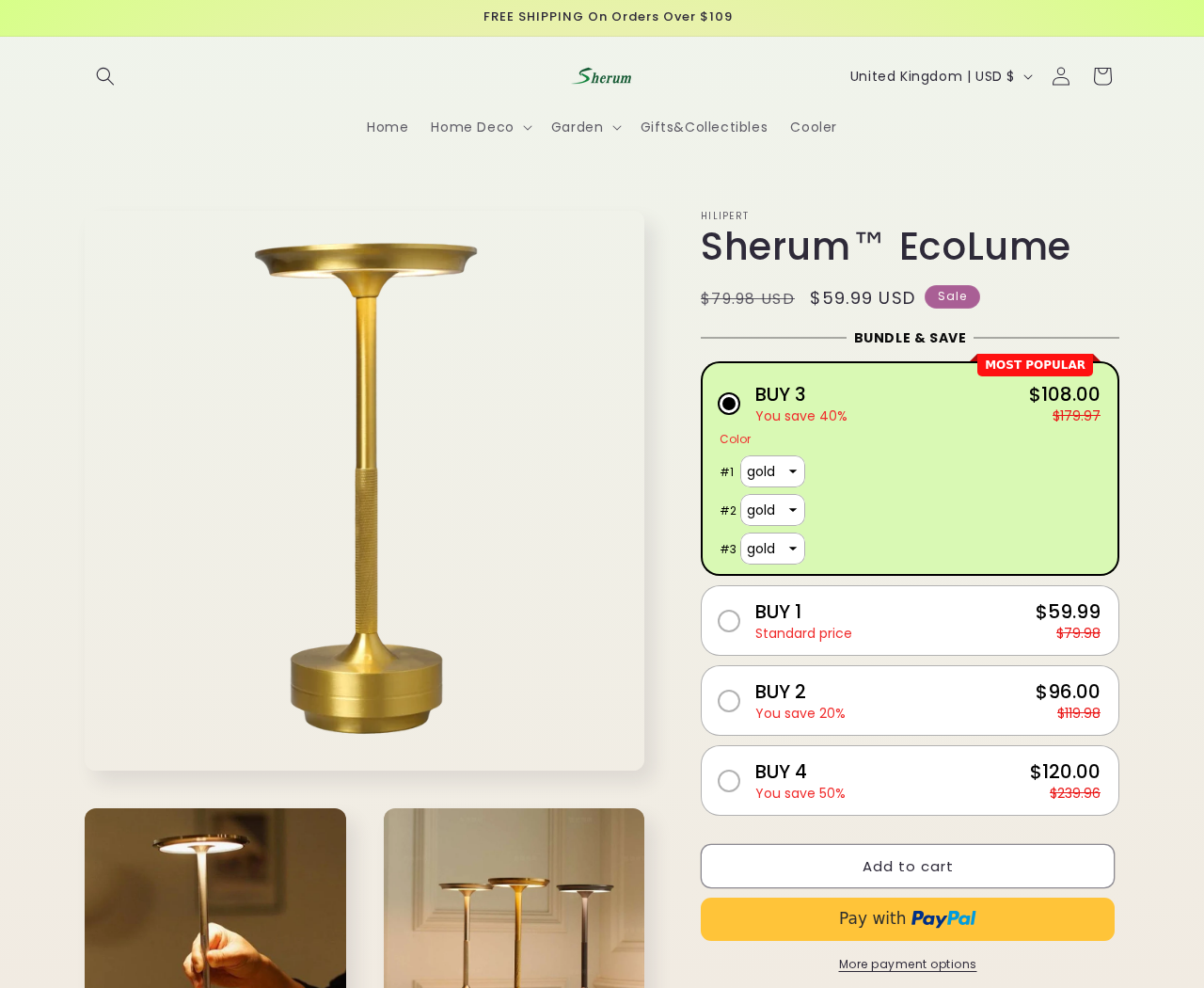
Sherum’s product page shows $59.99 beside the headline. In the United Kingdom storefront capture, displayed in USD, the marked selection is a three-lamp package at $108.
The store does let shoppers select a single lamp. The problem is the distance between the headline price and what is already selected when you scroll to buy.
The purchase checks that actually matter
Don’t try to assess a lamp by the size of the discount badge. Check what you would be paying for and whether you can return it:
- Quantity: Does the final summary say one lamp or a bundle?
- Price: What is the full charge on this particular route, before and after shipping?
- Lighting: Are runtime and brightness given for the same mode?
- Weather resistance: Does the rating apply to the lamp only, or to its charging equipment too?
- Returns: Which company will authorize one, and can a working lamp be returned after you open the box?
This is a review of the offer and its claims, not a hands-on brightness, battery or water-resistance test. A product picture doesn’t answer those questions.
Compare EcoLume With the Documented Ambientec Turn
The resemblance is specific
The gold lamp in Sherum’s product photo has a round shade, a narrow vertical stem, a flared junction above the base and a circular pedestal.
Look at the official Ambientec Turn page. It shows a similar silhouette and lists a body approximately 275 mm tall and 130 mm across.
Sherum’s specifications show a size of 27.5 by 13 without units in the displayed line. If those are centimeters, the dimensions match Ambientec’s published body dimensions.
Sherum also describes four brightness settings and up to 150 hours at low power on its product page. Ambientec publishes four settings and the same low-mode figure.
Those are points of comparison, not an authentication test. A body shape and a few lines of specifications cannot identify the battery, charging circuit or factory.
Important specifications don’t match
Ambientec names Nao Tamura as the Turn designer. Its brass version identifies brass construction and a separate charging stand, and its technical sheet gives a six-hour charge estimate.
The Sherum product page describes aluminum, a 2,000 mAh battery and a charging estimate of two to three hours or more. Don’t transfer one maker’s specs to the other.
Ambientec lists 150 hours at the lowest setting, 12 hours at high and five at its brightest. Sherum’s claimed range is eight hours at high to 150 at low.
Sherum’s own sales page also advertises three brightness levels, while its product page describes four. Ask which version will ship before buying for a specific light setting.
Use the comparison to avoid paying for an unverified story
A designer’s name should be traceable to something beyond the page selling the lamp. Ambientec provides its designer, model details, accessories and a drawing on one page.
That doesn’t prove a particular EcoLume is a counterfeit or that no person named Leo Fletcher exists. It shows why the EcoLume ad alone isn’t enough.
If you want the genuine Turn, buy it by that model name from a seller Ambientec lists. If you only want the look, compare ordinary cordless lamps.
Why the Same EcoLume Bundle Has Different Prices
One lamp and two lamps
The Sherum storefront displays $59.99 for one lamp and $96 for two. Those are the advertised package amounts, not a total with every delivery charge.
The separate EcoLume checkout shows $59.99 for one and $79.98 for two. That’s a $16.02 difference for the advertised two-lamp package.
The saving claimed for one lamp also starts from different figures. The storefront crosses out $79.98. The separate checkout puts $119.99 beside the same $59.99 offer.
The one-lamp price is the same, but the claimed saving depends on which comparison price the page uses. Compare the amount due, not the discount badge.
Three lamps and four lamps
For three, the storefront shows $108 and the separate checkout shows $109.98. The cheaper route for two isn’t automatically cheaper for three.
For four, the two amounts displayed are $120 and $119.97, respectively. The gap is small there, even though the savings labels can look much more dramatic.
This is how a bright red discount can get in the way of a simple question: how many lights do you need and how much will those cost?
If you want one lamp, three at $36 each isn’t a $36 purchase. It is a $108 selection before any other charges that may apply.
A selected bundle is not a subscription
The capture shows an initial three-unit choice on the product page. It does not show that a one-unit order will be changed later or that the lamps renew.
Check the selected quantity, color and currency in your final order summary. A region selector showing United Kingdom alongside USD is a good reason to check currency carefully.
Save that summary if you place an order. It gives you something concrete to compare against the receipt if the amount or quantity turns out to be different.
Who Sells the EcoLume and Where Would a Return Go?
Sherum is the name on the storefront, but not the only name shown
The product page carries Sherum branding and displays Hilipert above the product name. The storefront URL also retains Vueeze in its product handle.
On the linked return policy, the name RcGoing appears in the faulty-item and authorization instructions. The policy also lists a Colapa email for evidence of damage.
Different names can come from copied text, support arrangements or a change in branding. They don’t identify the legal seller on their own.
Before spending money, ask for the company that issues the receipt and the company that will approve a return. Save the response with the order.
A return address isn’t printed where you need it
The storefront policy sends buyers to support for authorization and an address. The dispatch label on a delivered parcel isn’t necessarily the address you should use.
That can make a big difference with a metal lamp, especially if you ordered several. Return postage for a bundle may eat into what you’d recover.
Ask for the actual destination and any carrier restrictions before mailing anything. The storefront terms say an unauthorized return or a return to the wrong address can be refused.
The headline guarantee leaves out real conditions
Sherum’s promotional page describes a 30-day refund in broad terms. The storefront policy limits ordinary unwanted returns to unused, unopened items in original packaging.
That difference matters if you need to open the box to see whether the lamp casts enough light. Don’t assume the headline allows a trial on your desk.
The policy separately lists a seven-day process for items that arrive dead or damaged. It also describes a different window and postage treatment for other faulty goods.
Ask which terms apply to your exact order route and circumstances. Store terms don’t necessarily replace rights you may have under local consumer law.
Design and dispatch aren’t the same thing
The ad’s US design badge does not tell you where the light is made. Neither the name on the product page nor a return address identifies the factory.
Ask for the model number and the manual for the unit sold. Compare the charging instructions, warranty contact and any weather rating before using it outside.
If you’re buying for a patio, make sure the seller distinguishes the lamp from the charger. An IP claim for one doesn’t automatically cover the other.
What to Do If You Ordered a Sherum EcoLume
- Compare the receipt to the offer you accepted. Check quantity, colors, delivery charges and currency. Save the receipt and the page showing what you selected.
- Request cancellation promptly if the quantity is wrong. The storefront policy says orders can only be canceled before shipping. Keep the time and date of your request.
- Report a defect as soon as you find it. Photograph the item, label and packaging. Ask which deadline and return authorization apply before sending anything back.
- Get the refund figure and destination in writing. Ask who pays postage, what must stay unopened and whether any shipping or customs costs will be deducted.
- Contact your payment provider if the seller doesn’t resolve it. Explain the actual issue, such as a wrong quantity, missing order or mismatch with the listing.
If you ordered several but only opened one, keep the remaining boxes closed while you ask about a return. Don’t lose an option by testing each lamp.
If the unit gets unusually hot, smells burnt or shows battery damage, stop using and charging it. Seek safe handling guidance rather than testing it again.
What to Look for in a Cordless Lamp Instead
For a dining table, the useful question is how well the lamp lights the plates without shining in anybody’s eyes. A wide shade is only one clue.
For reading, look for light output and where the beam falls. A low decorative glow can feel comfortable while still being too dim to read by.
Ask which charging parts come in the box. A listing can advertise USB charging without including a wall adapter, and a dedicated dock may be hard to replace.
If you move the lamp between rooms, check its weight and where the switch is. The metal finish does not tell you how stable it is.
Look at the seller’s returns wording before buying several. Being able to try one for a few evenings is more useful than a discount on four untested lamps.
Choose the amount of light you need, then compare sellers on the same measurements. A runtime estimate at the dimmest setting can’t stand in for usable brightness.
If you need it in a bathroom or on a patio, choose a model with written placement and charging instructions. Keep charging equipment dry unless its rating says otherwise.
If you need a lamp every evening, check what happens when the battery wears out. A replaceable part or documented repair service can matter more than an introductory price.
Frequently Asked Questions
Is Sherum EcoLume the same as Ambientec Turn?
The shape and some published figures are similar, but the listings name different designers and give different battery and charging details. Treat them as different offers.
If you want an Ambientec Turn, verify the exact model and seller with Ambientec. Don’t use an EcoLume listing as proof that you’re buying one.
Does Sherum automatically charge for three lamps?
The product page opened with a three-lamp bundle marked at $108 in the captured configuration. There was also an explicit one-lamp option.
That is a preset, not evidence of a changed charge after purchase. Check the final summary before paying and keep it with the receipt.
Is the 150-hour battery claim for reading brightness?
The seller attaches the 150-hour figure to low mode. The same listing claims a much shorter runtime at high.
A candle-like setting is not a substitute for task lighting. If you need to read or work, look for output and runtime at the usable setting.
Is the EcoLume safe in the rain?
Sherum claims IP66 on its product page. That is a seller specification, not an independent test of the EcoLume lamp or charging accessories.
Ask for the exact unit’s instructions. Don’t assume water resistance means the lamp can be submerged or charged outdoors while wet.
Can I return it after trying it?
Don’t count on that for a change-of-mind return. The linked storefront policy says ordinary unwanted goods must be unused and unopened.
Ask how the seller handles opened items and faulty goods before you ship anything. Document which version of the guarantee came with your order.
Do the bundle prices prove a recurring charge?
No. The displayed choices are for buying several units at once. That isn’t evidence of a repeating payment.
If you see an unfamiliar later charge, compare it with your receipt and contact your payment provider. Don’t assume every later charge was part of the lamp order.
The Bottom Line
Skip the EcoLume offer as presented. The designer story isn’t independently established, the package prices change by route, and the broad refund promise leaves out restrictive terms.
If you already ordered, check the quantity now. Ask for the applicable return terms in writing before opening extra units or paying to ship anything back.

Join the discussion
0 commentsShare your experience or ask a question about this article.
Discussion
Start the conversation
Have a question or something useful to share? Add the first comment.