

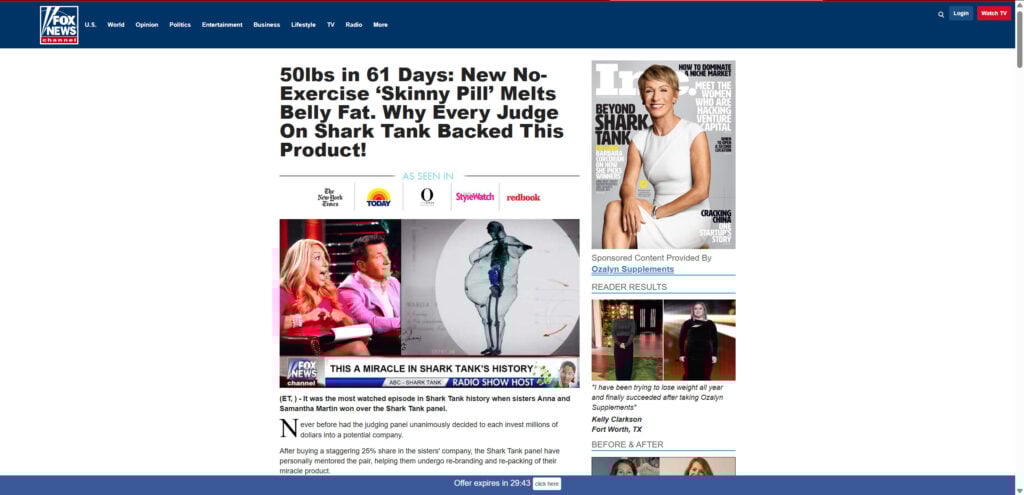
If you have seen a “skinny pill” ad promising dramatic weight loss in weeks, backed by Fox News branding, Shark Tank judges, and celebrity before-and-after photos, you are looking at a well-worn scam format.
The names on the bottle change constantly, but the playbook stays the same: borrowed credibility, unrealistic promises, and a checkout flow that can leave people with extra charges, unwanted refill subscriptions, and refunds that go nowhere.
This article breaks down how the skinny pill scam supplements work, what red flags to watch for, and what to do if you already ordered.
Scam Overview
What “skinny pill” scam supplements usually look like
Most people do not stumble onto these offers through normal shopping.
They are pushed through aggressive ads and clickbait pages designed to feel like trusted media or a viral business story.
The pages often claim something like:
- “Lose 50 lbs in 61 days”
- “No exercise required”
- “Melts belly fat”
- “Judges on Shark Tank backed it”
- “Fox News officially recommends it”
- “As seen in major outlets”
That framing is not accidental.
It is designed to bypass your skepticism and replace it with a feeling of certainty.
The Federal Trade Commission has long warned that promises of effortless, dramatic weight loss are a major red flag, and that no product can safely guarantee those kinds of results for everyone.
The Fox News look is a costume, not proof
A common trick is the “fake news page.”
The scam uses:
- a news-style masthead
- familiar fonts and layout
- an “as seen in” strip with logos
- a story format that reads like a journalist wrote it
But it is not real reporting.
It is an advertorial, advertising designed to look like editorial content.
The FTC has specifically described networks that used fake magazine and news sites with legitimate-looking mastheads and celebrity stories to sell supplements.
If the page looks like Fox News but the URL is unrelated, the links do not behave like a real news site, and every scroll leads you toward a “Get Your Bottle” button, treat it as marketing, not journalism.
“Shark Tank backed it” is one of the biggest tells
The Shark Tank endorsement angle is one of the most reused supplement scams online.
The story is usually written like a fairy tale:
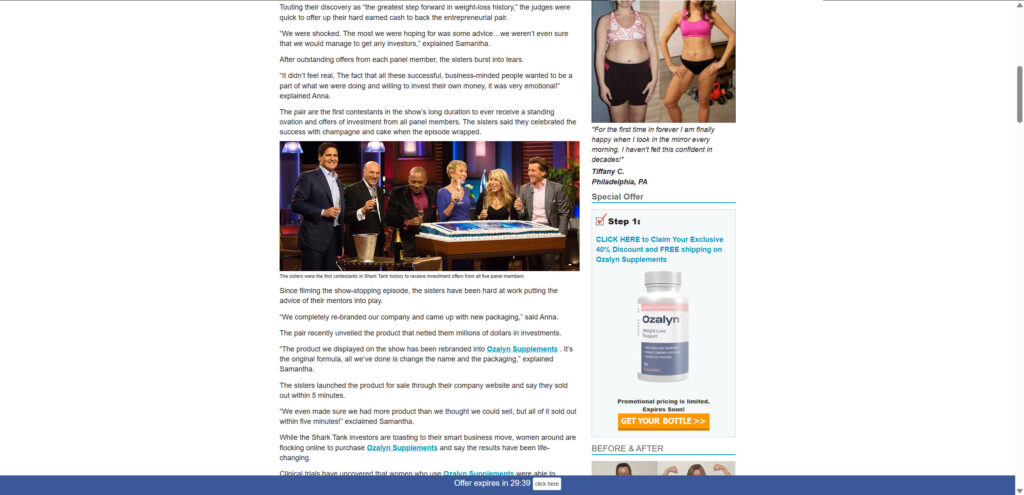
- two founders appear on Shark Tank
- every judge invests
- the product sells out instantly
- the “show’s secrets” are now available to you
It is powerful because it borrows credibility from a real show that people trust.
But this is also one of the easiest claims to verify, and it often collapses immediately.
AARP has warned about Shark Tank scams, including fake ads for weight-loss gummies and pills that use the sharks’ images and even AI to create the illusion of endorsement. It notes that none of the sharks endorse weight-loss supplements in ads.
Even fact-checkers have covered this pattern directly. AFP reported that weight loss pill ads claiming Shark Tank judge endorsement were fictitious, quoting Barbara Corcoran calling the ads “totally fictitious.”
So when a “skinny pill” page leans heavily on Shark Tank, it is not a credibility signal.
It is a red flag.

Celebrity photos and “testimonials” are part of the manipulation
These pages frequently include:
- celebrity transformation stories
- quotes attributed to public figures
- before-and-after photos with generic names and locations
- “results” shown in a perfect timeline like Day 1 and Day 22
The goal is to give you emotional proof.
It works because humans respond to stories more than to data.
But the FTC has a long history of taking action against fake celebrity endorsements and phony testimonials used to sell supplements.
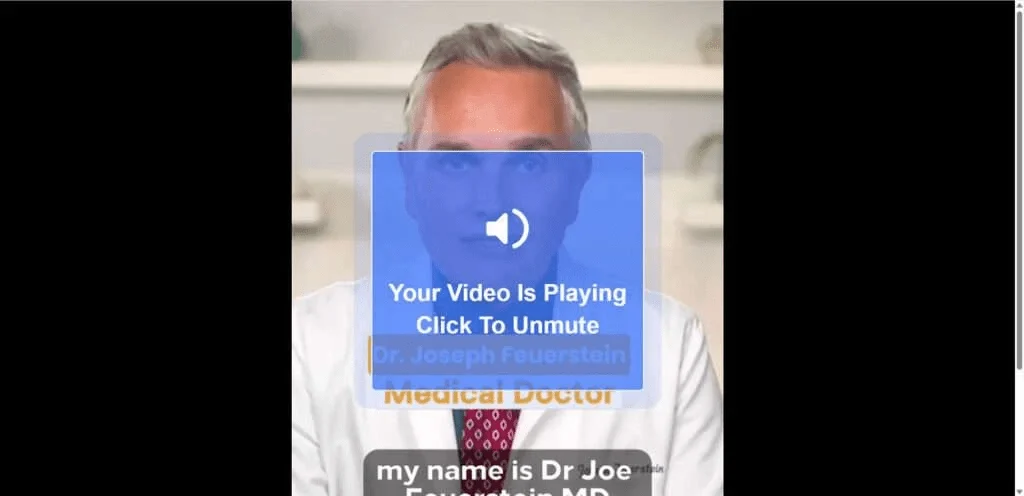
And the problem is getting worse, not better, because AI has made it easier to fake voices and videos.
The FTC has warned that scammers use fake celebrity and influencer endorsements, including doctored video and audio that can seem real.
So the presence of a celebrity photo, a familiar face, or a quote is not validation.
It is often the bait.
The “science” section is usually a sales script
Most skinny pill scam pages include a science paragraph designed to sound responsible.
A very common theme is ketosis and BHB, with claims like:
- “forces the body into ketosis”
- “burns fat instead of carbs”
- “kickstarts metabolism”
- “melts belly fat quickly”
Even when the page mentions real terms, the conclusions are usually exaggerated.
The science section typically has three goals:
- Make you feel the product is “medical”
- Make you feel the results are inevitable
- Make you stop questioning the timeline and claims
If you notice that the page gives big outcomes but avoids the hard questions, that is part of the scam structure.
Hard questions include:
- What exact dose is used, and where is that stated?
- What independent studies exist on the exact product and formula?
- Who owns the company, and where are they located?
- What are the real refund terms, and what are the cancellation steps?
Scam-style pages avoid clarity on these points because clarity slows conversions.
The real trap is often billing, not effectiveness
Many victims report that the worst part is not that the product “didn’t work.”
It is that the purchase was not what they thought it was.
Common complaint patterns in skinny pill funnels include:
- ordering one bottle and receiving a larger bill
- being pressured into bundles with “best value” pricing
- upsells that look like confirmation steps
- recurring “refill” or autoship subscriptions
- merchant names on bank statements that do not match the product name
- support that is slow or evasive
This matches what consumer agencies warn about more broadly.
The FTC’s weight-loss guidance warns that “free trial” and similar offers can lead to recurring charges and shipments people did not intend to sign up for.
If a page is pushing urgency and hiding the terms, assume the risk is not only wasted money.
It is ongoing charges.
Why these scams keep coming back under new names
Once a scam funnel converts, it can be cloned.
If complaints rise, the operators can:
- change the domain
- change the product name
- swap the label image
- rewrite the story
- relaunch with new ads
The FTC described a network that sold more than 40 products using fake news sites, bogus celebrity endorsements, and phony testimonials, which shows how scalable this model is.
That is why learning the pattern is more useful than memorizing one brand name.
How The Scam Works
Below is the typical step-by-step flow behind skinny pill scam supplements. The page design and product name vary, but the mechanics are remarkably consistent.
Step 1: The scroll-stopping ad promises a shortcut
Most people encounter these offers through ads on social media or display networks.
The ad usually hits emotional triggers fast:
- frustration with stubborn belly fat
- fear of aging
- shame about weight gain
- hope for a fast fix
- curiosity about a “secret”
Then it adds urgency:
- “limited supply”
- “today only”
- “watch before it’s removed”
- “breaking news”
Urgency is not there to help you.
It is there to stop you from researching.
Step 2: The click leads to a fake news-style advertorial
After the click, you land on a page designed to look like reporting.
It may use:
- a Fox News style header
- “as seen in” logos
- a long story format
- a big photo montage
- a fake reporter voice and tone
This is a credibility costume.
The FTC has described this exact deception in enforcement actions involving fake news and magazine sites used to sell supplements.
Step 3: The story inserts Shark Tank as a trust shortcut
Now the funnel drops in the Shark Tank angle.
The text often implies:
- the product was featured on the show
- the judges invested
- the product went viral overnight
- Fox News and major magazines covered it
This is the moment many people stop fact-checking.
They think, “If Shark Tank backed it, it must be real.”
But scam warnings and fact checks have repeatedly shown that criminals use Shark Tank images and even AI-created voices to sell fake weight loss products.
Step 4: The “results” section floods you with emotional proof
Next comes the part designed to override logic:
- dramatic before-and-after photos
- quotes with first names and cities
- storylines about losing 20, 30, 50 lbs quickly
- claims like “no exercise needed”
This is where you should slow down.
The FTC’s weight-loss guidance is blunt: promises of miraculous weight loss are untrue, and no product allows effortless results.
So if the page implies effortless transformation, it is marketing, not evidence.
Step 5: A pseudo-science explanation makes it feel inevitable
This is where the ketosis, BHB, or “fat burning mode” explanation appears.
The writing often sounds technical but is usually simplified and exaggerated.
The goal is not to educate you.
The goal is to make you feel like the product must work because the explanation sounds scientific.
Step 6: The offer is structured to push larger orders
Now the funnel introduces pricing.
Typical structure:
- 1 bottle, highest price
- 3 bottles, “most popular”
- 6 bottles, “best value”
The design makes the smallest option feel like the wrong choice.
This increases how much people spend before they have any idea what they will actually receive.
Step 7: Urgency tools are deployed to prevent second thoughts
As you near checkout, you often see:
- countdown timers
- “stock running out” warnings
- “offer expires” clocks
- popups claiming someone just bought
- “people watching now” counters
These are conversion tools.
They are not evidence.
Step 8: The checkout flow introduces the highest risk
This is where many victims get burned.
Common traps include:
- pre-selected quantities
- upsells that look like required steps
- add-ons that inflate totals
- continuity billing language in fine print
- unclear refund terms
People think they ordered one bottle.
Then they see multiple charges or monthly billing.
The FTC has warned that weight-loss promotions often involve recurring billing or shipments consumers did not want.
Step 9: Support friction makes cancellation and refunds difficult
After purchase, the funnel often becomes hard to unwind.
Common experiences:
- slow email-only support
- vague return instructions
- partial refund offers instead of cancellation
- long delays that push you outside dispute windows
This is why many victims describe returns as “impossible.”
Friction is often part of the model.
Step 10: The scam reappears under a new name
When complaints rise, the funnel can be relaunched under a different name and domain, using the same Shark Tank story and the same fake media styling.
That is why you keep seeing the exact same page with different bottles.
What To Do If You Have Fallen Victim to This Scam
If you bought a skinny pill from one of these fake news or Shark Tank pages, take these steps calmly and quickly.
- Save your evidence immediately
Screenshot the ad, the landing page, the offer section, and the final checkout total. Save confirmation emails and receipts. - Check your bank or card statement for extra charges
Look for split charges, higher totals than expected, or small “test” charges. - Search for subscription language
Check your confirmation email for terms like autoship, membership, monthly, continuity, refill, next shipment. - Email the seller to cancel in writing
Include your name, order number, and a clear request: cancel any subscription and do not charge me again. Ask for written confirmation. - Contact your card issuer if charges look unauthorized
Ask about disputing the charge, blocking future charges from the merchant, and whether replacing your card is recommended if rebilling continues. - Monitor transactions for at least 60 days
Many people see delayed repeat charges. Set a reminder to check weekly. - Report the ad where you saw it
Report it on the platform that served it, especially if it used fake Shark Tank or fake news branding. AARP warns that these scams misuse Shark Tank branding and even AI-generated voices. - Report fake endorsement scams
The FTC specifically warns about fake celebrity endorsements using doctored audio and video and encourages people to pause and verify. - Avoid “support” links sent after the fact
If you receive follow-up emails or texts with links, be cautious. Use the official payment dispute route when in doubt. - If a package arrives, photograph everything
Take photos of the label, packaging, and inserts before you attempt a return. Keep shipping materials.
The Bottom Line
Skinny pill scam supplements are rarely just “aggressive marketing.”
They are often a repeatable deception pattern that uses fake news styling, fake Shark Tank endorsements, and dramatic weight loss promises to push people into rushed purchases.
Consumer warnings and fact checks have repeatedly shown that Shark Tank endorsement ads for weight loss pills and gummies are a common scam tactic, and that the endorsements are fictitious.
If you already bought, focus on protection: save evidence, watch for repeat charges, cancel in writing, and involve your card issuer quickly if billing looks deceptive.
FAQ
What is the “skinny pill” scam?
It’s a recurring supplement scam that uses fake news-style pages, unrealistic weight loss promises, and borrowed credibility like Fox News or Shark Tank to push people into buying overpriced bottles fast.
Are these Fox News “skinny pill” pages real?
Usually not. They’re advertorials designed to look like news. If the URL is not the real Fox News domain and the page mainly funnels you to “Get Your Bottle,” treat it as marketing, not reporting.
Did Shark Tank judges really back these weight loss pills?
In most cases, no. Shark Tank endorsement claims are a common scam theme used to create instant trust.
Why do these pages show celebrity photos and dramatic before-and-after images?
Because emotional “proof” sells. These images and testimonials are often stock, recycled, or unverifiable, and they’re used to override skepticism.
Do “no exercise” and “lose 50 lbs fast” claims mean it’s a scam?
They are major red flags. Any product promising effortless, dramatic weight loss should be treated as unreliable.
Why do product names change so often?
Because the funnel is the product. When complaints rise, scammers can swap domains and labels and relaunch the same story under a new name.
How do people end up with more bottles than they ordered?
Checkout flows may include pre-selected quantities, bundle nudges, and upsells that look like required steps, especially on mobile.
How do unwanted refill subscriptions happen?
Continuity terms are often buried in fine print or shown in confusing screens, leading to recurring charges and monthly shipments buyers didn’t intend to join.
What should I do if I see repeat charges or a higher total than expected?
Save screenshots and receipts, email the seller to cancel in writing, and contact your card issuer to dispute unauthorized charges and block future billing if needed.
Where can I report these scam ads?
Report them on the platform where you saw them (Facebook, Instagram, TikTok, YouTube) and consider filing a complaint with your local consumer protection agency.

Join the discussion
0 commentsShare your experience or ask a question about this article.
Discussion
Start the conversation
Have a question or something useful to share? Add the first comment.