

Magnesium products have a way of showing up at exactly the right moment.
You are tired, stressed, waking up at night, dealing with tight muscles, or just looking for something that helps you feel more “settled” at the end of a long day. Then an ad appears that promises an easy fix: spray it on your skin, skip the stomach issues, sleep better tonight.
That is the pitch behind Sringe Magnesium Oil Spray.
It looks simple, it sounds gentle, and the website language is designed to feel safe and professional. But once you slow down and look at the details, there are enough inconsistencies and marketing red flags that most people should pause before buying.
This article breaks it all down in plain English: what Sringe claims, what topical magnesium can and cannot realistically do, what the site signals suggest, how the dropshipping-style funnel typically works, and what to do if you already placed an order.
Overview
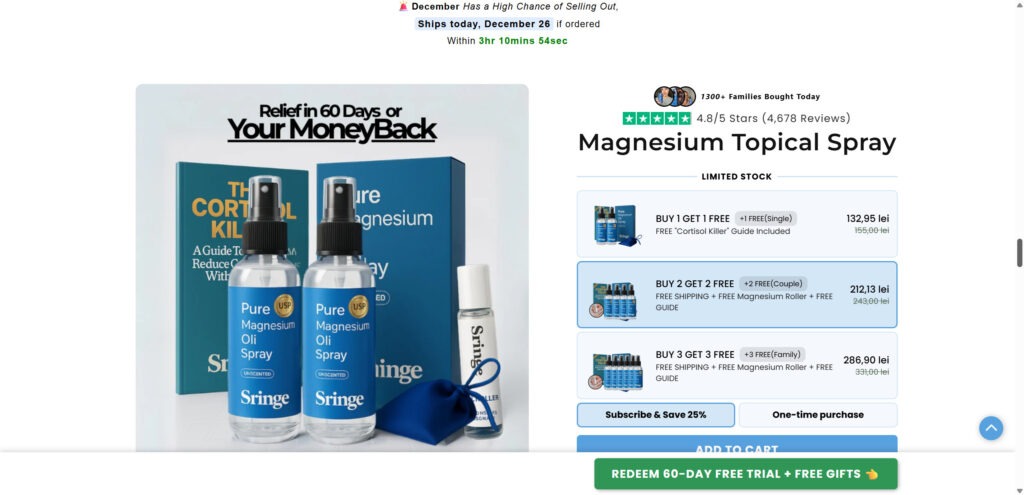
Sringe Magnesium Oil Spray is marketed as a topical magnesium solution that you apply to the skin to support relaxation and wellness. The product name itself is meant to sound clinical, like something you would find in a professional setting. The sales page often pairs the spray with phrases like “pure magnesium,” “relief in 60 days or your money back,” and a long list of benefits that read like a checklist of modern life problems.
The biggest promised outcomes usually include:
- Better sleep and deeper rest
- Muscle relaxation and reduced cramps
- Stress relief and a calmer nervous system
- Lower cortisol and fewer “sugar cravings”
- Relief for chronic discomfort, including claims that drift into neuropathy and pain relief
- A general “reset” of wellness, energy, and recovery
On its face, none of these goals are strange. People use magnesium for sleep, muscle function, and general supplementation all the time.
The important difference is how those benefits are being promised, and how the product is being presented.
What “magnesium oil” actually is
Let’s clear up a common misunderstanding first.
Magnesium “oil” is usually not an oil in the traditional sense. Most magnesium oil sprays are made from magnesium chloride dissolved in water, often from concentrated brine. It can feel slightly oily or slippery on the skin, which is how it got the nickname.
That matters because many ads imply a premium cosmetic-like oil, when the reality is often a simple mineral solution.
A basic topical magnesium spray may contain:
- Magnesium chloride (most common in sprays)
- Water
- Sometimes additional ingredients for scent or feel, like essential oils
In Sringe’s FAQ-style claims, the product is described as containing “pharmaceutical-grade magnesium glycinate” and frankincense oil.
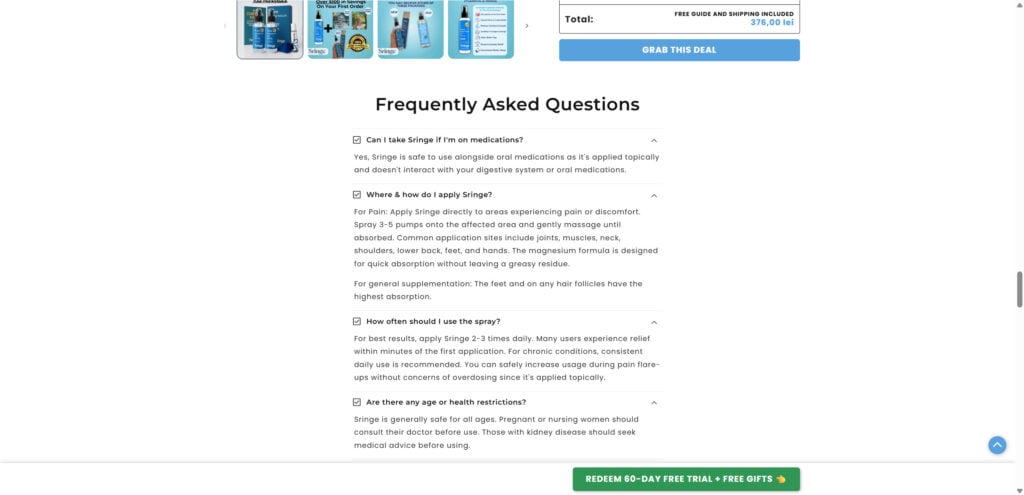
That is a notable claim because magnesium glycinate is best known as an oral supplement form, valued for gentler digestion compared to some other types. Topical magnesium products more commonly use magnesium chloride because it dissolves well and is widely used in spray formulations.
Could someone formulate a topical product using magnesium glycinate or a related compound? Possibly.
But it raises a practical question you should always ask with skincare-like health products:
Where is the clear ingredient label, with exact amounts, and a straightforward explanation of why this specific form was chosen for topical absorption?
If that clarity is missing, you are relying on marketing copy, not transparent product information.
Can magnesium absorb through the skin in meaningful amounts?
This is where topical magnesium marketing often gets slippery.
The skin is designed to be a barrier. That is its job. Some substances can pass through it, especially if the molecule is suitable, the formula supports penetration, and the dose is appropriate.
But the evidence that magnesium sprays reliably raise magnesium levels in the body is limited and debated. Some people report feeling better using magnesium sprays, and that experience is real to them. However, feeling better does not automatically mean the magnesium is being absorbed in a way that changes systemic magnesium status.
There are a few reasons topical magnesium can still “feel” helpful even if absorption is modest:
- The act of spraying and massaging can relax muscles.
- The routine itself can prime the body for sleep.
- Warmth, massage, and attention to sore areas can reduce perceived tension.
- Some ingredients can create a soothing sensation, or a tingling sensation that people interpret as “working.”
This is not to say topical magnesium is useless. It is to say the strongest claims, like dramatic changes in cortisol or quick fixes for chronic conditions, should be treated carefully unless backed by credible, product-specific evidence.
When a topical magnesium product is marketed responsibly
A responsibly marketed topical magnesium spray usually stays in a realistic lane. It focuses on:
- Comfort and relaxation
- Mild muscle support
- A simple topical product experience
- Clear usage instructions and skin safety guidance
- Transparent labeling and a stable brand presence
It does not usually promise dramatic hormone changes, rapid transformation, or broad disease-level improvements.
And that difference matters, because Sringe’s marketing, based on your findings and screenshots, leans into big, emotionally loaded promises.
The specific red flags that stand out with Sringe
Your notes highlight several issues that are common in dropshipping-style wellness offers.
1) Product images that appear AI-generated or heavily fabricated
One of the first trust tests is visual honesty.
If the site is selling a physical product, you should be able to see clear, consistent photos of:
- The actual bottle
- The label close-up
- The packaging
- The ingredients panel
- The back label with directions and warnings
When a page uses glossy images that look generated, composited, or overly perfect, it raises a simple question: why not show the real item?
AI visuals are not automatically proof of wrongdoing, but for ecommerce, they reduce trust because they can hide inconsistencies between what is advertised and what ships.
2) A “doctor endorsed” story with no verification
The sales language that a product is “perfected, tested, and recommended by professional practitioners” is powerful.
It also needs proof.
When a specific name is used, such as Dr. Daniel Barrett, you should be able to verify:
- Who the person is
- Their credentials
- Their professional affiliation
- A real statement of involvement that is not just marketing copy
If none of that is available, the “doctor” becomes a character in a sales story rather than a verifiable source.
That is a major credibility gap, especially when the product is making health claims that go beyond basic skincare.
3) Medical-level promises without medical-level evidence
Claims like:
- reducing cortisol
- controlling cravings
- supporting blood sugar balance
- relieving neuropathy
- alleviating chronic pain
- boosting metabolism
These are not small cosmetic promises. They edge into medical territory.
When a website makes claims at that level, a cautious consumer should expect to see something solid:
- Clinical studies on the specific product
- Clear citations, not vague references
- Product testing documentation
- Realistic and compliant wording, not sweeping guarantees
If those things are missing, the claims function mostly as persuasion.
4) “Free trial” language that does not behave like a real free trial
Many aggressive sales pages use phrases like “redeem a 60-day free trial” because it lowers resistance. People think they can try it with little risk.
But when you look closer, the offer often behaves like a normal purchase with:
- immediate billing
- subscriptions presented as the default or heavily encouraged
- unclear terms, or terms that only appear late in checkout
If there is no true $0 trial with clear terms, calling it a free trial is misleading at best.
5) High star ratings on-site, but missing independent reviews elsewhere
A claim like 4.8 stars with thousands of reviews is meant to end the debate for the buyer. It says: everyone loves it, so you can relax and click buy.
But when a product has thousands of satisfied customers, you would normally see at least some footprint on third-party platforms:
- Trustpilot
- Reddit discussions
- independent review sites
- forum posts
- YouTube reviews from real people
If the product has a huge review count only on its own website and nowhere else, it is a strong sign that the “review ecosystem” is controlled.
Controlled reviews are not automatically fake, but they are not independent evidence either.
6) Subscription nudges that can surprise buyers later
Your screenshot shows a button like “Subscribe & Save 25%” versus “One-time purchase.”
That structure is common, but it becomes risky when:
- the subscription option is preselected
- the terms are hard to find
- cancellation requires jumping through hoops
- the charge descriptor is unclear on bank statements
This is one of the most common ways buyers end up with unexpected repeat charges.
7) Weak contact details that reduce accountability
One of your screenshots shows contact information that looks generic, including an email address like sringe@email.com.
A legitimate ecommerce brand can still use a simple email, but most established brands provide at least:
- a domain-based support email
- a physical mailing address
- a company registration or corporate identity
- clear customer service hours and process
- a return address that is not vague
When contact details are minimal, disputes become harder.
The private-label angle: why the Alibaba-style listings matter
Your second image set shows what looks like wholesale and private label magnesium oil spray listings with pricing that can be as low as roughly $1 to $3 per unit at high quantities, depending on supplier, packaging, and order size.
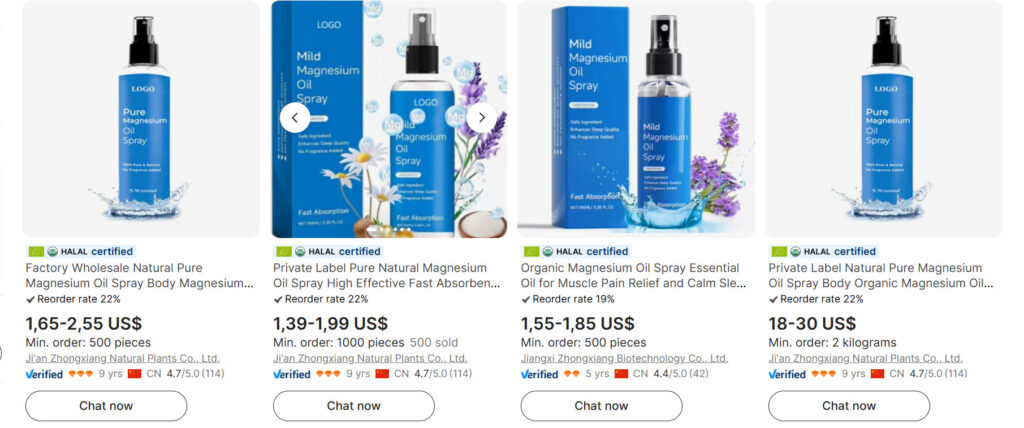
That is not shocking by itself.
Many legitimate brands use contract manufacturing and private label suppliers.
The difference is transparency and pricing behavior.
When a brand has:
- unclear identity
- a dramatic marketing story
- inflated health claims
- artificial urgency
- and product visuals that appear fabricated
Then cheap wholesale availability becomes more significant. It suggests the product may be a generic item wrapped in a premium narrative, priced far above its underlying cost.
A typical customer-facing offer might bundle bottles and price them in the $30 to $80 range depending on quantity and upsells. If the underlying product is widely available as a generic private-label spray, the main “value” being sold is the marketing.
What a realistic evaluation looks like
If someone asked, “Should I buy Sringe Magnesium Oil Spray?” a responsible answer has to separate two things:
- Topical magnesium sprays as a category
- Sringe as a specific brand and offer
Topical magnesium sprays can be fine for some people, especially for skin-level comfort and relaxation routines.
But the Sringe offer, based on the signals you provided, raises enough concerns that most buyers should be cautious.
It is not just about whether magnesium can help. It is about whether this seller and this funnel can be trusted with your money, your expectations, and your payment details.
How The Operation Works
The term “dropshipping” gets used in a lot of ways online. Sometimes it simply means a seller does not keep inventory and uses a third-party fulfillment partner. That can be legitimate.
In the riskier version, dropshipping becomes a marketing-first operation built to sell generic products through aggressive claims, high-pressure tactics, and a thin customer support layer.
What you found around Sringe fits many of the patterns of that second model.
Here is how these operations usually work, step by step, and where Sringe’s signals align.
Step 1: Pick a product category that already has demand
Magnesium is an ideal category for this kind of funnel.
It is:
- widely known
- associated with sleep and stress relief
- easy to market without needing a prescription
- emotionally relevant to a large audience
Better sleep alone is a huge driver. If you can promise sleep, you can sell.
The product itself does not need to be unique. It needs to be easy to explain in one sentence:
“Spray magnesium on your skin and sleep better.”
Step 2: Source a generic product that can be private-labeled quickly
Private label suppliers make it easy to create “a brand” fast.
A seller can choose:
- a bottle style
- a label template
- a box mockup
- a scent or oil add-on
- a name that sounds clinical and memorable
Your screenshots show multiple wholesale magnesium spray listings that look extremely similar in concept and packaging style.
This matters because it means the unique part of the business is not the formula. The unique part is the marketing story.
Step 3: Build a storefront that looks like a premium wellness brand
Next comes the website.
These stores are designed to feel trustworthy in seconds:
- clean layout
- big benefit headlines
- confident “money back” language
- professional product renders
- badges and trust icons
- a FAQ that answers objections before you ask them
But the goal is not education.
The goal is conversion.
If product images look AI-generated or overly stylized, it often signals speed. They are trying to launch fast and scale fast, not build long-term trust with transparent photography.
Step 4: Add an authority figure to short-circuit skepticism
A “doctor” is one of the strongest persuasion tools in wellness marketing.
Even a single line like “recommended by Dr. Daniel Barrett” can dramatically increase conversions.
In higher-risk funnels, this authority is often:
- vague
- unverified
- hard to trace
- presented as a story, not a credential
That is why the absence of proof matters. If the doctor endorsement cannot be verified, it is functioning as a trust prop.
Step 5: Make the benefits bigger than the product
A topical magnesium spray can reasonably be framed as relaxing, soothing, and supportive for muscle comfort.
But a high-conversion funnel expands the promise into life-changing territory.
That is where you see claims about:
- cortisol reduction
- metabolic changes
- chronic condition relief
- cravings and blood sugar shifts
- rapid improvements “within minutes”
- sleep tracker transformations
This is a known persuasion move: widen the benefit net so more people feel personally targeted.
If you have stress, it is for you. If you have sleep issues, it is for you. If you have pain, it is for you. If you struggle with cravings, it is for you.
The wider the net, the higher the conversion rate.
Step 6: Create urgency that makes people act before thinking
Many Sringe-style pages use urgency phrases like:
- “limited stock”
- “high chance of selling out”
- “ships today if ordered within X time”
- “redeem 60-day free trial + free gifts”
Urgency is not automatically dishonest, but it becomes suspicious when:
- it appears on every visit
- the countdown resets
- the “selling out” claim is constant
- the offer feels artificially dramatic
Urgency works because it pushes the buyer from analysis to impulse.
Step 7: Push bundles and anchor the buyer toward the bigger purchase
The pricing section is rarely simple.
Instead of one bottle, you see bundles:
- buy 1 get 1 free
- buy 2 get 2 free
- buy 3 get 3 free
This structure does two things:
- It makes the price feel like a deal even if the baseline price is inflated.
- It increases the average order value fast.
A buyer who came for one bottle can quickly be pushed into a multi-bottle purchase because the page makes it feel irrational not to.
Often the “best value” bundle is highlighted, and free gifts are attached to higher tiers.
Step 8: Introduce subscriptions as the “smart” choice
Many checkout flows include a subscription option, often with language like:
- “Subscribe & Save 25%”
- “VIP access”
- “priority shipping”
- “cancel anytime”
This can be legitimate when clear.
It becomes risky when:
- the subscription is encouraged as default
- cancellation instructions are hard to locate
- support is slow or unresponsive
- recurring billing surprises customers
If buyers later report difficulty canceling, that is usually because the seller benefits from friction.
Step 9: Use on-page review widgets as social proof
A claim like 4.8 stars from thousands of reviews is a powerful conversion tool.
But on-page review systems can be:
- imported from templates
- populated with unverified entries
- curated to show only positive reviews
- disconnected from the real product experience
The key point is independence.
If you cannot find meaningful third-party feedback, the on-page star rating should be treated as marketing, not evidence.
Step 10: Fulfillment through third parties, often from overseas
In many dropshipping funnels, the product ships from:
- a third-party warehouse
- a manufacturer directly
- or a fulfillment agent
When a product is widely available through private label suppliers, overseas fulfillment is common.
This is where buyers run into:
- longer shipping times than implied
- tracking that changes carriers
- packaging that does not match the premium branding
- difficulty returning because returns must go overseas
Even when the product arrives, the refund process can become the real battle.
Step 11: The refund promise becomes complicated in practice
A “60-day money-back guarantee” sounds comforting.
But in higher-risk operations, guarantees often come with friction such as:
- strict windows and conditions
- “contact us first” rules
- restocking fees
- buyer-paid return shipping
- return addresses that are expensive to ship to
- slow or non-responsive support
The guarantee is designed to remove fear at purchase, not necessarily to be painless afterward.
Step 12: Support and accountability remain thin
The last screenshot you provided shows a terms section with contact info that appears minimal, and the footer looks like a standard template structure.
That is not proof of wrongdoing, but it fits the pattern of stores built quickly to run campaigns, not to build a long-term, deeply accountable brand.
When customer support is thin, the buyer carries the risk.
The simplest way to judge a dropshipping funnel
If you want a quick mental checklist, ask these questions:
- Can I verify the brand beyond its own website?
- Are the product photos clearly real and consistent?
- Are the claims realistic and modest, or sweeping and dramatic?
- Can I verify endorsements and credentials?
- Are the reviews visible on independent platforms?
- Is the return process clearly stated with a local return address?
- Is subscription billing optional, transparent, and easy to cancel?
If too many answers are “no,” the safest move is not to buy.
What To Do If You Have Bought This
If you already purchased Sringe Magnesium Oil Spray, you still have options. The key is to act calmly and document everything.
Here is a practical, step-by-step approach.
1) Save your proof right now
Before anything changes, collect:
- a screenshot of the product page
- the pricing and bundle you selected
- the checkout page showing subscription vs one-time purchase
- the order confirmation page
- the confirmation email
- the refund policy page
- the URL of the site you bought from
If you later need to dispute a charge, screenshots help.
2) Check whether you accidentally subscribed
Look at your order email and any account page if one exists.
Specifically check for wording like:
- “subscription”
- “recurring”
- “auto-ship”
- “next billing date”
- “manage subscriptions”
If you are subscribed and you do not want to be, cancel immediately and screenshot the confirmation.
3) Monitor your payment method for unexpected charges
For the next 30 days, keep an eye on your statement.
Look for:
- a second charge
- a charge from a different merchant name
- a charge amount that does not match what you expected
If you see anything surprising, act quickly.
4) Contact support once, clearly, in writing
Send a short message that includes:
- your full name
- order number
- date of purchase
- the action you want (cancel, refund, stop subscription)
Keep the tone neutral and direct. You want a clear paper trail.
5) If support stalls, contact your bank or card issuer
If the company does not respond, or if you believe the offer was misleading, contact your payment provider.
Explain:
- what you bought
- what was promised
- what happened afterward (missing product, subscription surprise, refusal to refund, unclear terms)
Ask what they need for a dispute or chargeback.
6) Do not pay extra to “unlock” your refund
Some buyers get offered confusing options like:
- pay shipping fees first
- accept a partial refund and keep the product
- wait for a special approval
If you want a refund, keep it simple:
You requested it, you documented it, and you are prepared to escalate through your card issuer if needed.
7) Be cautious about returning internationally
If the return address is overseas and expensive, talk to your bank first.
Sometimes a chargeback is a better route than paying significant return shipping and hoping the seller confirms receipt.
8) If the product arrives and you still want to try it, do a basic skin safety approach
This is general safety guidance, not medical advice:
- patch test on a small area first
- avoid broken or irritated skin
- stop if you get burning, rash, swelling, or persistent discomfort
- wash hands after applying, especially before touching eyes
- keep it away from children and pets
Many magnesium sprays can sting or irritate, especially after shaving or on sensitive skin.
9) If you have a medical condition or take medication, don’t rely on a spray for serious claims
If the product is marketed for cortisol, blood sugar, neuropathy, or chronic pain, treat those as high-stakes claims.
If you are managing any health condition, it is safer to speak with a clinician before trusting a topical product marketed online as a broad solution.
10) Report misleading ads and pages
If you believe the advertising was deceptive, report it.
It helps protect other buyers and creates a record.
You can report:
- the ad platform where you saw it
- your consumer protection authority
- your payment provider if billing was confusing or recurring without clear consent
The Bottom Line
Sringe Magnesium Oil Spray is marketed as a topical shortcut to better sleep, lower stress, and deep body relief, but the offer is weighed down by credibility gaps: questionable visuals, unverifiable doctor endorsement claims, medical-level promises without clear evidence, on-site review numbers that do not appear supported by independent platforms, and sales tactics that lean heavily on urgency and subscription nudges.
Topical magnesium sprays, as a category, can be fine for simple relaxation routines and mild comfort, but that does not mean every brand deserves your trust.
If you want to try a magnesium oil spray, the safer approach is choosing a well-established seller with transparent labeling, real product photography, verifiable customer reviews, and a clear return process.
If you already bought Sringe, focus on documentation, subscription checks, and quick action with your payment provider if anything feels off.

Join the discussion
0 commentsShare your experience or ask a question about this article.
Discussion
Start the conversation
Have a question or something useful to share? Add the first comment.