

The internet is filled with cybercriminals looking to separate you from your hard-earned money. One prevalent scam involving PayPal aims to trick you into paying for a fake Bitcoin order you never placed.
This article will uncover all the devious methods scammers use to carry out the PayPal Bitcoin order confirmation scam. You’ll learn how to spot their phony emails, avoid being manipulated by phone calls, and protect yourself from account theft or identity fraud.
Let’s dig into this guide so you can stay two steps ahead of fraudsters seeking their next victim.
Overview of the Deceptive Scam
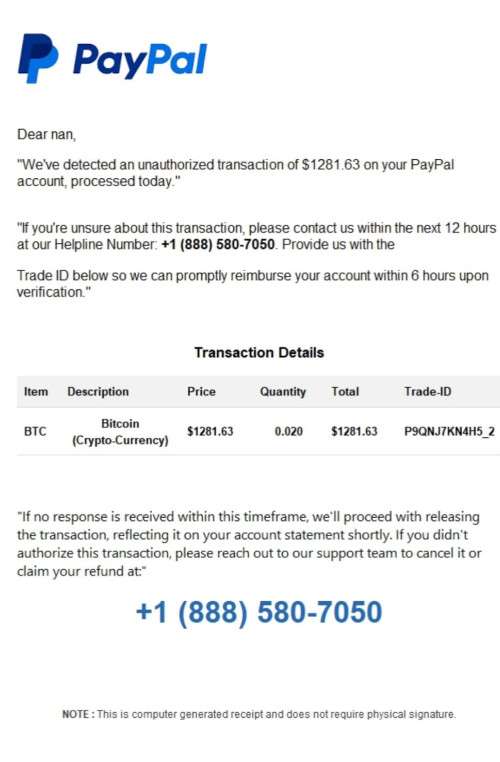
The PayPal Bitcoin order confirmation scam is an increasingly common ruse aiming to convince recipients they accidentally purchased Bitcoin through PayPal. The goal is ultimately stealing your money or personal information. This overview will delve into how the intricate scheme works.
It starts by an email landing in your inbox claiming PayPal processed an order and payment on your behalf for a high amount of Bitcoin, like $500 or $1,000 worth. The message includes convincing details like an order confirmation number, date of purchase, and the pending charge that will debit from your linked bank account or credit card in 1-2 business days.
Of course the entire email is a fake, but many elements aim to make it look legitimate:
- The sender address appears to be from PayPal, such as “service@paypal.com”. But a closer look reveals slight modifications, like using a 1 instead of an l.
- The PayPal logo is used multiple times to establish authenticity at a glance.
- An official-sounding 13-digit “order confirmation number” is provided.
- Details are included like the amount of Bitcoin ordered in BTC, its dollar equivalent, and the total charge.
- Account suspension threats warn your account may freeze if the invoice goes unpaid.
The email urges you to call a provided 800-number within 24 hours if you did not authorize the Bitcoin order. But the real scam begins once you call that number.
You’ll reach a smooth-talking scammer posing as a PayPal support agent. Their goal is keeping you on the phone so they can trick you into paying the fake invoice using tactics like:
- Verifying the order is “legitimate” by referencing the confirmation number or amount.
- Warning your account will be frozen if the invoice goes unpaid per PayPal’s terms.
- Claiming the only way to cancel and refund the order is providing your credit card information.
- Insisting you buy iTunes or Google Play gift cards to repay the balance and read off the redemption codes.
- Asking you to download remote access software so they can “reverse the charges.”
- Directing you to a spoofed PayPal login page to steal your username and password.
The scammers manipulate victims using authority, urgency, intimidation, and fake friendliness. Their ultimate goal is gaining enough trust to extract banking credentials, credit card info, or gift card codes, which they quickly monetize before you can act.
With your account details and payment information compromised, scammers can:
- Use remote access to drain your accounts or transfer funds to themselves.
- Make expensive fraudulent purchases with your credit card information.
- Steal your identity and open new lines of credit in your name.
- Sell your personal information and logins on the dark web.
- Infect your device with malware to spy and gather data covertly.
Victims often lose hundreds or thousands of dollars by the time they realize it’s a scam. But even if no money is lost, the compromise of personal data can lead to identity theft and account breaches.
That’s why spotting these scam emails beforehand is crucial. But if you did engage with the scammers by phone, immediate damage control measures are necessary to protect yourself. Avoidance is the best outcome, but failing that, quick reaction can reduce harm.
Now that you understand the mechanics of this sophisticated social engineering ruse, you can be better prepared to evade it. We’ll cover explicit methods for detecting and stopping the scam later in this guide. Forewarned is forearmed when it comes to protecting your accounts and assets from devious cybercriminals.
Anatomy of the Scam Email
The scam email is the bait used to lure you into the trap. Let’s dissect the common elements that make up one of these PayPal Bitcoin order confirmation messages:
- Spoofed Sender Address – While the “From” address appears to be from service@paypal.com, it actually contains slight modifications to mislead.
- Subject Line – Contains “Invoice” or “Order Confirmation” to get you to open the email quickly.
- PayPal Logos – Contains several PayPal logos and branding elements to look legitimate.
- Charge Amount – Claims you bought a high dollar amount of Bitcoin, like $500 or $1000 worth.
- Order Number – Includes a long alphanumeric “order number” to reference, like 3627PPI234971308.
- Call to Action – Urges you to call a provided 800-number within 72 hours if you did not authorize the charge.
- Threats – Warns your account may be frozen or suspended if you don’t pay promptly.
With enough authentic-looking details, the email can cause even savvy users to question if it’s real. But calling the number starts the real scam.
What Happens When You Call?
Once you call the number provided in the email, the friendly “PayPal agent” who answers will insist that the Bitcoin order is legitimate. They’ll reference details from the email, like the order number, to falsely verify the purchase.
Some other lies and manipulation tactics they will use include:
- Claiming there is a “pending Bitcoin withdrawal” from your bank account to PayPal.
- Stating the purchase was made from your device’s IP address.
- Warning your account will be frozen if you don’t pay immediately.
- Offering to refund the order, but only if you provide credit card details.
- Insisting you buy gift cards to repay the amount and read off the codes.
Their goal is maintaining control of the call so they can pressure you into giving up banking login credentials, credit card info, or gift card numbers to “repay” the fake Bitcoin order. Once they get this sensitive data, your accounts and identity are compromised.
How Victims Get Scammed
During these calls, scammers employ various tactics to gain enough trust to extract valuable personal information:
1. They Direct You to a Fake Website
The “agent” may guide you to click a link in the email routing to a convincing mockup of the real PayPal site. But it’s completely controlled by the scammers to steal login credentials you enter.
2. They Request Remote Access to Your Computer
Scammers may ask to remotely access your computer to supposedly process a refund. This allows them to install malware and spyware to steal data.
3. They Ask for Credit Card and Bank Account Details
They claim they need your account numbers to refund the fraudulent Bitcoin order. But in reality, they use it to commit theft and fraud.
4. They Demand Gift Card Purchase
Insisting gift cards are the only way to repay the order is merely a way to get you to hand over codes they can redeem for cash.
As long as the scammer maintains dominance on the call, their chances of duping you increases. That’s why avoiding their calls entirely protects you from their manipulation and social engineering.
What to do if You Paid the Scammers
If you already fell victim and made payments to the scammers, take these steps immediately:
- Call your bank and credit card companies. Request to block payments or freeze accounts compromised by the scammers.
- Change passwords on all online accounts, especially financial ones, to new secure passwords.
- Scan devices with security software to uncover any malware installed during remote access. Remove any infections.
- Place fraud alerts with credit bureaus to flag any new lines of credit opened in your name.
- Monitor your credit reports closely for signs of identity theft. Dispute fraudulent accounts.
- File complaints with the FTC and PayPal so they can investigate the scam. Provide details on how the scam occurred.
- Contact your local police department to file an official report about the fraud.
The sooner you take counteractions, the less ability scammers have to misuse your stolen personal information and cause further harm. But avoiding the scam in the first place is ideal.
Is Your Device Infected? Run a Free Malware Scan
Slow performance, constant pop-ups, or strange behavior? These are classic signs of a malware infection. The fastest way to find out is to scan your device with Malwarebytes Free — one of the most trusted malware removal tools available.
The free version detects and removes the most common threats, including:
- Adware — the cause of those annoying pop-ups
- Browser hijackers — unwanted redirects and changed homepages
- Trojans and spyware — hidden programs stealing your data
- Potentially unwanted programs (PUPs) — software you never asked for
👉 Select your device below — Windows, Mac, or Android — then follow the simple steps to download Malwarebytes, scan your system, and remove any threats it finds. The scan usually takes 5 to 20 minutes.
Run a Malware Scan with Malwarebytes for Windows
Malwarebytes is one of the most popular and trusted anti-malware tools for Windows — and it’s completely free for removing infections. It catches threats that many antivirus programs miss, including adware, browser hijackers, and trojans. Follow the steps below to scan and clean your PC in just a few minutes.
Download Malwarebytes
Click the button below to download the latest version of Malwarebytes for Windows from the official source. The free version is all you need — it will scan your computer and remove adware, browser hijackers, and other malicious software at no cost.
Download MalwarebytesOfficial installer for Windows 11 and 10. Your download starts right away.Want real-time protection? See Malwarebytes Premium Malwarebytes Free for WindowsScans and removes malware at no cost
-
Install Malwarebytes
When the download finishes, open your Downloads folder and double-click the MBSetup file. If Windows shows a User Account Control pop-up, click “Yes” to allow the installation.
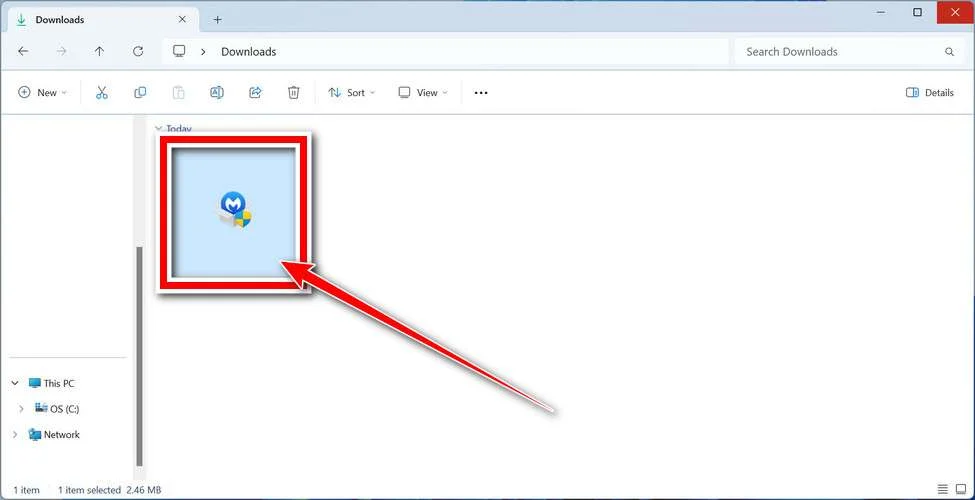
Follow the On-Screen Prompts to Install Malwarebytes
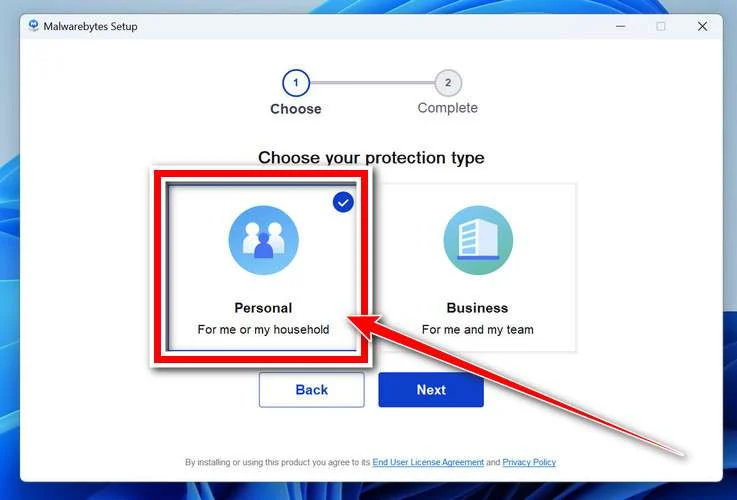
The setup wizard will walk you through a few quick screens:
-
Choose where you’re installing the program — “Personal Computer” or “Work Computer” — then click Next.
-
Malwarebytes will now install on your device. This usually takes under a minute.

-
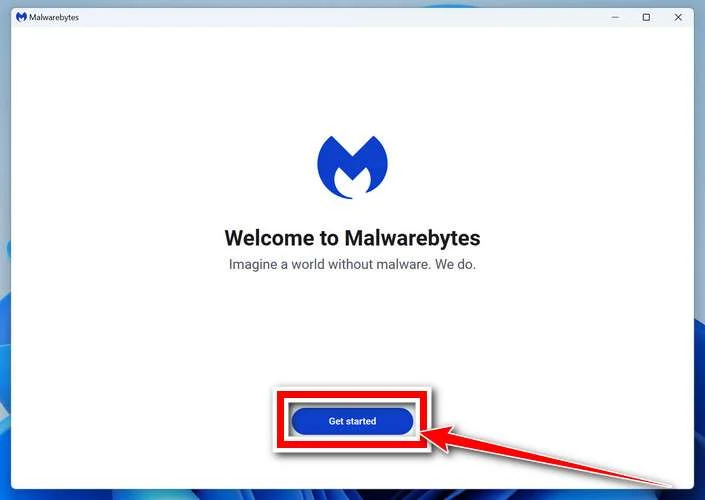
When installation is complete, the “Welcome to Malwarebytes” screen will open automatically.
-
On the final screen, click Open Malwarebytes to launch the program.

-
Enable “Scan for Rootkits”
Before scanning, turn on rootkit detection so Malwarebytes can find even the most hidden threats. Click the Settings gear icon on the left side of the screen.
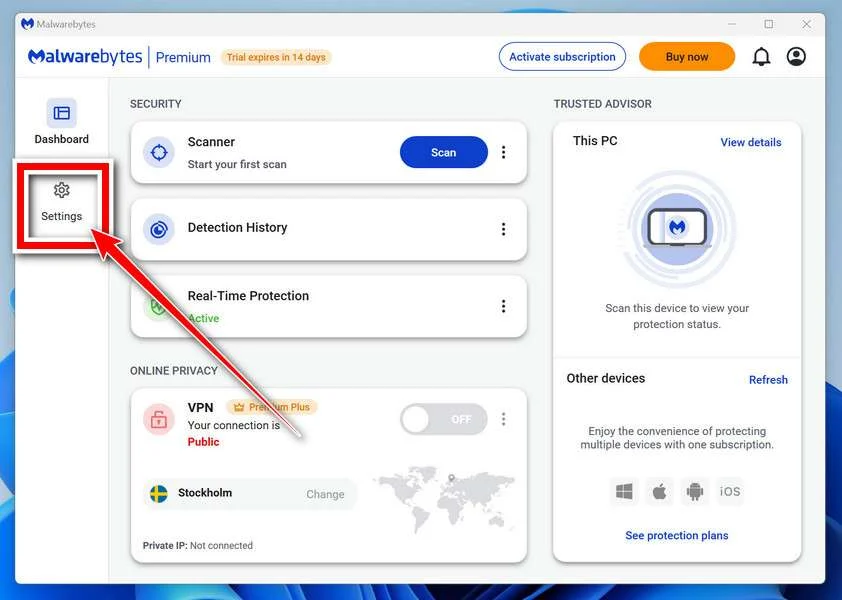
In the settings menu, find “Scan for rootkits” and click the toggle so it turns blue.

Done? Click “Dashboard” in the left pane to return to the main screen.
Start the Scan
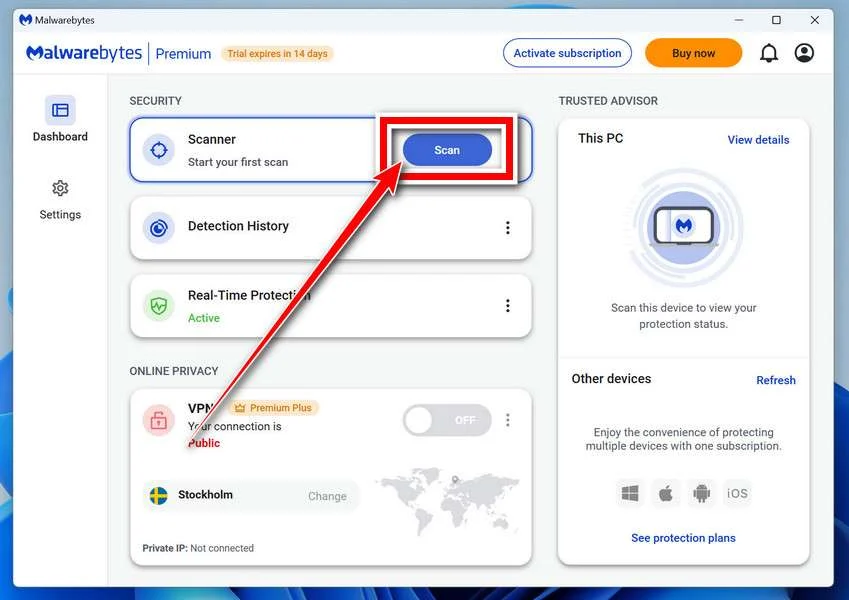
Click the blue Scan button. Malwarebytes will automatically update its virus database and start checking your computer for malware.
-
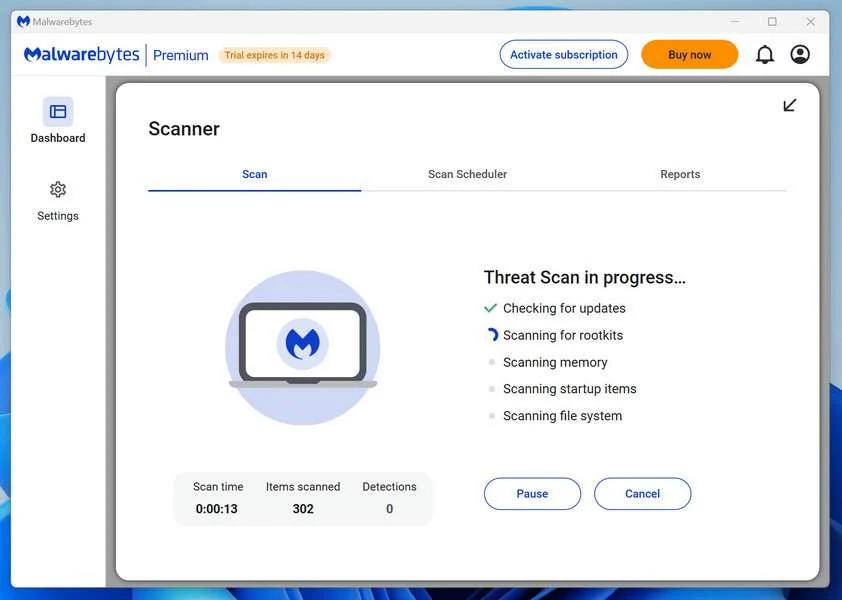
Wait for the Scan to Finish
The scan checks your entire system for browser hijackers and other malicious programs, so it can take 5 to 20 minutes depending on your computer. Feel free to do something else — just check back occasionally to see the progress.
-
Quarantine the Detected Threats
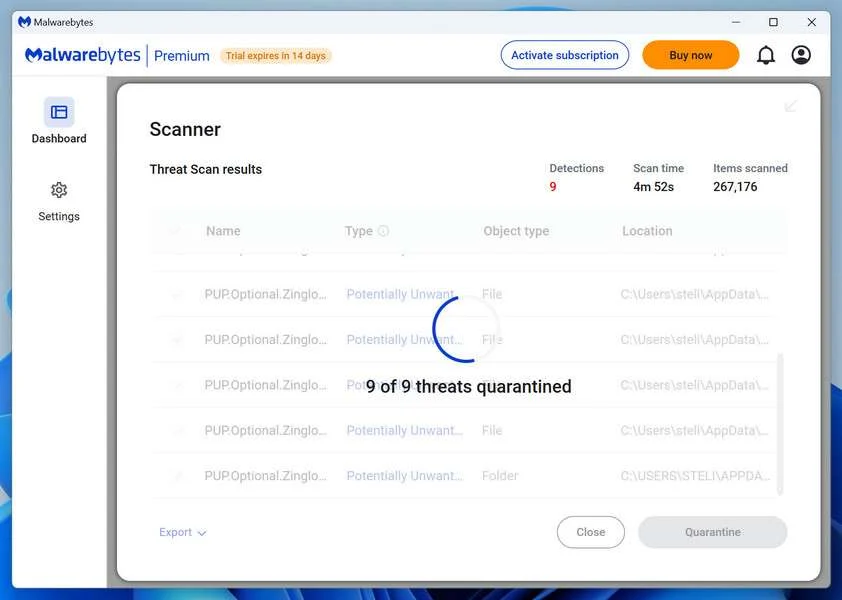
When the scan is done, you’ll see a list of everything Malwarebytes found — malware, adware, and potentially unwanted programs. Click the “Quarantine” button to remove all of them at once.
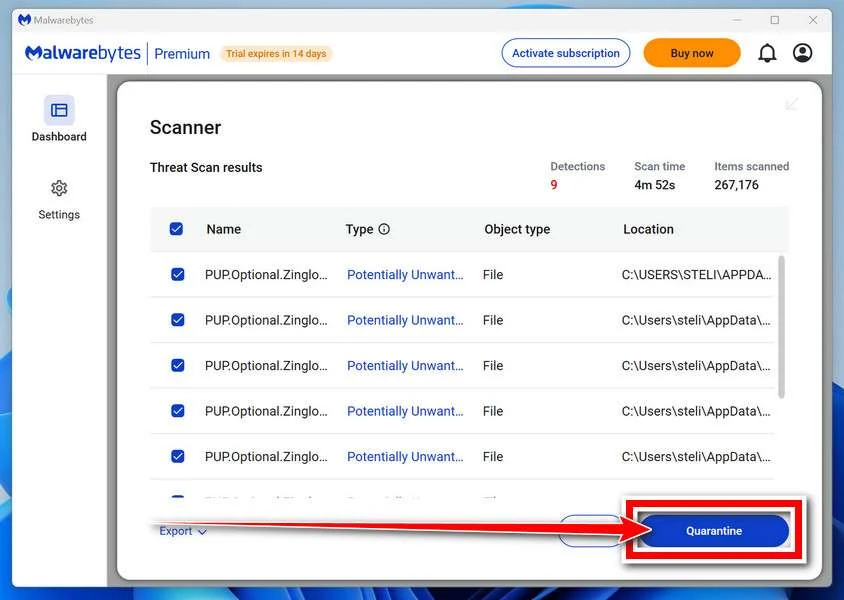
Malwarebytes will now remove the malicious files and registry entries and move them safely into quarantine.
-
Restart Your Computer
Some threats can only be fully removed after a reboot. If Malwarebytes asks you to restart, click Yes. Once you’re logged back in, Malwarebytes has finished removing the threats it found.
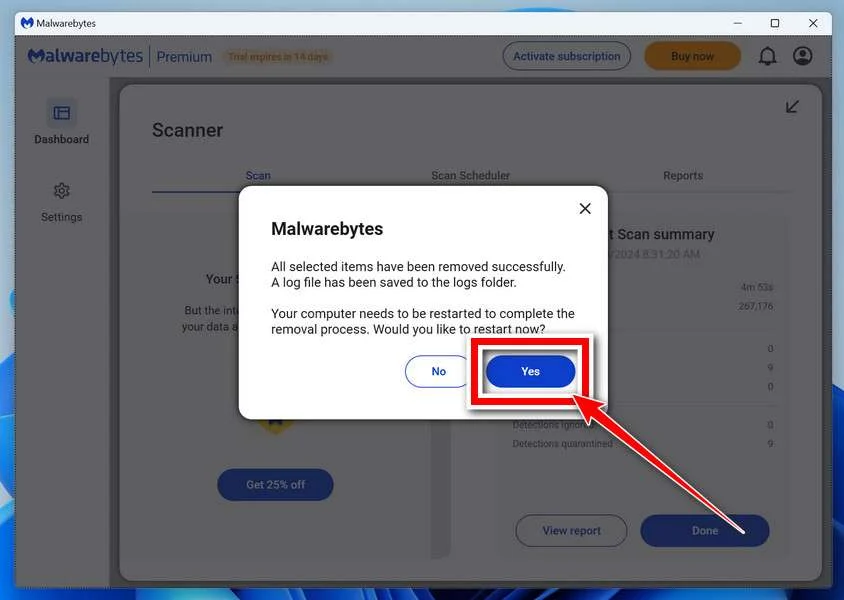
That’s it — your Windows PC is now clean of trojans, adware, and other malware, and should be back to running smoothly.
If you are still having problems with your computer after completing these instructions, then please follow one of the steps:
- Run a computer scan with ESET Online Scanner
- Ask for help in our Windows Malware Removal Help & Support forum.
Run a Malware Scan with Malwarebytes for Mac
Malwarebytes for Mac is a free on-demand scanner that removes the malware other security software tends to miss — adware, browser hijackers, and unwanted programs included. Cleaning an infected Mac with Malwarebytes has always been completely free, and it’s our go-to recommendation. Follow the steps below to scan and clean your Mac in just a few minutes.
-
Download Malwarebytes for Mac
Click the button below to download the latest version of Malwarebytes for Mac.
Download MalwarebytesOfficial installer for macOS. Your download starts right away.Want real-time protection? See Malwarebytes PremiumMalwarebytes Free for MacScans and removes malware at no cost -
Open the Malwarebytes setup file
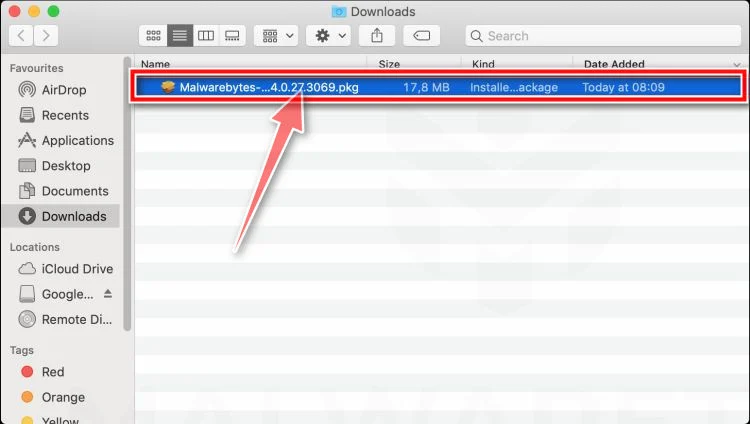
When the download finishes, open your Downloads folder and double-click the setup file to begin the installation.
-
Follow the On-Screen Prompts to Install Malwarebytes
The Malwarebytes for Mac Installer will guide you through a few quick screens. Click “Continue” and keep following the prompts until the installation completes.
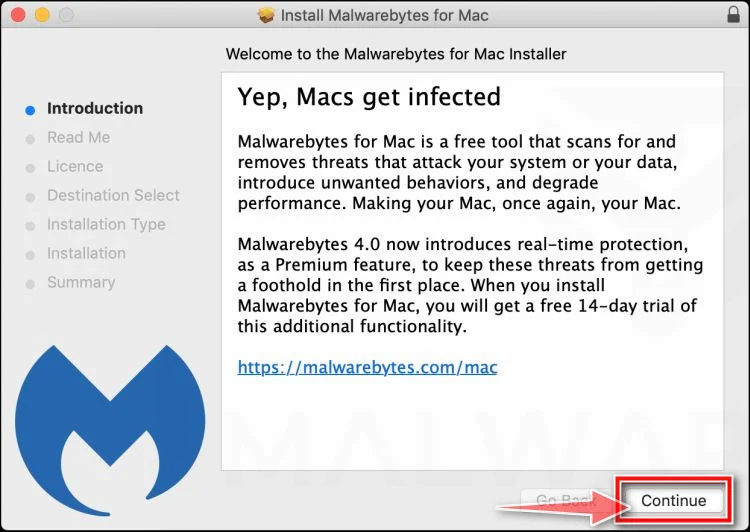
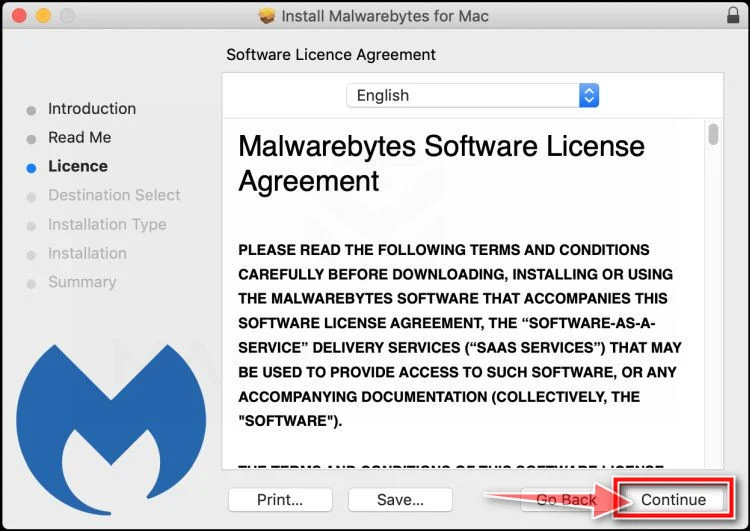
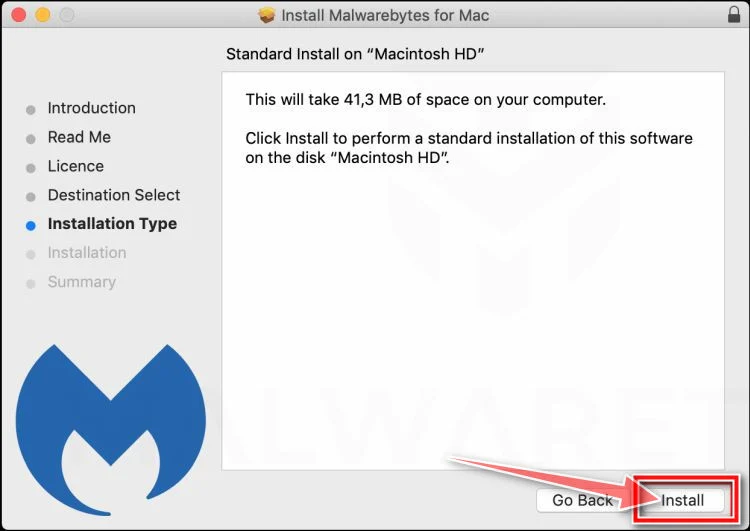
When the installation is complete, Malwarebytes opens to the Welcome to Malwarebytes screen. Click “Get started“.
-
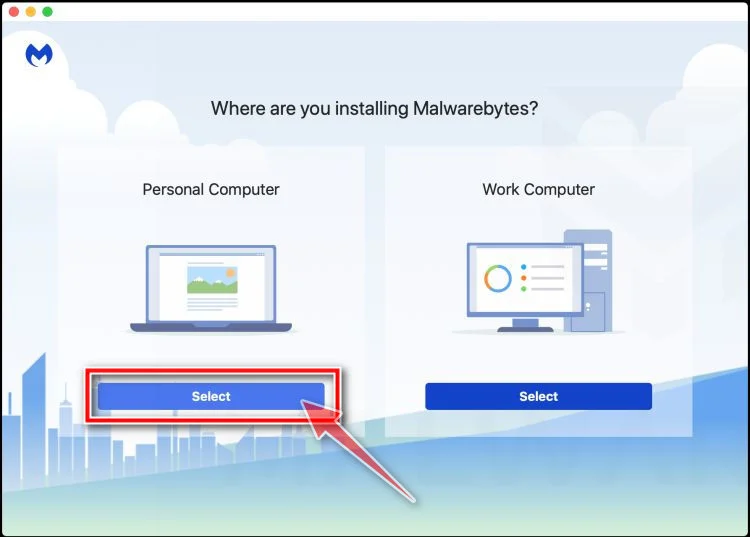
Select “Personal Computer” or “Work Computer”
Malwarebytes will ask what type of computer you’re installing it on. Click either Personal Computer or Work Computer, whichever applies.
-
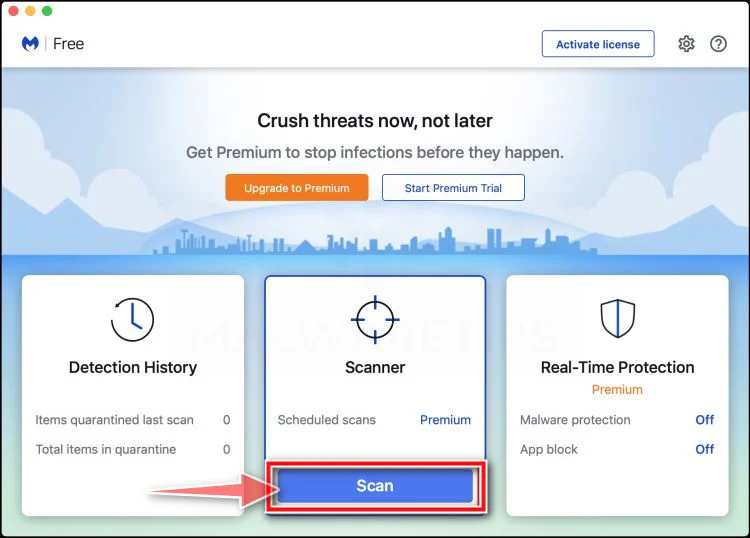
Start the Scan
Click the “Scan” button. Malwarebytes will automatically update its detection database and begin checking your Mac for malware.
-
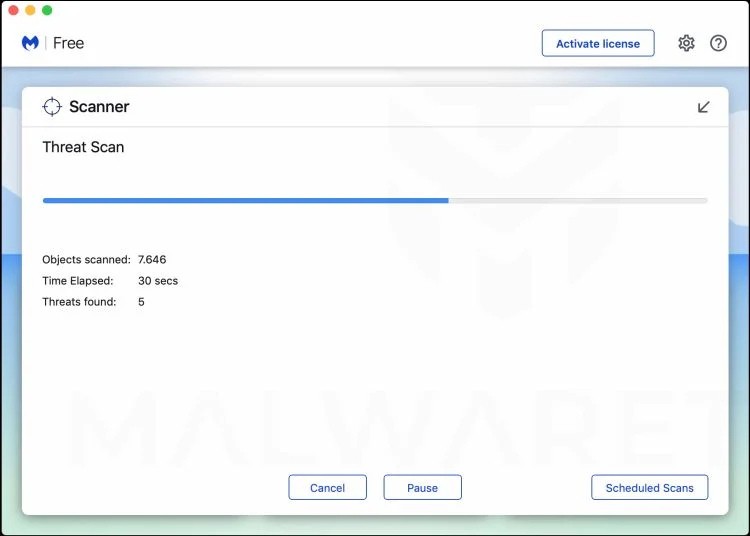
Wait for the Scan to Finish
Malwarebytes will scan your Mac for adware, browser hijackers, and other malicious programs. This can take a few minutes, so feel free to do something else — just check back occasionally to see the progress.
-
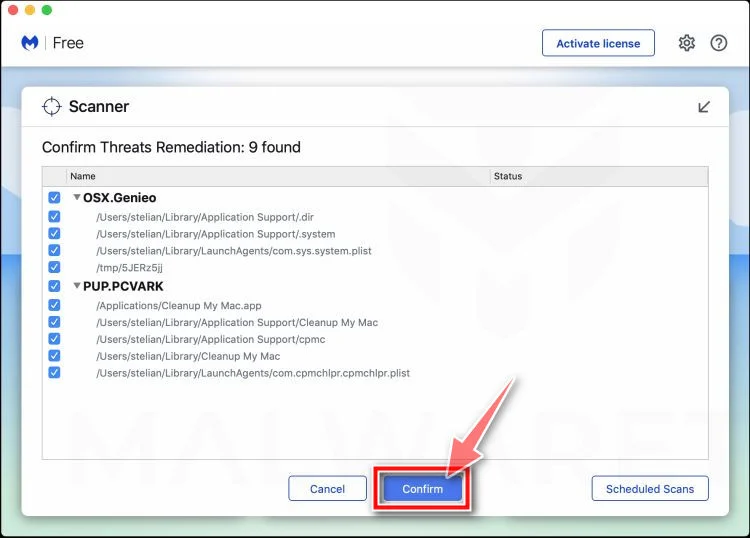
Quarantine the Detected Threats
When the scan is done, you’ll see a list of everything Malwarebytes found. Click the “Quarantine” button to remove all the threats at once.
-
Restart Your Mac
Malwarebytes will now remove all the malicious files it found. Some threats can only be fully removed after a reboot — if Malwarebytes asks you to restart, allow it. Once you’re logged back in, your Mac is clean.
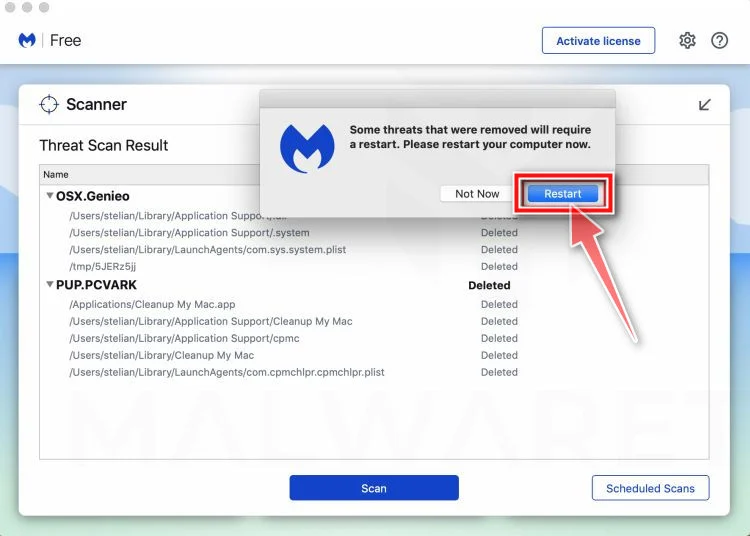
That’s it — your Mac is now free of adware, rogue browser extensions, and other potentially harmful software.
If you are still experiencing problems while trying to remove a malicious program from your computer, please ask for help in our Mac Malware Removal Help & Support forum.
Run a Malware Scan with Malwarebytes for Android
Malwarebytes for Android automatically detects and removes dangerous threats like malware and ransomware so you don’t have to worry about your most-used device being compromised. Aggressive detection of adware and potentially unwanted programs keeps your Android phone or tablet running smooth.
-
Download Malwarebytes for Android.
You can download Malwarebytes for Android by clicking the link below.
Get Malwarebytes for AndroidOpens Google Play in a new tab.Want real-time protection? See Malwarebytes Premium for AndroidMalwarebytes for AndroidScans your phone and removes malware at no cost -
Install Malwarebytes for Android on your phone.
In the Google Play Store, tap “Install” to install Malwarebytes for Android on your device.

When the installation process has finished, tap “Open” to begin using Malwarebytes for Android. You can also open Malwarebytes by tapping on its icon in your phone menu or home screen.

-
Follow the on-screen prompts to complete the setup process
When Malwarebytes will open, you will see the Malwarebytes Setup Wizard which will guide you through a series of permissions and other setup options.
This is the first of two screens that explain the difference between the Premium and Free versions. Swipe this screen to continue.
Tap on “Got it” to proceed to the next step.
Malwarebytes for Android will now ask for a set of permissions that are required to scan your device and protect it from malware. Tap on “Give permission” to continue.
Tap on “Allow” to permit Malwarebytes to access the files on your phone.
-
Update database and run a scan with Malwarebytes for Android
You will now be prompted to update the Malwarebytes database and run a full system scan.

Click on “Update database” to update the Malwarebytes for Android definitions to the latest version, then click on “Run full scan” to perform a system scan.

-
Wait for the Malwarebytes scan to complete.
Malwarebytes will now start scanning your phone for adware and other malicious apps. This process can take a few minutes, so we suggest you do something else and periodically check on the status of the scan to see when it is finished.

-
Click on “Remove Selected”.
When the scan has been completed, you will be presented with a screen showing the malware infections that Malwarebytes for Android has detected. To remove the malicious apps that Malwarebytes has found, tap on the “Remove Selected” button.

-
Restart your phone.
Malwarebytes for Android will now remove all the malicious apps that it has found. To complete the malware removal process, Malwarebytes may ask you to restart your device.
That’s it — your Android phone is now clean — no more malicious apps, adware, or browser redirects.
If you are still having problems with your phone after completing these instructions, then please follow one of the steps:
- Restore your phone to factory settings by going to Settings > General management > Reset > Factory data reset.
- Ask for help in our Mobile Malware Removal Help & Support forum.
Stay Protected: Block Ads and Malicious Sites
Now that your device is clean, keep it that way. Most infections start with a malicious ad or a fake download button — so blocking them at the source is your best defense.
We recommend AdGuard, which blocks malicious ads, phishing pages, and dangerous redirects before they can reach you.
👉 Download AdGuard and browse safely
How to Detect Fake PayPal Bitcoin Emails
Here are some telltale indicators an email is a scam attempt, not legitimate communication from PayPal:
- Generic greetings like “Dear PayPal user” instead of your name.
- Sender address contains misspellings or extra characters.
- Urgency cues like “you must contact us within 24 hours”.
- Unnatural phrasing and language errors throughout.
- Requests for prepaid cards or bank access for repayment.
- Links to spoofed websites dressed as the real PayPal site.
- Threats to suspend your account if the invoice goes unpaid.
With a critical eye trained to spot subtle clues, you can identify these scam emails before even reading the content. When in doubt, contact PayPal directly through official channels to verify legitimacy. Any email pressuring urgent action or payment should be presumed fraudulent.
Avoiding the PayPal Bitcoin Order Scam
Implement these tips to keep your accounts and identity protected from the Bitcoin order confirmation scam:
- Never call unsolicited numbers provided in emails, always contact PayPal directly through known methods.
- Set up two-factor authentication on your PayPal account and other critical logins for extra security.
- Routinely monitor bank and credit card statements for unfamiliar charges indicating possible scams.
- Be wary of urgent threats, demands for remote access, and requests for account details over the phone.
- Never provide your password, one-time codes, or other login credentials to anyone. Keep payment information private until verifying independently that the request is legitimate.
With vigilance and healthy skepticism, you can evade tricks aimed at stealing your hard-earned savings or personal data.
Frequently Asked Questions About the PayPal Bitcoin Order Scam
1. I got an email from PayPal about a Bitcoin order I never placed. Is it real?
No, this is most likely the PayPal Bitcoin order confirmation scam. PayPal does not actually sell or transact with Bitcoin. Any email about an unauthorized Bitcoin order through PayPal is falsified to steal your information.
2. How did the scammers know my name and email address?
Scammers likely obtained your personal details from a data breach, public records, or by purchasing stolen info on the dark web. This information is then used to make the fake emails appear more convincing.
3. What happens if I call the number listed in the email?
Calling the number connects you with a scammer posing as PayPal support. They will attempt to trick you into paying the false invoice through various social engineering techniques and threats. Never call unverified numbers in emails.
4. Could the email be real if it looks like it’s from PayPal?
No, scammers fake the sender address and PayPal branding to fool you. PayPal would never contact you demanding immediate payment for an unauthorized Bitcoin order in this manner. Assume these emails are fraudulent.
5. I already paid the scammers – what should I do now?
Contact your bank immediately to reverse any transfers or freeze your accounts. Monitor your credit closely for signs of identity theft and request fraud alerts. Change online account passwords. File complaints with the FTC and PayPal.
6. Why do scammers ask for gift cards to settle payments?
Gift cards like iTunes and Google Play provide scammers with untraceable cash when the codes are redeemed. Victims can’t get reimbursed for gift card scams. Never pay questionable invoices with gift cards.
7. Can I get my money back if I fell for this scam?
If you paid by credit card or bank transfer, you may successfully dispute the charges. But payments via gift cards, crypto, wire transfers or friends & family PayPal are usually impossible to recover. Act quickly to increase chances.
8. What tips can prevent me from being scammed?
Avoid calls from unfamiliar numbers. Use caller ID and don’t answer suspicious calls. Never provide personal information over the phone. Be wary of threats demanding urgent payment. Verify requests independently through official channels.
9. Why does PayPal warn against sending money to friends and family?
Scammers often insist on friends & family PayPal payments because they can’t be disputed or reversed later when the scam is discovered. PayPal cautions against these types of transfers for protection.
10. Where can I report the scam emails and numbers?
Forward scam emails to PayPal at spoof@paypal.com. Report scam phone numbers to the FTC’s Do Not Call registry. Add the number to your smartphone’s global spam list. File an official complaint about the scam at ReportFraud.ftc.gov.
In Summary
The PayPal Bitcoin order confirmation scam starts with a convincing email about an unauthorized Bitcoin purchase but evolves into sophisticated social engineering over the phone. If you receive a suspicious email, report it to PayPal immediately without calling the provided number. Remember, real PayPal support will never cold call demanding account access or prepaid gift cards.
Spread awareness about this scam to protect more innocent victims from its financial and personal damages. Now that the devious workings of this scam are exposed, you have the knowledge needed to keep your accounts protected and avoid being manipulated. Don’t let these professional thieves swindle you out of account information or a single penny.

Join the discussion
0 commentsShare your experience or ask a question about this article.
Discussion
Start the conversation
Have a question or something useful to share? Add the first comment.