

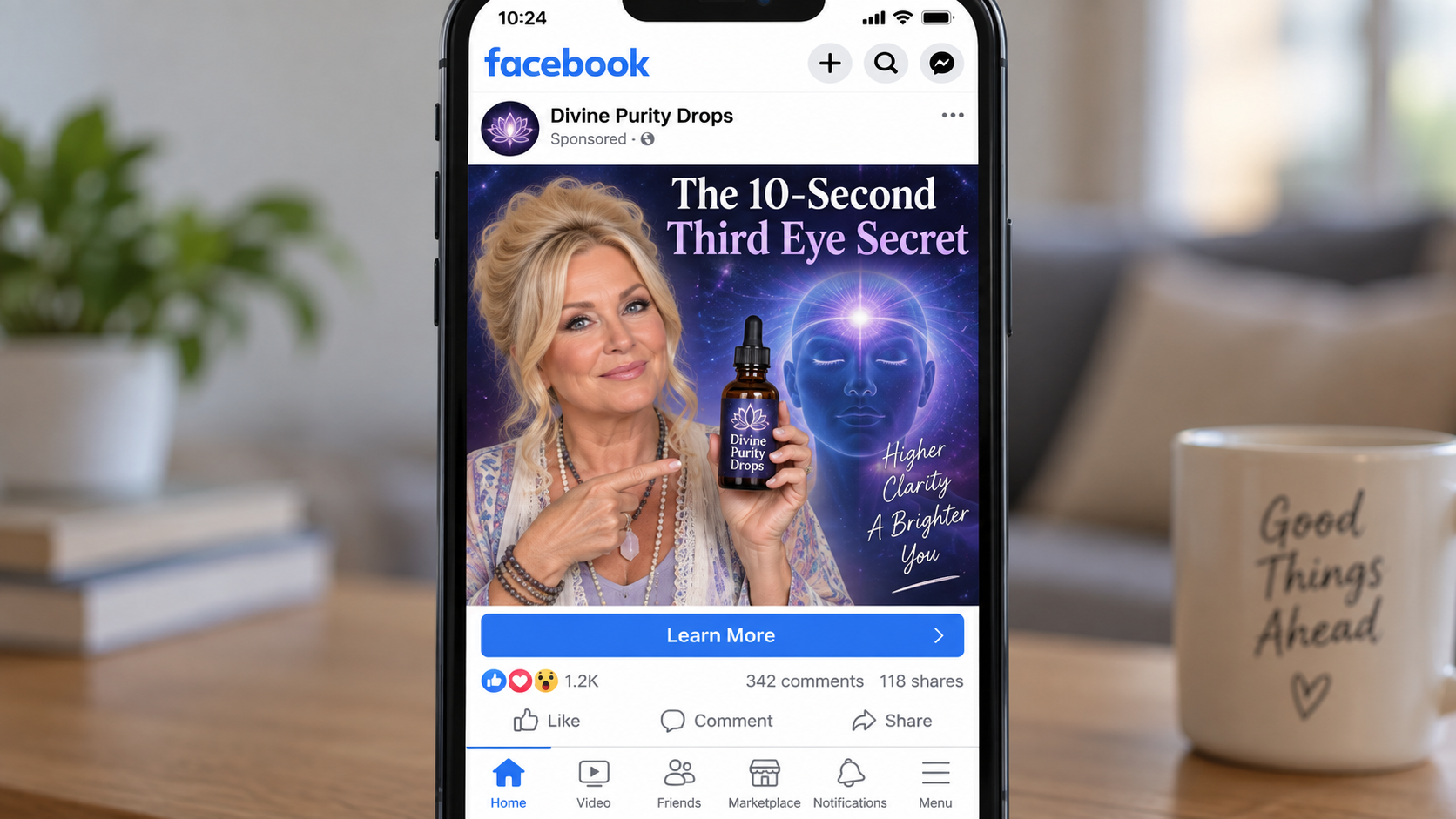
A familiar television face seems to reveal a private spiritual discovery. A small bottle appears beside promises about clarity, intuition, and an awakened mind.
The presentation is polished enough to deserve a second look. That closer inspection reveals important details the advertisement never pauses to explain.
Overview
The campaign borrows Theresa Caputo’s identity without credible authorization
The circulating video makes viewers believe Theresa Caputo is discussing a hidden method for activating the pineal gland and opening a so-called third eye.
Her recognizable appearance supplies trust before the seller has established who created the drops, tested them, or stands behind the medical-sounding promises.
The speech, facial movements, and sales transition show the hallmarks of an AI-manipulated endorsement rather than a normal celebrity advertisement.
We found no credible announcement from Caputo confirming that she created, uses, or recommends Divine Purity Drops.
Other versions reportedly rotate through different famous women, allowing the promotion to reach several audiences while preserving the same underlying pitch.
Mystical language is blended with claims that sound medical
The story moves between spirituality and biology, treating the pineal gland as though it were a blocked switch that a liquid supplement can unlock.
That framing is persuasive because the pineal gland is real, while the promised transformation remains vague enough to mean different things to different viewers.
Words such as detoxify, decalcify, awaken, and restore are used to suggest a biological mechanism without presenting reliable clinical evidence.
No dietary supplement can be assumed to diagnose, treat, reverse, or prevent a medical condition because a dramatic video says so.
People experiencing memory changes, sleep problems, anxiety, confusion, or unusual perceptions need qualified medical advice, not an anonymous advertorial.
The purchasing terms become less reassuring at checkout
The promotional presentation reviewed for this investigation advertised a 180-day promise, creating the impression of a long and generous trial period.
The associated Digistore24 checkout reportedly displayed a 60-day refund period instead, a material difference that should be resolved before anyone pays.
Checkout pages can also introduce bundles, optional services, recurring terms, or separate seller conditions that were not prominent in the opening story.
The safest interpretation is the written term attached to the final transaction, not the largest guarantee shown earlier in the funnel.
- The video uses an apparently AI-generated Theresa Caputo endorsement.
- The pitch connects a real gland with unsupported third-eye promises.
- Famous names substitute for transparent clinical evidence.
- The promotion can reappear under different product names.
- The advertised guarantee and checkout refund period conflict.
- The legal seller is difficult to identify from the emotional story.
- A product existing does not make the celebrity endorsement genuine.
- The unrelated business at DivinePurity.co should not be confused with this offer.
How the Scam Works
Step 1: A sensational social media video stops the scroll
The advertisement opens with a face viewers recognize, often framed as a confession that television producers, doctors, or powerful interests supposedly suppressed.
That secrecy story gives ordinary skepticism a convenient enemy. Anyone questioning the claim can be portrayed as part of the system hiding it.
Short clips are edited for speed, with captions, emotional music, and close shots that leave little time to study unnatural speech or facial movement.
The viewer is invited to listen for a personal revelation, not to examine a commercial offer.
This is why the celebrity appears before the product. Borrowed authority is the hook, while the bottle arrives only after attention has been secured.
Step 2: The fake endorsement becomes a personal testimony
Instead of presenting verifiable research, the narrator describes a discovery, struggle, or private ritual that supposedly changed mental clarity and spiritual awareness.
The story may name other celebrities to create the illusion that an exclusive circle already knows the secret.
AI voice cloning lets operators change names and details quickly without filming a new spokesperson.
Small visual glitches are easy to miss on a phone, especially when captions cover the mouth and the clip changes scenes every few seconds.
Even a perfect-looking video proves nothing by itself. Endorsements should be confirmed through the person’s verified accounts or reputable reporting.
Step 3: A fake news-style page stretches the story
Clicking the advertisement leads to a long advertorial designed to resemble journalism, a television transcript, or an independent health investigation.
The page repeats the celebrity story while gradually adding urgency, testimonials, ingredient language, and reasons conventional advice allegedly failed.
Navigation may be limited, dates may update automatically, and comments can be static decorations rather than genuine reader responses.
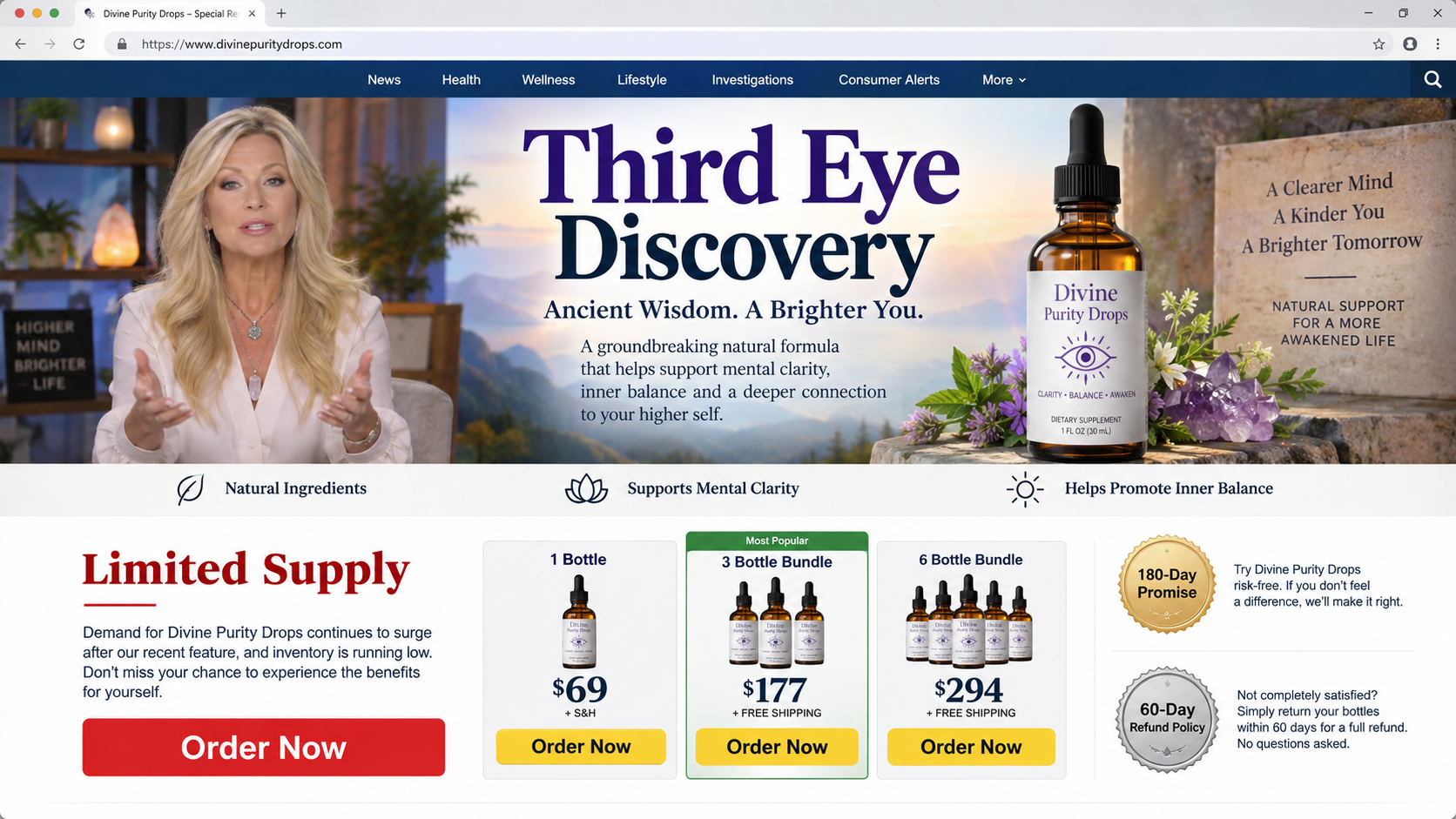
The advertorial keeps readers inside one controlled narrative. It rarely provides the balanced risks, study design, adverse events, or ownership details expected from health reporting.
Buttons placed throughout the story move visitors toward a checkout before they can independently search the product, company, and refund rules.
Step 4: The pineal gland becomes a bridge between science and mysticism
The pineal gland helps regulate melatonin and sleep timing. That real function gives promoters a scientific word they can attach to much broader promises.
The scam then leaps from established anatomy to claims about intuition, psychic perception, toxins, calcification, memory, or hidden human potential.
Those are separate propositions requiring evidence. Repeating them beside brain imagery does not establish that the drops reach, cleanse, or activate anything.
Vague outcomes also protect the pitch from easy measurement. Feeling brighter, aligned, or awakened lacks the objective endpoint used in a meaningful clinical trial.
When an advertisement moves smoothly from a real organ to an extraordinary conclusion, examine every missing step in the argument.
Step 5: Testimonials replace evidence that could be checked
The page may display polished customers describing rapid clarity, deeper sleep, renewed intuition, or emotional transformation.
Names, photographs, star ratings, and verified-buyer badges are all controlled by the page operator unless an independent review system can authenticate them.
Testimonials cannot show whether improvement came from the product, expectation, unrelated lifestyle changes, selective editing, or a completely invented profile.
Look for complete ingredient quantities, contraindications, batch testing, manufacturer identity, and studies on the finished formula.
If those basics remain missing while dramatic stories dominate the screen, the evidence hierarchy has been turned upside down.
Step 6: Bundle pricing raises the amount at risk
The checkout commonly places one bottle beside three-bottle and six-bottle packages, describing the larger purchase as the most popular or best value.
Crossed-out prices make a multi-month supply appear economical, although the customer has not tested tolerance, shipping reliability, or support responsiveness.
A preselected bundle can also cause someone intending to buy one bottle to approve a much larger total.
Buyers should check quantity, shipping, taxes, add-ons, future billing language, and the exact merchant name before submitting payment.
Saving the final checkout screen matters because the landing page may change after complaints begin.
Step 7: Refund friction appears after the sale
The large guarantee near the order button feels simple, yet detailed conditions can impose shorter deadlines, approval requirements, return postage, or product-use restrictions.
Here, the reported difference between a 180-day promotional promise and a 60-day checkout term is not a minor formatting issue.
It changes how long a buyer believes protection lasts and which party may control the dispute.
Support may point to the processor’s policy while the buyer remembers the broader claim that created confidence.
That conflict should stop the purchase until the seller identifies one controlling policy in writing.
Why the Theresa Caputo Story Is Not Credible
A real celebrity campaign leaves a trace outside one advertisement
Legitimate endorsements normally appear through verified social accounts, press releases, brand disclosures, interviews, or advertising archives tied to accountable companies.
This campaign depends on isolated paid videos and a sales page rather than independent confirmation from Caputo.
Search the exact quotation, not merely the person’s name with the product. Fabricated promotions often flood search results with copied reviews.
Check whether reputable coverage predates the advertisement and whether it links to a verifiable statement.
Silence across official channels is especially important when the ad claims a major exclusive revelation.
AI video can look convincing without being authentic
Modern tools can clone voices, synchronize lips, replace facial movements, and assemble footage from interviews that originally discussed unrelated subjects.
Watch for changes in skin texture, teeth, earrings, hair edges, cadence, eye movement, lighting, and emotional tone between cuts.
None of those clues is conclusive alone. The decisive test is whether the endorsement can be verified from the supposed speaker’s own channels.
Scammers benefit when viewers debate pixel details while overlooking the missing authorization and anonymous seller.
Treat provenance as the central question: who published the original, when, and with what commercial disclosure?
The product name can change while the script survives
Direct-response campaigns frequently reuse an effective narrative with a different label, checkout, spokesperson, or ingredient list.
That flexibility explains why searching one bottle name may reveal little history even when the underlying deception has circulated for months.
Remember the story pattern: secret third-eye discovery, famous endorsement, suppressed solution, urgent advertorial, bundle checkout, and difficult accountability.
Recognizing the pattern protects shoppers after Divine Purity Drops disappears or returns under another name.
The story is the durable asset. The bottle is replaceable packaging around it.
Company, Address, and Fulfillment Checks
The promotion does not clearly identify an accountable operator
The celebrity story occupies far more space than the legal identity accepting responsibility for claims, support, refunds, and adverse-event reports.
A brand name is not the same as a registered company. Buyers need a complete entity name, jurisdiction, physical address, and working contact route.
Do not confuse this offer with unrelated businesses using similar words, including the established Divine Purity bath-and-body company at DivinePurity.co.
A payment processor is not necessarily the product company
Digistore24 can process transactions for third-party vendors. Its presence can identify a payment route without proving who formulated or manufactured the drops.
Read the checkout for the vendor name, billing descriptor, refund controller, recurring status, and customer-service channel.
If the advertorial, checkout, receipt, and bottle name different entities, preserve every version and request an explanation before using the product.
A fulfillment address may reveal very little
A returns warehouse can receive parcels for many online sellers without being the headquarters, manufacturer, or party that wrote the advertisement.
Search any disclosed address independently. Determine whether it belongs to an office, mailbox, home, logistics center, or unrelated company.
An address mismatch is not automatic proof of fraud, but unexplained identities make enforcement and medical follow-up substantially harder.
Missing formula accountability creates a health risk
Consumers should see a complete Supplement Facts panel, serving size, ingredient amounts, warnings, lot information, and a traceable manufacturer or distributor.
Words like natural, doctor formulated, or facility registered do not prove effectiveness, purity, or FDA approval of the finished supplement.
Never combine an unfamiliar formula with prescriptions or use it during pregnancy without speaking to a qualified clinician or pharmacist.
What to Do If You Fell Victim to This Scam
- Save the entire trail. Capture the advertisement, video, advertorial, checkout, guarantee, receipt, card descriptor, emails, bottle, shipping label, and every support response before pages change.
- Contact the payment provider quickly. Explain that an unauthorized celebrity endorsement and conflicting refund terms influenced the purchase, then ask about cancellation, chargeback, and recurring-payment controls.
- Cancel any future billing in writing. Ask the seller and processor to confirm that no subscription, autoship, membership, or additional order remains active.
- Do not use unknown drops blindly. Keep the sealed bottle and packaging while seeking professional advice, especially if ingredients, amounts, warnings, or manufacturing details are incomplete.
- Seek medical help for symptoms. Contact a clinician or poison-control service after any concerning reaction, and bring the bottle, label, dose, and purchase details.
- Report the fake endorsement. Use the social platform’s impersonation and fraud tools, then report financial loss to the FTC, IC3, or the appropriate authority in your country.
- Secure accounts after suspicious redirects. Change any reused password, enable multi-factor authentication, and review browser extensions or downloads if the funnel requested unusual software.
- Scan when a file was downloaded. Run a full Malwarebytes scan if the advertisement delivered an attachment, installer, or unexpected download. AdGuard can reduce malicious advertising exposure but cannot validate supplements.
How to Avoid the Next Version of This Promotion
Verify the person before researching the bottle
Start with the supposed endorsement because it is often the easiest claim to disprove.
Visit the person’s verified website and social accounts directly, then search reputable coverage for the exact product and quotation.
Do not accept a blue checkmark shown inside an advertisement. Interface graphics can be copied into any video.
Separate spiritual beliefs from commercial health promises
People may hold sincere beliefs about intuition, meditation, or a third eye. A seller still needs evidence for claims about a purchased supplement.
Ask what measurable outcome was tested, who conducted the study, how many participants completed it, and whether the finished formula was evaluated.
If the answer returns to testimonials, conspiracies, or ancient secrets, the medical-sounding claim remains unsupported.
Read checkout terms before supplying card details
Open every refund, subscription, privacy, shipping, and contact link before choosing a bundle.
Search the page for recurring, monthly, autoship, membership, rebill, cancellation, return authorization, opened bottles, and restocking fee.
Leave when the guarantee changes between pages or the responsible seller remains unclear.
Use payment protection without treating it as prevention
A credit card provides a dispute route, but winning a case still requires evidence and timely action.
Avoid bank transfers, gift cards, cryptocurrency, or payment applications used as irreversible person-to-person transfers.
The best outcome is declining a deceptive offer before money, health information, and contact details enter the funnel.
Frequently Asked Questions
Did Theresa Caputo really endorse Divine Purity Drops?
We found no credible confirmation that Theresa Caputo endorsed the product. The circulating presentation shows the characteristics of an unauthorized AI-manipulated celebrity promotion.
Are Divine Purity Drops proven to activate the pineal gland?
No reliable clinical evidence was presented showing that this finished formula opens a third eye, decalcifies the pineal gland, or produces the advertised transformation.
Is every product called Divine Purity connected to this campaign?
No. Similar names can belong to unrelated businesses and marketplace sellers. Match the exact domain, bottle, checkout vendor, receipt, and advertisement before drawing conclusions.
Why does the guarantee length matter?
A 180-day promise creates materially different expectations from a 60-day refund period. Conflicting terms can delay action until a processor’s actual deadline has passed.
Could the drops be safe even if the advertisement is fake?
Possibly, but a product’s existence or tolerability does not repair a fabricated endorsement. Safety requires transparent ingredients, manufacturing accountability, warnings, and appropriate professional advice.
Will AdGuard or Malwarebytes stop every advertisement like this?
No tool catches every campaign. AdGuard can reduce malicious ads, while Malwarebytes can scan downloaded threats. Verification and cautious payment decisions remain essential.
The Bottom Line
The Theresa Caputo Third Eye Drops campaign is deceptive because it uses an unverified AI celebrity endorsement to give extraordinary pineal-gland claims borrowed authority.
The conflicting refund language and unclear operator add practical risk after the emotional story has already pushed viewers toward a multi-bottle checkout.
Avoid the offer. Remember the narrative, not only the Divine Purity Drops name, because the same story can return tomorrow around a different bottle.

Reviews & discussion
0 commentsShare a firsthand experience, or ask a question.
Community reviews
Theresa Caputo Third Eye Drops
Moderated reader experiences, not an editorial verdict.
Start the conversation
Have a question or something useful to share? Add the first comment.