

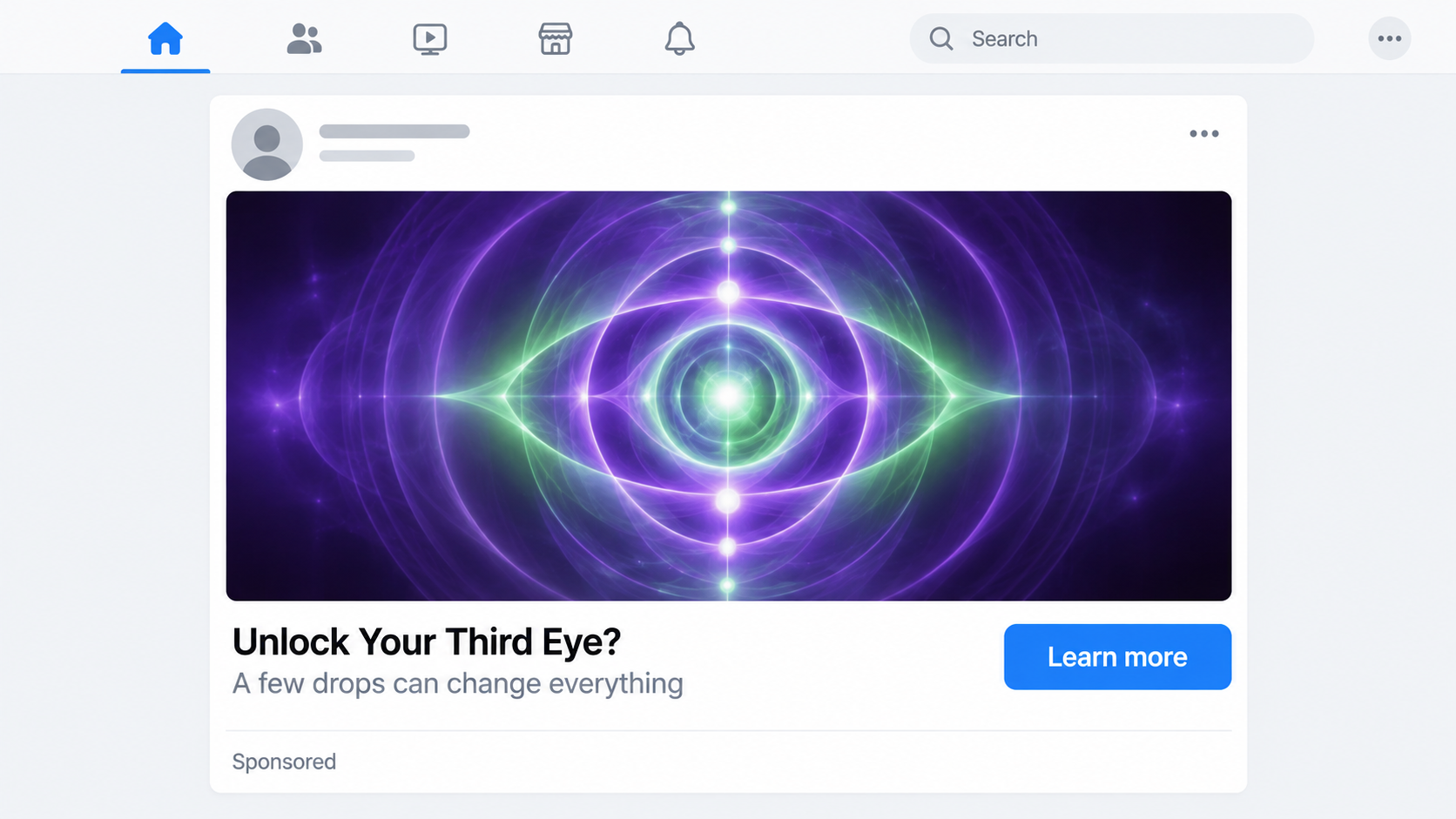
A familiar television personality appears in a short clip about intuition. Then the video introduces a bottle of drops that supposedly changes what people can perceive.
It is an unusual promise, but the real question comes before any ingredient list: did the person in the clip actually say it?
Overview
The story behind the ad
Third eye drops promotions have circulated with footage made to resemble an endorsement from Theresa Caputo. One product name attached to the story is Divine Purity Drops.
The pitch connects spiritual curiosity to the pineal gland, then suggests a bottle can help unlock perception or mental clarity. Celebrity familiarity supplies the initial trust.
We could not verify a direct endorsement from Caputo. Nor could we verify a live checkout from the circulating video.
For that reason, this article does not claim a specific price or subscription.
Why the claim needs scrutiny
The FTC warns that fake celebrity promotions can use doctored video and audio. A clip that looks authentic can still be assembled without consent.
The pineal gland is real, but its established role is not supernatural perception. A medical reference from NCBI Bookshelf describes melatonin and light-dark signaling.
A spiritual belief is a personal matter. It becomes a consumer problem when a marketer converts it into an unverified biological claim that justifies buying drops.
The checks that matter most
The safest way to evaluate this particular pitch is to separate the person, the product, and the payment page.
- Find the alleged endorsement on Caputo’s verified channels, not only in a reposted advertisement.
- Look for a named legal seller, a complete ingredient label, and a working support route.
- Read the final checkout for bottle quantity, total cost, recurring terms, and return conditions.
- Do not treat a moving mouth or familiar voice as proof that a celebrity consented.
These checks remain useful if the same video later promotes a differently named bottle. The misleading story can survive a change of domain or label.
What We Could Verify, and What Remains Open
We found the claim that Caputo appears to promote third eye drops in a circulating video. We did not find an official statement confirming that endorsement.
That is enough to warn readers not to assume the clip is genuine. It is not enough to identify every person or company involved in distributing it.
One domain resembling the product name currently displays a default hosting page rather than a functioning offer. We cannot prove that domain was the video’s destination.
A dead or parked page also cannot tell us what an earlier buyer saw. Advertisers can rotate destinations, affiliate links, and product names quickly.
For that reason, screenshots in this article illustrate the ad and sales pattern. They are not presented as recovered frames from a specific checkout.
The FTC’s warning about celebrity deepfakes is broader than this case. It explains why an apparently natural interview clip needs independent verification.
A video may combine genuine footage with newly recorded narration, altered mouth movement, subtitles, or a separate voice. The precise technique varies.
Without access to the original file and production records, we cannot say which tool produced this clip. The practical problem is misattributed speech.
The claim should be tested at its source. A real endorsement should be visible through the celebrity’s official website, verified account, or reputable interview archive.
Even a genuine endorsement would not prove that drops work. Popularity and personal experience are not substitutes for reliable product testing.
There is a practical way to check the clip without becoming a video-forensics expert. Start with the account that posted it and its history.
Does the account belong to the named person, or was it created recently to run ads? An official-looking username can differ by one character.
Search a distinctive sentence from the video. If it appears only on product pages and affiliate posts, that is different from a real interview record.
Pause on any broadcaster logo. A logo placed over unrelated footage does not establish that the broadcaster aired the segment.
Listen for abrupt changes in room sound and cadence, but do not treat the absence of glitches as proof. Modern edits can be subtle.
Finally, look for the endorsement on a channel controlled by the person or their team. That check is stronger than counting likes beneath an ad.
How the Third Eye Drops Promotion Works
Step 1: A short clip borrows a recognizable face
The opening relies on familiarity. Someone who has watched Caputo on television may stop scrolling before reading the tiny sponsor or account name.
The ad often speaks to curiosity rather than a diagnosed illness. That makes its promise feel less like medicine and more like an invitation to discover something hidden.
Because the clip is short, it leaves little time to ask whether it came from a verified account. The platform’s feed does the distribution work.
Step 2: A mysterious body explanation creates a gap
The story invokes the pineal gland, sometimes called the third eye in popular culture. That name gives the pitch a scientific-sounding bridge to a spiritual idea.
The gland does produce melatonin, which helps signal the sleep-wake cycle. That fact does not imply an oral drop can reveal hidden information or awaken intuition.
When a marketer moves from anatomy to extraordinary perception without evidence, the gap is not a breakthrough. It is the central unsupported leap.
Step 3: The video offers a purchasable answer
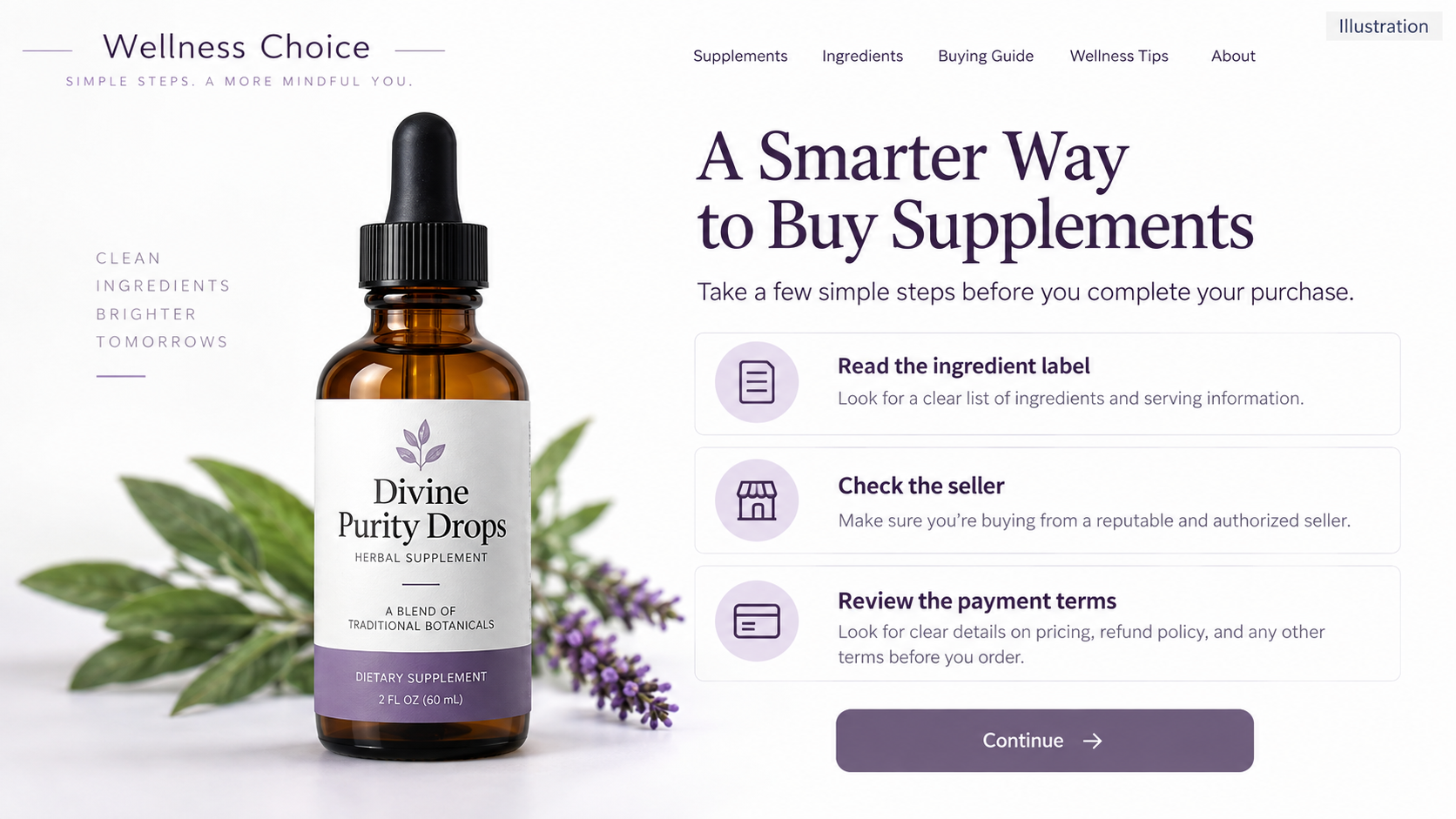
A named bottle, such as Divine Purity Drops, becomes the supposed solution. Packaging makes an abstract promise feel tangible, measurable, and easy to try.
The label can change while the narrative stays the same. A reader should therefore remember the story, not merely the current product name.
A product page may add testimonials, before-and-after language, or claims about blocked energy. Those are advertising statements until independently supported.
Step 4: Social proof reduces the urge to verify
Other celebrity names may appear near this style of promotion, along with comments or star ratings. Each association can create a false sense of acceptance.
Search those names separately. A mention on a seller-controlled page does not prove the person bought, used, recommended, or even saw the product.
Be especially wary of a testimonial whose wording is copied across unrelated products. Recycling praise is a sign of weak verification, not broad success.
Step 5: The order page determines the financial risk
The circulating ad is not itself a contract. The decisive details are the final merchant name, item count, shipping cost, recurring terms, and cancellation instructions.
We have not verified a live checkout for this campaign. We cannot say buyers are automatically subscribed or charged a particular amount.
However, the FTC has documented past supplement promotions that mixed fake celebrity claims with hidden automatic shipments. That history is a reason to inspect, not assume.
If a checkout asks for one-time consent and separately offers refills, make your selection deliberately. Capture the screen before payment.
Step 6: A complaint becomes harder when pages vanish
Sponsored ads may disappear from a feed. Landing pages can change, and an affiliate link can direct another person to a different version.
Save the ad account name, date, destination URL, receipt, and any page promising refunds. These details help identify the actual merchant later.
Do not rely on the celebrity’s name as your only record. The person being impersonated may have no connection to the sale or customer service.
The Pineal Gland Is Not a Product Proof
Stories about a third eye have a long cultural history. That metaphor can have personal meaning without serving as evidence for a supplement’s biological effect.
The pineal gland’s well-described role is producing melatonin in relation to the light-dark cycle. Researchers study other possible functions, but that is not this ad’s proof.
A persuasive pitch may cite a real gland and then add an unsupported claim. The true first sentence does not validate the invented second sentence.
To evaluate any offered drops, ask for the complete ingredients, doses, human study design, and outcomes. Did researchers test this exact formulation?
Was the product compared with a placebo? Were outcomes defined before the study? Were participants similar to the buyers being targeted?
A seller may instead cite a general article about melatonin. That would not demonstrate improved intuition, spiritual ability, memory, or mental clarity from its bottle.
Some ingredients can interact with medicines or have side effects. The FDA advises discussing supplements with a health professional.
The word natural does not erase dosage concerns. Nor does a celebrity-style video establish that a product is safe for pregnancy, chronic illness, or other medicines.
A short video also cannot show whether a benefit lasts, how often it occurs, or how many users noticed nothing. Those missing denominators matter.
When an ad promises an extraordinary change in perception, the evidence should be unusually clear. A bottle photograph and a voiceover are not enough.
Company, Checkout, and Fulfillment Checks
Find the seller behind the label
A product name is not a legal company. Look for the business that accepts payment, issues receipts, and answers refund requests.
Compare the company on the checkout, terms, privacy page, and card statement. A mismatch is not automatically fraud, but it needs an explanation.
If the ad sends you through several domains, record each one. The first promotional page may be an affiliate, while a different business handles the order.
Test the contact information before paying
A working email form is not the same as responsive support. Send a specific question about the product, refund window, and recurring charges.
Ask for a clear answer in writing. An automated reply that never identifies the merchant or product should not reassure you.
Do not call a phone number shown only inside an alleged celebrity video. Find it again on the merchant’s formal checkout or policy page.
Check the return address and shipping origin
Where will a returned bottle go? A warehouse or mailbox can process packages without being the manufacturer’s headquarters.
Read whether opened bottles qualify, whether shipping is refundable, and how long you have to submit a request after delivery.
Do not infer a product’s manufacturing country from a long shipping estimate. Look for a label or seller disclosure that actually identifies it.
Read the label and payment authorization
The Supplement Facts panel should list ingredients and amounts. A vague promise about purity or frequency is not a substitute for that information.
Inspect every preselected box and the final order total. If a refill plan exists, its price, frequency, and cancellation path should be explicit.
We have not verified such a plan for Divine Purity Drops. This is a pre-purchase check, not an allegation that the current campaign enrolls buyers.
What to Do If You Bought Third Eye Drops From the Ad
- Preserve what you saw. Save the video link, advertiser name, landing address, order page, receipt, package label, and any promise mentioning the celebrity or a refund.
- Identify the actual merchant. Use the receipt and card descriptor, not the face in the ad. Ask the merchant in writing to confirm the order’s terms.
- Check for later charges. Review your account after the first payment. If a charge appears that you did not authorize, contact the issuer promptly.
- Request a refund with specifics. State the advertised representation you relied on, your order number, and the remedy requested. Keep copies of each reply.
- Discuss use with a clinician. Bring the bottle and ingredient list, particularly if you take medication or experienced an unexpected reaction.
- Report the impersonation. Flag the ad on its platform and report a deceptive endorsement to the FTC. Include the URL, date, and screenshots.
If you only watched the clip, there is no need to cancel a card. Simply avoid the link and verify future endorsements through official channels.
If you entered a password into a page reached from the ad, change that password from the real service and enable two-factor authentication.
Frequently Asked Questions
Did Theresa Caputo endorse Divine Purity Drops?
We could not verify an endorsement on her official channels. Treat the circulating clip as unverified rather than accepting a familiar face as proof.
Can a video be faked without obvious glitches?
Yes. The FTC warns that doctored audio and video can make endorsements look convincing. An authentic-looking clip still needs source verification.
Does the pineal gland control a third eye?
Medical references describe its role in melatonin and light-dark signaling. Spiritual language about a third eye does not establish a supplement effect.
Are these drops sold through a subscription?
We could not verify a live checkout for the campaign. Read the exact payment page and receipt before assuming either a one-time sale or recurring refills.
Does a money-back guarantee make the product safe?
No. A refund policy concerns payment, not medical safety or effectiveness. Read the ingredients and ask a qualified professional about personal risks.
What if the product name changes?
Recheck the same core story: the claimed celebrity endorsement, extraordinary third eye benefit, legal seller, full label, and checkout terms.
The Bottom Line
The Theresa Caputo third eye drops story asks viewers to trust a face before they inspect a bottle. We could not verify the endorsement or a live campaign checkout.
Pause before buying. Check official channels, demand real product evidence, and save the complete payment terms if you decide to proceed.

Join the discussion
0 commentsShare your experience or ask a question about this article.
Discussion
Start the conversation
Have a question or something useful to share? Add the first comment.