

Dry eyes can turn a book, a drive, or an ordinary workday into a struggle. A comfortable heated mask is an understandable thing to investigate.
EYEMOS DryRelief makes an appealing offer, but the details matter. Look beyond the relief stories before deciding what the mask can reasonably do for you.
Overview
A Heated Mask, Not an Imaginary Treatment Category
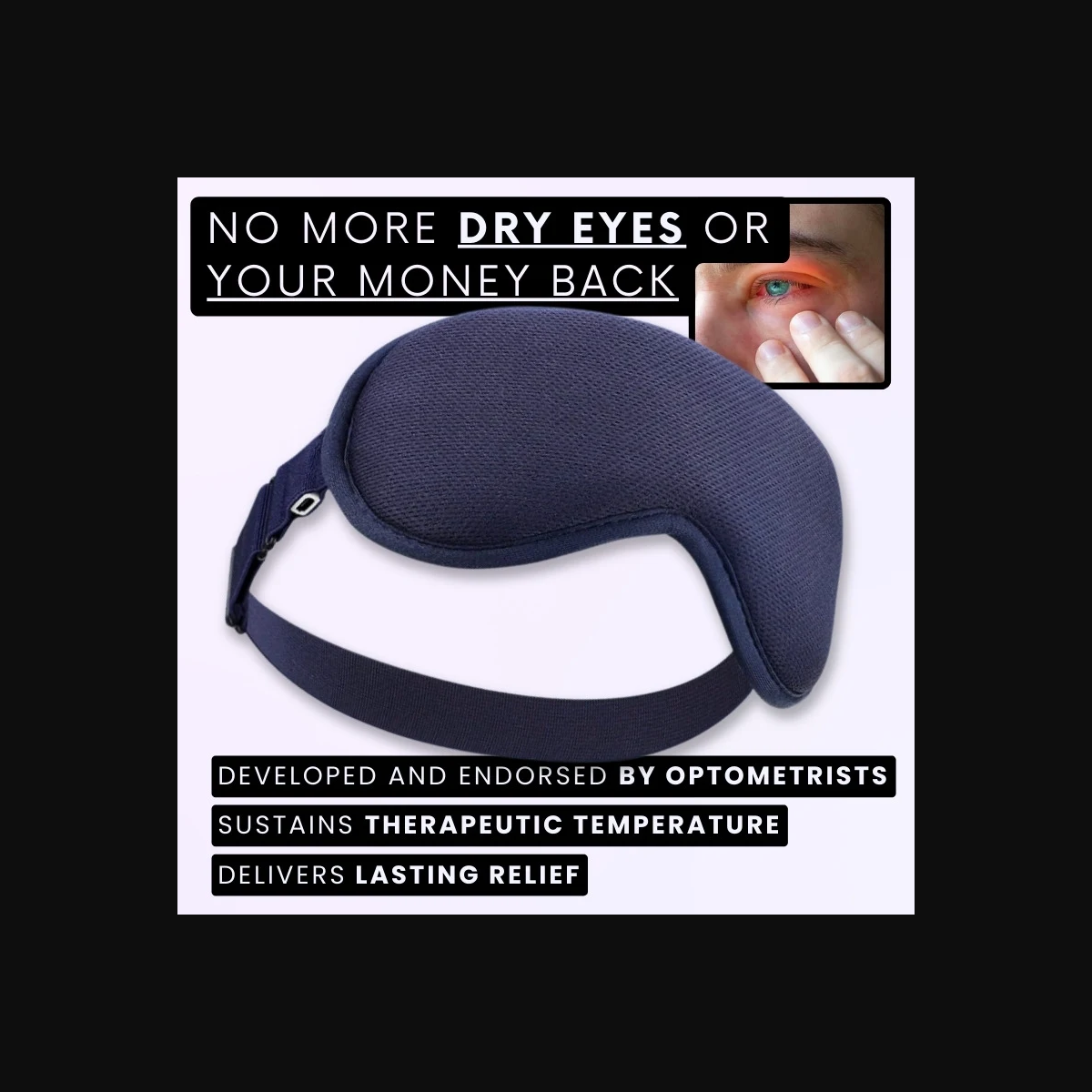
EYEMOS DryRelief is advertised as a USB-powered warming eye mask with adjustable settings, vibration, and an automatic timer. It is marketed for dry-eye comfort.
Warm compresses have a legitimate role in some eye-care routines. That fact should not be erased simply because an advertisement uses exaggerated or overly confident language.
The important distinction is between a reasonable category of care and proof of the particular results a branded product promises.
The Claims and Conditions to Examine
- Comparisons suggesting the mask outperforms ordinary compresses or eye drops.
- Customer-survey percentages presented close to clinical-sounding explanations.
- A long service-life claim alongside a stated number of heating cycles.
- A 30-day satisfaction promise with return shipping and condition requirements.
- Testimonials about reducing drops that should not become instructions to change treatment.
Our Assessment Is About the Offer, Not a Fraud Verdict
The evidence reviewed does not justify declaring EYEMOS a confirmed scam. The website describes an identifiable device and publishes purchase and return information.
It also does not establish that this mask reliably replaces other care, suits every dry-eye problem, or achieves every comparative claim on the page.
The sensible decision depends on your actual eye condition, the evidence behind the promised benefit, and whether the trial terms genuinely suit your purchase.
Where the Medical Explanation Needs More Care
Dry-eye symptoms do not all have one cause. That is why a convincing explanation about blocked glands cannot diagnose the person reading a product advertisement.
The American Academy of Ophthalmology includes warm compresses among measures used in dry-eye care. That supports the category, not every branded performance claim.
A mask may make a recommended routine easier to follow. Convenience can be valuable, especially if an ordinary cloth cools too quickly or is awkward.
However, making a routine easier is not the same as proving a device is clinically superior to prescribed medication or appropriate for every condition.
The National Eye Institute describes different causes and treatments for dry eye and advises following your doctor’s instructions for eye drops.
Keep that distinction in mind when a testimonial describes no longer needing drops. Someone else’s experience is not permission to stop your own treatment.
Persistent, worsening, or unusual symptoms deserve proper assessment. Do not use a retail guarantee as a reason to postpone professional advice about your eyes.
How the EYEMOS DryRelief Offer Builds Confidence
Step 1: Connect With the Everyday Frustration of Dry Eyes
The landing page describes difficulties with reading, driving, sleep, and repeatedly reaching for drops. Those are relatable problems for the intended audience.
That recognition can make the proposed solution feel personal. A reader may start imagining relief before considering whether the explanation fits their diagnosis.
Use that moment to separate recognition from assessment. An advertisement can describe your discomfort accurately without knowing why it happens.
The useful next question is not whether the story sounds familiar. It is whether a warming mask belongs in the care plan appropriate for you.
Step 2: Move From Heat Therapy to Strong Product Comparisons
The product page claims performance up to three times that of a traditional warm compress. It also displays effectiveness comparisons with drops and wet compresses.
For those comparisons to guide a purchase, readers need to know what effectiveness means. Comfort ratings, tear measurements, and lasting symptom changes are different outcomes.
They also need comparable testing conditions. A figure for one group cannot simply be placed beside another treatment’s figure and treated as a fair contest.
The reviewed material does not establish a matched head-to-head study supporting all those comparisons. Treat them as claims requiring explanation, not settled clinical rankings.
Step 3: Let Customer Percentages Carry the Evidence Story
The landing page reports favorable percentages for comfort, reduced reliance on other remedies, and fatigue. It attributes them to a survey of 732 repeat customers.
That description matters. Repeat customers are a selected group, not necessarily representative of everyone who bought, tried, returned, or stopped using the mask.
Customer reports can help identify experiences people value. They cannot, on their own, show which part of an improvement came from the device.
For example, changed routines, other treatments, and the natural course of symptoms can affect an individual’s report. A clinical comparison needs to address those possibilities.
Step 4: Turn a Single Trial Into a Multi-Mask Choice
The inspected landing page presented one kit for $55, two for $85, and three for $110. Larger packages reduce the displayed price per mask.
Those are clearly different quantities, not proof of unauthorized extras. A bundle promotion becomes your purchase only when you authorize the corresponding order.
Still, the useful starting point is whether one mask is suitable. Buying duplicates before learning that answer increases the amount tied up in a trial.
Check the confirmation for the chosen package and currency. Localized storefront pricing can differ from amounts printed in a separate campaign page.
Step 5: Close With Long-Life and Satisfaction Assurances
The product information describes a long working life and at least 3,000 heating cycles. Those statements sound like a reason to spread the cost over years.
But 3,000 sessions correspond to approximately 8.2 years at one session daily, or 4.1 years at two. That is simple arithmetic, not a durability test.
The seller’s suggested usage includes one or two sessions daily. Buyers should not assume a decade of that routine is covered by the stated cycle count.
A stated one-year manufacturing-defect warranty is also different from a multi-year lifespan claim. Ask what the warranty covers, rather than treating the two as interchangeable.
What to Check Before Treating It as a Trial
The Refund Clock Is Not Explained Consistently
The landing-page guarantee says the 30-day satisfaction period begins on receipt. The refund policy also uses receipt as its starting point.
However, a product FAQ refers to contacting the company within 30 days of purchase. That wording creates an avoidable disagreement if delivery takes time.
Ask which date controls your order and retain the answer. A trial period should not become shorter simply because different sections use different wording.
Buyer-Paid Return Shipping Changes the Risk
The refund policy requires the original packaging and item condition, prior approval, and buyer-paid return shipping. Those conditions belong in your cost calculation.
The satisfaction promise sounds like an invitation to test the mask. Clarify whether a used trial remains eligible under the condition requirement.
A merchant can explain that point without asking you to purchase first. If the answer is unclear, do not treat the guarantee as a free experiment.
Comfort and Safety Need Your Own Circumstances
The advertised settings and timer are features, not personalized instructions. More heat or stronger vibration is not automatically better care.
Follow appropriate professional advice and the actual instructions supplied with the device. Seek guidance before use if you have a relevant eye condition or recent procedure.
Do not imitate a customer’s post-surgery routine from a testimonial. It may omit the medical advice and circumstances that made that person’s experience different.
If the mask causes pain, irritation, or an unexpected reaction, stop and obtain suitable advice. Do not keep using it merely to complete an advertised trial.
A USB Cable Is Not a Cordless Feature
The product description specifies USB power and a controller cable. Do not assume that wording means the mask contains a rechargeable battery.
That distinction affects where you can use it comfortably. Consider your seating position, available power connection, and whether a cable will be practical for your routine.
The page also contains different cable-length descriptions. Ask which version ships with your order if reaching a suitable connection is important.
A longer cable listed among the box contents may reflect an updated package, but the seller should resolve the difference rather than leaving customers guessing.
Check the supplied instructions for compatible power equipment. Do not assume every old adapter or improvised connection is suitable simply because a plug fits.
These details are not as dramatic as a relief percentage, but they can determine whether you consistently use a device recommended for your routine.
Buy for a clearly understood function, not an imagined feature. Convenience is only valuable when the product actually fits the way you intend to use it.
Seller, Support, Shipping, and Return Details
The Brand Should Identify the Seller Behind the Receipt
The inspected contact-information policy provides an EYEMOS email route but does not identify a full legal business name and address there.
That does not prove a fictitious company. It means buyers should establish the contracting seller through the actual checkout and receipt before relying on a warranty.
Keep the entity taking payment separate from the brand printed on the mask. The former matters if you need a refund or formal complaint.
The Published Email Routes Are Not Service Tests
The landing page uses customercare@eyemos.com, while the contact and refund policies use hello@eyemos.com. Both are published by the site.
No email was sent for this investigation. We therefore make no claim that either inbox is unresponsive or that either one guarantees prompt resolution.
For a return, use the policy’s stated route and preserve your message. Include the order reference so support can identify the transaction.
Delivery Estimates Should Be Kept With the Order
The shipping policy describes processing separately from transit and provides different estimates by country. A broad fast-delivery phrase should not erase that distinction.
Use the estimate applicable to your destination and order, not a testimonial from another market. Save it before the page changes.
A claim about local warehouses does not independently establish manufacturing origin. This article does not label the mask Chinese-made without supporting product or shipment evidence.
What This Review Can Establish
The research examined current promotional, product, contact, shipping, and refund pages. It did not purchase a mask, test temperatures, verify durability, or measure clinical outcomes.
The finding is a buyer-risk assessment of comparative claims and trial conditions. It is not a conclusion that warm compresses are bogus or EYEMOS never delivers.
Do not buy because an advertisement implies you can replace prescribed care. Consider a warming device only within an appropriate routine and with clearly understood purchase terms.
What to Do if You Already Bought EYEMOS DryRelief
-
Keep your existing eye-care plan intact. Do not stop prescribed drops or other treatment because a testimonial describes doing so.
Ask your eye-care professional whether a warming mask is suitable for your condition and how it fits alongside the measures already recommended.
-
Check what you actually ordered. Confirm the number of masks, currency, total, delivery estimate, and seller details shown on the receipt.
A lower advertised unit price may belong to a larger bundle. Raise an unintended package choice promptly rather than waiting until dispatch.
-
Preserve the packaging and purchase promises. Keep the instructions, order confirmation, guarantee, refund policy, and proof of delivery date.
These records matter if different sections disagree about the start of the return period or whether an opened trial is eligible.
-
Report a product problem specifically. Describe a missing component, intermittent operation, visible damage, or unexpected discomfort without assuming its cause.
Do not modify the electronics or improvise a repair before discussing the warranty. Keep photographs and any safe evidence of the fault.
-
Request return approval before posting the parcel. Ask support to confirm eligibility, deadline, destination, postage responsibility, and expected refund amount.
Use tracking for an authorized return and keep the receipt. The policy says unsolicited returns are not accepted, so obtain clear instructions first.
-
Follow up on the actual refund. The policy describes repayment after inspection and approval, followed by processing time through the original payment method.
If a documented issue remains unresolved, ask your payment provider about its dispute process and deadlines. A dispute is not guaranteed to succeed.
Frequently Asked Questions
Is EYEMOS DryRelief a scam?
A confirmed scam was not established. The more useful warning concerns strong comparative claims, a survey-based evidence story, and return terms that deserve clarification.
That is different from claiming the mask cannot provide comfort or that the entire category of warm eye compresses is fraudulent.
Can a heated mask help with dry eyes?
Warm compresses can be part of care for some dry-eye problems. Your diagnosis and circumstances matter, and a particular retail device is not automatically suitable.
Should I stop using eye drops if I buy it?
No. Follow your clinician’s instructions. A customer story about using fewer drops is not an individualized treatment recommendation for another person.
Does the survey prove the mask beats other treatments?
No. The reported survey involved repeat customers. It does not establish a controlled, matched comparison proving superiority over prescribed drops or every ordinary warm compress.
Is the 30-day trial free of costs?
Not necessarily. The refund policy assigns return shipping to the buyer and requires approval and qualifying condition. Clarify whether an opened trial is covered before ordering.
Does the cycle count guarantee ten years of daily use?
No. Three thousand sessions do not equal ten years at one or two sessions every day. A cycle claim is also different from a warranty.
The Bottom Line
Do not buy EYEMOS DryRelief as a proven replacement for eye drops or personalized treatment. Its marketing does not establish that promise.
If a warming mask fits your clinician’s advice, settle the trial eligibility and return costs first. Existing buyers should keep their care plan and act before refund deadlines.

Join the discussion
0 commentsShare your experience or ask a question about this article.
Discussion
Start the conversation
Have a question or something useful to share? Add the first comment.