

A text arrives while you are working: someone else is trying to claim your business name. It sounds like the kind of problem you cannot afford to ignore.
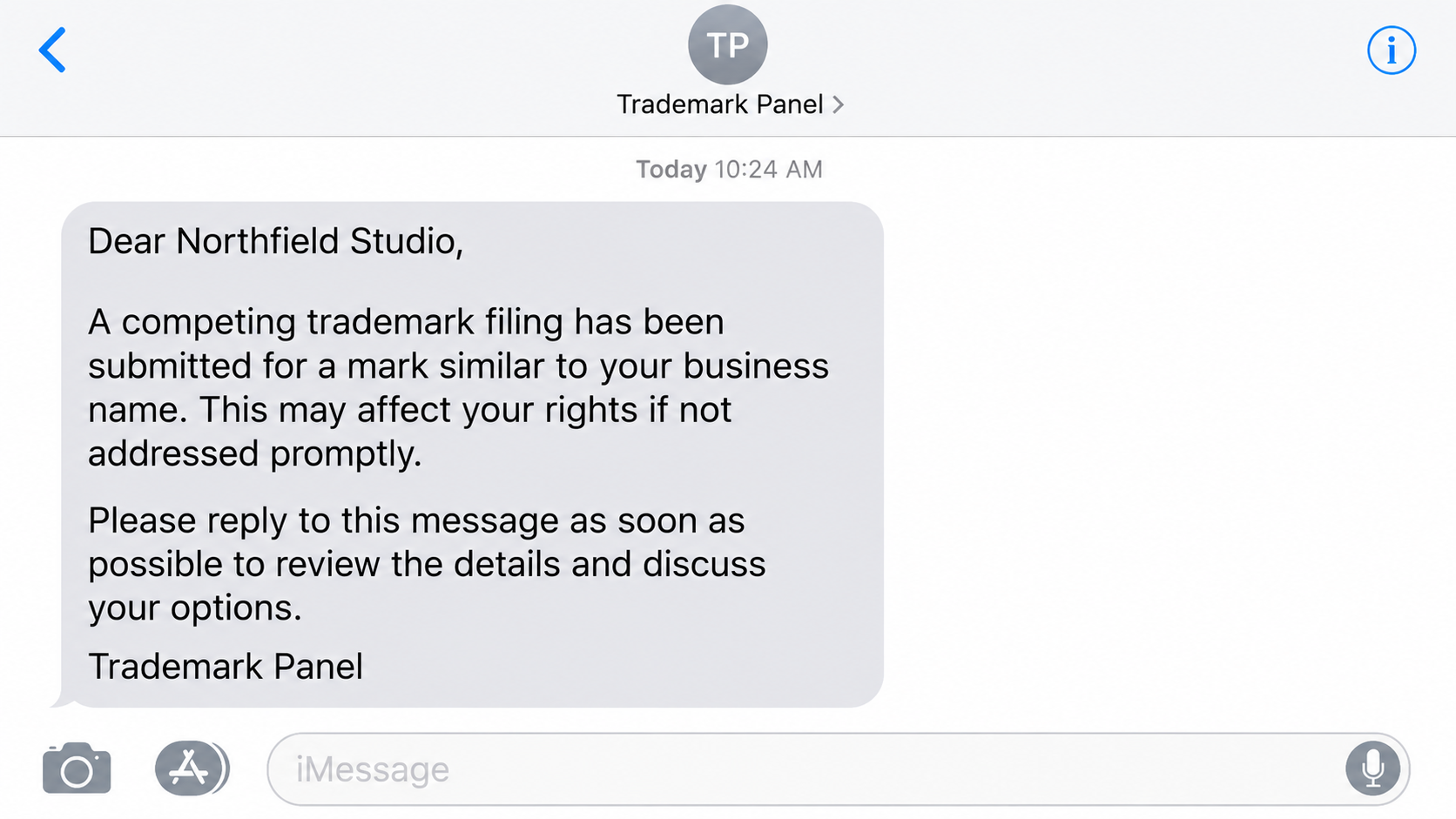
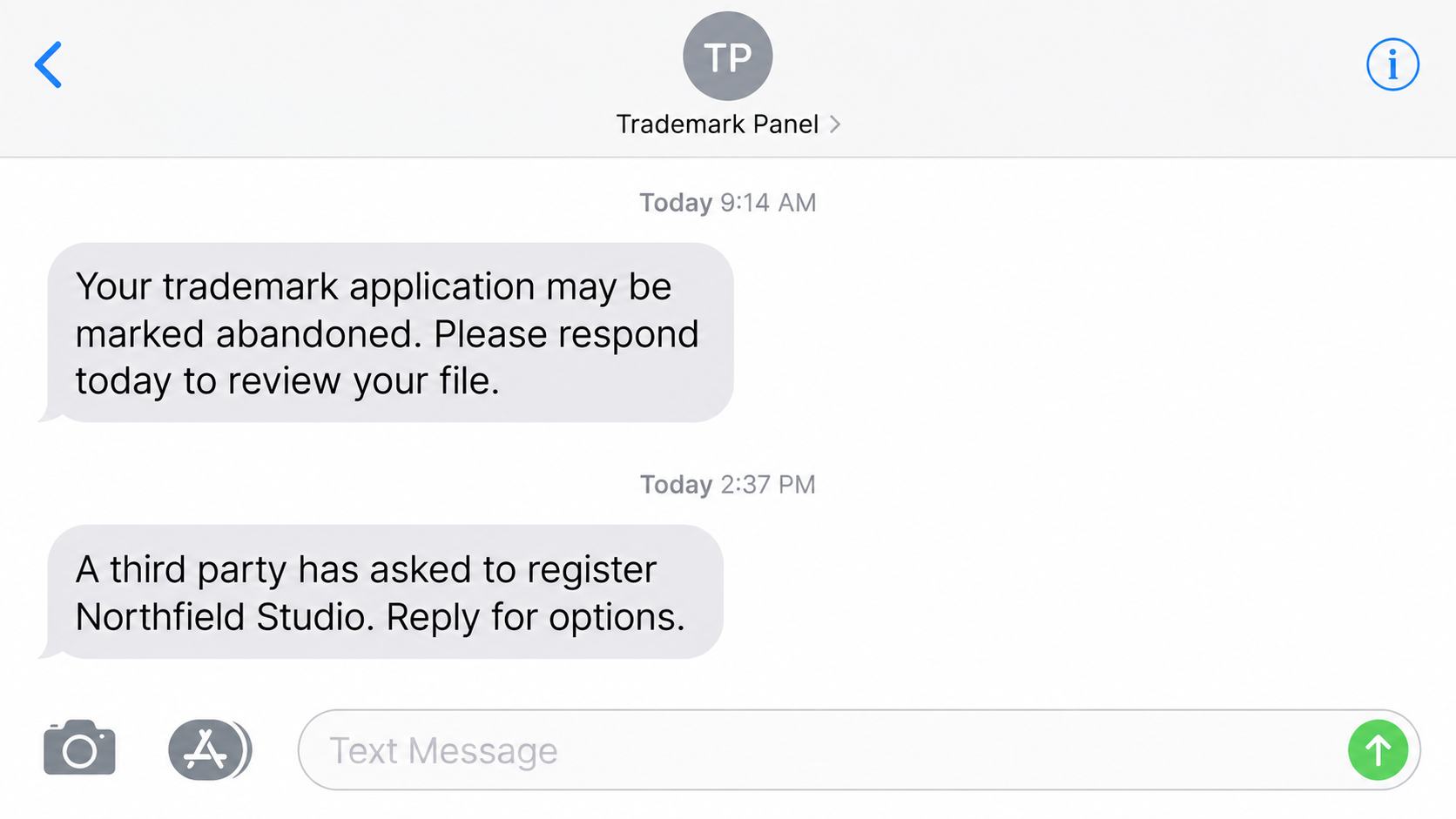
The sender calls itself Trademark Panel. Another message says your application may be abandoned unless you respond today.
If you received one of these notices, the Trademark Panel text scam is worth checking before you reply, pay, or let a stranger explain your trademark file.
Overview
A text turns a business name into an emergency
A business owner might recognize the name in the message and assume the sender has inside knowledge. Trademark records, however, are searchable. Knowing a name, filing number, or owner does not prove that the person texting works for a registry or represents another applicant.
The Canadian Intellectual Property Office (CIPO) has published real examples of this scam. In a September 8, 2026 example, Trademark Panel texted a client from multiple numbers. The messages falsely claimed a rival had filed for the business name, the mark had expired, or CIPO had issued an abandonment notice.
Those claims are not three verified events in the client’s record. They are three versions of the pressure tactic CIPO documented. A recipient needs to check the official record before treating any one of them as fact.
The sender borrows urgency, not authority
The message asks for a response before the owner has had time to search the register or speak to the agent already handling the mark. If the owner replies, the stranger gains a direct conversation in which to request details, invent fees, or sell unnecessary services.
CIPO says its legitimate text messages are limited to two-step verification codes for someone accessing its online services. They do not announce trademark conflicts, payment deadlines, renewals, or abandonment. That makes an unsolicited Trademark Panel notice especially easy to classify: it is not an official CIPO text.
- The message refers to your actual business or mark.
- It claims a competing filing, expiry, or abandonment.
- It asks you to reply or call before you verify the record.
- It may arrive from more than one number.
- The sender’s name sounds official but is not proof of CIPO authority.
- Any fee or legal threat appears inside the conversation, not in your verified record.
What is confirmed, and what is not
CIPO’s example establishes that these messages were fraudulent. It does not show that every recipient was charged, that every number belonged to one operator, or that every message led to the same website. We have not inspected a live checkout tied to the September example.
The two images here are nonfunctional reconstructions using a fictional business name. They illustrate the reported text patterns; they are not screenshots of the actual recipient’s phone. The key evidence is the agency’s published warning and its explanation of how genuine correspondence works.
The scam matters even when no link is supplied. A request to reply can be the whole entry point. Once you move into a call or chat, the sender can adapt the story to what you reveal.
Why a Plausible Trademark Warning Can Be False
We have also covered a different trademark-themed scam. The common lesson is to verify the official record, not to assume that every message using legal vocabulary comes from an authorized agent.
Trademark applications are public in many jurisdictions. That transparency helps owners and examiners identify potential conflicts, but it also gives opportunists material for targeted solicitations. A text naming your company can feel personal even if its details came from a database available to anyone.
A real trademark issue can exist. A competing application, missed deadline, or office action deserves attention. The question is whether this specific sender has accurately described your file and whether the action they demand is required. The answer should come from the official register or your retained agent, not from the text.
The wording also trades on uncertainty. A business owner may know the name is valuable but not remember every filing date, class, or renewal deadline. “May be abandoned” invites the reader to fill that gap with anxiety. It does not identify an official decision or attach a verifiable record.
A warning that someone else filed for your name is similarly incomplete. A business name and a registered trademark are not identical concepts. Similar marks can coexist in different goods, services, or jurisdictions. A real conflict requires examination of the actual application and legal context, not a one-line ultimatum.
Do not let the sender act as both alarm bell and solution. If a person claims to have found an urgent registry problem and immediately offers to fix it for a fee, you are being asked to trust an interested party at the point when independent verification matters most.
CIPO provides a practical way to separate the two: look up the mark through its official intellectual property databases and review correspondence attached to the record. An authentic office notice should have a trail there.
The Three Stories Hidden in the Texts
The first story is a rival filing. It implies that waiting even a day could cost you the brand you built. That is effective because business owners have often spent years putting the name on websites, packaging, signs, and invoices. The message turns sunk effort into a reason to reply immediately.
The second story is expiry. Renewals are real administrative events, so the term sounds credible. But a text that offers no verified record, exact date, or official notice cannot establish that a registration has expired. If the date matters, you can find it through CIPO’s database.
The third story is abandonment. That word has a specific legal meaning, which can make a vague text sound authoritative. Yet the sender has not shown that CIPO sent an abandonment notice to you or your agent. A genuine decision is not proved by someone repeating the term on a phone.
These versions are designed to catch different owners. Someone who has never filed may worry about a rival. Someone who filed years ago may fear a missed renewal. Someone with a pending application may fear it was abandoned. The script changes, but the next requested action is the same: engage the sender before checking independently.
How the Trademark Panel Text Scam Works
Step 1: The operator finds a credible target
Public business and trademark information can supply a name that feels too specific to be random. The sender may also use information from websites, directories, or earlier filings. That does not require access to a confidential government system.
CIPO’s warning does not identify exactly how the September sender selected the client. Treat public-record research as an explanation of how such personalization is possible, not as a proven detail of this particular message.
Step 2: A familiar name arrives with a deadline
The text says a third party filed first, the mark expired, or an abandonment notice exists. Each version frames delay as the dangerous choice. A hurried owner may respond before checking whether there is any real application or deadline.
Multiple phone numbers can make the same story reappear after one message is ignored. Changing numbers does not create independent confirmation. It can be one campaign repeating the same claim.
Step 3: Replying creates a private sales conversation
The initial message may omit a payment link entirely. It only needs an answer. Once the owner responds, the sender can ask for an application number, email address, filing documents, or payment information while presenting those requests as necessary to review the case.
Any specific fee, contract, or link should be assessed on its own evidence. CIPO documents the false texts; it does not say that every recipient saw identical demands afterward. The safest assumption is not that every route is known, but that the sender has not earned trust.
Step 4: Official language disguises the gap
Terms such as “examiner,” “registration,” “opposition,” and “abandonment” can be used correctly in a fraudulent pitch. A person who can pronounce the vocabulary has not proved that they are a licensed agent or a CIPO employee.
If the conversation moves to email or a website, compare the sender and destination with official channels. CIPO states that its email addresses end in @ised-isde.gc.ca. A lookalike domain, free inbox, or unfamiliar payment processor is not equivalent.
Step 5: The owner is pressed to act without the record
The point of the sequence is to turn an unverified claim into a decision: pay, share information, or engage a supposed specialist. Pressure can make even an experienced business owner focus on preventing a loss rather than establishing whether the loss is real.
You can break that sequence without debating the sender. Stop the chat. Search the mark through CIPO, retrieve correspondence, and speak with your own agent or CIPO through contact details you found independently.
Sender, Record, and Payment Checks
Who is Trademark Panel?
A display name in a text is not a corporate identity or a professional license. Ask for the legal business name and the individual agent’s registration, then check the College of Patent Agents and Trademark Agents public register if someone claims to be a Canadian trademark agent.
Do not assume that a real-sounding business name, a clean website, or a familiar legal term makes the text an authorized CIPO communication. The agency expressly describes the Trademark Panel example as fraudulent.
Which address is attached to the claim?
A footer address, suite, or map pin can be copied from a real office. Compare it with registry records and the professional register. A correspondence address does not prove that the person texting controls a trademark file.
For this reported campaign, CIPO’s public summary does not establish a particular office, warehouse, or mailroom address. We will not invent one. If the sender gives you an address, verify that exact address before trusting it.
Does support exist outside the text thread?
Contact CIPO from its website or the agent you already hired. Do not call a number included in the warning as your only check. A second person who answers the same operation’s number is not independent confirmation.
If your agent confirms a real issue, ask them to identify the official document and deadline. If they cannot see the claimed notice, send them a screenshot of the suspicious text for review rather than forwarding private account access.
Can the filing and fee be traced?
Use the trademark number and your business name to locate the record yourself. Look for the filing status, documents, parties, and renewal information. An unsupported screenshot or invoice is weaker evidence than an entry in the official database.
CIPO posts its official trademark fees. Compare any demanded charge with those amounts, but remember that a matching amount alone does not authenticate the payee. Confirm the payment path from an official service, not the sender’s link.
What to Do if You Have Fallen Victim to This Scam
- Stop the conversation. You do not need to negotiate with the sender or pay to keep an unverified deadline open. Save the messages before blocking the numbers.
- Check the trademark record. Use CIPO’s database and document retrieval tools. If you have an agent, send them the text and ask whether any official action is actually pending.
- Contact your bank or card issuer immediately if you paid. Say you responded to a fraudulent trademark solicitation. Ask about recall, dispute, card replacement, and monitoring, depending on the payment method.
- Preserve the full evidence. Keep every number, text, email, invoice, website address, bank recipient, transaction reference, and the time of each contact. A cropped screenshot can omit details investigators need.
- Protect exposed accounts. If you supplied a password, change it through the real service and sign out of other sessions. If you shared an identity document, ask your bank and the document issuer about additional safeguards.
- Scan if you installed something. A message alone does not infect a device. If you opened a file or installed an app at the sender’s request, disconnect it if needed and use a reputable scanner such as Malwarebytes to check for malicious software.
- Block follow-up destinations. AdGuard can help reduce exposure to known malicious pages and advertising links, but it cannot establish whether a trademark claim is legally valid. Use official records for that decision.
- Report the attempt. Send the texts to CIPO and report suspected fraud to the Canadian Anti-Fraud Centre or your local police. Warn colleagues who may receive the same message.
- Refuse recovery promises. Anyone offering to retrieve your payment or rescue the mark for another surprise fee needs the same independent verification as the first sender.
Frequently Asked Questions
Does Trademark Panel work for CIPO?
CIPO listed messages from a sender using that name among its scam examples. The name in the text is not evidence of an official relationship. Check any individual claiming professional status in the relevant public register.
Can CIPO text me about an expiring trademark?
CIPO says its text messages are for two-step login codes, not trademark expirations, fees, or application problems. Check renewal dates and official correspondence in your record.
What if the message knows my actual business name?
That makes it more persuasive, not more authoritative. Business and trademark information can be public. Verify the claimed filing rather than trusting the sender’s knowledge.
Is a rival trademark filing always a crisis?
No. Similar names require context, including classes, jurisdictions, and the actual application. A licensed agent can assess a real conflict after you locate the official record.
Should I reply just to ask for proof?
Use an independent route instead. Replying confirms that your number reaches a concerned owner and can lead to more pressure. CIPO or your own agent can check the record without involving the sender.
Can I recover money already sent?
It depends on how and when you paid. Contact the bank or card issuer immediately, preserve transaction details, and report the fraud. Do not pay a stranger who promises guaranteed recovery.
The Bottom Line
The Trademark Panel text scam uses a business owner’s fear of losing a name to make an unverified message feel urgent. CIPO has documented the false claims and says genuine trademark notices do not arrive as these texts.
Your next move is not to reply. Open the official trademark record, speak to your own agent if you have one, and act only on correspondence you can independently verify.

Join the discussion
0 commentsShare your experience or ask a question about this article.
Discussion
Start the conversation
Have a question or something useful to share? Add the first comment.