

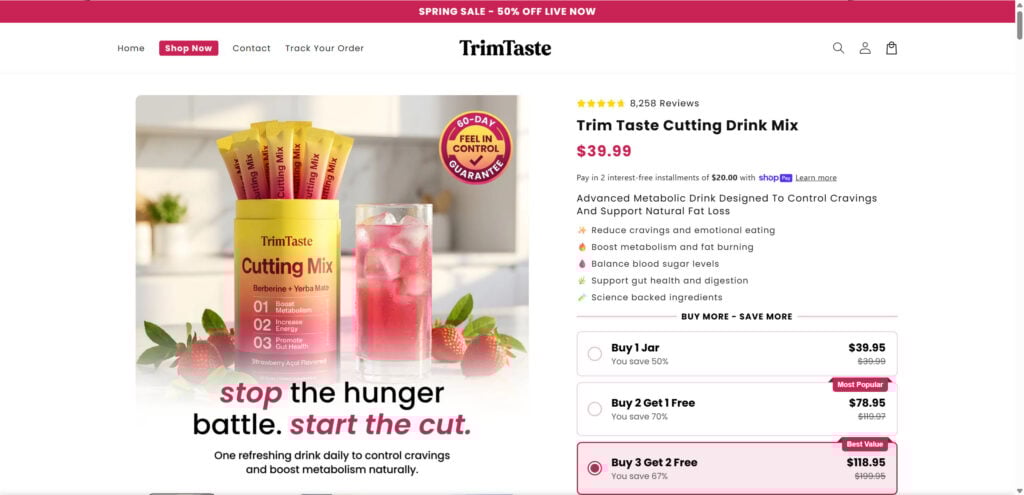
Trim Taste markets its Cutting Drink Mix as a simple daily solution to “stop cravings,” “boost metabolism,” and support fat loss. The branding is clean. The claims are strong. The offer looks convincing.
But once you break it down, this follows a very familiar pattern.
The product may exist. The operation behind it is the real concern.
Overview
This is not a premium supplement brand built on transparency, research, and long-term reputation.
It appears to be a classic dropshipping-style supplement funnel built to:
- Sell a generic low-cost product at a high markup
- Use aggressive weight-loss claims to drive impulse purchases
- Create artificial trust through reviews and guarantees
- Make refunds difficult in practice
The biggest issue is not whether something arrives.
It’s that what you’re promised and what you get are likely very different.
What They Promise vs What It Likely Is
What the site claims:
- “Advanced metabolic drink”
- Controls cravings and emotional eating
- Boosts metabolism and fat burning
- Balances blood sugar
- Supports gut health
- “Science-backed” and “doctor reviewed”
What it actually looks like:
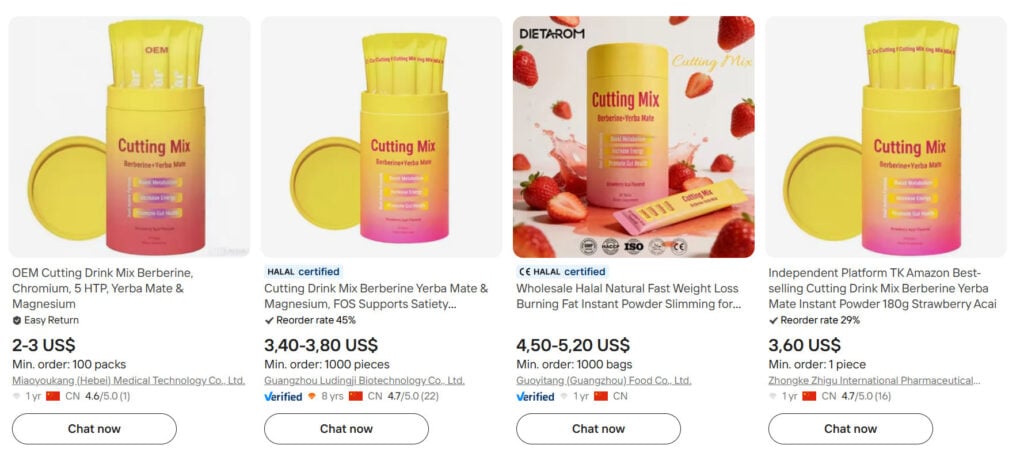
- A generic supplement mix (berberine + yerba mate type formula)
- Mass-produced and sold wholesale for $2–$5 per unit
- Rebranded with a custom label and strong marketing
Your screenshots confirm it clearly:
- Identical products exist on wholesale platforms
- Same packaging, same ingredients, same positioning
This is not unique. It’s private-label reselling.
Major Red Flags
1. Over-the-Top Weight Loss Claims
The product is marketed like a shortcut to fat loss:
- “Stop the hunger battle”
- “Start the cut”
- “Control cravings effortlessly”
These are high-risk claims.
There is:
- No clinical proof shown
- No real studies linked
- No verified medical backing
This is typical supplement marketing exaggeration.
2. “Doctor Reviewed” With Zero Proof
The site claims the product is:
- “Doctor reviewed”
- “Science-backed”
But:
- No doctor is named
- No credentials shown
- No study references provided
This is a trust-building tactic, not real validation.
3. Inflated Reviews and Social Proof
The page shows:
- 8,000+ reviews
- 100,000+ customers
- 4.9★ ratings
There is no way to verify:
- Where these reviews come from
- If they are real
- If they belong to this product
This is standard fake authority positioning.
4. Fake Discounts and Bundle Tricks
Pricing is structured to push bigger orders:
- Buy 1 → $39.99
- Buy 2 → “save more”
- Buy 3 → “best value”
Meanwhile:
- The product likely costs $2–$5 wholesale
- “Discounts” are artificially created
This is conversion psychology, not real savings.
5. Contradictory Refund Policy
They advertise:
- “60-Day Guarantee”
- “No questions asked”
But in reality:
- Refund policy says 30 days
- Fees may apply
- Conditions exist
This inconsistency is a major red flag.
6. No Real Company Transparency
What’s missing:
- Real company identity
- Manufacturing details
- Verified business address
- Leadership or team
You only get:
- A generic brand name
- A basic email
That’s not how real supplement brands operate.
7. Template Store + Reused Content
Clear signs of a quick-build store:
- Generic Shopify layout
- Recycled product structure
- Inconsistent branding elements
This is not a long-term brand.
It’s a sales funnel.
8. Dropshipping Supply Chain Evidence
Your screenshots confirm:
- Same product sold on wholesale platforms
- Same packaging and ingredient positioning
- Prices between $2–$5 per unit
That means:
- No proprietary formula
- No exclusivity
- No quality differentiation
Just reselling with markup.
What You Will Actually Receive
If the product arrives, expect:
- A generic powdered supplement
- Basic packaging (possibly slightly different)
- Standard taste and effects
- No dramatic fat loss or appetite suppression
The marketing shows transformation.
The reality is likely average at best.
Why This Model Works
This type of store relies on:
- Emotional triggers (weight loss, cravings)
- Fast decisions (discounts + urgency)
- Visual persuasion (before/after style messaging)
- Low product cost vs high selling price
Most customers:
- Don’t return products
- Accept small losses
- Move on
That’s how these businesses scale.
Should You Buy It?
Short answer: Not recommended.
You’re dealing with:
- A non-transparent seller
- Exaggerated health claims
- Generic product sourcing
- Weak refund reliability
Even if it arrives, it’s unlikely to match expectations.
What To Do If You Already Ordered
1. Save everything
- Order confirmation
- Product page screenshots
- Guarantee claims
2. Watch deadlines
- Don’t rely on “60 days”
- Act within 30 days
3. Test immediately
- Check quality
- Compare with claims
4. Push for refund fast
- Email support quickly
- Document responses
5. Use chargeback if needed
If:
- Product doesn’t arrive
- Refund is refused
- Seller ignores you
Contact your bank.
The Bottom Line
Trim Taste Cutting Drink Mix is not a revolutionary supplement.
It is a generic low-cost product sold through an aggressive marketing funnel.
The biggest issues:
- Inflated claims
- Fake or unverifiable trust signals
- Weak transparency
- Dropshipping sourcing
You may receive a product.
But you are not buying from a trustworthy brand.
Proceed with caution.








