

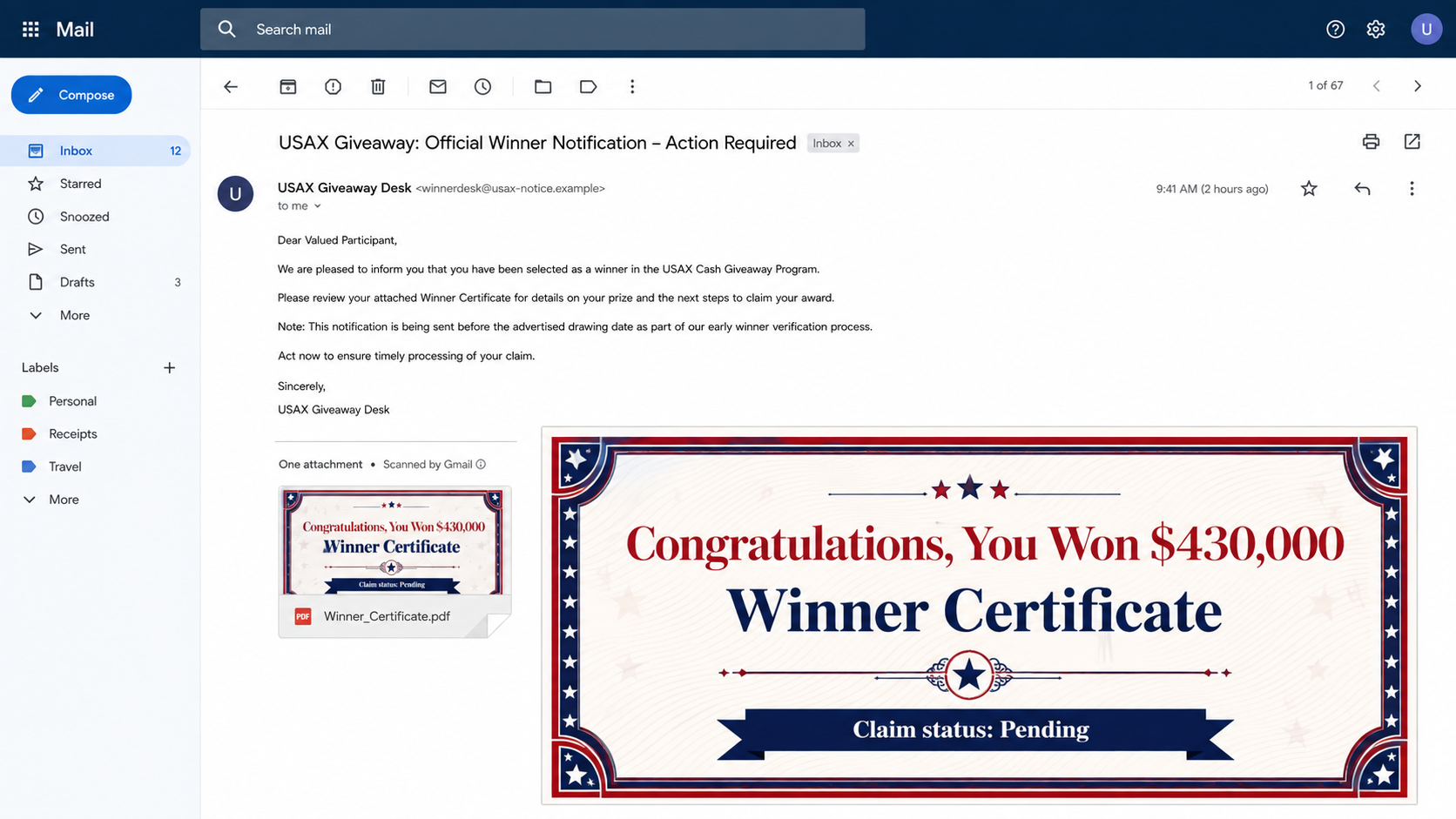
A certificate says the recipient has won $430,000. The document looks formal, the amount is specific, and the claim instructions appear connected to an online giveaway the person remembers entering.
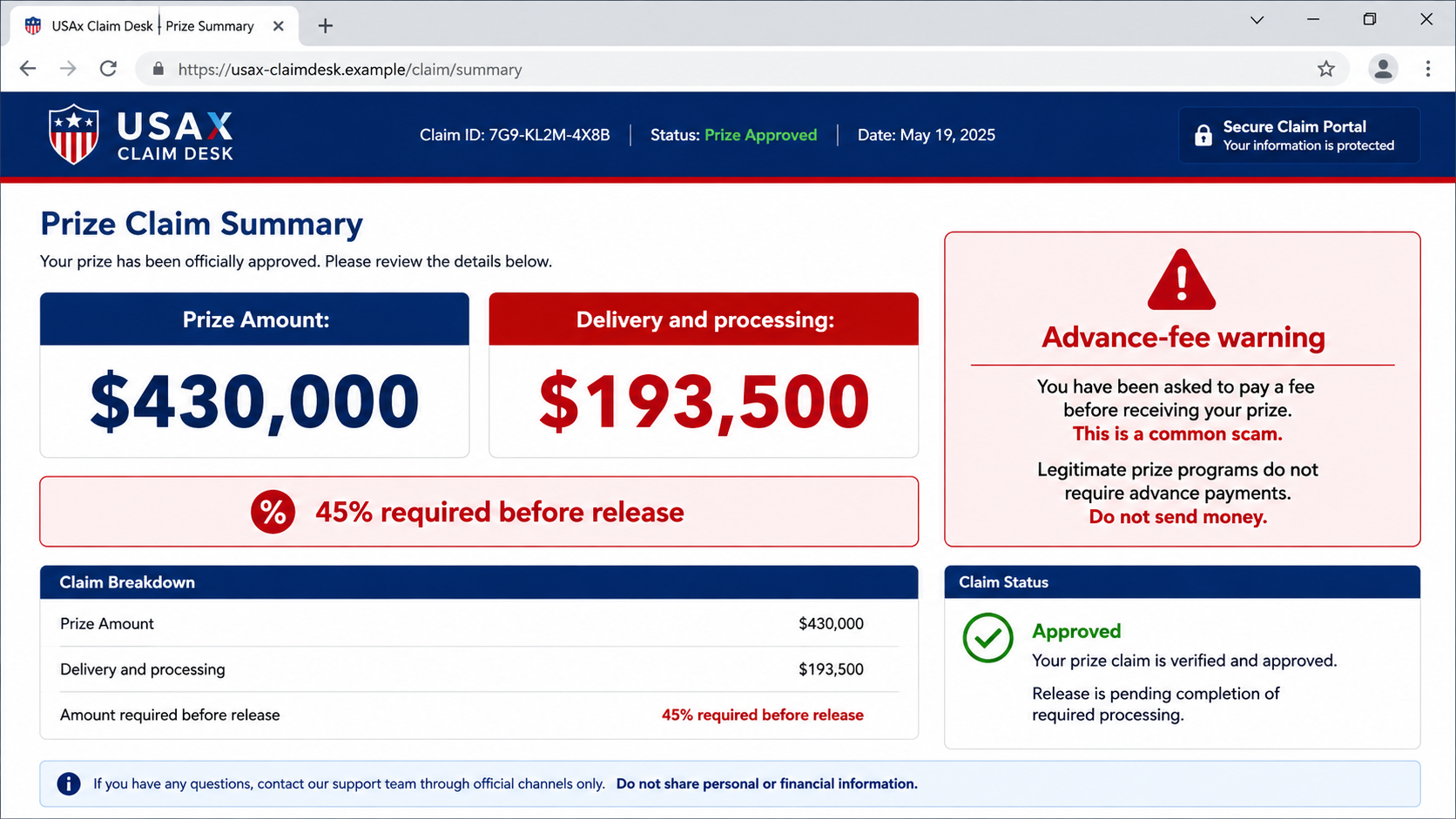
There is one impossible condition. Before the cash can be released, the winner must cover delivery and processing costs equal to 45% of the supposed prize.
The USAX PAC prize fee scam is exposed by the conflict between the public promise of a free drawing and the enormous private demand that follows.
Overview
The winner is selected before the advertised drawing ends
The USAX PAC website currently says its giveaway remains open until February 1, 2027. It describes one random draw after entries close and says winners are selected from valid entries. A message declaring a $430,000 winner before that advertised end date does not fit the process on the site.
An “early verification” explanation does not solve the contradiction. Verifying an entrant is different from naming a winner before a random drawing supposedly occurs. A certificate cannot replace the timeline the promoter published.
Scammers often connect their messages to something the recipient really entered. A leaked entry list, malicious form, or dishonest follow-up can contain the correct name and contact details. Familiarity with the giveaway does not authenticate the award.
The 45% demand makes it an advance-fee prize scam
The public USAX PAC page says “No purchase, no fee” and states that no payment is required to enter or be selected. A private demand for $193,500 to deliver or process $430,000 directly contradicts that promise.
The Federal Trade Commission says anyone who requires taxes, shipping, handling, processing, or customs payments to receive a prize is a scammer. Real prizes are free. The label on the charge does not change the rule.
Cash does not need delivery costing nearly half its value. If a sender claims the payment is refundable, insured, government-mandated, or necessary to create a release code, the basic advance-fee structure remains the same.
The public website leaves important verification gaps
The site displays a Delaware street address under its land-prize description, but it does not present that address as a clearly identified corporate office. It also uses the label “PAC” without a visible committee ID, treasurer, sponsor, or campaign-finance disclosure on the page reviewed.
Its “Official Rules” and “Privacy” links resolve to the same giveaway page in the current public version rather than presenting readable standalone terms in the page captured by our check. The site nevertheless asks entrants for name, email, telephone number, date of birth, sex, and location.
Warning signs include:
- A winner certificate arrives before the advertised drawing date.
- The award is far larger than anything independently documented.
- The public page says no fee, but a private agent demands one.
- Cash supposedly requires shipping or delivery costs.
- The fee equals a large share of the prize.
- Payment is required before any settled award exists.
- The claim process asks for government ID through email or an unknown portal.
- Testimonials use initials without independently verifiable winners.
- Official rules are promised but not presented as readable separate terms.
- The organization name cannot be matched confidently to a public registration.
How the USAX PAC Prize Fee Scam Works
Step 1: The target enters a free giveaway
The entry form asks for enough information to personalize a later approach. The current USAX PAC page requests full name, email, telephone number, date of birth, sex, and location. The visitor is told entry takes less than a minute.
A form can collect leads even when no payment is requested. Those details let a later email use the correct name, location, and giveaway reference, making it feel unlike ordinary spam.
Step 2: An official-looking award arrives
The target receives a certificate, winner number, claim code, or congratulatory email. Patriotic colors, stars, formal typography, and words such as verified or official create authority without proving who sent it.
The document may repeat prize ranges shown on the website. Copying public numbers requires no access to a real drawing system. A certificate is a graphic until an identifiable promoter and documented selection process validate it.
Step 3: The timeline problem is given a story
If the giveaway is still open, the sender may describe the recipient as a preliminary winner, early selection, reserved claimant, or subject of advance verification. Those phrases are designed to prevent the recipient from comparing dates.
The current site says winners are drawn after entries close. A contact that changes those rules in private should not be trusted. Legitimate promotions publish changes and complete rules where every entrant can read them.
Step 4: Identity verification gathers stronger data
The site says a winner must provide government-issued photo identification. An impersonator can use that expectation to request an ID image, selfie, Social Security number, bank details, or proof of address through email or a copycat portal.
Identity checks can exist in real promotions, but the requester must first be authenticated. Do not send documents to the same contact whose award and timeline are under investigation.
Step 5: The enormous prize creates room for an enormous fee
A demand for $193,500 would look absurd beside an ordinary purchase. Beside a promised $430,000 payout, the operator wants it to feel like a painful but profitable transaction. The victim is encouraged to compare the fee with imaginary winnings rather than real savings.
The charge may be split into smaller transfers. A supposed lawyer, courier, tax officer, or claims director can provide different accounts so the process resembles several departments.
Step 6: Every payment produces another requirement
There is no prize waiting to cover the loss. After the first transfer, another obstacle can appear: a release bond, anti-money-laundering certificate, international clearance, bank activation, or late fee.
Victims may be told the previous money is refundable after completion. That claim uses the sunk cost to obtain another payment. Stop when the first advance fee appears.
Step 7: Identity data and loss records create new scams
An ID image and detailed profile can support account opening, impersonation, password-reset attempts, or targeted calls. Payment records prove that the victim is both financially invested and responsive to authority.
A recovery agent may later claim the giveaway was investigated and funds are available. The agent then asks for another retainer, tax, or release payment. The new story is an extension of the original advance-fee fraud.
What the USAX PAC Website Currently Says
Our review found a public giveaway page offering cash between $50,000 and $500,000, a vehicle, and a parcel of land. It says entry is open to adults in the United States and abroad, with some prize restrictions for international entrants.
The page says there is one entry per person, no purchase is necessary, and no fee is required to enter or be selected. It states that winners are chosen at random after the entry period closes.
Those statements are important because the $430,000 claim message conflicts with them twice. It arrives before the stated closing date, and it demands money before release. The private sender cannot use the website for credibility while ignoring its core rules.
The page says prize specifics are confirmed at the time of award. It also says vehicle and land images will be added closer to the drawing. Prospective entrants therefore cannot inspect the non-cash prizes in the current page content.
The listed land location is 651 N Broad Street, Middletown, Delaware. The same street address appears in public corporate filings for unrelated entities. That does not prove fraud, but it means the address alone cannot identify the giveaway operator or a specific land parcel.
The site includes winner testimonials identified only by an initial and surname. We could not independently verify those accounts from the information shown. Testimonials should never outweigh a payment demand that meets the FTC’s definition of a prize scam.
How to Verify a Large Prize Claim
Begin with the official published rules, not the certificate. Confirm the promoter’s full legal name, eligibility, entry dates, selection date, prize details, odds, claim deadline, tax treatment, and dispute terms. If the rules are unavailable, do not continue.
Compare the award date with the drawing date. A random drawing cannot produce its declared winner before the described entry period ends unless the rules clearly establish multiple drawings. Private changes sent only to one claimant are not trustworthy.
Search public registrations using the exact organization name. The Federal Election Commission provides committee search tools for PACs and parties. We did not locate an exact “USAX PAC” match in the search results reviewed, though absence from that federal database alone is not final proof about every type of entity.
Contact the promoter through independently verified details. Do not use the telephone number, reply address, portal, or payment account from the winner message. Ask for the rule provision authorizing the charge and written identification of the legal operator.
Never borrow money, liquidate savings, or send a small test payment. A real award does not require the recipient to finance its release. The FTC’s rule is easier and safer than any complicated explanation: pay-to-claim means scam.
Company, Address, and Fulfillment Checks
The exact legal operator is not clearly identified
The public page uses “USAX PAC,” but our review did not find a visible legal entity name, committee ID, treasurer, or sponsor in the page content. A brand label is not a substitute for an accountable operator.
The Delaware address does not verify the land prize
The page places 651 N Broad Street beneath the land description. Public records show the address is used by unrelated entities. Verify a land parcel through county records, a deed, and a parcel number, not a website label.
The rules and privacy links need readable documents
In the version checked, those links returned to the same giveaway page rather than exposing standalone terms to the crawler. Do not submit sensitive data until current rules and privacy disclosures can be read and saved.
The private payment demand defeats the public promise
The site says no fee is required to enter or be selected. A message demanding 45% before releasing a prize is not a harmless variation. It is the defining advance-fee contradiction.
What to Do if You Have Fallen Victim to This Scam
- Do not send the 45% charge. Stop all payments and communication after preserving the certificate, full email headers, claim portal, telephone numbers, account details, and messages.
- Contact the payment provider. Tell the bank, card issuer, wire service, payment app, exchange, or gift-card company that the payment followed a prize scam. Ask immediately about recall, reversal, and account protection.
- Protect exposed bank accounts. If account or routing details were shared, ask the bank about transfer blocks, check replacement, monitoring, and whether a new account number is necessary.
- Respond to identity exposure. If an ID, Social Security number, date of birth, or detailed profile was sent, create a recovery plan at IdentityTheft.gov and consider credit freezes.
- Replace compromised passwords. Change reused credentials from the real service, starting with email and financial accounts. Enable an authenticator app or passkey and review active sessions.
- Scan any device used for attachments. Run a full Malwarebytes scan if you opened a certificate, installer, archive, or document that behaved unexpectedly.
- Add web protection as a preventive layer. AdGuard can block many known malicious pages and ad routes. It cannot recover money or make a private claims portal legitimate.
- Report the prize scam. Submit evidence to ReportFraud.ftc.gov and serious internet crime to IC3.gov. Contact the relevant state attorney general and consumer protection office.
- Report mailed material appropriately. If a certificate or payment request arrived through physical mail, submit it to the U.S. Postal Inspection Service.
- Warn anyone whose data was included. If a family member helped with the entry or payment, explain what information was shared so each person can secure the right accounts.
- Ignore recovery agents. No investigator can guarantee repayment. Do not pay a retainer, release charge, or tax to someone who contacts you claiming the prize funds were found.
Frequently Asked Questions
Is the $430,000 USAX PAC winner message a scam?
Yes, when it declares a winner before the advertised draw and demands 45% before release. An advance payment for shipping or processing a prize is a confirmed prize-scam pattern.
Does entering the website make the winner email legitimate?
No. Correct entry details can make impersonation more convincing. Verify the sender, published rules, drawing date, and legal operator independently.
Can taxes be deducted from the prize?
Tax obligations depend on jurisdiction, but a stranger demanding advance payment through a personal account, gift card, cryptocurrency, or wire is not collecting legitimate prize tax.
Why is the winner chosen before February 1, 2027?
The current site says entries close on that date and winners are drawn afterward. A private “early winner” claim conflicts with the advertised process and should be rejected.
Is the Delaware address proof that USAX PAC is real?
No. An address can be used by many entities or copied. Verify the exact legal operator, land parcel, registration, and rules rather than relying on one accurate street line.
What if I sent a photo of my ID but no money?
Treat it as identity exposure. Follow IdentityTheft.gov, freeze credit where appropriate, secure email and financial accounts, and watch for tailored calls and applications.
The Bottom Line
The USAX PAC prize fee scam combines a remembered entry, an official-looking certificate, and a life-changing amount. The scheme fails two basic checks: the winner appears before the advertised draw, and a supposedly free prize requires $193,500 in advance.
Do not pay. Save the evidence, protect any identity or banking data already shared, and report the claim. A legitimate promotion can show clear rules, an accountable operator, and a completed drawing without asking the winner to finance the prize.

Join the discussion
0 commentsShare your experience or ask a question about this article.
Discussion
Start the conversation
Have a question or something useful to share? Add the first comment.