


The caller says a large prize and a car are waiting, with only a few remaining costs standing between you and delivery.
When another problem appears after your payment, the promise of finally receiving the winnings can make the next request difficult to refuse.
Overview
A fake prize became a continuing demand for money
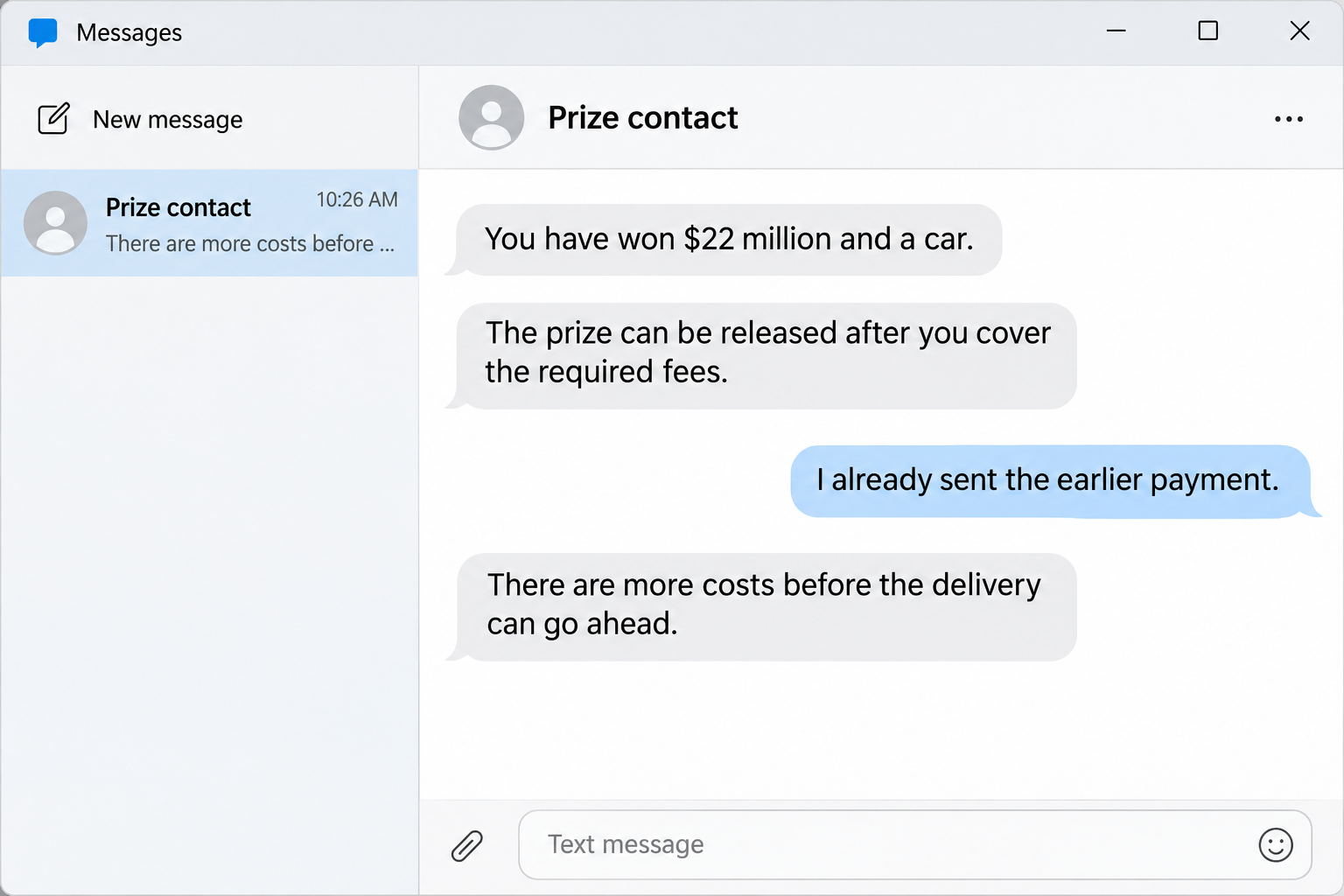
Roshard Andrew Carty posed as a Publishers Clearing House employee and told a Washington retiree that she had won $22 million and a car.
He demanded taxes and fees before releasing the supposed winnings, persuading her to send over $600,000 through cash couriers in the United States.
The DOJ’s sentencing announcement describes a confirmed fraud that continued even when the woman hesitated or tried to end contact.
Carty pleaded guilty to wire fraud and received three years in federal prison in May 2026 for the scheme.
Smaller payments grew into pressure involving her home
The requests began with smaller cash withdrawals and grew as Carty invented further obstacles, including claims that earlier money had been lost or stolen.
He told the victim to borrow against her home and eventually persuaded her to sell it to cover more supposed prize costs.
The money was sent through U.S. couriers who forwarded it to Carty in Jamaica, while the promised winnings never arrived.
The message image reconstructs the repeated-fee conversation using fictional wording, rather than reproducing an original text sent to the victim.
Ending the payments required more than blocking one number
Carty used different telephone numbers and texting programs, contacting the victim thousands of times and trying other methods when she cut off communication.
- He falsely claimed the FBI was recording a call, adding apparent authority while telling the victim to keep the prize secret.
- He said previous payments had disappeared, turning the missing money into a reason to demand another payment rather than explain the loss.
- He tried tow trucks and pizza deliveries as ways to reestablish contact, and asked the victim’s landlord for a welfare check.
- The documented conduct shows why relatives, banks and legitimate service providers may need clear information when a persistent caller refuses to stop.
The accusation concerns Carty’s impersonation and fee demands, without suggesting that the real prize brand or innocent delivery workers organized his conduct.
Why Another Fee Can Feel Like Protecting the Money Already Sent
After someone pays once, the next request arrives with a powerful suggestion that stopping now would waste everything they have already contributed.
The promised prize then becomes a reason to continue, even as the caller’s explanation for the latest payment grows more difficult to follow.
In this case, claims that cash had been lost or stolen helped shift attention away from whether the supposed prize existed.
The victim was encouraged to solve each new problem with another payment, while the earlier payments remained tied to an unfulfilled promise.
That is why calculating the total already sent can be more useful than arguing about the caller’s latest individual excuse.
Put the payments and promised delivery dates in one place, then ask what independent evidence confirms the prize or the recipient’s authority.
Do that with someone outside the conversation, because another explanation from the caller leaves the same person controlling both the demand and its justification.
The FTC’s prize-scam guidance identifies demands for advance taxes, shipping or other charges as a warning that the claimed prize is fraudulent.
How the Carty Lottery Fee Scam Works
Step 1: A familiar prize name supplies the opening story
Carty contacted the victim in 2020 and claimed she had won a large cash prize and a car through a familiar sweepstakes name.
Using that name made the offer easier to recognize, but recognition did not establish that the real company had contacted her.
The relevant check is the specific notification and demand, rather than whether the company being impersonated is a recognizable business.
Do not let the caller supply the only route for verifying the prize, especially when they also insist that payment is required first.
Step 2: False authority and secrecy discourage outside checks
Carty told the victim that the FBI was recording the call and instructed her not to tell anyone about the supposed win.
That claim gave a private conversation the appearance of official oversight while making it harder for someone else to question the payment request.
A caller’s statement that law enforcement is involved does not independently confirm their identity, their payment instructions or the existence of winnings.
You can end the call and seek help through an official contact without asking the supposed prize agent for permission to do so.
Step 3: Cash is sent to couriers instead of a genuine prize process
The victim was directed to withdraw cash and send it through FedEx to locations in the United States, where couriers helped move the proceeds.
The use of domestic destinations could make the transaction feel more familiar even though the money ultimately reached Carty in Jamaica.
Keep the actual recipient and delivery details when documenting such a payment, since they may identify a different person from the caller.
Do not assume the courier company endorsed the claimed prize simply because it carried a package that the sender had arranged.
Step 4: Missing payments become reasons to ask for more
Carty claimed earlier money had been lost or stolen and demanded replacements, extending the scheme instead of producing the promised winnings.
For the victim, a new payment could appear to repair an unfortunate setback rather than create an additional loss to the same fraud.
Stop evaluating each request in isolation and compare it with the full history, including every earlier promise about when the prize would arrive.
A genuine explanation needs independent support, while another private payment to an unrelated recipient leaves the original problem unresolved.
Step 5: The pressure reaches savings and the home
As the demands escalated, Carty told the woman to borrow against her home and convinced her to sell it to meet further costs.
The case therefore involved more than an inexpensive fee, with the promised prize being used to justify decisions affecting retirement and housing.
If a caller tells you to borrow or sell property to unlock winnings, stop the transaction and involve your bank and someone independent immediately.
Keep any existing loan or sale documents for qualified advice, because stopping contact with the scammer does not automatically reverse those separate transactions.
Step 6: Persistent contact continues after the victim tries to withdraw
Carty contacted the victim through multiple numbers and texting services, then tried outside deliveries and a landlord welfare-check request to regain her attention.
Those actions show how refusing another payment can become a practical safety and harassment problem rather than merely an unanswered sales call.
Preserve the contact attempts and explain the history to trusted people who may receive related calls, without assuming every unfamiliar visitor is knowingly involved.
If someone threatens you or you face immediate danger, contact emergency services rather than continuing the conversation in hopes of resolving the prize claim.
Recognize the Demand Without Debating Every Excuse
The following comparisons help a recipient move from the caller’s explanation toward a concrete decision about the requested money or contact.
| What the caller says | What you should do |
|---|---|
| Taxes or delivery costs must be paid first | Do not send the advance payment to release the promised prize. |
| Previous cash was lost or stolen | Preserve the payment records and report the suspected fraud instead of sending replacement cash. |
| The FBI is recording the call | End the conversation and verify any claimed official role through an independently obtained agency contact. |
| Borrow against the house to finish the claim | Pause the financial decision and involve your bank and an independent adviser. |
| Keep the winnings secret from everyone | Discuss the request with someone you trust before taking any further financial action. |
You do not need to disprove the caller’s entire biography before deciding not to send another fee for supposed winnings.
The payment condition itself provides the practical reason to stop, while the earlier conversation and transactions can be preserved for investigators.
If the caller introduces a new agent, supervisor or recovery specialist, treat that contact as unverified until you establish its identity independently.
Changing the speaker does not explain the missing prize or make a new request for money part of a legitimate recovery process.
What to Do if You Have Fallen Victim to This Scam
-
Stop all further prize-related payments and preserve the messages, caller identifiers and previous instructions before blocking the contact routes you can control.
Tell someone you trust what happened, especially if the caller demanded secrecy or knows enough about your circumstances to keep applying pressure.
Ask that person to help with the next financial calls rather than promising the scammer one final payment to end the problem.
-
If cash or another payment is still in transit, contact the actual carrier or payment institution immediately using details from your genuine receipt.
For FedEx, its official fraud page publishes 1-800-463-3339 as a contact route; provide the tracking reference and explain the suspected fraud.
Ask whether the shipment can be stopped or returned before delivery, without assuming an interception remains possible or that the cash is insured.
-
Contact your bank about withdrawals, checks, transfers or borrowing connected to the scam, identifying each transaction separately with its actual date and amount.
Ask which payments can still be stopped or investigated and whether additional protection is needed for account information you disclosed to the caller.
Keep the bank’s reference and evidence requests, describing approved withdrawals obtained through deception accurately rather than inventing unauthorized transactions that did not occur.
-
If you borrowed against or sold a home, collect the relevant agreements and seek independent advice about the obligations and any remaining deadlines.
Contact the actual lender or professional handling the transaction through verified details, explaining the fraud without assuming that a criminal report cancels the agreement.
-
Report the text-enabled fraud at FBI IC3, opening File A Complaint and reviewing its terms before accepting and entering the requested information.
Include telephone identifiers, messages, recipient details, courier records and the payment timeline, retaining the complaint confirmation alongside your bank and carrier references.
-
Keep a separate record of repeated calls, threats, unexpected deliveries or attempts to contact your landlord after you have tried to end communication.
Explain the pattern to local police through their genuine contact route, calling 911 if immediate danger requires an emergency response in the United States.
Tell your landlord or trusted household members about relevant contact attempts so they can verify unusual requests without sharing your private financial records.
-
Refuse additional payments to someone claiming the first prize, lost cash or recovered money can finally be released for another fee.
Confirm any supposed investigator through the actual agency’s independently obtained contact, especially if the person uses information already revealed during the original fraud.
When Deliveries or Welfare Requests Follow the Calls
An unexpected pizza delivery or tow truck does not by itself prove a scam, and the person sent to your address may be innocent.
The Carty case nevertheless shows why a documented pattern of such incidents should be kept with the history of unwanted contact.
Do not confront an unfamiliar driver as though they organized the fraud, but record what happened and communicate through the legitimate service if needed.
If a real police officer conducts a welfare check, explain the suspected scam and ask how to verify the officer through the department.
Avoid sharing money, bank details or account access with anyone who says a payment is necessary to make the unwanted visits stop.
The goal is to separate legitimate assistance from the caller’s pressure while giving trusted people enough information to recognize another attempt at contact.
Frequently Asked Questions
Was Carty’s lottery offer confirmed to be fraudulent?
Carty pleaded guilty to wire fraud and received a three-year sentence after using a false prize and advance-fee demands to obtain the victim’s money.
The criminal case supports direct scam wording about that conduct, rather than relying on an unresolved complaint about a genuine prize company.
Did Publishers Clearing House organize the calls?
The announcement says Carty impersonated an employee while promising winnings, so the company’s recognizable name formed part of his deceptive presentation.
The accusation concerns the impersonator and payment demands, without establishing that the real company authorized or participated in his scheme.
Why did the victim send more after earlier payments disappeared?
Carty claimed cash had been lost or stolen, making another payment seem necessary to preserve the chance of receiving the promised prize.
That explanation kept the conversation focused on repairing a setback rather than checking whether any genuine winnings were waiting to be released.
Can blocking one telephone number stop this kind of contact?
Carty used different numbers and texting programs, so blocking a single identifier did not necessarily end his attempts to reach the victim.
Keep evidence of the wider pattern, involve trusted people where relevant and report threats or immediate danger through the appropriate police route.
Does a domestic payment destination make the prize genuine?
The victim sent cash to couriers in the United States, who ultimately forwarded the money to Carty rather than delivering a prize.
The location of a recipient does not authenticate the caller’s identity or justify paying an advance charge for supposedly free winnings.
Can a report undo a loan or home sale?
Reporting the fraud does not automatically cancel a separate financial agreement, so the actual lender or transaction professional should be contacted promptly.
Preserve the documents and obtain independent advice about your circumstances, while refusing another caller’s promise that a new payment will reverse everything.
The Bottom Line
Do not send advance fees, replacement cash or borrowed money to release a prize, regardless of the caller’s brand name or claimed official connection.
If you already paid, contact the relevant bank or carrier quickly, preserve the records and bring someone you trust into the conversation.
When persistent calls extend into threats or unwanted visits, document the pattern and seek legitimate help rather than paying the caller to stop.

Join the discussion
0 commentsShare your experience or ask a question about this article.
Community experiences
Did this happen to you?
Your experience could help someone recognize the same scam. Submit a private report for our team to review.
I experienced this tooReports are reviewed before publication. Sharing publicly is always your choice.
Discussion
Start the conversation
Have a question or something useful to share? Add the first comment.