


You’ve completed the deliveries, but the expected payment hasn’t reached your account, and the app suddenly refuses the login you normally use.
An unexpected account-change notice can seem like another technical problem until you check whether the contact details and payment destination still belong to you.
Overview
Criminals used drivers’ identities to take over their earnings
Oluwatobi Otukelu and Evan Edwards admitted using Dashers’ personal information to impersonate them to DoorDash support and obtain control of their accounts.
Once access changed, the conspirators redirected wages toward financial accounts they controlled, taking money that genuine delivery workers had already earned.
The DOJ’s account of their guilty pleas says both defendants admitted stealing from at least 138 individual Dasher victims.
This case concerns criminals pretending to be drivers when dealing with real support, rather than only strangers calling workers and pretending to offer help.
The court record separates stolen wages from attempted transfers
Otukelu admitted that the conspirators stole at least $743,235.55 and attempted to obtain at least another $69,276.30 through the scheme.
The $160,115 Edwards admitted obtaining with Otukelu overlaps the conspiracy figures, so it should not be added as a separate loss.
Otukelu received a 24-month federal prison sentence in June 2026, while the July announcement records Edwards’s guilty plea to conspiracy to commit wire fraud.
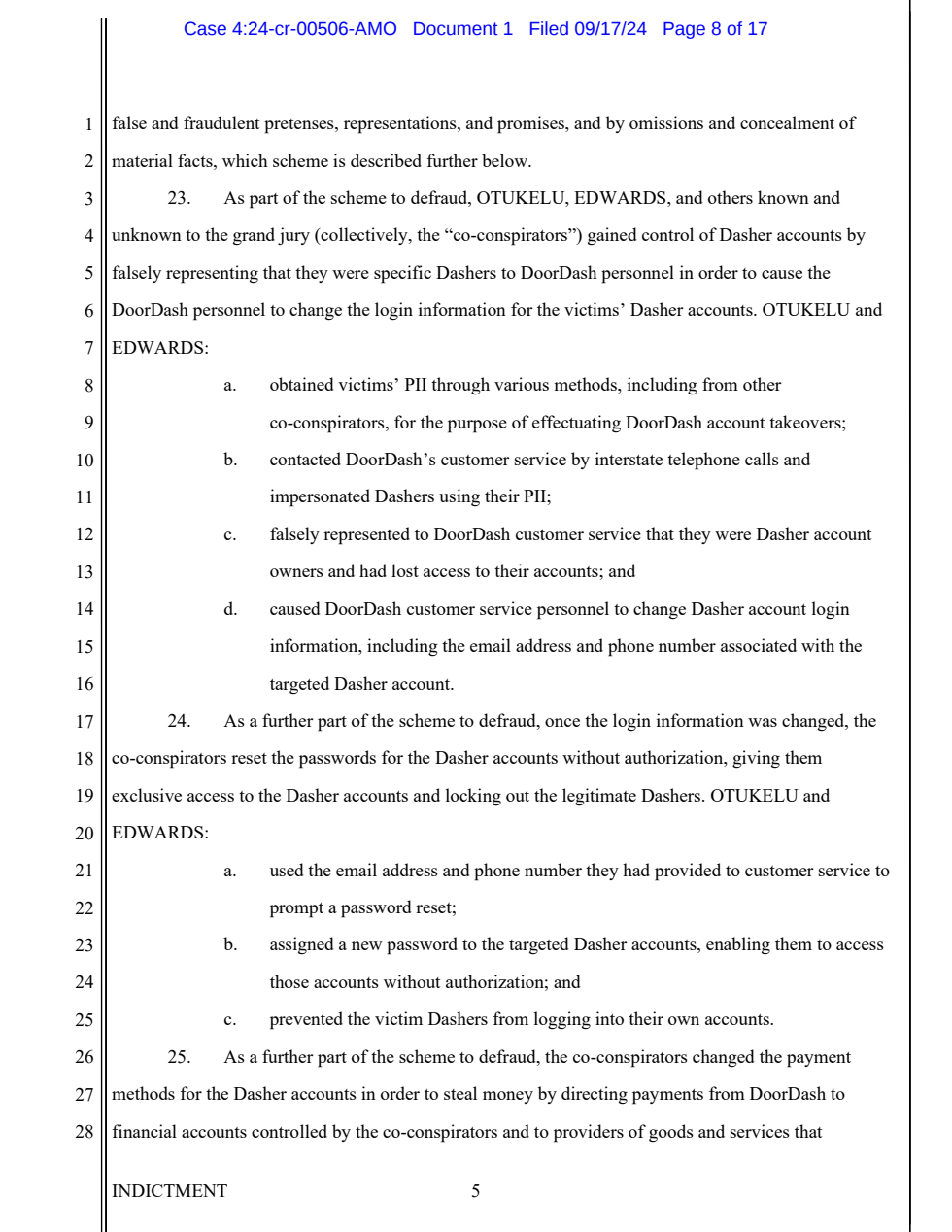
The lead shows page eight of the original federal indictment, a historical court document describing the account-takeover process rather than a current app screenshot.
Account access and wage recovery need separate attention
The immediate questions concern who controls your profile, which payment destination is registered and what happened to any earnings already released.
- Ask genuine Dasher support to investigate unexpected changes to your email address, phone number or login before relying on the account again.
- Establish whether the missing money remains with the platform, was transferred to your own bank or went to an unfamiliar destination.
- Preserve earnings records and payment notices so the disputed amount can be checked against actual completed work rather than an estimated balance.
- Review payout settings after access returns, because successfully logging in does not by itself confirm that future earnings will reach you.
DoorDash is the legitimate service being abused in this case, and the criminal findings concern the defendants’ impersonation and diversion of workers’ pay.
Why This Was More Than a Stolen Password
Many account-takeover warnings focus on a criminal persuading the account owner to share a password, a verification code or a fraudulent login link.
Those remain important risks, but this prosecution describes another route in which personal information was used to mislead the service’s support process.
The original indictment says the conspirators claimed to be legitimate account owners who had lost access and wanted their contact information changed.
After the changes, they could control password resets and prevent real drivers from entering accounts that had previously worked normally.
The later guilty-plea announcement confirms impersonation, account takeovers, unauthorized account creation and redirected wage payments as admitted parts of the scheme.
If support changed the contact details, another reset email may reach the intruder instead, so ask support to examine those changes.
It also explains why wages deserve attention immediately, even when the driver is still trying to determine how the account was accessed.
The money was connected to completed deliveries, so a lost login could interrupt both access to work records and control over the next payout.
How the Dasher Identity and Payout Scam Works
Step 1: Personal information is used to impersonate the driver
The conspirators obtained drivers’ identifying information and used it without authorization to present themselves as the genuine people behind Dasher accounts.
The prosecution does not establish that every affected worker voluntarily shared credentials or encountered the same incoming message before the takeover occurred.
Avoid assuming that a missing password proves a particular employee mistake, since the relevant evidence may lie within the service’s account-recovery records.
When reporting the incident, describe the changes and payments you can document instead of guessing which conversation or earlier disclosure caused them.
Step 2: Real support is persuaded to change account access
The original indictment describes the defendants impersonating Dashers to customer-service staff and causing email addresses or phone numbers associated with accounts to change.
That removed the real worker from information used to manage access, allowing the account to behave as though the intruder were its owner.
If you receive a contact-change notice you did not request, preserve it and contact DoorDash independently rather than replying to an unfamiliar sender.
Ask support to examine the change history, particularly when password resets no longer reach the email address or telephone number you originally registered.
Step 3: The genuine worker is locked out
With the altered contact details, the conspirators reset passwords without permission and obtained access that excluded the Dashers who actually owned the accounts.
A worker may first notice that problem while trying to start another shift, check recent earnings or investigate a payment that failed to arrive.
Treat the timing as useful evidence, recording when access last worked and which unexpected notices appeared before the problem became clear.
Do not create additional replacement profiles simply to escape the login problem before support checks what happened to the existing account and its earnings.
Step 4: Wage payments are directed toward controlled accounts
After gaining access, the conspirators altered payment arrangements so earnings went to financial accounts they controlled instead of the real drivers’ intended destinations.
The indictment also describes unauthorized financial accounts and misuse of the payment products available during the historical period covered by the scheme.
Those historical product names should not substitute for checking whichever payout method is actually attached to a driver’s account today.
Ask support to identify the actual transfer route, destination and payment reference before approaching a bank about money that never entered your own account.
Step 5: The stolen earnings are spent or moved onward
The defendants admitted using stolen funds for purchases that included vehicles, airline tickets, cosmetic procedures and personal training rather than returning them to drivers.
That movement makes early reporting important, while a platform report and a bank inquiry may each address a different part of the financial trail.
Request clear case references and keep the payment details together so the investigation does not become a series of disconnected explanations.
Restoring the login addresses access, but the missing earnings and any altered payment destination still require explicit confirmation from the responsible institution.
Check These Details Before Assuming a Payout Is Merely Late
A delayed deposit can have an ordinary explanation, so compare the actual account records and notices before describing the incident as a confirmed takeover.
The following observations help you explain the problem precisely without mistaking every payment delay for the scheme established in this prosecution.
| What you notice | What to ask support to verify |
|---|---|
| Unexpected email or phone change | Whether the change was authorized and which recovery details currently control the profile. |
| Your login no longer works | Whether an account reset, contact change or other restriction explains the loss of access. |
| Expected earnings are missing | Whether payment was released, which destination received it and what transaction reference identifies it. |
| An unfamiliar payment destination | When it was added, whether future payouts can be paused and how the correct details will be restored. |
| A new financial account in your name | Which institution opened it and what identity-theft review or account protection is available. |
If support identifies an ordinary delay, keep its explanation and expected payment timing instead of adding an unsupported account-takeover allegation to your report.
If it confirms unauthorized changes, ask what has been contained and what remains unresolved, including any payout still scheduled for the altered destination.
Save available information before correcting it, while avoiding screenshots that expose full banking details when shared outside the official support process.
Reach Real Dasher Support Before Changing Anything Else
DoorDash’s official U.S. Dasher support page publishes 855-431-0459, giving a direct contact route when the app is inaccessible.
Call that published number independently and explain that your account may have been taken over, identifying the unexpected contact changes and missing earnings.
Ask the representative to secure the account, review payout activity and explain the verified ownership-recovery process before you supply sensitive documentation.
Keep the support reference and ask how to submit evidence through the genuine case, rather than sending identity records to an unsolicited text contact.
DoorDash’s published fraud guidance also warns that staff will not call asking for your password or one-time verification code.
A familiar caller name doesn’t change that boundary, even when the person mentions a delivery or claims your account needs repair.
End the unexpected conversation and contact support yourself, so the person requesting information cannot also control the route used for verification.
Reset Your Password Only Through the Genuine Route
If you still control the registered email, open DoorDash’s password-reset page yourself and enter the address associated with your account.
Choose Reset Password and find the email you requested, then use its instructions to create a strong password you haven’t used elsewhere.
DoorDash documents this route in its account-information guide, which explains that changing a linked customer password also changes the Dasher password.
If the email doesn’t arrive or the account address has changed, contact support instead of repeatedly following replacement links from strangers.
After access returns, ask support to confirm that the registered contact information and current payment destination belong to you before another payout is released.
Resetting a linked login may affect your other DoorDash access, so use the account you own and keep that shared-password effect in mind.
What to Do if You Have Fallen Victim to This Scam
-
Contact genuine Dasher support immediately and describe the account-access problem, unauthorized changes and missing pay as separate issues within the same incident.
Ask whether future payouts to an unfamiliar destination can be stopped while ownership and banking information are checked through the verified recovery process.
Record what support actually confirmed, including the case reference and any remaining steps needed before your account and earnings are secure.
-
Collect your recent earnings information, expected payment dates, bank statements and relevant account-change notices without deleting the original messages or altering their dates.
Prepare a timeline showing completed work, the last successful login and when the missing payment or changed details first became apparent.
-
Use the genuine password-reset process if you retain access to the registered email, then confirm that support has addressed any unauthorized contact changes.
If ownership verification is required, submit documentation only through the support route you independently opened and keep a record of the requested material.
-
Ask DoorDash for the disputed payout’s actual destination and transaction reference, then contact your own bank if the payment supposedly reached your account.
Tell the bank which credit is missing or which separate unauthorized transaction occurred, keeping those facts distinct from wages sent to someone else’s account.
If a financial account was opened using your identity, contact that institution’s fraud department directly and request investigation of the unauthorized account.
-
Report the internet-related theft through the FBI’s IC3 website, reading the complaint terms before accepting and entering the information requested about the incident.
Include support references, dates, disputed earnings and any destination information the platform supplied, retaining the report confirmation with your existing evidence.
-
Watch for another contact offering to restore access or release wages in exchange for a fee, account password or verification code.
Use the support case already established to check further instructions, especially when someone claims their knowledge of your delivery history proves their authority.
Frequently Asked Questions
Did criminals pretend to be DoorDash support in this case?
The admitted scheme involved criminals impersonating real Dashers when speaking with DoorDash support, then using the resulting account access to redirect wages.
Fake-support calls to workers are another recognized risk, but they should not replace the different mechanism documented in this particular criminal case.
How many workers were affected by the admitted scheme?
Both defendants admitted stealing from at least 138 individual Dashers, according to the July 2026 announcement describing the guilty pleas and related sentence.
Those workers had genuine delivery earnings at stake, making this a confirmed theft case rather than an ordinary disagreement about a platform’s pay calculation.
Should the amounts in the announcement be added together?
Otukelu’s admitted theft, additional attempts and the amount Edwards agreed they obtained describe different aspects of the case, including overlapping conduct.
Keep completed theft separate from attempts and avoid adding the Edwards figure as though it necessarily represents an additional independent loss.
Does every missing payout mean an account was stolen?
A delayed payment can have other explanations, so compare the expected transfer with support records before assuming your account was taken over.
Unexpected contact changes, lost access or an unfamiliar destination warrant prompt investigation, particularly when several of those problems occur together.
Is changing the password enough to protect the next payment?
A new password does not itself confirm that an altered email address, phone number or payment destination has been corrected in the profile.
Have genuine support review those details and the disputed transfer, keeping account recovery and wage recovery visible as separate tasks.
Is DasherDirect necessarily the payment product to contact today?
The historical indictment discusses payment products used during the scheme, while a current driver should identify the method actually receiving their earnings.
Ask support which institution and transaction route handled the disputed payout instead of assuming an older product name describes your present arrangement.
The Bottom Line
Treat unexplained account changes and missing Dasher pay as a reason to contact genuine support promptly, while checking the actual payment records.
Restore control of the profile and verify the payout destination before relying on another deposit, rather than considering a successful login the complete solution.
If earnings were stolen, preserve work and transfer records, use the responsible institution’s fraud process and reject anyone charging to release your pay.

Join the discussion
0 commentsShare your experience or ask a question about this article.
Community experiences
Did this happen to you?
Your experience could help someone recognize the same scam. Submit a private report for our team to review.
I experienced this tooReports are reviewed before publication. Sharing publicly is always your choice.
Discussion
Start the conversation
Have a question or something useful to share? Add the first comment.