


The man you’ve been speaking with online says a gift card will keep him connected, so your conversations can continue without interruption.
After months of regular messages, paying for that small problem can feel more like helping someone you know than sending money to a stranger.
Overview
An online relationship became a series of payment requests
Stephen Odiboh contacted a 77-year-old woman on Facebook while pretending to be Oliver Wilson, an American widower living in Norway.
Over approximately a year and a half, the invented relationship developed into requests for gift cards, mailed checks and a supposed customs fine.
The DOJ sentencing announcement connects that conduct with other schemes involving dating-site contacts and a false catering order.
Odiboh received 33 months in prison in October 2026 and was ordered to pay $196,500 in restitution for the confirmed fraud.
The bank stopped a much larger demand before payment
The woman sent approximately $15,000 in gift cards and more than $162,000 through eight checks before the supposed emergency escalated further.
In December 2024, the person using the Wilson identity claimed Norwegian customs authorities were holding him and demanded a $158,000 fine.
She mailed two checks for that amount, but her bank detected the fraud and stopped payment before they could be cashed.
That intervention matters because the case’s $356,500 figure includes both actual and attempted losses across four victims, rather than completed payments alone.
Different stories led toward the same recipient network
The prosecution described several approaches that made a request for money seem connected to a relationship or an ordinary business transaction:
- A Facebook contact claimed gift cards were needed to remain online, followed by checks and a supposedly urgent customs problem.
- A false catering customer sent more than the requested deposit and instructed the business to forward the difference through Zelle.
- Another dating-site contact gained trust before persuading a victim to send money through CashApp to Odiboh in August 2024.
- A further online partner claimed he needed funds to ship goods from Bahrain to Texas, prompting a victim’s wire transfer.
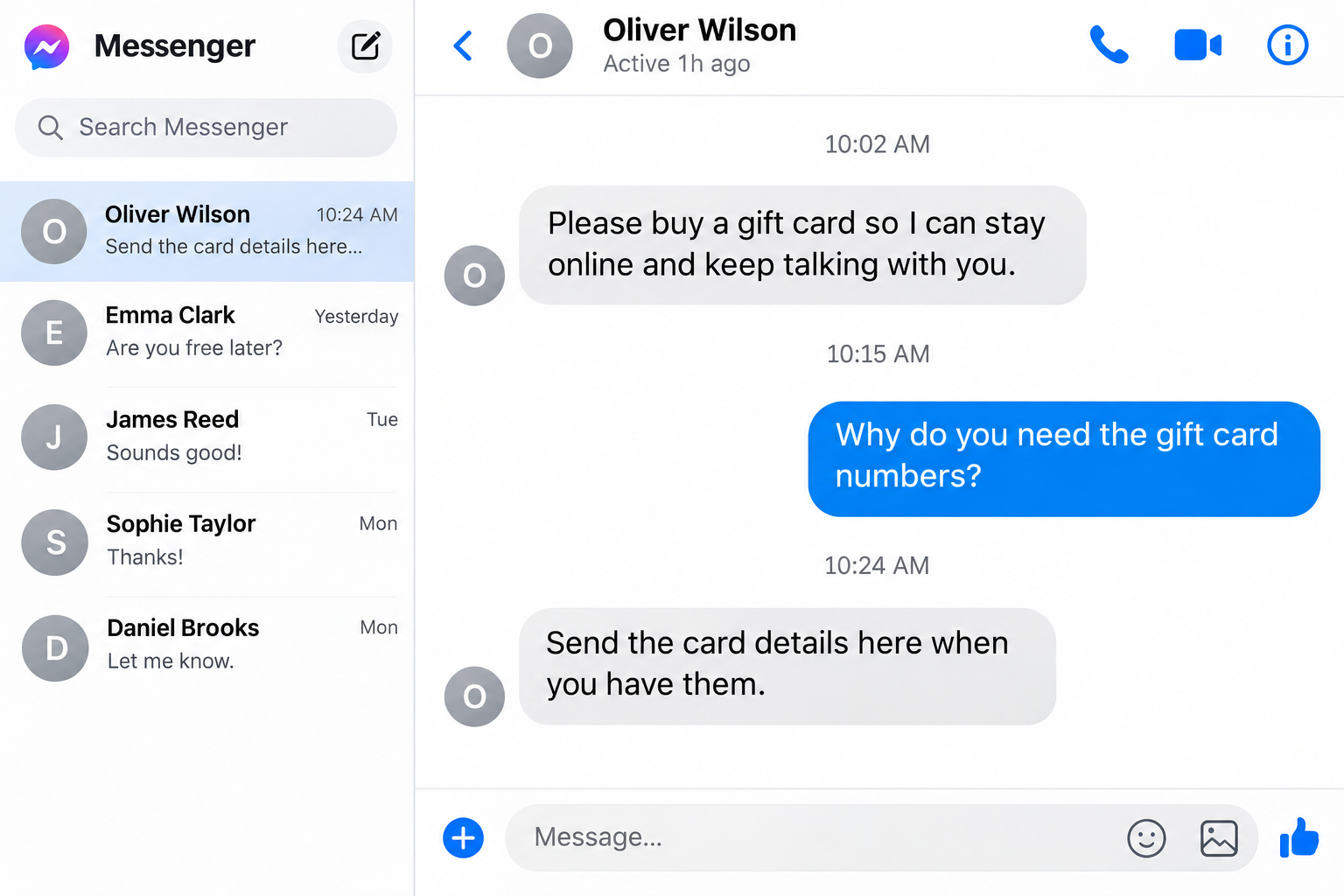
The chat image uses fictional wording to illustrate the gift-card request, with the surrounding interface also reconstructed rather than taken from a victim’s account.
Why Paying for a Conversation Can Become a Trap
A request connected to staying online makes the payment seem necessary for the relationship itself, rather than a separate financial decision.
Refusing can feel as though you are choosing to lose contact, especially after months of messages have created a daily routine.
That emotional pressure changes how the recipient evaluates an otherwise unusual demand, including why a supposed partner needs gift-card details instead of ordinary assistance.
In Odiboh’s case, the invented identity included a nationality, marital history and overseas location, giving later money requests an established personal story.
Those details came from the person soliciting payment, so repeating them consistently did not make the identity or financial emergency genuine.
The gift cards were followed by checks sent to particular people and entities, including two checks made out to Stephen Odiboh.
A relationship with Oliver Wilson therefore involved payments to recipients bearing different names, creating a financial trail that the romantic story did not explain.
If you face a similar mismatch, stop before sending more and show the actual request and payment destination to someone you trust.
How the Oliver Wilson Romance Scam Works
Step 1: A false identity creates a familiar relationship
Odiboh approached the first victim through Facebook in 2023, claiming to be a widower from the United States who was living in Norway.
The online relationship continued long enough for later requests to arrive from an apparently familiar partner rather than an obviously new salesperson.
For the recipient, that history can make checking the identity feel unnecessary or disloyal, even when the proposed payment deserves independent scrutiny.
Treat a new financial request as a decision that needs its own evidence, regardless of how long the conversation has continued.
Step 2: Gift cards are presented as necessary to stay connected
The person using the Wilson name said gift cards would let him remain online and continue talking with the woman.
She provided approximately 30 cards worth $500 each, showing how repeated smaller requests can produce a substantial total over time.
Once someone receives usable gift-card details, keeping the physical card does not necessarily protect the balance you originally loaded onto it.
The FTC’s gift-card guidance recommends contacting the issuer immediately, preserving receipts and asking whether funds can be frozen or returned.
Step 3: Checks move money beyond the supposed partner
Between January and July 2024, the woman mailed eight checks totaling more than $162,000 to recipients specified by the person she trusted.
Two checks went to Odiboh, connecting the invented romance identity with an actual recipient named in the subsequent criminal case.
Before sending money to another person on an online partner’s instructions, consider whether you can independently explain the recipient’s legitimate role.
An elaborate story about a helper, account problem or overseas restriction should not replace that explanation or justify another transfer.
Step 4: A customs emergency demands a much larger payment
The claimed detention in Norway introduced a more urgent problem, with $158,000 supposedly required before the online partner could be released.
The story encouraged the victim to regard payment as rescue, while the amount exposed her to a much larger additional loss.
Her bank stopped the two checks before they were cashed, demonstrating why contacting the institution can still matter after an instruction has been followed.
Report the actual payment status promptly instead of assuming a mailed check is irretrievable or waiting for the supposed emergency to resolve itself.
Step 5: Other identities draw money through different explanations
The same prosecution described co-conspirators using other names for dating-site relationships and a catering request, with payments directed toward Odiboh or controlled accounts.
These examples show a connected fraud case, without establishing that Odiboh personally used every alias or wrote every message described by prosecutors.
For victims, recording the advertised identity separately from the real payment recipient helps investigators compare approaches that initially appear unrelated.
Preserve both names in your report rather than replacing the original alias with a guess about who was behind the conversation.
The Catering Order Shows a Different Route to the Same Money
A caterer contacted by someone calling himself Alex Alberto requested an $800 deposit, but the supposed customer sent a check for $2,800.
The sender instructed the caterer to deposit it and forward the additional $2,000 to Odiboh through Zelle, creating an apparent refund task.
The caterer recognized the deception and did not deposit the check, preventing the proposed payment from becoming another completed loss.
This approach differs from the romance story because the requested transfer was disguised as handling money for a customer rather than helping a partner.
The FTC’s fake-check guidance explains why an available bank balance does not establish that a deposited check is genuine or finally paid.
A check can be rejected after funds appear available, leaving the depositor responsible for money already sent to the supposed customer’s chosen recipient.
Do not forward an overpayment through another payment service, even if the check resembles a business payment or the sender offers a convincing explanation.
If you already deposited it, tell your bank about the suspected fake check before withdrawing or forwarding any of the displayed funds.
Compare the Story With the Actual Payment
These details help separate the explanations given to victims from what happened to their money, without merging attempted transfers into completed losses.
| Story presented | Payment described in the case | Outcome or concern |
|---|---|---|
| Gift cards to remain online | Approximately $15,000 across about 30 cards | Repeated payments supported the invented relationship. |
| Instructions to mail checks | Eight checks totaling over $162,000 | Recipients included Odiboh, whose name differed from the romantic identity. |
| Supposed Norway customs fine | Two checks totaling $158,000 | The bank stopped payment before the checks were cashed. |
| Overpaid catering deposit | $2,800 check, with $2,000 requested through Zelle | The caterer recognized the scam and did not deposit the check. |
The other two victims encountered online dating identities, with one sending $2,000 through CashApp and another wiring $17,525 over a shipping story.
Keep those incidents separate when understanding the record, since each involved a different encounter, payment method and stated reason for sending funds.
For your own situation, list what actually left your accounts before adding demands that were refused, blocked or never carried out.
That distinction helps the bank assess transactions and prevents a report from accidentally overstating a completed loss or overlooking an attempted payment.
What to Do if You Have Fallen Victim to This Scam
-
Stop sending gift-card details, checks or transfers to the online contact, and preserve the relationship messages before blocking or reporting the account.
Ask someone you trust to help organize the records if the emotional pressure makes it difficult to review the conversation alone.
You can end the payments without first persuading the sender to confess or settling every question about the identity they used.
-
For gift cards, contact the issuer using the number printed on the card or its verified support site and explain the scam immediately.
Provide the card and store receipt privately, ask whether any balance remains, and request a freeze or refund where the issuer can help.
Keep the case reference and original card even after reporting, without sending its usable details to an unsolicited person offering recovery assistance.
-
If you mailed your own checks, contact your bank with each check number, amount and payee to establish whether payment has occurred.
Ask whether a stop-payment request remains possible and what it covers, recording any fees, duration or additional action the bank explains.
For a check already paid, request the available transaction evidence and fraud-review options rather than assuming the original stop-payment process still applies.
-
If a supposed customer sent you an excessive check, do not deposit it or forward the difference through Zelle or another payment service.
If you deposited it already, alert the bank before using the funds and explain the sender’s instruction to pay a separate recipient.
Preserve the check image, envelope and conversation so the bank can assess the actual instrument rather than relying on your current available balance.
-
Report any completed app payment or wire to the institution that processed it, identifying the recipient, date, amount and relevant transaction reference.
Ask about its fraud process and any possible recovery attempt, describing whether you authorized the payment after deception or discovered a separate unauthorized transaction.
-
Submit the online-fraud account at FBI IC3, selecting File A Complaint and reviewing its terms before entering the requested encounter and payment information.
Include the aliases used, actual recipient names and evidence of blocked attempts, then save your submission details and any confirmation provided.
-
Keep new requests for customs charges, release payments or recovery fees with the existing evidence instead of treating them as a fresh emergency.
Verify any claimed bank or investigative representative through an independently obtained official contact, especially when the caller already knows details of your loss.
Help a Friend Pause the Payments Without Blaming Them
The first victim spent approximately a year and a half in the invented relationship, making the loss more personal than one suspicious transaction.
If someone you know is in a similar position, start with the current money request rather than attacking their judgment or demanding immediate agreement.
Offer to sit with them while they call the bank, compare recipient names or collect gift-card receipts from the payments already made.
Use the stopped $158,000 demand to explain why reporting remains worthwhile, without promising that another institution can reproduce the same outcome.
Keep the person’s financial information private, and let them share their own records with investigators instead of posting the conversation publicly.
Frequently Asked Questions
Who was the person using the Oliver Wilson identity?
The sentencing announcement says Odiboh used that identity while contacting the first victim on Facebook and developing the false romantic relationship.
Other names in the case were used by co-conspirators, so they should not all be presented as identities Odiboh personally operated.
Was the $158,000 customs payment actually lost?
The victim mailed two checks for that amount, but her bank detected fraud and stopped them before they could be cashed.
The demand was therefore an attempted additional loss, which should remain separate from the gift cards and earlier checks actually sent.
Were all four victims approached through romance?
Three described encounters involved Facebook or dating-site relationships, while another began with someone pretending to be a customer seeking catering services.
The catering victim recognized the excessive-check request and did not deposit it, avoiding the proposed transfer of the difference through Zelle.
Can gift cards really pay for staying online?
Here, a false partner used that explanation to obtain valuable card details, without presenting a genuine bill from a service provider.
Do not send gift-card codes to maintain an online relationship, and contact the issuer promptly if someone already received usable card information.
Does a deposited check mean the overpayment is safe?
The FTC explains that banks may make funds available before discovering a fake check, so an accessible balance does not establish final payment.
Tell the bank about the suspicious instrument and do not forward the supposed excess simply because money appears in your account.
Does the restitution order mean money is waiting for victims?
The $196,500 order records a court obligation, while the announcement does not establish that a particular repayment has already been collected or distributed.
Keep your payment evidence and use verified case communications, refusing anyone who asks for an advance fee to release a supposed refund.
The Bottom Line
Do not send gift-card details or new payments to a supposed online partner whose continued contact or release depends on your money.
If you already paid, contact the relevant bank, card issuer or payment service promptly, keeping completed transactions separate from blocked or refused demands.
Preserve the relationship messages and recipient details for an official report, and involve someone you trust before the next invented emergency arrives.

Join the discussion
0 commentsShare your experience or ask a question about this article.
Community experiences
Did this happen to you?
Your experience could help someone recognize the same scam. Submit a private report for our team to review.
I experienced this tooReports are reviewed before publication. Sharing publicly is always your choice.
Discussion
Start the conversation
Have a question or something useful to share? Add the first comment.